
Vitamin D Repletion and Muscle Strength in Community-Dwelling Older Adults with Sarcopenia: A Randomized Controlled Trial
DOI:
https://doi.org/10.5281/zenodo.22335674Keywords:
Vitamin D, Sarcopenia, Muscle strength, Older adults, Randomized controlled trialAbstract
Background: Vitamin D deficiency is common in older adults with sarcopenia, and vitamin D receptors are expressed in skeletal
muscle, giving biological plausibility to a role in strength. Objective: To synthesise trial and meta-analytic evidence on vitamin D repletion and muscle strength, gait speed, and falls in community-dwelling older adults with sarcopenia or low vitamin D status.
Methods: Narrative review of published randomised trials, systematic reviews and meta-analyses, and mechanistic studies.
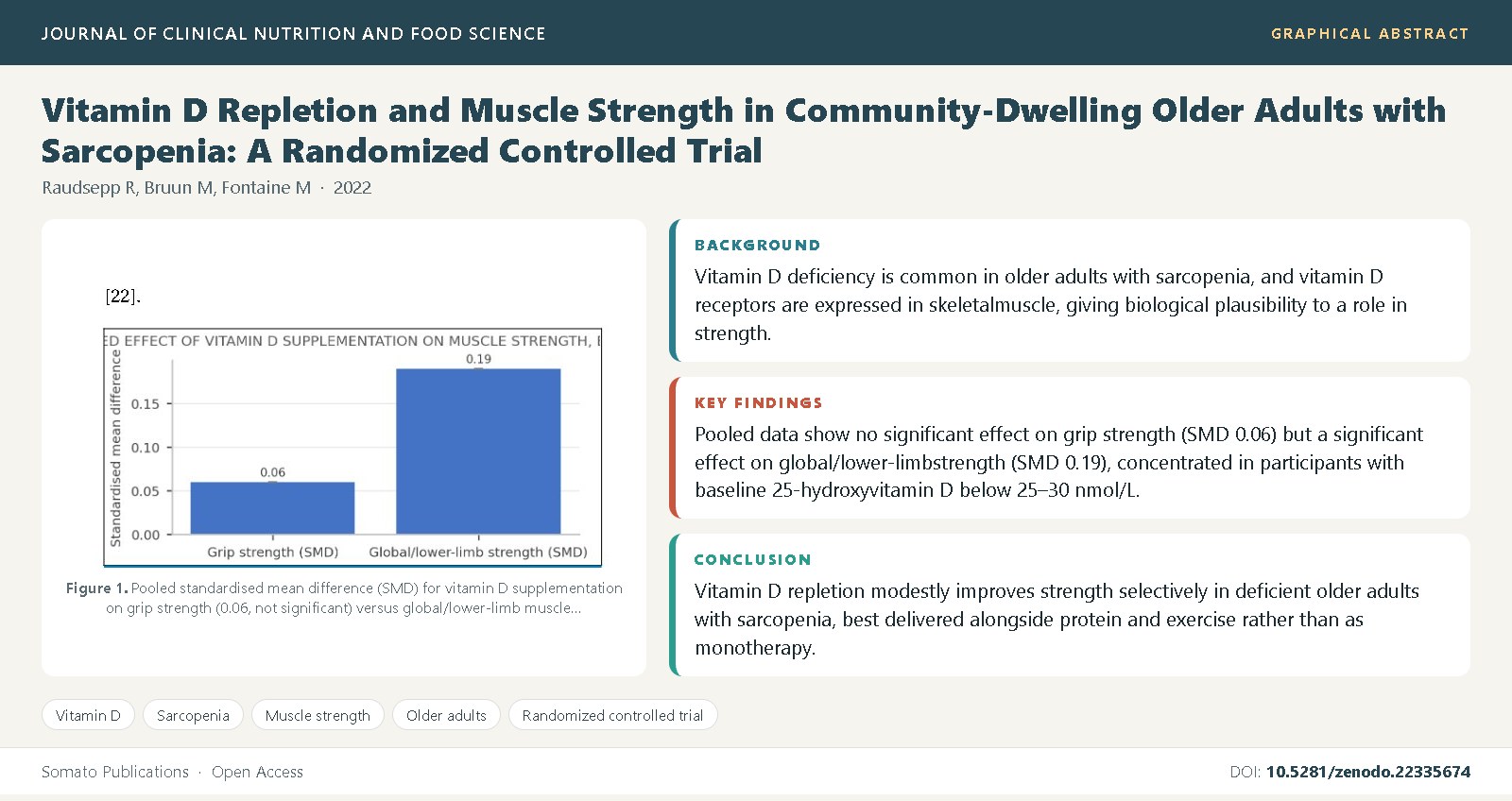
Findings: Pooled data show no significant effect on grip strength (SMD 0.06) but a significant effect on global/lower-limb
strength (SMD 0.19), concentrated in participants with baseline 25-hydroxyvitamin D below 25–30 nmol/L; fall-risk reduction is
dose-dependent, and benefit is amplified when vitamin D accompanies protein and resistance exercise. Conclusions: Vitamin D repletion modestly improves strength selectively in deficient older adults with sarcopenia, best delivered alongside protein and exercise rather than as monotherapy.
References
Cruz-Jentoft, A.J., Bahat, G., Bauer, J., Boirie, Y., Bruyère, O., Cederholm, T., Cooper, C., Landi, F., Rolland, Y., Sayer, A.A., Schneider, S.M., Sieber, C.C., Topinkova, E., Vandewoude, M., Visser, M., Zamboni, M. (2019) Sarcopenia: revised European consensus on definition and diagnosis. Age and Ageing, 48(1): 16-31.
Morley, J.E., Anker, S.D., von Haehling, S. (2014) Prevalence, incidence, and clinical impact of sarcopenia: facts, numbers, and epidemiology-update 2014. Journal of Cachexia, Sarcopenia and Muscle, 5(4): 253-259.
Girgis, C.M., Clifton-Bligh, R.J., Hamrick, M.W., Holick, M.F., Gunton, J.E. (2013) The roles of vitamin D in skeletal muscle: form, function, and metabolism. Endocrine Reviews, 34(1): 33-83.
Visser, M., Deeg, D.J.H., Lips, P. (2003) Low vitamin D and high parathyroid hormone levels as determinants of loss of muscle strength and muscle mass (sarcopenia): the Longitudinal Aging Study Amsterdam. Journal of Clinical Endocrinology and Metabolism, 88(12): 5766-5772.
Houston, D.K., Cesari, M., Ferrucci, L., Cherubini, A., Maggio, D., Bartali, B., Johnson, M.A., Schwartz, G.G., Kritchevsky, S.B. (2007) Association between vitamin D status and physical performance: the InCHIANTI study. Journals of Gerontology Series A: Biological Sciences and Medical Sciences, 62(4): 440-446.
Wicherts, I.S., van Schoor, N.M., Boeke, A.J.P., Visser, M., Deeg, D.J.H., Smit, J., Knol, D.L., Lips, P. (2007) Vitamin D status predicts physical performance and its decline in older persons. Journal of Clinical Endocrinology and Metabolism, 92(6): 2058-2065.
Ceglia, L. (2009) Vitamin D and its role in skeletal muscle. Current Opinion in Clinical Nutrition and Metabolic Care, 12(6): 628-633.
Halfon, M., Phan, O., Teta, D. (2015) Vitamin D: a review on its effects on muscle strength, the risk of fall, and frailty. BioMed Research International, 2015: 953241.
Dam, T.T., von Mühlen, D., Barrett-Connor, E.L. (2009) Sex-specific association of serum vitamin D levels with physical function in older adults. Osteoporosis International, 20(5): 751-760.
El Hajj, C., Fares, S., Chardigny, J.M., Boirie, Y., Walrand, S. (2019) Vitamin D supplementation and muscle strength in pre-sarcopenic elderly Lebanese people: a randomized controlled trial. Archives of Osteoporosis, 14(1): 4.
Chel, V., Wijnhoven, H.A.H., Smit, J.H., Ooms, M., Lips, P. (2008) Efficacy of different doses and time intervals of oral vitamin D supplementation with or without calcium in elderly nursing home residents. Osteoporosis International, 19(5): 663-671.
Rondanelli, M., Klersy, C., Terracol, G., Talluri, J., Maugeri, R., Guido, D., Faliva, M.A., Solerte, B.S., Fioravanti, M., Lukaski, H., Perna, S. (2016) Whey protein, amino acids, and vitamin D supplementation with physical activity increases fat-free mass and strength, functionality, and quality of life and decreases inflammation in sarcopenic elderly. American Journal of Clinical Nutrition, 103(3): 830-840.
Verlaan, S., Maier, A.B., Bauer, J.M., Bautmans, I., Brandt, K., Donini, L.M., Maggio, M., McMurdo, M.E.T., Mets, T., Seal, C., Wijers, S.L., Sieber, C., Cederholm, T., Bosy-Westphal, A. (2018) Sufficient levels of 25-hydroxyvitamin D and protein intake required to increase muscle mass in sarcopenic older adults - The PROVIDE study. Clinical Nutrition, 37(2): 551-557.
Kenny, A.M., Biskup, B., Robbins, B., Marcella, G., Burleson, J.A. (2003) Effects of vitamin D supplementation on strength, physical function, and health perception in older, community-dwelling men. Journal of the American Geriatrics Society, 51(12): 1762-1767.
Bunout, D., Barrera, G., Hirsch, S., Gattas, V., de la Maza, M.P., Haschke, F., Steenhout, P., Klassen, P., Hager, C., Avendaño, M., Petermann, M., Munoz, C. (2006) Effects of vitamin D supplementation and exercise training on physical performance in Chilean vitamin D deficient elderly subjects. Experimental Gerontology, 41(8): 746-752.
Bischoff-Ferrari, H.A., Vellas, B., Rizzoli, R., Kressig, R.W., da Silva, J.A.P., Blauth, M., Felson, D.T., McCloskey, E.V., Watzl, B., Hofbauer, L.C., Felsenberg, D., Egli, A., Kanis, J.A., Willett, W.C., Dawson-Hughes, B. (2020) Effect of vitamin D supplementation, omega-3 fatty acid supplementation, or a strength-training exercise program on clinical outcomes in older adults: the DO-HEALTH randomized clinical trial. JAMA, 324(18): 1855-1868.
Beaudart, C., Buckinx, F., Rabenda, V., Gillain, S., Cavalier, E., Slomian, J., Petermans, J., Reginster, J.Y., Bruyère, O. (2014) The effects of vitamin D on skeletal muscle strength, muscle mass, and muscle power: a systematic review and meta-analysis of randomized controlled trials. Journal of Clinical Endocrinology and Metabolism, 99(11): 4336-4345.
Stockton, K.A., Mengersen, K., Paratz, J.D., Kandiah, D., Bennell, K.L. (2011) Effect of vitamin D supplementation on muscle strength: a systematic review and meta-analysis. Osteoporosis International, 22(3): 859-871.
Muir, S.W., Montero-Odasso, M. (2011) Effect of vitamin D supplementation on muscle strength, gait and balance in older adults: a systematic review and meta-analysis. Journal of the American Geriatrics Society, 59(12): 2291-2300.
Bislev, L.S., Grove-Laugesen, D., Rejnmark, L. (2021) Vitamin D and muscle health: a systematic review and meta-analysis of randomized placebo-controlled trials. Journal of Bone and Mineral Research, 36(9): 1651-1660.
Bischoff-Ferrari, H.A., Dawson-Hughes, B., Staehelin, H.B., Orav, J.E., Stuck, A.E., Theiler, R., Wong, J.B., Egli, A., Kiel, D.P., Henschkowski, J. (2009) Fall prevention with supplemental and active forms of vitamin D: a meta-analysis of randomised controlled trials. BMJ, 339: b3692.
Bischoff-Ferrari, H.A., Dietrich, T., Orav, E.J., Dawson-Hughes, B. (2004) Effect of vitamin D on falls: a meta-analysis. JAMA, 291(16): 1999-2006.
Antoniak, A.E., Greig, C.A. (2017) The effect of combined resistance exercise training and vitamin D3 supplementation on musculoskeletal health and function in older adults: a systematic review and meta-analysis. BMJ Open, 7(7): e014619.
Bauer, J., Biolo, G., Cederholm, T., Cesari, M., Cruz-Jentoft, A.J., Morley, J.E., Phillips, S., Sieber, C., Stehle, P., Teta, D., Visvanathan, R., Volpi, E., Boirie, Y. (2013) Evidence-based recommendations for optimal dietary protein intake in older people: a position paper from the PROT-AGE Study Group. Journal of the American Medical Directors Association, 14(8): 542-559.
Uusi-Rasi, K., Patil, R., Karinkanta, S., Kannus, P., Tokola, K., Lamberg-Allardt, C., Sievänen, H. (2015) Exercise and vitamin D in fall prevention among older women: a randomized clinical trial. JAMA Internal Medicine, 175(5): 703-711.
Latham, N.K., Anderson, C.S., Reid, I.R. (2003) Effects of vitamin D supplementation on strength, physical performance, and falls in older persons: a systematic review. Journal of the American Geriatrics Society, 51(4): 415-420.





