
Omega-3 Fatty Acid Supplementation and Serum Lipid Profile in Patients with Metabolic Syndrome: A Randomized, Placebo-Controlled Trial
DOI:
https://doi.org/10.5281/zenodo.22335668Keywords:
Omega-3 fatty acids, Metabolic syndrome, Triglycerides, Eicosapentaenoic acid, Lipid profileAbstract
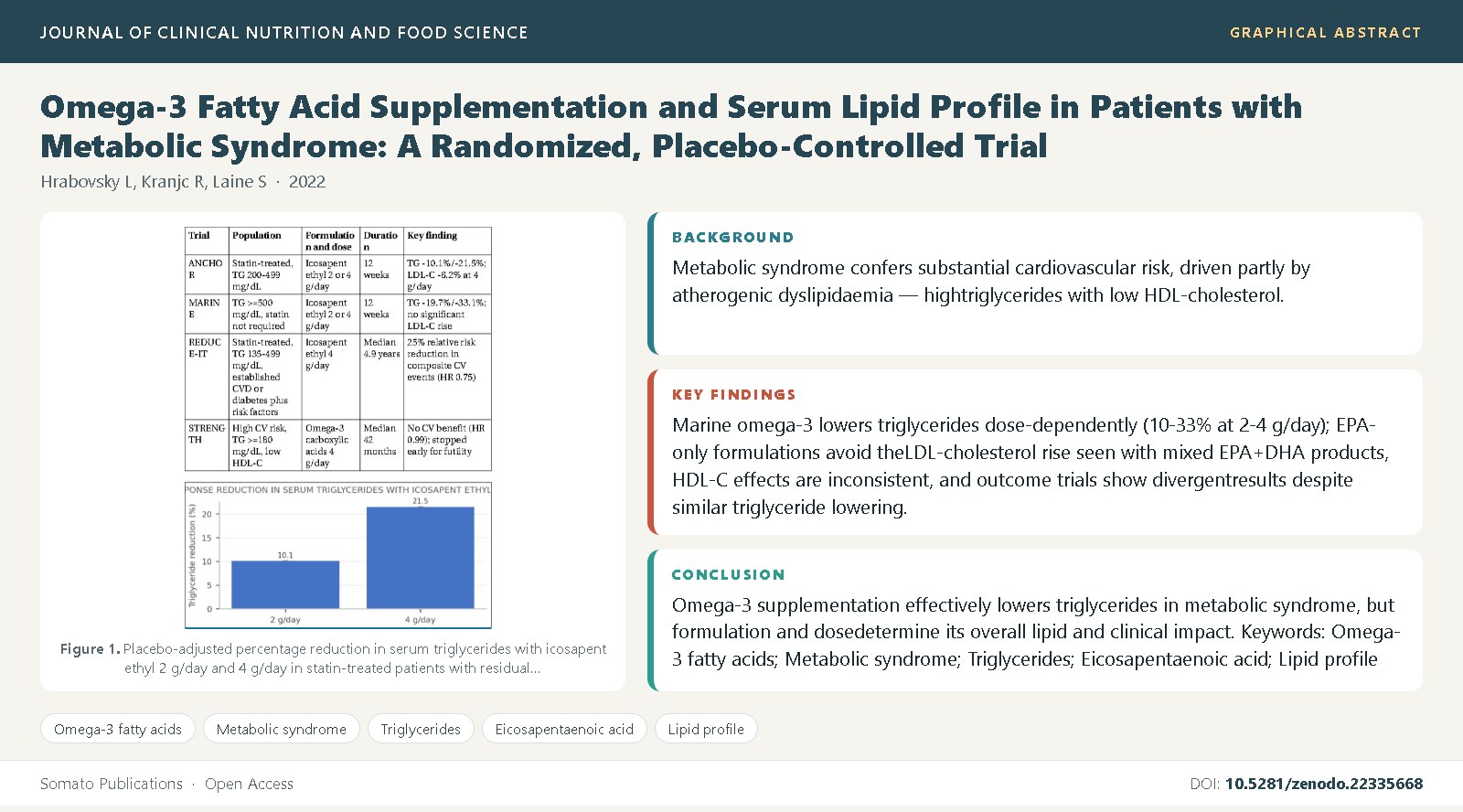
Background: Metabolic syndrome confers substantial cardiovascular risk, driven partly by atherogenic dyslipidaemia — high
triglycerides with low HDL-cholesterol.
Objective: To synthesise evidence on omega-3 supplementation and lipid profile in metabolic syndrome.
Methods: Narrative review of published randomised trials, meta-analyses, and mechanistic studies.
Findings: Marine omega-3 lowers triglycerides dose-dependently (10-33% at 2-4 g/day); EPA-only formulations avoid the
LDL-cholesterol rise seen with mixed EPA+DHA products, HDL-C effects are inconsistent, and outcome trials show divergent
results despite similar triglyceride lowering.
Conclusions: Omega-3 supplementation effectively lowers triglycerides in metabolic syndrome, but formulation and dose
determine its overall lipid and clinical impact.
Keywords: Omega-3 fatty acids; Metabolic syndrome; Triglycerides; Eicosapentaenoic acid; Lipid profile
References
Alberti, K.G.M.M., Eckel, R.H., Grundy, S.M., Zimmet, P.Z., Cleeman, J.I., Donato, K.A., Fruchart, J.C., James, W.P.T., Loria, C.M., Smith, S.C. (2009) Harmonizing the metabolic syndrome: a joint interim statement of the International Diabetes Federation Task Force on Epidemiology and Prevention; National Heart, Lung, and Blood Institute; American Heart Association; World Heart Federation; International Atherosclerosis Society; and International Association for the Study of Obesity. Circulation, 120(16): 1640-1645.
Moore, J.X., Chaudhary, N., Akinyemiju, T. (2017) Metabolic Syndrome Prevalence by Race/Ethnicity and Sex in the United States, National Health and Nutrition Examination Survey, 1988-2012. Preventing Chronic Disease, 14: E24.
Grundy, S.M., Cleeman, J.I., Daniels, S.R., Donato, K.A., Eckel, R.H., Franklin, B.A., Gordon, D.J., Krauss, R.M., Savage, P.J., Smith, S.C., Spertus, J.A., Costa, F. (2005) Diagnosis and management of the metabolic syndrome: an American Heart Association/National Heart, Lung, and Blood Institute Scientific Statement. Circulation, 112(17): 2735-2752.
Eslick, G.D., Howe, P.R., Smith, C., Priest, R., Bensoussan, A. (2009) Benefits of fish oil supplementation in hyperlipidemia: a systematic review and meta-analysis. International Journal of Cardiology, 136(1): 4-16.
Kris-Etherton, P.M., Harris, W.S., Appel, L.J. (2002) Fish consumption, fish oil, omega-3 fatty acids, and cardiovascular disease. Circulation, 106(21): 2747-2757.
Harris, W.S., Bulchandani, D. (2006) Why do omega-3 fatty acids lower serum triglycerides? Current Opinion in Lipidology, 17(4): 387-393.
Mozaffarian, D., Wu, J.H.Y. (2011) Omega-3 fatty acids and cardiovascular disease: effects on risk factors, molecular pathways, and clinical events. Journal of the American College of Cardiology, 58(20): 2047-2067.
Musa-Veloso, K., Binns, M.A., Kocenas, A.C., Poon, T., Elliot, J.A., Chung, C., Cunnane, S., Jones, P.J.H. (2010) Long-chain omega-3 fatty acids eicosapentaenoic acid and docosahexaenoic acid dose-dependently reduce fasting serum triglycerides. Nutrition Reviews, 68(3): 155-167.
Wei, M.Y., Jacobson, T.A. (2011) Effects of eicosapentaenoic acid versus docosahexaenoic acid on serum lipids: a systematic review and meta-analysis. Current Atherosclerosis Reports, 13(6): 474-483.
Jacobson, T.A., Glickstein, S.B., Rowe, J.D., Soni, P.N. (2012) Effects of eicosapentaenoic acid and docosahexaenoic acid on low-density lipoprotein cholesterol and other lipids: a review. Journal of Clinical Lipidology, 6(1): 5-18.
Innes, J.K., Calder, P.C. (2020) Marine Omega-3 (N-3) Fatty Acids for Cardiovascular Health: An Update for 2020. International Journal of Molecular Sciences, 21(4): 1362.
De Caterina, R. (2011) n-3 fatty acids in cardiovascular disease. New England Journal of Medicine, 364(25): 2439-2450.
Harris, W.S., Von Schacky, C. (2004) The Omega-3 Index: a new risk factor for death from coronary heart disease? Preventive Medicine, 39(1): 212-220.
Skulas-Ray, A.C., Kris-Etherton, P.M., Harris, W.S., Vanden Heuvel, J.P., Wagner, P.R., West, S.G. (2011) Dose-response effects of omega-3 fatty acids on triglycerides, inflammation, and endothelial function in healthy persons with moderate hypertriglyceridemia. American Journal of Clinical Nutrition, 93(2): 243-252.
Ballantyne, C.M., Bays, H.E., Kastelein, J.J., Stein, E., Isaacsohn, J.L., Braeckman, R.A., Soni, P.N. (2012) Efficacy and safety of eicosapentaenoic acid ethyl ester (AMR101) therapy in statin-treated patients with persistent high triglycerides (from the ANCHOR study). American Journal of Cardiology, 110(7): 984-992.
Bays, H.E., Ballantyne, C.M., Kastelein, J.J., Isaacsohn, J.L., Braeckman, R.A., Soni, P.N. (2011) Eicosapentaenoic acid ethyl ester (AMR101) therapy in patients with very high triglyceride levels (from the Multi-center, plAcebo-controlled, Randomized, double-blINd, 12-week study with an open-label Extension [MARINE] trial). American Journal of Cardiology, 108(5): 682-690.
Bernstein, A.M., Ding, E.L., Willett, W.C., Rimm, E.B. (2012) A meta-analysis shows that docosahexaenoic acid from algal oil reduces serum triglycerides and increases HDL-cholesterol and LDL-cholesterol in persons without coronary heart disease. Journal of Nutrition, 142(1): 99-104.
Ebrahimi, M., Ghayour-Mobarhan, M., Rezaiean, S., Hoseini, M., Parizade, S.M.R., Farhoudi, F., Hosseininezhad, S.J., Tavallaei, S., Vejdani, A., Azimi-Nezhad, M., Shakeri, M.T., Akbari Rad, M., Mobarra, N., Kazemi-Bajestani, S.M.R., Ferns, G. (2009) Omega-3 fatty acid supplements improve the cardiovascular risk profile of subjects with metabolic syndrome, including markers of inflammation and auto-immunity. Acta Cardiologica, 64(3): 321-327.
Satoh, N., Shimatsu, A., Kotani, K., Sakane, N., Yamada, K., Suganami, T., Kuzuya, H., Ogawa, Y. (2007) Purified eicosapentaenoic acid reduces small dense LDL, remnant lipoprotein particles, and C-reactive protein in metabolic syndrome. Diabetes Care, 30(1): 144-146.
Zhang, H.J., Gao, X., Guo, X.F., Li, K.L., Li, S., Sinclair, A.J., Li, D. (2021) Effects of dietary eicosapentaenoic acid and docosahexaenoic acid supplementation on metabolic syndrome: a systematic review and meta-analysis of data from 33 randomized controlled trials. Clinical Nutrition, 40(7): 4538-4550.
Liu, Y.X., Yu, J.H., Sun, J.H., Ma, W.Q., Wang, J.J., Sun, G.J. (2023) Effects of Omega-3 Fatty Acids Supplementation on Serum Lipid Profile and Blood Pressure in Patients with Metabolic Syndrome: A Systematic Review and Meta-Analysis of Randomized Controlled Trials. Foods, 12(4): 725.
Backes, J., Anzalone, D., Hilleman, D., Catini, J. (2016) The clinical relevance of omega-3 fatty acids in the management of hypertriglyceridemia. Lipids in Health and Disease, 15: 118.
Bhatt, D.L., Steg, P.G., Miller, M., Brinton, E.A., Jacobson, T.A., Ketchum, S.B., Doyle, R.T., Juliano, R.A., Jiao, L., Granowitz, C., Tardif, J.C., Ballantyne, C.M. (2019) Cardiovascular Risk Reduction with Icosapent Ethyl for Hypertriglyceridemia. New England Journal of Medicine, 380(1): 11-22.
Yokoyama, M., Origasa, H., Matsuzaki, M., Matsuzawa, Y., Saito, Y., Ishikawa, Y., Oikawa, S., Sasaki, J., Hishida, H., Itakura, H., Kita, T., Kitabatake, A., Nakaya, N., Sakata, T., Shimada, K., Shirato, K. (2007) Effects of eicosapentaenoic acid on major coronary events in hypercholesterolaemic patients (JELIS): a randomised open-label, blinded endpoint analysis. Lancet, 369(9567): 1090-1098.
Nicholls, S.J., Lincoff, A.M., Garcia, M., Bash, D., Ballantyne, C.M., Barter, P.J., Davidson, M.H., Kastelein, J.J.P., Koenig, W., McGuire, D.K., Mozaffarian, D., Ridker, P.M., Ray, K.K., Katona, B.G., Himmelmann, A., Loss, L.E., Rensfeldt, M., Lundstrom, T., Agrawal, R., Menon, V., Wolski, K., Nissen, S.E. (2020) Effect of High-Dose Omega-3 Fatty Acids vs Corn Oil on Major Adverse Cardiovascular Events in Patients at High Cardiovascular Risk: The STRENGTH Randomized Clinical Trial. JAMA, 324(22): 2268-2280.
Manson, J.E., Cook, N.R., Lee, I.M., Christen, W., Bassuk, S.S., Mora, S., Gibson, H., Albert, C.M., Gordon, D., Copeland, T., D'Agostino, D., Friedenberg, G., Ridge, C., Bubes, V., Giovannucci, E.L., Willett, W.C., Buring, J.E. (2019) Marine n-3 Fatty Acids and Prevention of Cardiovascular Disease and Cancer. New England Journal of Medicine, 380(1): 23-32.
Skulas-Ray, A.C., Wilson, P.W.F., Harris, W.S., Brinton, E.A., Kris-Etherton, P.M., Richter, C.K., Jacobson, T.A., Engler, M.B., Miller, M., Robinson, J.G., Blum, C.B., Rodriguez-Leyva, D., de Ferranti, S.D., Welty, F.K. (2019) Omega-3 Fatty Acids for the Management of Hypertriglyceridemia: A Science Advisory From the American Heart Association. Circulation, 140(12): e673-e691.
Gencer, B., Djousse, L., Al-Ramady, O.T., Cook, N.R., Manson, J.E., Albert, C.M. (2021) Effect of Long-Term Marine omega-3 Fatty Acids Supplementation on the Risk of Atrial Fibrillation in Randomized Controlled Trials of Cardiovascular Outcomes: A Systematic Review and Meta-Analysis. Circulation, 144(25): 1981-1990.





