
The Combination of Radix Codonopsis, Semen Raphani and Resistant Dextrin Relieves Constipation and Regulates Gut Microbiota: A Randomized, Double-blind, Placebo-Controlled Clinical Trial
Keywords:
Radix Codonopsis, Semen Raphani, Resistant Dextrin, Constipation, Gut Microbiota, Clinical TrialAbstract
Objectives: Constipation has high prevalence in all age groups, notably in the elderly population. Traditional treatment with
laxatives may cause unexpected adverse effects. Therefore, alternative nutritional supplements are necessary to alleviate
constipation and improve gut health. The aim of the present study was to evaluate the effects of Relief Drink formula (RDF)
composed of Radix Codonopsis, Semen Raphani and resistant dextrin on adults with functional constipation in a randomized,
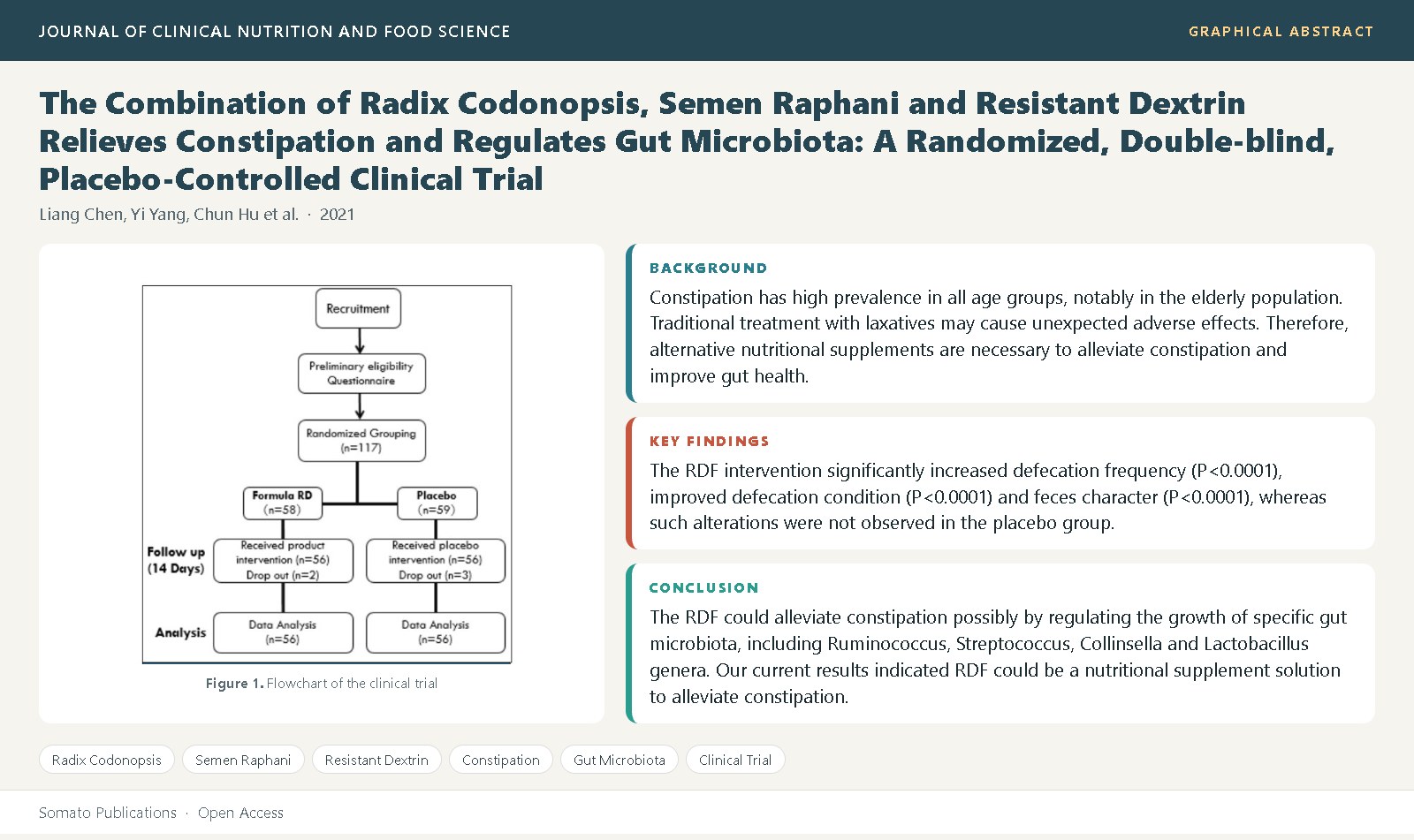
double-blind and placebo-controlled 2-week clinical trial. Methods: The participants (N=117) were randomized to receive RDF (N=58) or placebo (N=59) for 2 weeks. The daily self-reported defecation index, including defecation frequency, defecation condition and fecal character were collected. In addition, the fecal samples were collected at the 0-week and 2-week time points for metagenomic sequencing using the shotgun method. Results: The RDF intervention significantly increased defecation frequency (P<0.0001), improved defecation condition (P<0.0001) and feces character (P<0.0001), whereas such alterations were not observed in the placebo group. Moreover, the microbiota profile of RDF group following intervention was significantly increased with regard to the Streptococcus salivarius (P=0.008), Ruminococcus obeum (P=0.013), Ruminococcus gnavus (P=0.021), Lactobacillus salivarius (P=0.033) and Collinsella aerofaciens (P=0.016) strains. Significant differences of functional metabolites-producing potential, such as short-chain fatty acids (SCFAs) and L-glutamine (P<0.05) were observed between the RDF and the placebo groups.Conclusions: The RDF could alleviate constipation possibly by regulating the growth of specific gut microbiota, including Ruminococcus, Streptococcus, Collinsella and Lactobacillus genera. Our current results indicated RDF could be a nutritional supplement solution to alleviate constipation.
References
Tiro, J., Lee, SJC., Lipshultz, SE., Miller, TL., Wilkinson, JD., Mestre, MA., et al. (2013) National Institute of Diabetes and Digestive and Kidney Diseases. In: Gellman, M.D. and Turner, J.R. (eds.) Encyclopedia of Behavioral Medicine. pp. 1290–1291. Springer New York, New York.
Mugie, SM., Benninga, MA., Lorenzo, C DI. (2011) Epidemiology of constipation in children and adults: A systematic review. Best Pract Res Clin Gastroenterol, 25(1): 3-18.
Stewart, WF., Liberman, JN., Sandler, RS., Woods, MS., Stemhagen, A., Chee, E., et al. (1999) Epidemiology of constipation (EPOC) study in the United States: relation of clinical subtypes to sociodemographic features. Am J Gastroenterol, 94(12): 3530-3540.
Campbell, AJ., Busby, WJ., Horwath, CC. (1993) Factors associated with constipation in a community based sample of people aged 70 years and over. J Epidemiol Community Health, 47(1): 23-26.
Madsen, JL. (1992) Effects of gender, age, and body mass index on gastrointestinal transit times. Dig Dis Sci, 37(10): 1548-1553.
Leung, L., Riutta, T., Kotecha, J., Rosser, W. (2011) Chronic Constipation: An Evidence-Based Review. J Am Board Fam Med, 24(4): 436-451.
Amenta, M., Cascio, MT., Fiore, PD., Venturini, I. (2006) Diet and chronic constipation. Benefits of oral supplementation with symbiotic zir fos (Bifidobacterium longum W11 + FOS Actilight). Acta BioMed, 77(3): 157- 162.
An, HM., Baek, EH., Jang, S., Lee, DK., Kim, MJ., Kim, JR., et al. (2010) Efficacy of Lactic Acid Bacteria (LAB) supplement in management of constipation among nursing home residents. Nutri J, 9: 5. doi: 10.1186/1475-2891-9-5.
Khalif, IL., Quigley, EMM., Konovitch, EA., Maximova, ID. (2005) Alterations in the colonic flora and intestinal permeability and evidence of immune activation in chronic constipation. Dig Liver Dis, 37(11):838-849.
Gerritsen, J., Smidt, H., Rijkers, GT., de Vos, WM. (2011) Intestinal microbiota in human health and disease: the impact of probiotics. Genes Nutr, 6(3): 209-240.
Spohn, SN., Mawe, GN. (2017) Non-conventional features of peripheral serotonin signalling — the gut and beyond. Nat Rev Gastroenterol Hepatol, 14(7): 412–420.
Canani, RB. (2011) Potential beneficial effects of butyrate in intestinal and extraintestinal diseases. World J Gastroenterol, 17(2): 1519.
Campbell, AJ., Busby, WJ., Horwath, CC. (1993) Factors associated with constipation in a community based sample of people aged 70 years and over. Epidemiol Community Health, 47(1): 23–26.
Chinese Pharmacopoeia Commission. Chinese pharmacopoeia [M]. Beijing: China Medical Science Press, 2020: 293-294.
Chinese Pharmacopoeia Commission. Chinese pharmacopoeia [M]. Beijing: China Medical Science Press, 2020: 284-285.
Yongxu, S., Jicheng, L. (2008) Structural characterization of a water-soluble polysaccharide from the Roots of Codonopsis pilosula and its immunity activity. Int J Biol Macromol, 43(3): 279–282.
Wang, X., Chen, L. (2014) Effects of the rich seleniumbanqiao-Codonopsis pilosula on the aged rats’ immune functions and its underlying mechanism. Zhongguo Ying Yong Sheng Li Xue Za Zhi, 30(5): 401–404.
Hou, J., Jiang, Z., He, Z. (1989) Effects of Codonopsis pilosula (Franch) Nannf on gastric electricity, gastric motility and gastric emptying. Zhong Xi Yi Jie He Za Zhi, 9(1): 31–32.
Zhao, J., Li, Y., Sun, M., Xin, L., Wang, T., Wei, L., et al. (2019) The Chinese Herbal Formula Shenzhu Tiaopi Granule Results in Metabolic Improvement in Type 2 Diabetic Rats by Modulating the Gut Microbiota. Evidence-Based Complementary and Alternative Medicine, 2019: 1–14.
Liu, C., Chen, J., Li, E., Fan, Q., Wang, D., Li, P., et al. (2015) The comparison of antioxidative and hepatoprotective activities of Codonopsis pilosula polysaccharide (CP) and sulfated CP. Int Immunopharmacol, 24(2): 299–305.
Chu, X., Liu, XJ., Qiu, JM., Zeng, XL., Bao, HR., Shu, J. (2016) Effects of Astragalus and Codonopsis pilosula polysaccharides on alveolar macrophage phagocytosis and inflammation in chronic obstructive pulmonary disease mice exposed to PM2.5. Environ Toxicol Pharmacol, 48: 76–84.
Wang, Y., Wang, Y. (2014) Effects of sijunzi dripping Pill on gastrointestinal motility of mice. Chinese Herbal Medicines. Chinese Herbal Medicines, 6(2): 120–124.
Ma, F., Shen, X., Shi, J. (2014) Effect of Codonopsis polysaccharide on gastrointestinal tract of experimental rats and mice. Anhui Medical and Pharmaceutical Journal, 18(9): 1626–1630.
Chen, L., Kan, J., Tian, F., Han, Q., Li, M., Qu, J., et al. (2018) Experimental Study on Defecating Function of Codonopsis Pilosula Water Extract. Food and Nutrition in China, 24(11): 73–77.
Zhang, Q. (2010) Semen raphani treated intractable constipation. Journal of New Chinese Medicine, 42(11): 13.
Shi, Y., Si, C., Liu, B., Liu, C., Guo, J. (2009) Kinetogenic effects of serum with semen raphani on colon smooth muscle in rats. Journal of Shandong University (Health Science), 47(1): 34–37.
Liu, R., Lu, Y., Liu, M., Liu, J., Cao, Y. (2010) The effects of different radish seed extractive on defection of mice with experimental constipation. Modern Traditional Chinese Medicine, 30(2): 59–60.
Gan, D., Qu, J., Du, J., Cen, H., Tian, F., Gui, M., et al. (2016) Experimental study on constipation relief function by a complex formula composed by extract of codonopsis pilosula and semen raphani and resistant dextrin. Food and Nutrition in China. Food and Nutrition in China, 22(6): 59–63.
Kan, J., Cheng J., Xu, L., Hood, M., Zhong, D., Cheng, M., et al. (2019) The combination of wheat peptides and fucoidan protects against chronic superficial gastritis and alters gut microbiota: a double-blinded, placebo-controlled study. Eur J Nutr, 59(4): 1655-1666.
Truong, DT., Franzosa, EA., Tickle, TL., Scholz, M., Weingart, G., Pasolli, E., et al. (2015) MetaPhlAn2 for enhanced metagenomic taxonomic profiling. Nat Methods, 12(10): 902–903.
Sung, J., Kim, S., Cabatbat, JJT., Jang, S., Jin, YS., Jung, GY., et al. (2017) Global metabolic interaction network of the human gut microbiota for context-specific communityscale analysis. Nat Communications, 8(1).
Jing, Y., Li, A., Liu, Z., Yang, P., Wei, J., Chen, X., et al. (2018) Absorption of Codonopsis pilosula Saponins by Coexisting Polysaccharides Alleviates Gut Microbial Dysbiosis with Dextran Sulfate Sodium-Induced Colitis in Model Mice. BioMed Res Int, 2018: 1–18.
Fu, YP., Feng, B., Zhu, ZX., Feng, X., Chen, SF., Li, LX., et al. (2018) The Polysaccharides from Codonopsis pilosula Modulates the Immunity and Intestinal Microbiota of Cyclophosphamide-Treated Immunosuppressed Mice. Molecules, 23(7): 1801.
Li, Y., Li, J., Su, Q., Liu, Y. (2019) Sinapine reduces nonalcoholic fatty liver disease in mice by modulating the composition of the gut microbiota. Food Funct, 10(6): 3637–3649.
Baer, DJ., Stote, KS., Henderson, T., Paul, DR., Okuma, K., Tagami, H., et al. (2014) The Metabolizable Energy of Dietary Resistant Maltodextrin Is Variable and Alters Fecal Microbiota Composition in Adult Men. J Nutr, 144(7): 1023–1029.
Valcheva, R., Hotte, N., Gillevet, P., Sikaroodi, M., Thiessen, A., Madsen, KL. (2015) Soluble Dextrin Fibers Alter the Intestinal Microbiota and Reduce Proinflammatory Cytokine Secretion in Male IL-10–Deficient Mice. J Nutr, 145(9): 2060–2066.
Carlson, J., Erickson, J., Hess, J., Gould, T., Slavin, J. (2017) Prebiotic Dietary Fiber and Gut Health: Comparing the in Vitro Fermentations of Beta-Glucan, Inulin and Xylooligosaccharide. Nutrients, 9(12): 1361.
Airaksinen, K., Yeung, N., Lyra, A., Lahtinen, SJ., Huttunen, T., Shanahan, F., Ouwehand, AC. (2019) The effect of a probiotic blend on gastrointestinal symptoms in constipated patients: a double blind, randomised, placebo controlled 2-week trial. Benef Microbes, 10(6):617-627.
Yoon, JY., Cha, JM., Oh, KJ., Tan, PL., Kim, SH., Kwak, MS., et al. (2018) Probiotics Ameliorate Stool Consistency in Patients with Chronic Constipation: A Randomized, Double-Blind, Placebo-Controlled Study. Dig Dis Sci, 63(10): 2754–2764.
Couvigny, B., de Wouters, T., Kaci, G., Jacouton, E., Delorme, C., Doré, J., et al. (2015) Commensal Streptococcus salivarius Modulates PPARγ Transcriptional Activity in Human Intestinal Epithelial Cells. PLOS ONE, 10(5): e0125371.
Zheng, H., Liang, H., Wang, Y., Miao, M., Shi, T., Yang, F., et al. (2016) Altered Gut Microbiota Composition Associated with Eczema in Infants. PLOS ONE, 11(11): e0166026.
Delorme, C., Abraham, AL., Renault, P., Guédon, E. (2015) Genomics of Streptococcus salivarius , a major human commensal. Infect Genet Evol, 33: 381–392.
Crost, EH., Le Gall, G., Laverde-Gomez, JA., Mukhopadhya, I., Flint, HJ., Juge, H. (2018) Mechanistic Insights Into the Cross-Feeding of Ruminococcus gnavus and Ruminococcus bromii on Host and Dietary Carbohydrates. Frontiers in Microbiology, 9: 2558.
Domingo, MC., Huletsky, A., Boissinot, M., Bernard, KA., Picard, FJ., Bergeron, MG. (2008) Ruminococcus gauvreauii sp. nov., a glycopeptide-resistant species isolated from a human faecal specimen. Int J Syst Evol Microbiol, 58(6): 1393–1397.
Nilsson, U., Nyman, M., Ahrné, S., Sullivan, EO., Fitzgerald, G. (2006) Bifidobacterium lactis Bb-12 and Lactobacillus salivarius UCC500 modify carboxylic acid formation in the hindgut of rats given pectin, inulin, and lactitol. J Nutr, 136(8): 2175–2180.
Qin, P., Zou, Y., Dai, Y., Luo, G., Zhang, X., Xiao, L. (2019) Characterization a Novel Butyric Acid-Producing Bacterium Collinsellaaerofaciens Subsp. Shenzhenensis Subsp. Nov. Microorganisms, 7(3): 78.
Grider, JR., Piland, BE. (2007) The peristaltic reflex induced by short-chain fatty acids is mediated by sequential release of 5-HT and neuronal CGRP but not BDNF. Am J Physiol Gastrointest Liver Physiol, 292(1): G429–G437.
Holscher, HD. (2017) Dietary fiber and prebiotics and the gastrointestinal microbiota. Gut Microbes, 8(2): 172–184.
Reigstad, CS., Salmonson, CE., Rainey, JF., Szurszewski, JH., Linden, DR., Sonnenburg, JL., et al. (2015) Gut microbes promote colonic serotonin production through an effect of short-chain fatty acids on enterochromaffin cells. FASEB, 29(4): 1395–1403.
Zhang, Y., Lu, T., Han, L., Zhao, L., Niu, Y., Chen, H. (2017) L-Glutamine Supplementation Alleviates Constipation during Late Gestation of Mini Sows by Modifying the Microbiota Composition in Feces. BioMed Res Int, 2017: 1–9.
Alves, FPB., Alves, AMP., Pereira, RVF., de M. Neto, MH., Zanoni, JN. (2010) Immunohistochemical study of vasoactive intestinal peptide (VIP) enteric neurons in diabetic rats supplemented with L-glutamine. Nutr Neurosci, 13(1): 43–51.
Ban, K., Kozar, RA. (2008) Enteral glutamine: a novel mediator of PPARγ in the postischemic gut. J Leukoc Biol, 84(3): 595–599.
Li, Y., Wang, J., Li, Y., Hu, Y., Tang, J., Yu, L. (2008) Effect of qilang decoction on substance P and vasoactive intestine polypeptide in the mucous enteric nervous system. World Chinese Journal of Digestion, 16(3): 272–276.
Cortesini, C., Cinchi, F., Infantino, A., Lise, M. (1995) Nitric oxide synthase and vip distribution in enteric nervous system in idiopathic chronic constipation. Dig Dis Sci, 40(11): 2450.
Palsson, OS., Morteau, O., Bozymski, EM., Woosley, JT., Sartor, RB., Davies, MJ., et al. (2004) Elevated Vasoactive Intestinal Peptide Concentrations in Patients with Irritable Bowel Syndrome. Dig Dis Sci, 49(8): 1236–1243.





