
The Probiotic Properties of Enterococcus faecium Strains Isolated From Buffalo Milk: Food Matrix Studies
Keywords:
lactic acid bacteria, Enterococcus, buffalo milk, microencapsulation, probioticsAbstract
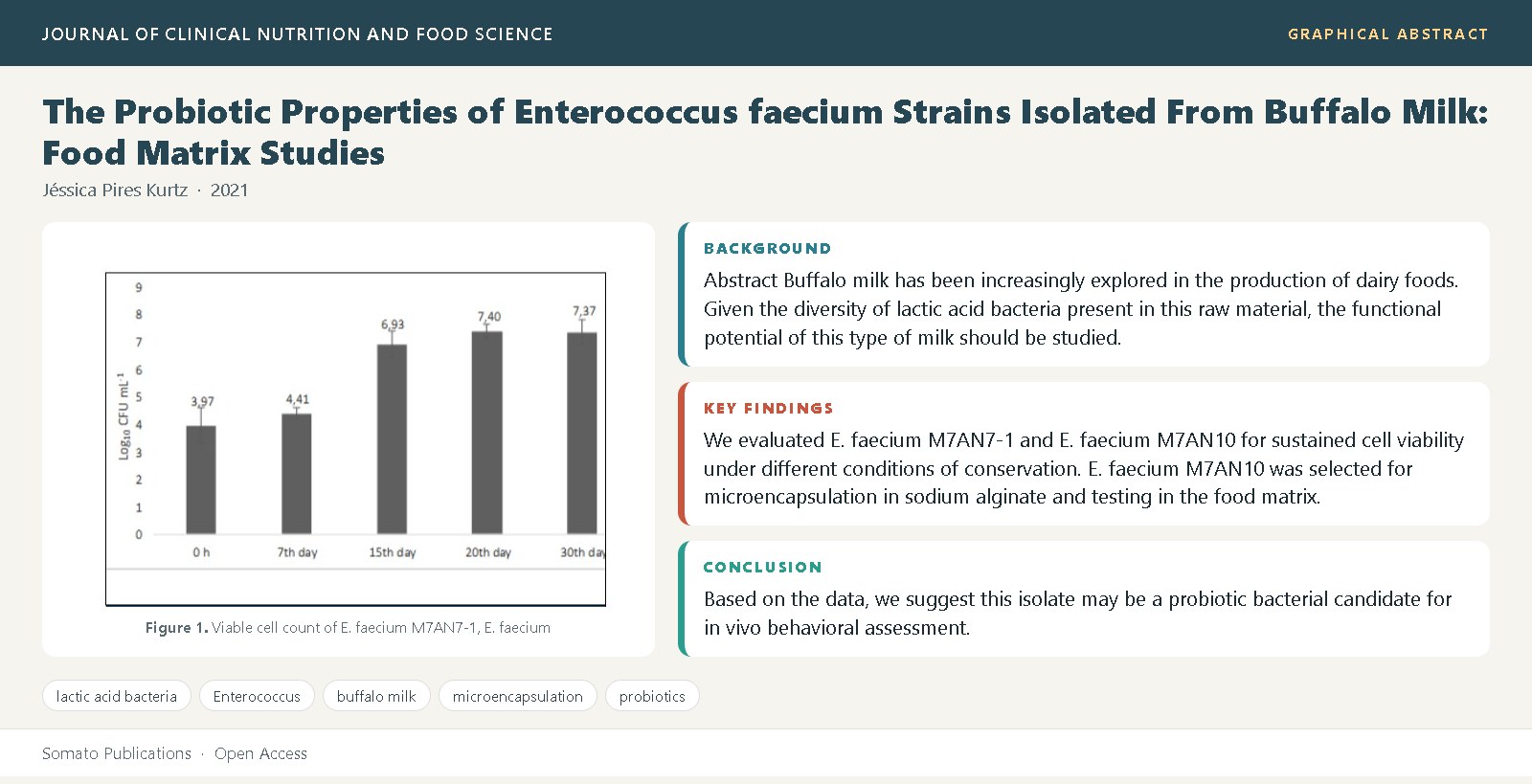
Abstract Buffalo milk has been increasingly explored in the production of dairy foods. Given the diversity of lactic acid bacteria present in this raw material, the functional potential of this type of milk should be studied. This study aims to assess the probiotic potential of two strains of Enterococcus faecium isolated from buffalo milk. We evaluated E. faecium M7AN7-1 and E. faecium M7AN10 for sustained cell viability under different conditions of conservation. We also assessed adhesion and cell viability in a simulated gastrointestinal transit test. E. faecium M7AN10 was selected for microencapsulation in sodium alginate and testing in the food matrix. The isolates maintained cell viability after refrigeration, freezing, and freeze-drying. E. faecium M7AN10 showed higher concentrations of viable cells than E. faecium M7AN7-1 after 180 min of contact with simulated gastric fluid, reaching 7.19 ± 0.59 Log10 CFU mL-1. We also observed sustained cell viability after exposure to simulated intestinal fluid. After encapsulation, E. faecium M7AN10 was tested in the food matrix of UHT milk. Cell count viability was maintained and its release was sustained in this medium for 30 days. The results of the in vitro assessment demonstrated that E. faecium M7AN10 remained functionally active under these experimental conditions. Similarly, they showed that it is a bacterium capable of sustaining viability in this type of food and after transit in a simulated gastrointestinal tract. Based on the data, we suggest this isolate may be a probiotic bacterial candidate for in vivo behavioral assessment.
References
Godinho, F., Krug, M., Figueiredo, R., Müller, A., Jank, L., Tomaszewski, C, et al. (2020) Microbiological and physicochemical characteristics of buffalo milk used for dairy products in southern Brazil. Journal of Dairy Research, 87(4): 463-468.
Breyer, GM., Arechavaleta, NN., Siqueira, FM., Motta, AS. (2020) Characterization of Lactic Acid Bacteria in Raw Buffalo Milk: a Screening for Novel Probiotic Candidates and Their Transcriptional Response to Acid Stress. Probiotics Antimicrob Proteins, doi: 10.1007/s12602-020-09700-4.
Jeronymo-Ceneviva, AB., Paula, AT., Silva, LF., Todorov, SD., Franco, BDGM., Penna, ALB. (2014) Probiotic properties of lactic acid bacteria isolated from water-buffalo mozzarella cheese. Probiotics Antimicrob Proteins, 6(3-
: 141-56. 4. Krasaekoopt, W., Bhandari, B., Deeth, H. (2003) Evaluation of encapsulation techniques of probiotics for yoghurt. International Dairy Journal, 13(1): 3-13.
Todorov,SD.,LeBlanc,JG.,Franco,BDGM.(2012)Evaluation of the probiotic potential and effect of encapsulation on survival for Lactobacillus plantarum ST16Pa isolated from papaya. World J Microbiol Biotechno, 28(3): 973- 984.
Sousa, S., Gomes, AM., Pintado, MM., Malcata, FX., Silva, JP., Sousa, JM., et al. (2012) Encapsulation of probiotic strains in plain or cysteine-supplemented alginate improves viability at storage below freezing temperatures. Eng Life Sci, 12(4): 457-465.
Zacarías, MF., Binetti, A., Laco, M., Reinheimer, J., Vinderola G. (2011) Preliminary technological and potential probiotic characterization of bifidobacteria isolated from breast milk for use in dairy products. International Dairy Journal, 21(8): 548-555.
Miles, AA., Misra, SS., Irwin, JO. (1938) The estimation of the bactericidal power of the blood. J Hyg (Lond), 38(6): 732-749.
Meira, SMM., Helfer, VE., Velho, RV., Medina, LFC., Brandelli, A. (2010). Identification and resistance to biological barriers of lactic acid bacteria isolated from milk and sheep cheese. Brazilian Journal of Food Technology. 3:75- 80.
Charteris, WP., Kelly, PM., Morelli, L., Collins, JK. (1998) Development and application of an in vitro methodology to determine the transit tolerance of potentially probiotic Lactobacillus and Bifidobacterium species in the upper human gastrointestinal tract. J Appl Microbiol, 84(5): 759-768.
Abbasiliasi, S., Tan, JS., Bashokouh, F., Ibrahim, TAT., Mustafa, S., Vakhshiteh, F., et al. (2017) In vitro assessment of Pediococcus acidilactici Kp10 for its potential use in the food industry. BMC Microbiology, 17(121): 2-11.
Mousavi, E., Makvandi, M., Teimoori, A., Ataei, A., Ghafari, S., Najafian, M., et al. (2016) In vitro adherence of Lactobacillus strains isolated from the vaginas of healthy Iranian women. J Chin Med Assoc, 79(12): 665-671.
Todorov, SD., Dicks, LMT. (2008) Evaluation of lactic acid bacteria from kefir, molasses and olive brine as possible probiotics based on physiological properties. Food Microbiology, 58(4): 661-670.
Capela, P., Hay, TKC., Shah, NP. (2007) Effect of homogenisation on bead size and survival of encapsulated probiotic bacteria. Food Research International, 40(10):1261-1269.
Silvetti, T., Morandi, S., Brasca, M. (2019) Does Enterococcus faecalis from Traditional Raw Milk Cheeses Serve as a Reservoir of Antibiotic Resistance and Pathogenic Traits? Foodborne Pathog Dis, 6(5): 359-367.
Ispirli, H., Demirbas, F., Dertli, E. (2017) Characterization of functional properties of Enterococcus spp. isolated from Turkish white cheese. LWT, 75: 358-65.
Silva, LF., Casella, T., Gomes, ES., Nogueira, MCL., Dea Lindner, J., Penna, ALB. (2015) Diversity of lactic acid bacteria isolated from Brazilian water buffalo mozzarella cheese. J Food Sci, 80(2): 411-417.
Prichula, J., Zvoboda, DA., Pereira, RI., Santestevan, NA., Medeiros, AW., Motta, AS., et al. (2013) Antimicrobial susceptibility profile and diversity of enterococcus species isolated from raw buffalo milk in southern Brazil. Revista Brasileira de Ciência Veterinária, 20(2): 104-09.
Todorov, SD., Perin, LM., Carneiro, BM., Rahal, P., Holzapfel ,W., Nero, LA. (2017) Safety of Lactobacillus plantarum ST8Sh and Its Bacteriocin. Probiotics Antimicrob Proteins, 9(3): 334-344.
Murtaza, MA., Huma, N., Shabbir, MA., Murtaza, MS., Anees-ur-Rehman, M. (2017) Survival of micro-organisms and organic acid profile of probiotic Cheddar cheese from buffalo milk during accelerated ripening. International Journal of Dairy Technology, 70(4): 562-571.
Patrignani,F.,Siroli,L.,Serrazanetti,DI.,Braschi,G.,Betoret, E., Reinheimer, JA., et al. (2017) Microencapsulation of functional strains by high pressure homogenization for a potential use in fermented milk. Food Res Int, 97: 250– 257.
Afzaal, M., Saeed, F., Arshad, MU., Nadeem, MT., Saeed, M., Tufail, T. (2019) The Effect of Encapsulation on The Stability of Probiotic Bacteria in Ice Cream and Simulated Gastrointestinal Conditions. Probiotics Antimicrob Proteins, 11(4): 1348-1354.
Kataria, A., Achi, SC., Halami, PM. (2018) Effect of Encapsulation on Viability of Bifidobacterium longum CFR815j and Physiochemical Properties of Ice Cream. Indian J Microbiol, 58(2): 248-251.
Terpou, A., Mantzourani, I., Galanis, A., Kanellaki, M., Bezirtzoglou, E., Bekatorou, A., et al. (2018) Employment of L. paracasei K5 as a Novel Potentially Probiotic Freeze-Dried Starter for Feta-Type Cheese Production. Microorganisms, 7(1): 3.
Astesana, DM., Zimmermann, JA., Frizzo, LS., Zbrun, MV., Blajman, JE., Berisvil, AP., et al. (2018) Development and storage studies of high density macrocapsules containing Lactobacillus spp. strains as nutritional supplement in young calves. Rev Argent Microbiol, 50(4): 398-407.
FAO-WHO. Food and Agriculture Organization of the United Nations. World Health Organization. 2001. Report of a joint FAO-WHO expert consultation on evaluation of the health and nutritional properties of probiotics in food including powder milk with live lactic acid bacteria, 34 p.
Pieniz, S., Andreazza, R., Anghinoni, T., Camargo, F., Brandelli, A. (2014) Probiotic potential, antimicrobial and antioxidant activities of Enterococcus durans strain LAB18s. Food Control, 37: 251-256.
Maia, LF, Giazzi, A, Brandalize, C, Katsuda, MS, Rocha, KR, Terra, MR. Furlaneto, MC. (2017). Isolation and characterization of potential probiotic enterococci strains from soft cheese flora. African Journal of Microbiology Research. 11(12):482-87.
Cebrián, R., Baños, A., Valdivia, E., Pérez-Pulido, R., Martínez-Bueno, M., Maqueda, M. (2012) Characterization of functional, safety, and probiotic properties of Enterococcus faecalis UGRA10, a new AS-48-producer strain. Food Microbiol, 30(1): 59-67.
Bagci, U., Togay, SO., Temiz, A., Ay, M. (2019) Probiotic characteristics of bacteriocin-producing Enterococcus faecium strains isolated from human milk and colostrum. Folia Microbiol (Praha), 64(6): 735-750.
Nascimento, LCS., Casarotti, SN., Todorov, SD., Penna, ALB. (2019) Probiotic potential and safety of enterococci strains. Annals of Microbiology, 69: 241–252.
Guerra, AF, Lemos Junior, WJF, Santos, GO, Andrighetto, C, Gianomini, A, Corich, V, Luchese, RH. (2018). Lactobacillus paracasei probiotic properties and survivability under stress-induced by processing and storage of ice cream bar or ice-lolly. Ciência Rural. 48(09):1-9.
Senter, L, Pereira, JQ, Vieira, MA, Michielin, EMZ, Tondo, EC. (2015). Isolation and characterization of Lactobacillus plantarum BLS29 as a potential probiotic starter culture for pork sausage production. African Journal of Microbiology Research. 9(32):1887-95.
Dutra, V., Silva, AC., Cabrita, P., Peres, C., Malcata, X., Brito L. (2016) Lactobacillus plantarum LB95 impairs the virulence potential of Gram-positive and Gram-negative food-borne pathogens in HT-29 and Vero cell cultures. J Med Microbiol, 65(1): 28-35.
Zommiti, M., Cambronel, M., Maillot, O., Barreau, M., Sebei, K., Feuilloley, M., et al. (2018) Evaluation of Probiotic Properties and Safety of Enterococcus faecium Isolated From Artisanal Tunisian Meat “Dried Ossban”. Front Microbiol, 9: 1685.
Barbosa, J., Teixeira, P. (2017) Development of probiotic fruit juice powders by spray drying: a review. Food Reviews International. 33(4): 335-358.
Surono, I., Verhoeven, J., Verbruggen, S., Venema, K. (2018) Microencapsulation increases survival of the probiotic Lactobacillus plantarum IS-10506, but not Enterococcus faecium IS-27526 in a dynamic, computer-controlled in vitro model of the upper gastrointestinal tract. J Appl Microbiol, 124(6): 1604-1609.
Agência Nacional de Vigilância Sanitária – Gerência Geral de Alimentos. 2017. Probióticos: Construção da Lista de Linhagens Probióticas. Disponível em: . Acesso em: 28 out. 2018.





