
Poor Nutritional Status of Disadvantaged Groups Since COVID-19
Abstract
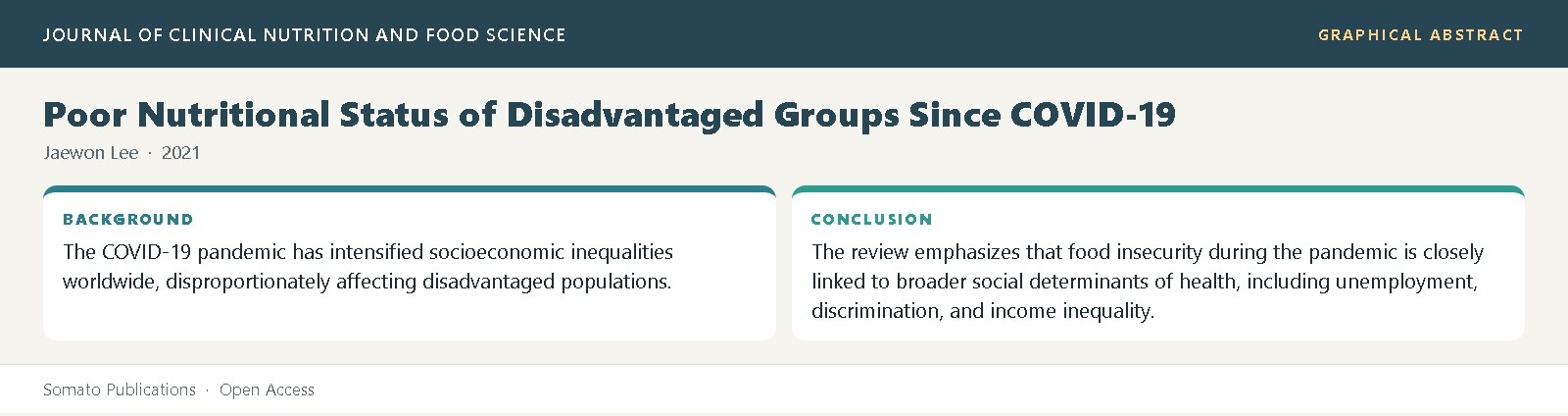
Background: The COVID-19 pandemic has intensified socioeconomic inequalities worldwide, disproportionately affecting disadvantaged populations. Rising unemployment, reduced household income, and financial insecurity have limited access to nutritious foods, increasing the risk of poor nutritional status among vulnerable groups.
Review: This review discusses the impact of the COVID-19 pandemic on the nutritional well-being of disadvantaged populations, including older adults, people with disabilities, homeless individuals, migrants, minorities, and children without parental care. Economic hardship has reduced the affordability of healthy foods, leading many low-income households to rely on less nutritious, inexpensive alternatives. School closures have also disrupted nutrition assistance programs, limiting access to balanced meals for children. These factors have increased the risk of malnutrition, impaired physical development, and poorer overall health outcomes, particularly among individuals who were already nutritionally vulnerable before the pandemic.
Discussion: The review emphasizes that food insecurity during the pandemic is closely linked to broader social determinants of health, including unemployment, discrimination, and income inequality. Poor nutrition may further exacerbate physical, cognitive, and behavioral health problems, widening existing health disparities. Addressing these challenges requires coordinated public health and social welfare interventions to improve food accessibility and affordability.
Conclusion: The COVID-19 pandemic has significantly worsened nutritional inequalities among disadvantaged populations. Strengthening nutrition assistance programs, expanding community food distribution initiatives, and providing greater financial support to vulnerable groups are essential strategies to improve nutritional status and reduce health disparities during and beyond the pandemic.
References
United States Bureau of Labor Statistics. (2021). The employment situation – January 2021. Retrieved March 1st, 2021 from https://www.bls.gov/news.release/ archives/empsit_02052021.htm
Patel, J. A., Nielsen, F. B. H., Badiani, A. A., Assi, S., Unadkat, V. A., Patel, B., et al. (2020) Poverty, inequality and COVID-19: The forgotten vulnerable. Public Health, 183: 110-111.
Akseer, N., Kandru, G., Keats, E. C., Bhutta, Z. A. (2020) COVID-19 pandemic and mitigation strategies: Implications for maternal and child health and nutrition. The American Journal of Clinical Nutrition, 112(2): 251- 256.
Rao, M., Afshin, A., Singh, G., Mozaffarian, D. (2013) Do healthier foods and diet patterns cost more than less healthy options? A systematic review and meta-analysis. BMJ Open, 3(12): e004277.
Bertrand, M., Mullainathan, S. (2004) Are Emily and Greg more employable than Lakisha and Jamal? A field experiment on labor market discrimination. American Economic Review, 94(4): 991-1013.
Chernoff, R. (2001). Nutrition and health promotion in older adults. J Gerontol A Biol Sci Med Sci, 56(Suppl 2), 47-53.
Tooley, UA., Makhoul, Z., Fisher, PA. (2016) Nutritional status of foster children in the U.S.: Implications for cognitive and behavioral development. Child Youth Serv Rev, 70: 369-374.
Riach, PA., Rich, J. (2002) Field experiments of discrimination in the market place. The Economic Journal, 112(483): F480-F518.





