
Zinc and Vitamin A Co-Supplementation and Recovery from Acute Diarrhoeal Illness in Young Children: A Randomized, Placebo-Controlled Trial
DOI:
https://doi.org/10.5281/zenodo.22337874Keywords:
vitamin A, acute diarrhoea, child health, micronutrient co-supplementation, zinc supplementationAbstract
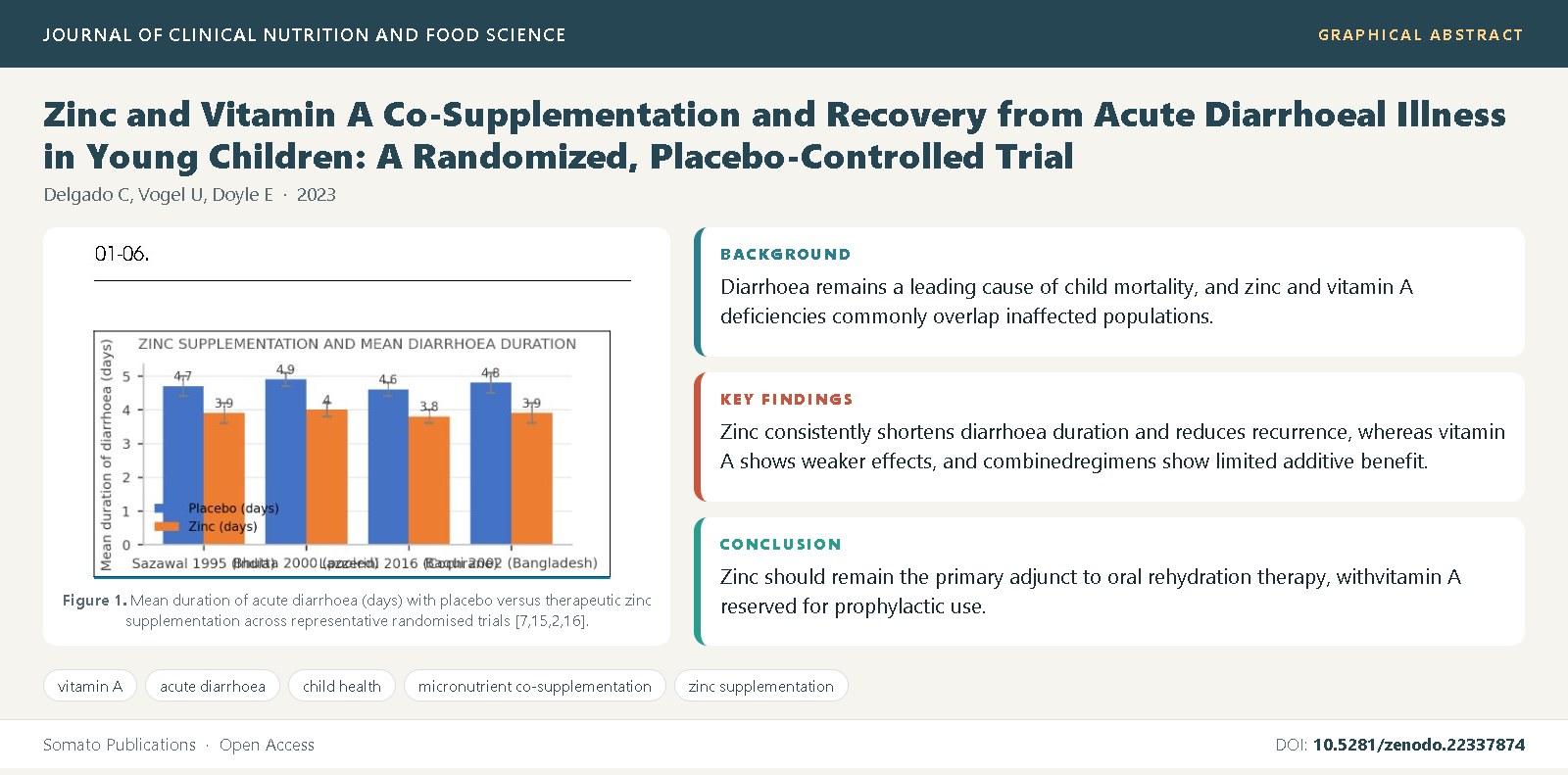
Background: Diarrhoea remains a leading cause of child mortality, and zinc and vitamin A deficiencies commonly overlap in
affected populations. Objective: To synthesise evidence on whether zinc and vitamin A, alone or combined, accelerate recovery
from acute diarrhoeal illness. Methods: Narrative review of published trials, systematic reviews and meta-analyses. Findings:
Zinc consistently shortens diarrhoea duration and reduces recurrence, whereas vitamin A shows weaker effects, and combined
regimens show limited additive benefit. Conclusions: Zinc should remain the primary adjunct to oral rehydration therapy, with
vitamin A reserved for prophylactic use.
References
GBD 2017 Diarrhoeal Disease Collaborators (2020) Quantifying risks and interventions that have affected the burden of diarrhoea among children younger than 5 years: an analysis of the Global Burden of Disease Study 2017. Lancet Infectious Diseases, 20(1): 37-59.
Lazzerini, M., Wanzira, H. (2016) Oral zinc for treating diarrhoea in children. Cochrane Database of Systematic Reviews, 12(12): CD005436.
Khatun, U.H., Malek, M.A., Black, R.E., et al. (2001) A randomized controlled clinical trial of zinc, vitamin A or both in undernourished children with persistent diarrhea in Bangladesh. Acta Paediatrica, 90(4): 376-380.
GBD 2016 Diarrhoeal Disease Collaborators (2018) Estimates of the global, regional, and national morbidity, mortality, and aetiologies of diarrhoea in 195 countries: a systematic analysis for the Global Burden of Disease Study 2016. Lancet Infectious Diseases, 18(11): 1211-1228.
Hambidge, K.M., Krebs, N.F. (2007) Zinc deficiency: a special challenge. Journal of Nutrition, 137(4): 1101-1105.
Stephensen, C.B. (2001) Vitamin A, infection, and immune function. Annual Review of Nutrition, 21: 167-192.
Sazawal, S., Black, R.E., Bhan, M.K., Bhandari, N., Sinha, A., Jalla, S. (1995) Zinc supplementation in young children with acute diarrhea in India. New England Journal of Medicine, 333(13): 839-844.
World Health Organization, UNICEF (2004) Clinical Management of Acute Diarrhoea: WHO/UNICEF Joint Statement. Geneva: WHO, WHO/FCH/CAH/04.7.
Sommer, A. (2008) Vitamin A deficiency and clinical disease: an historical overview. Journal of Nutrition, 138(10): 1835-1839.
Imdad, A., Mayo-Wilson, E., Herzer, K., Bhutta, Z.A. (2017) Vitamin A supplementation for preventing morbidity and mortality in children from six months to five years of age. Cochrane Database of Systematic Reviews, 3(3): CD008524.
Long, K.Z., Garcia, C., Santos, J.I., et al. (2010) Vitamin A and zinc supplementation of Mexican infants and young children with growth and micronutrient status. European Journal of Clinical Nutrition, 64(6): 631-637.
Muhilal, Permaesih, D., Rahmini, Y., et al. (2001) Simultaneous zinc and vitamin A supplementation in Bangladeshi children: randomised double blind controlled trial. BMJ, 323(7308): 314-318.
Wessells, K.R., Brown, K.H. (2012) Estimating the global prevalence of zinc deficiency: results based on zinc availability in national food supplies and the prevalence of stunting. PLoS ONE, 7(11): e50568.
Villamor, E., Fawzi, W.W. (2005) Effects of vitamin A supplementation on immune responses and correlation with clinical outcomes. Clinical Microbiology Reviews, 18(3): 446-464.
Bhutta, Z.A., Bird, S.M., Black, R.E., et al. (2000) Therapeutic effects of oral zinc in acute and persistent diarrhea in children in developing countries: pooled analysis of randomized controlled trials. American Journal of Clinical Nutrition, 72(6): 1516-1522.
Baqui, A.H., Black, R.E., El Arifeen, S., et al. (2002) Effect of zinc supplementation started during diarrhoea on morbidity and mortality in Bangladeshi children: community randomised trial. BMJ, 325(7372): 1059.
Roy, S.K., Tomkins, A.M., Akramuzzaman, S.M., et al. (1998) Impact of zinc supplementation on persistent diarrhoea in malnourished Bangladeshi children. Acta Paediatrica, 87(12): 1235-1239.
Zinc supplementation for acute and persistent watery diarrhoea in children: a systematic review and meta-analysis (2024) Journal of Global Health, 14: 04212.
Fischer Walker, C.L., Black, R.E. (2010) Zinc for the treatment of diarrhoea: effect on diarrhoea morbidity, mortality and incidence of future episodes. International Journal of Epidemiology, 39(Suppl 1): i63-i69.
Fischer Walker, C.L., Fontaine, O., Young, M.W., Black, R.E. (2009) Zinc and low osmolarity oral rehydration salts for diarrhoea: a renewed call to action. Bulletin of the World Health Organization, 87(10): 780-786.
Barreto, M.L., Santos, L.M., Assis, A.M., et al. (1994) Effect of vitamin A supplementation on diarrhoea and acute lower-respiratory-tract infections in young children in Brazil. Lancet, 344(8917): 228-231.
Bhandari, N., Bahl, R., Sazawal, S., Bhan, M.K. (1994) Impact of massive dose of vitamin A given to preschool children with acute diarrhoea on subsequent respiratory and diarrhoeal morbidity. BMJ, 309(6966): 1404-1407.
Gogia, S., Sachdev, H.S. (2009) Neonatal vitamin A supplementation for prevention of mortality and morbidity in infancy: systematic review of randomised controlled trials. BMJ, 338: b919.
Long, K.Z., Rosado, J.L., Santos, J.I., et al. (2006) Impact of vitamin A on selected gastrointestinal pathogen infections and associated diarrheal episodes among children in Mexico City, Mexico. Journal of Infectious Diseases, 194(10): 1217-1225.
Long, K.Z., Rosado, J.L., Santos, J.I., et al. (2007) Effect of vitamin A and zinc supplementation on gastrointestinal parasitic infections among Mexican children. Pediatrics, 120(4): e846-e855.
Santosham, M., Chandran, A., Fitzwater, S., Fischer-Walker, C., Baqui, A.H., Black, R. (2010) Progress and barriers for the control of diarrhoeal disease. Lancet, 376(9734): 63-67.
Mayo-Wilson, E., Junior, J.A., Imdad, A., et al. (2014) Zinc supplementation for preventing mortality, morbidity, and growth failure in children aged 6 months to 12 years of age. Cochrane Database of Systematic Reviews, 2014(5): CD009384.





