
Dietary Fibre Enrichment of Wheat Bread and Postprandial Glucose Response in Healthy Adults: A Randomized Crossover Trial
DOI:
https://doi.org/10.5281/zenodo.22335634Keywords:
Dietary fibre, Postprandial glucose, Beta-glucan, Resistant starch, Wheat breadAbstract
Background: Wheat bread is a major dietary source of rapidly digestible starch, and fibre enrichment is widely studied for
blunting postprandial glycaemia.
Objective: To synthesise trial evidence on fibre-enriched wheat bread and postprandial glucose response in healthy adults.
Methods: Narrative review of published randomised trials, meta-analyses, and mechanistic studies.
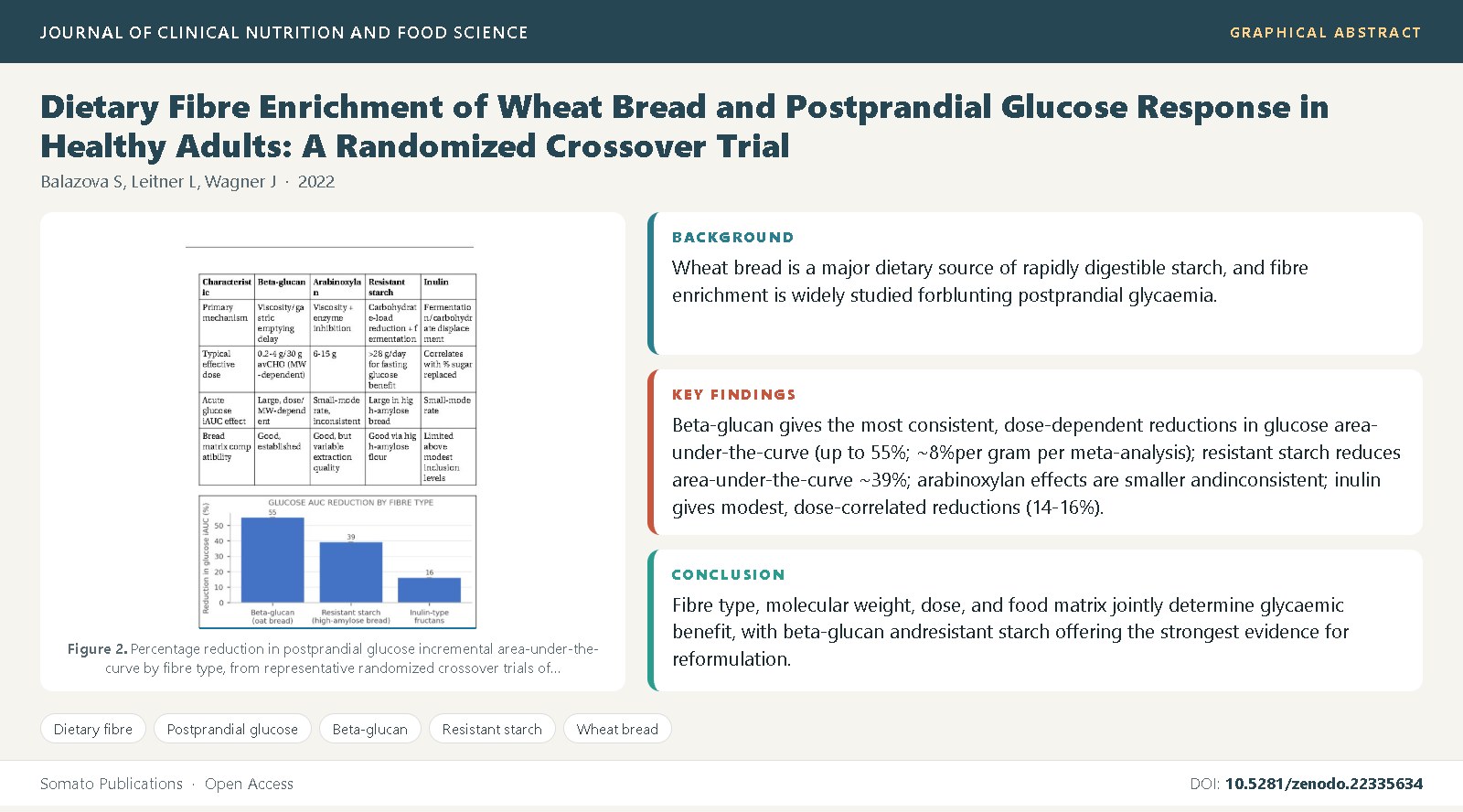
Findings: Beta-glucan gives the most consistent, dose-dependent reductions in glucose area-under-the-curve (up to 55%; ~8%
per gram per meta-analysis); resistant starch reduces area-under-the-curve ~39%; arabinoxylan effects are smaller and
inconsistent; inulin gives modest, dose-correlated reductions (14-16%).
Conclusions: Fibre type, molecular weight, dose, and food matrix jointly determine glycaemic benefit, with beta-glucan and
resistant starch offering the strongest evidence for reformulation.
References
Jenkins, D.J.A., Wolever, T.M.S., Taylor, R.H., Barker, H., Fielden, H., Baldwin, J.M., Bowling, A.C., Newman, H.C., Jenkins, A.L., Goff, D.V. (1981) Glycemic index of foods: a physiological basis for carbohydrate exchange. American Journal of Clinical Nutrition, 34(3): 362-366.
Brouns, F., Bjorck, I., Frayn, K.N., Gibbs, A.L., Lang, V., Slama, G., Wolever, T.M.S. (2005) Glycaemic index methodology. Nutrition Research Reviews, 18(1): 145-171.
Revheim, I., Ballance, S., Standal, A.F., Rieder, A., Dierkes, J., Buyken, A.E., Gilja, O.H., Hausken, T., Rosendahl-Riise, H. (2024) The acute effect of a β-glucan-enriched oat bread on gastric emptying, GLP-1 response, and postprandial glycaemia and insulinemia: a randomised crossover trial in healthy adults. Nutrition & Metabolism, 21: 13.
Tolhurst, G., Heffron, H., Lam, Y.S., Parker, H.E., Habib, A.M., Diakogiannaki, E., Cameron, J., Grosse, J., Reimann, F., Gribble, F.M. (2012) Short-chain fatty acids stimulate glucagon-like peptide-1 secretion via the G-protein-coupled receptor FFAR2. Diabetes, 61(2): 364-371.
Koh, A., De Vadder, F., Kovatcheva-Datchary, P., Backhed, F. (2016) From dietary fiber to host physiology: short-chain fatty acids as key bacterial metabolites. Cell, 165(6): 1332-1345.
Salamone, D., Rivellese, A.A., Vetrani, C. (2021) The relationship between gut microbiota, short-chain fatty acids and type 2 diabetes mellitus: the possible role of dietary fibre. Acta Diabetologica, 58(9): 1131-1138.
Giuntini, E.B., Sarda, F.A.H., de Menezes, E.W. (2022) The effects of soluble dietary fibers on glycemic response: an overview and futures perspectives. Foods, 11(23): 3934.
Zurbau, A., Noronha, J.C., Khan, T.A., Sievenpiper, J.L., Wolever, T.M.S. (2021) The effect of oat β-glucan on postprandial blood glucose and insulin responses: a systematic review and meta-analysis. European Journal of Clinical Nutrition, 75(11): 1540-1554.
Noronha, J.C., Zurbau, A., Wolever, T.M.S. (2023) The importance of molecular weight in determining the minimum dose of oat β-glucan required to reduce the glycaemic response in healthy subjects without diabetes: a systematic review and meta-regression analysis. European Journal of Clinical Nutrition, 77(3): 308-315.
Caferoglu, Z., Aytekin Sahin, G., Gonulalan, Z., Hatipoglu, N. (2022) Effects of whole-grain barley and oat β-glucans on postprandial glycemia and appetite: a randomized controlled crossover trial. Food & Function, 13(19): 10225-10234.
Kellogg, J.A., Monsivais, P., Murphy, K.M., Perrigue, M.M. (2025) High β-glucan whole grain barley reduces postprandial glycemic response in healthy adults - Part one of a randomized controlled trial. Nutrients, 17(3): 430.
EFSA Panel on Dietetic Products, Nutrition and Allergies (NDA) (2011) Scientific Opinion on the substantiation of health claims related to beta-glucans from oats and barley and maintenance of normal blood LDL-cholesterol concentrations, increase in satiety leading to a reduction in energy intake, reduction of post-prandial glycaemic responses, and "digestive function". EFSA Journal, 9(6): 2207.
Lu, Z.X., Walker, K.Z., Muir, J.G., Mascara, T., O'Dea, K. (2000) Arabinoxylan fiber, a byproduct of wheat flour processing, reduces the postprandial glucose response in normoglycemic subjects. American Journal of Clinical Nutrition, 71(5): 1123-1128.
Garcia, A.L., Otto, B., Reich, S.C., Weickert, M.O., Steiniger, J., Machowetz, A., Rudovich, N.N., Mohlig, M., Katz, N., Speth, M., Meuser, F., Doerfer, J., Zunft, H.J.F., Pfeiffer, A.H.F., Koebnick, C. (2007) Arabinoxylan consumption decreases postprandial serum glucose, serum insulin and plasma total ghrelin response in subjects with impaired glucose tolerance. European Journal of Clinical Nutrition, 61(3): 334-341.
Hartvigsen, M.L., Gregersen, S., Laerke, H.N., Holst, J.J., Bach Knudsen, K.E., Hermansen, K. (2014) Effects of concentrated arabinoxylan and β-glucan compared with refined wheat and whole grain rye on glucose and appetite in subjects with the metabolic syndrome: a randomized study. European Journal of Clinical Nutrition, 68(1): 84-90.
Hald, S., Schioldan, A.G., Moore, M.E., Dige, A., Laerke, H.N., Agnholt, J., Bach Knudsen, K.E., Hermansen, K., Marco, M.L., Gregersen, S., Dahlerup, J.F. (2016) Effects of arabinoxylan and resistant starch on intestinal microbiota and short-chain fatty acids in subjects with metabolic syndrome: a randomised crossover study. PLOS ONE, 11(7): e0159223.
Xu, Y., Liang, Y., Kim, J.E. (2025) Impact of arabinoxylan consumption on glycemic control: a systematic review and meta-analysis of preclinical and clinical studies. Nutrients, 17(17): 2840.
Malunga, L.N., Izydorczyk, M., Beta, T. (2017) Antiglycemic effect of water extractable arabinoxylan from wheat aleurone and bran. Journal of Nutrition and Metabolism, 2017: 5784759.
EFSA Panel on Dietetic Products, Nutrition and Allergies (NDA) (2011) Scientific Opinion on the substantiation of health claims related to arabinoxylan produced from wheat endosperm and reduction of post-prandial glycaemic responses (ID 830) pursuant to Article 13(1) of Regulation (EC) No 1924/2006. EFSA Journal, 9(6): 2205.
Xiong, K., Wang, J., Kang, T., Xu, F., Ma, A. (2021) Effects of resistant starch on glycaemic control: a systematic review and meta-analysis. British Journal of Nutrition, 125(11): 1260-1269.
Pugh, J.E., Cai, M., Altieri, N., Frost, G. (2023) A comparison of the effects of resistant starch types on glycemic response in individuals with type 2 diabetes or prediabetes: a systematic review and meta-analysis. Frontiers in Nutrition, 10: 1118229.
Belobrajdic, D.P., Regina, A., Klingner, B., Zajac, I., Chapron, S., Berbezy, P., Bird, A.R. (2019) High-amylose wheat lowers the postprandial glycemic response to bread in healthy adults: a randomized controlled crossover trial. Journal of Nutrition, 149(8): 1335-1345.
Lightowler, H., Thondre, S., Holz, A., Theis, S. (2018) Replacement of glycaemic carbohydrates by inulin-type fructans from chicory (oligofructose, inulin) reduces the postprandial blood glucose and insulin response to foods: report of two double-blind, randomized, controlled trials. European Journal of Nutrition, 57(3): 1259-1268.
Wijaya, H., Tjahjono, Y., Foe, K., Setiadi, D.A., Kasih, E., Wihadmadyatami, H. (2022) Pre-meal high-performance inulin supplementation reduce post-prandial glycaemic response in healthy subjects: a repeated single-arm clinical trial. Diabetes & Metabolic Syndrome, 16(1): 102354.
Hlebowicz, J., Jonsson, J.M., Lindstedt, S., Bjorgell, O., Darwiche, G., Almer, L.O. (2009) Effect of commercial rye whole-meal bread on postprandial blood glucose and gastric emptying in healthy subjects. Nutrition Journal, 8: 26.
Kristensen, M., Jensen, M.G., Riboldi, G., Petronio, M., Bugel, S., Toubro, S., Tetens, I., Astrup, A. (2010) Wholegrain vs. refined wheat bread and pasta: effect on postprandial glycemia, appetite, and subsequent ad libitum energy intake in young healthy adults. Appetite, 54(1): 163-169.
Lu, K., Yu, T., Cao, X., Xia, H., Wang, S., Sun, G., Chen, L., Liao, W. (2023) Effect of viscous soluble dietary fiber on glucose and lipid metabolism in patients with type 2 diabetes mellitus: a systematic review and meta-analysis on randomized clinical trials. Frontiers in Nutrition, 10: 1253312.
Kurek, M.A., Wyrwisz, J., Karp, S., Wierzbicka, A. (2018) Effect of fiber sources on fatty acids profile, glycemic index, and phenolic compound content of in vitro digested fortified wheat bread. Journal of Food Science and Technology, 55(5): 1632-1640.





