
Effect of a Fermented Soy-Based Probiotic Beverage on Bowel Habit and Faecal Microbiota Composition in Adults with Functional Constipation: A Randomized, Double-Blind, Placebo-Controlled Trial
DOI:
https://doi.org/10.5281/zenodo.22335611Keywords:
Functional constipation, Probiotic, Fermented soy beverage, Faecal microbiota, Short-chain fatty acidsAbstract
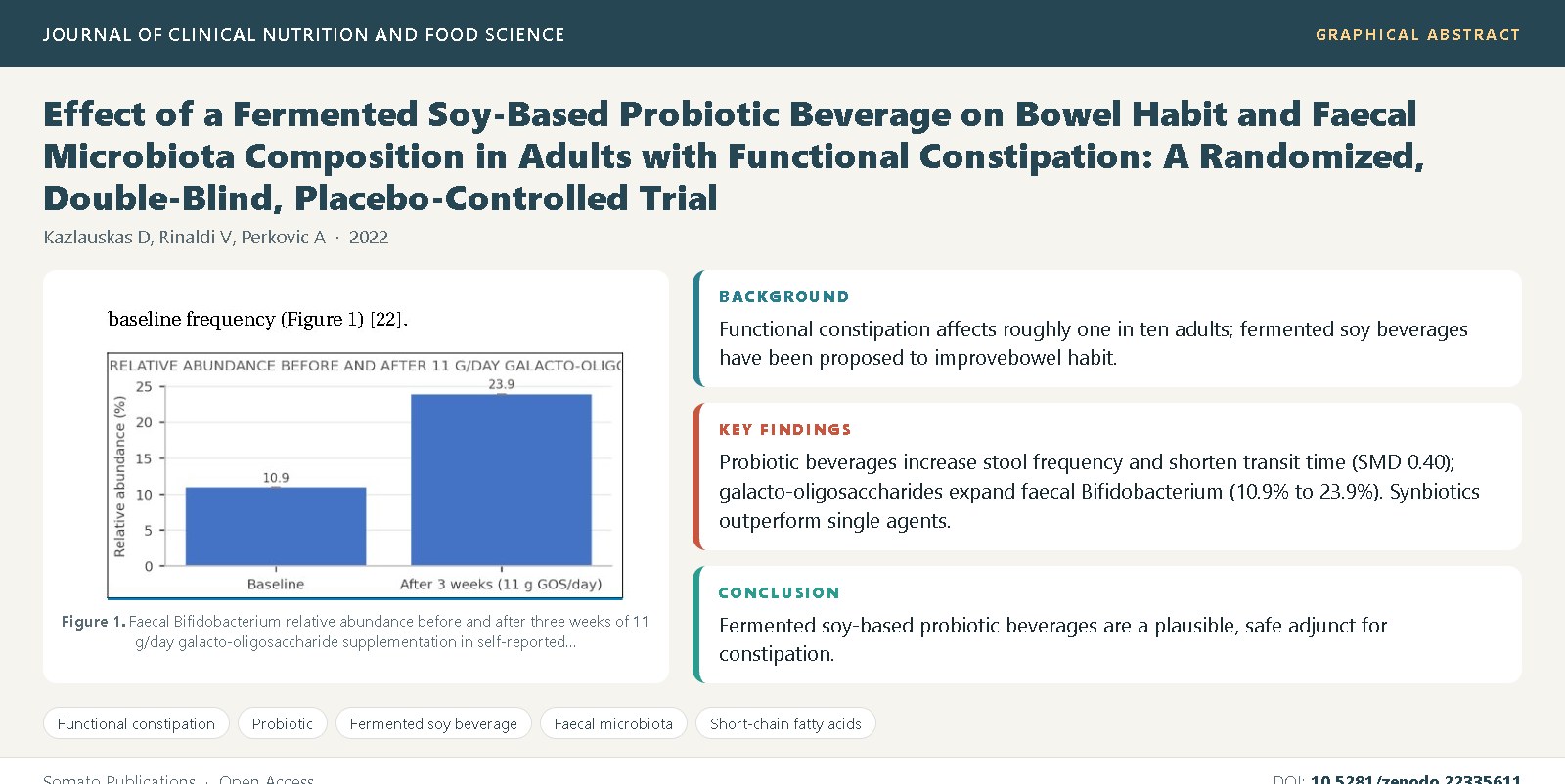
Background: Functional constipation affects roughly one in ten adults; fermented soy beverages have been proposed to improve
bowel habit. Objective: To synthesise trial evidence on soy/dairy probiotic beverages and microbiota outcomes in constipation.
Methods: Narrative review of randomised trials, meta-analyses, and mechanistic studies. Findings: Probiotic beverages increase stool frequency and shorten transit time (SMD 0.40); galacto-oligosaccharides expand faecal Bifidobacterium (10.9% to 23.9%). Synbiotics outperform single agents. Conclusions: Fermented soy-based probiotic beverages are a plausible, safe adjunct for constipation.
References
Barberio, B., Judge, C., Savarino, E.V., Ford, A.C. (2021) Global prevalence of functional constipation according to the Rome criteria: a systematic review and meta-analysis. Lancet Gastroenterology & Hepatology, 6(8): 638-648.
Suares, N.C., Ford, A.C. (2011) Prevalence of, and risk factors for, chronic idiopathic constipation in the community: systematic review and meta-analysis. American Journal of Gastroenterology, 106(9): 1582-1591.
Hill, C., Guarner, F., Reid, G., Gibson, G.R., Merenstein, D.J., Pot, B., Morelli, L., Canani, R.B., Flint, H.J., Salminen, S., Calder, P.C., Sanders, M.E. (2014) The International Scientific Association for Probiotics and Prebiotics consensus statement on the scope and appropriate use of the term probiotic. Nature Reviews Gastroenterology & Hepatology, 11(8): 506-514.
Langa, S., Peirotén, Á., Curiel, J.A., Ruiz de la Bastida, A., Landete, J.M. (2023) Isoflavone metabolism by lactic acid bacteria and its application in the development of fermented soy food with beneficial effects on human health. Foods, 12(6): 1293.
Chen, Z., Shen, Y., Xu, J. (2023) Efficient degradation for raffinose and stachyose of a β-D-fructofuranosidase and its new function to improve gel properties of coagulated fermented-soymilk. Gels, 9(4): 345.
Molina, G.E.S., Ras, G., da Silva, D.F., Duedahl-Olesen, L., Hansen, E.B., Bang-Berthelsen, C.H. (2025) Metabolic insights of lactic acid bacteria in reducing off-flavors and antinutrients in plant-based fermented dairy alternatives. Comprehensive Reviews in Food Science and Food Safety, 24(2): e70134.
Kumari, M., Kokkiligadda, A., Dasriya, V., Naithani, H. (2022) Functional relevance and health benefits of soymilk fermented by lactic acid bacteria. Journal of Applied Microbiology, 133(1): 104-119.
Saini, V., Verma, A., Kumari, S., Chaudhary, S., Mishra, A., Kumar, A., Jha, H.C. (2026) The gut microbiome axis: how Lactobacillus-fermented soymilk orchestrates health. Archives of Microbiology, 208(7): 321.
Kaga, C., Nagino, T., Gomi, A., Takagi, A., Miyazaki, K., Yoshida, Y., Shida, K. (2024) Effects of fermented soymilk with Lacticaseibacillus paracasei YIT 9029 on gut microbiota and defecation habits: a randomised, double-blind, placebo-controlled study. Beneficial Microbes, 15(2): 127-143.
Zhang, X., Chen, S., Zhang, M., Ren, F., Ren, Y., Li, Y., Liu, N., Zhang, Y., Zhang, Q., Wang, R. (2021) Effects of fermented milk containing Lacticaseibacillus paracasei strain Shirota on constipation in patients with depression: a randomized, double-blind, placebo-controlled trial. Nutrients, 13(7): 2238.
Li, X., Lan, H., Guan, Y., Wang, L., Zhao, W., He, J., Zhao, Z., Li, M., Han, Q., Gong, Y., Yan, X., Li, Z., Guo, J., Wang, R., He, J. (2026) A heat-inactivated two-strain Lacticaseibacillus paracasei fermented milk as a postbiotic for functional constipation: a randomized, double-blind, placebo-controlled trial. Nutrients, 18(13): 2114.
Mazlyn, M.M., Nagarajah, L.H., Fatimah, A., Norimah, A.K., Goh, K.L. (2013) Effects of a probiotic fermented milk on functional constipation: a randomized, double-blind, placebo-controlled study. Journal of Gastroenterology and Hepatology, 28(7): 1141-1147.
Marteau, P., Cuillerier, E., Meance, S., Gerhardt, M.F., Myara, A., Bouvier, M., Bouley, C., Tondu, F., Bommelaer, G., Grimaud, J.C. (2002) Bifidobacterium animalis strain DN-173 010 shortens the colonic transit time in healthy women: a double-blind, randomized, controlled study. Alimentary Pharmacology & Therapeutics, 16(3): 587-593.
Guyonnet, D., Woodcock, A., Stefani, B., Trevisan, C., Hall, C. (2009) Fermented milk containing Bifidobacterium lactis DN-173 010 improved self-reported digestive comfort amongst a general population of adults: a randomized, open-label, controlled, pilot study. Journal of Digestive Diseases, 10(1): 61-70.
Miller, L.E., Ouwehand, A.C. (2013) Probiotic supplementation decreases intestinal transit time: meta-analysis of randomized controlled trials. World Journal of Gastroenterology, 19(29): 4718-4725.
Dimidi, E., Christodoulides, S., Fragkos, K.C., Scott, S.M., Whelan, K. (2014) The effect of probiotics on functional constipation in adults: a systematic review and meta-analysis of randomized controlled trials. American Journal of Clinical Nutrition, 100(4): 1075-1084.
Zhang, C., Jiang, J., Tian, F., Zhao, J., Zhang, H., Zhai, Q., Chen, W. (2020) Meta-analysis of randomized controlled trials of the effects of probiotics on functional constipation in adults. Clinical Nutrition, 39(10): 2960-2969.
Li, H., Chen, J., Ren, X., Yang, C., Liu, S., Bai, X., Shan, S., Dong, X. (2021) Gut microbiota composition changes in constipated women of reproductive age. Frontiers in Cellular and Infection Microbiology, 10: 557515.
Yu, T., Ding, Y., Qian, D., Lin, L., Tang, Y. (2023) Characteristics of fecal microbiota in different constipation subtypes and association with colon physiology, lifestyle factors, and psychological status. Therapeutic Advances in Gastroenterology, 16: 1-14.
Li, Y-q., Yan, X-y., Xiao, X-j., Ma, P-t., Wang, S-q., Liu, H-l., Zhang, W., Chen, M., Yao, J-p., Li, Y. (2023) The gut microbiome and metabolites are altered and interrelated in patients with functional constipation. Frontiers in Microbiology, 14: 1320567.
Ohkusa, T., Koido, S., Nishikawa, Y., Sato, N. (2019) Gut microbiota and chronic constipation: a review and update. Frontiers in Medicine, 6: 19.
Schoemaker, M.H., Hageman, J.H.J., ten Haaf, D., Hartog, A., Scholtens, P.A.M.J., Boekhorst, J., Nauta, A., Bos, R. (2022) Prebiotic galacto-oligosaccharides impact stool frequency and fecal microbiota in self-reported constipated adults: a randomized clinical trial. Nutrients, 14(2): 309.
Liu, S.H., Yang, X.F., Liang, L., Song, B.B., Song, X.M., Yang, Y.J., Alhoot, M.A. (2025) Regulatory mechanisms of the gut microbiota-short chain fatty acids signaling axis in slow transit constipation and progress in multi-target interventions. Frontiers in Microbiology, 16: 1689597.
Deng, X., Liang, C., Zhou, L., Shang, X., Hui, X., Hou, L., Wang, Y., Liu, W., Liang, S., Yao, L., Yang, K., Li, X. (2024) Network meta-analysis of probiotics, prebiotics, and synbiotics for the treatment of chronic constipation in adults. European Journal of Nutrition, 63(6): 1999-2010.
Chatsirisakul, O., Leenabanchong, N., Siripaopradit, Y., et al. (2025) Strain-specific therapeutic potential of Lactiplantibacillus plantarum: a systematic scoping review. Nutrients, 17(7): 1165.
Churin, A.A., Sokolyanskaya, L.O., Lukina, A.P., Karnachuk, O.V. (2026) Current concepts in probiotic safety and efficacy. Nutrients, 18(4): 696.





