
Fermented Kimchi-Style Vegetable Supplementation and Gut Microbiota Diversity in Adults with Metabolic Syndrome: A Randomized, Double-Blind, Placebo-Controlled Trial
DOI:
https://doi.org/10.5281/zenodo.22343578Keywords:
kimchi, gut microbiota, metabolic syndrome, fermented vegetables, short-chain fatty acidsAbstract
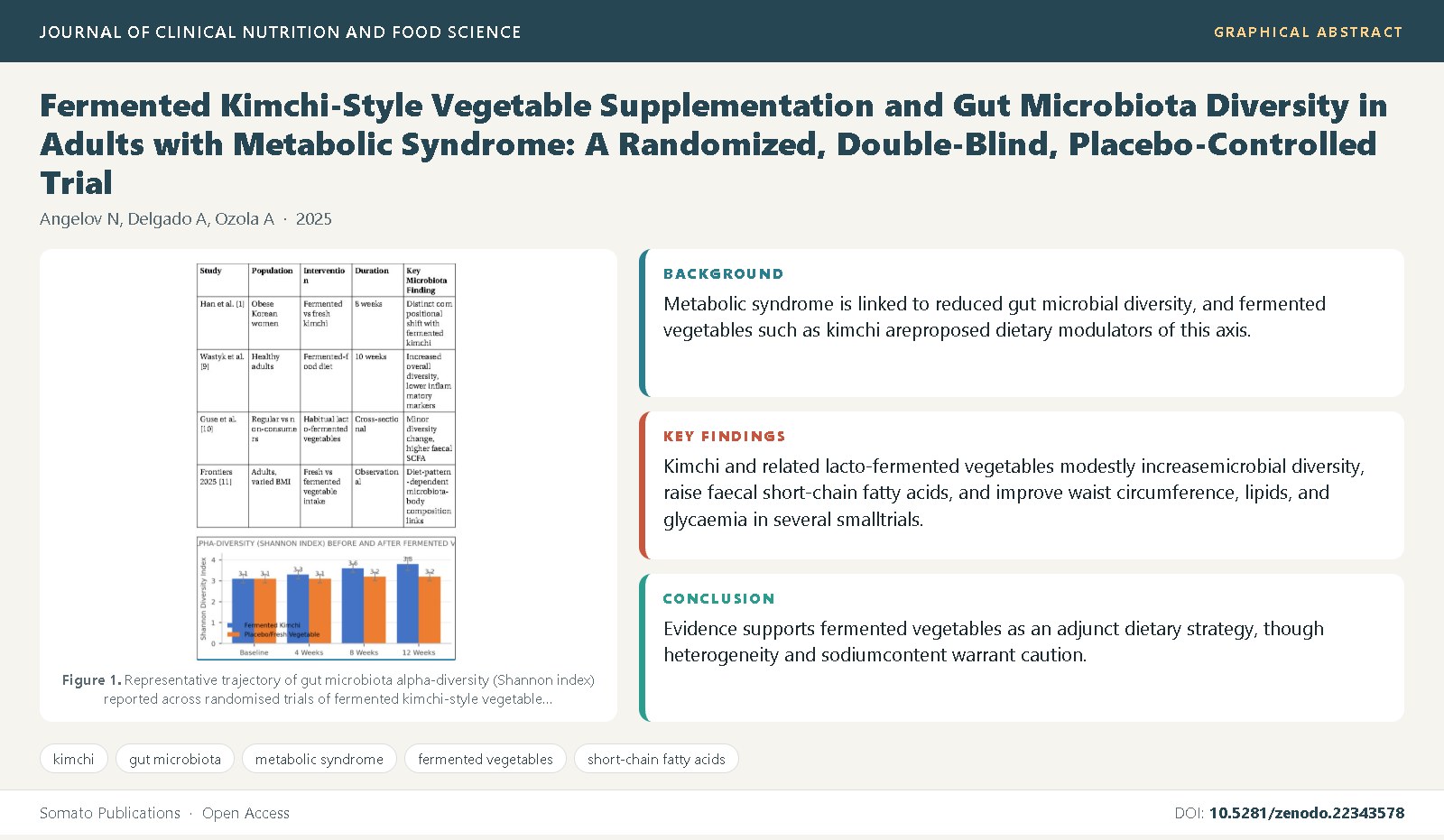
Background: Metabolic syndrome is linked to reduced gut microbial diversity, and fermented vegetables such as kimchi are
proposed dietary modulators of this axis. Objective: To synthesise published evidence on fermented kimchi-style vegetables, gut
microbiota diversity, and metabolic syndrome outcomes. Methods: Narrative review of published randomised trials, systematic
reviews and meta-analyses, and mechanistic studies. Findings: Kimchi and related lacto-fermented vegetables modestly increase
microbial diversity, raise faecal short-chain fatty acids, and improve waist circumference, lipids, and glycaemia in several small
trials. Conclusions: Evidence supports fermented vegetables as an adjunct dietary strategy, though heterogeneity and sodium
content warrant caution.
References
Han K, Bose S, Wang JH, Kim BS, Kim MJ, Kim EJ, Kim H. Contrasting effects of fresh and fermented kimchi consumption on gut microbiota composition and gene expression related to metabolic syndrome in obese Korean women. Mol Nutr Food Res. 2015;59(5):1004-1008. doi:10.1002/mnfr.201400780. PMID:25688926.
Alberti KGMM, Eckel RH, Grundy SM, Zimmet PZ, Cleeman JI, Donato KA, Fruchart JC, James WPT, Loria CM, Smith SC Jr. Harmonizing the metabolic syndrome: a joint interim statement of the International Diabetes Federation Task Force on Epidemiology and Prevention; National Heart, Lung, and Blood Institute; American Heart Association; World Heart Federation; International Atherosclerosis Society; and International Association for the Study of Obesity. Circulation. 2009;120(16):1640-1645. doi:10.1161/CIRCULATIONAHA.109.192644. PMID:19805654.
Magne F, Gotteland M, Gauthier L, Zazueta A, Pesoa S, Navarrete P, Balamurugan R. The Firmicutes/Bacteroidetes ratio: a relevant marker of gut dysbiosis in obese patients? Nutrients. 2020;12(5):1474. doi:10.3390/nu12051474. PMID:32438689.
Pinart M, Dötsch A, Schlicht K, Laudes M, Bouwman J, Forslund SK, Pischon T, Nimptsch K. Gut microbiome composition in obese and non-obese persons: a systematic review and meta-analysis. Nutrients. 2022;14(1):12. doi:10.3390/nu14010012. PMID:35010887.
Patra JK, Das G, Paramithiotis S, Shin HS. Kimchi and other widely consumed traditional fermented foods of Korea: a review. Front Microbiol. 2016;7:1493. doi:10.3389/fmicb.2016.01493. PMID:27733844.
Jung MJ, Lee J, Shin NR, Kim MS, Hyun DW, Yun JH, Kim PS, Whon TW, Bae JW. Multifunctional properties of Lactobacillus plantarum strains WiKim83 and WiKim87 as a starter culture for fermented food. Food Sci Nutr. 2019;7(6):2288-2295. doi:10.1002/fsn3.1075.
Park S, Kim S, Kim GH, Kim GB. Suitability analysis of 17 probiotic type strains of lactic acid bacteria as starter for kimchi fermentation. Foods. 2021;10(6):1435. doi:10.3390/foods10061435.
Marco ML, Sanders ME, Gänzle M, Arrieta MC, Cotter PD, De Vuyst L, Hill C, Holzapfel W, Lebeer S, Merenstein D, Reid G, Wolfe BE, Hutkins R. The International Scientific Association for Probiotics and Prebiotics (ISAPP) consensus statement on fermented foods. Nat Rev Gastroenterol Hepatol. 2021;18(3):196-208. doi:10.1038/s41575-020-00390-5. PMID:33398112.
Wastyk HC, Fragiadakis GK, Perelman D, Dahan D, Merrill BD, Yu FB, Topf M, Gonzalez CG, Van Treuren W, Han S, Robinson JL, Elias JE, Sonnenburg ED, Gardner CD, Sonnenburg JL. Gut-microbiota-targeted diets modulate human immune status. Cell. 2021;184(16):4137-4153.e14. doi:10.1016/j.cell.2021.06.019. PMID:34256014.
Guse K, Sharma A, Weyenberg E, Davison S, Ma Y, Choi Y, Johnson AJ, Chen C, Gomez A. Regular consumption of lacto-fermented vegetables has greater effects on the gut metabolome compared with the microbiome. Gut Microbiome. 2023;4:e11. doi:10.1017/gmb.2023.9. PMID:39295909.
Impact of fresh and fermented vegetable consumption on gut microbiota and body composition: insights from diverse data analysis approaches. Front Nutr. 2025;12:1623710. doi:10.3389/fnut.2025.1623710. PMID:40735240.
Kim EK, An SY, Lee MS, Kim MJ, Lee HK, Lee SO, Song KI, Lee KE, Lee HK. Fermented kimchi reduces body weight and improves metabolic parameters in overweight and obese patients. Nutr Res. 2011;31(6):436-443. doi:10.1016/j.nutres.2011.06.009. PMID:21745625.
Lee W, Kwon MS, Yun YR, Choi H, Jung MJ, Hwang H, Shin MJ, Park JH, Kim DR, Chang JY, Moon SY, Lee HJ, Kim TW, Whon TW, Hong SW. Effects of kimchi consumption on body fat and intestinal microbiota in overweight participants: a randomized, double-blind, placebo-controlled, single-center clinical trial. J Funct Foods. 2024;121:106401. doi:10.1016/j.jff.2024.106401.
Choi IH, Noh JS, Han JS, Kim HJ, Han ES, Song YO. Kimchi, a fermented vegetable, improves serum lipid profiles in healthy young adults: randomized clinical trial. J Med Food. 2013;16(3):223-229. doi:10.1089/jmf.2012.2563. PMID:23444963.
Park JA, Tirupathi Pichiah PB, Yu JJ, Oh SH, Daily JW, Cha YS. Clinical trials of kimchi intakes on the regulation of metabolic parameters and colon health in healthy Korean young adults. J Ethn Foods. 2018;5(2):85-91. doi:10.1016/j.jef.2018.02.007.
Zhang J, Wang Y, Shen L, Cai Q, Chen L, Kang M, Wang R, Zhao X. Immunomodulatory effects of kimchi in Chinese healthy college students: a randomized controlled trial. J Med Food. 2014;17(9):984-989. doi:10.1089/jmf.2013.3053. PMID:25136537.
Chan M, Larsen N, Baxter H, Jespersen L, Ekinci EI, Howell K. The impact of botanical fermented foods on metabolic syndrome and type 2 diabetes: a systematic review of randomised controlled trials. Nutr Res Rev. 2024;37(2):396-415. doi:10.1017/S0954422423000252. PMID:37881833.
Boulangé CL, Neves AL, Chilloux J, Nicholson JK, Dumas ME. Impact of the gut microbiota on inflammation, obesity, and metabolic disease. Genome Med. 2016;8:42. doi:10.1186/s13073-016-0303-2. PMID:27098727.
Rohr MW, Narasimhulu CA, Rudeski-Rohr TA, Parthasarathy S. Negative effects of a high-fat diet on intestinal permeability: a review. Adv Nutr. 2020;11(1):77-91. doi:10.1093/advances/nmz061. PMID:31268137.
Depommier C, Everard A, Druart C, Plovier H, Van Hul M, Vieira-Silva S, Falony G, Raes J, Maiter D, Delzenne NM, de Barsy M, Loumaye A, Hermans MP, Thissen JP, de Vos WM, Cani PD. Supplementation with Akkermansia muciniphila in overweight and obese human volunteers: a proof-of-concept exploratory study. Nat Med. 2019;25(7):1096-1103. doi:10.1038/s41591-019-0495-2. PMID:31263284.
Zhang T, Li Q, Cheng L, Buch H, Zhang F. Akkermansia muciniphila is a promising probiotic. Microb Biotechnol. 2019;12(6):1109-1125. doi:10.1111/1751-7915.13410. PMID:31006222.
LeBlanc JG, Milani C, de Giori GS, Sesma F, van Sinderen D, Ventura M. Bacteria as vitamin suppliers to their host: a gut microbiota perspective. Curr Opin Biotechnol. 2013;24(2):160-168. doi:10.1016/j.copbio.2012.08.005. PMID:22940212.
Fu J, Zheng Y, Gao Y, Xu W. Dietary fiber intake and gut microbiota in human health. Microorganisms. 2022;10(12):2507. doi:10.3390/microorganisms10122507. PMID:36557760.
Oliver A, Chase AB, Weihe C, Orchanian SB, Riedel SF, Hendrickson CL, Lay M, Sewall JM, Martiny JBH, Whiteson K. High-fiber, whole-food dietary intervention alters the human gut microbiome but not fecal short-chain fatty acids. mSystems. 2021;6(2):e00115-21. doi:10.1128/msystems.00115-21. PMID:33727392.
Sonnenburg ED, Sonnenburg JL. The ancestral and industrialized gut microbiota and implications for human health. Nat Rev Microbiol. 2019;17(6):383-390. doi:10.1038/s41579-019-0191-8. PMID:30894663.
Park JH, Jung JW. Consumption of kimchi, a salt fermented vegetable, is not associated with hypertension prevalence. J Ethn Foods. 2014;1(1):8-12. doi:10.1016/j.jef.2014.11.001.
Kim EK, An SY, Lee MS, Kim TH, Lee HK, Hwang WS, Choe SJ, Kim TY, Han SJ, Kim HJ, Kim DJ, Lee KW. Effects of kimchi supplementation on blood pressure and cardiac hypertrophy with varying sodium content in spontaneously hypertensive rats. Nutr Res Pract. 2012;6(4):315-320. doi:10.4162/nrp.2012.6.4.315. PMID:22977685.
Companys J, Pla-Pagà L, Calderón-Pérez L, Llauradó E, Solà R, Pedret A, Valls RM. Fermented dairy products, probiotic supplementation, and cardiometabolic diseases: a systematic review and meta-analysis. Adv Nutr. 2020;11(4):834-863. doi:10.1093/advances/nmaa030. PMID:32277831.





