
Mutational Landscape and Clinical Outcomes of BRAF-Altered Tumors in Patients with Metastatic Colorectal Cancer: A Review
DOI:
https://doi.org/10.5281/zenodo.22163707Keywords:
BRAF, Metastatic Colorectal Cancer, V600E, Encorafenib, Molecular SubtypesAbstract
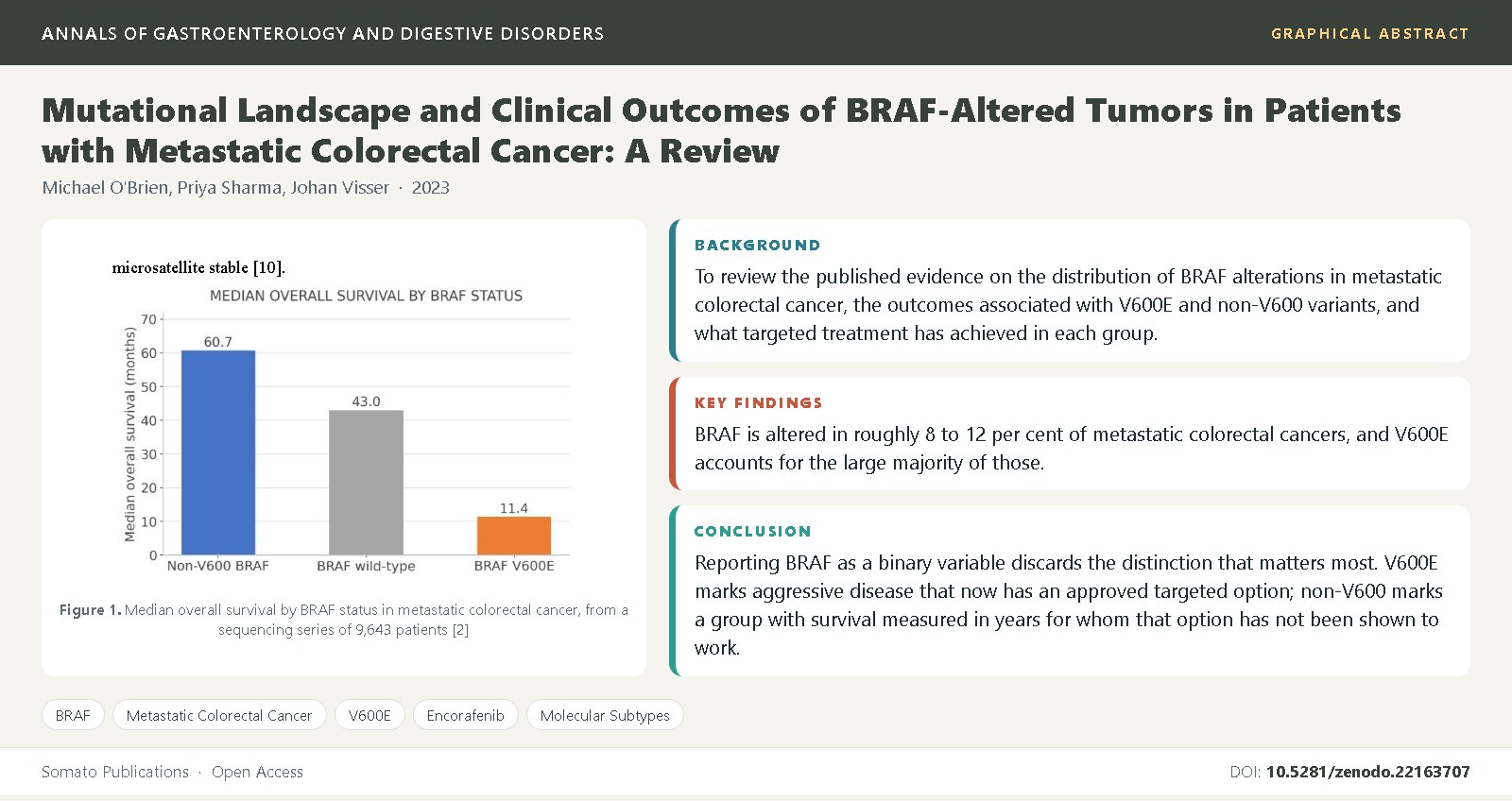
BRAF-altered colorectal cancer is routinely described as a single poor-prognosis group, and reported as mutated or wild-type on the pathology form. Neither is accurate. The alterations fall into classes with different biochemistry, and the survival difference between them is larger than the difference between BRAF-mutant and BRAF-wild-type disease. Objectives: To review the published evidence on the distribution of BRAF alterations in metastatic colorectal cancer, the outcomes associated with V600E and non-V600 variants, and what targeted treatment has achieved in each group. Material and Methods: Narrative review of randomised trials, trial biomarker analyses, sequencing cohorts and population-based series indexed in PubMed and the major oncology journals. Studies were eligible if they reported the prevalence or classification of BRAF alterations in colorectal cancer, outcomes stratified by BRAF variant, or the efficacy of BRAF-directed treatment. No new patient data were generated; every frequency, hazard ratio, response rate and survival estimate quoted is one published by the original investigators. Results: BRAF is altered in roughly 8 to 12 per cent of metastatic colorectal cancers, and V600E accounts for the large majority of those. Non-V600 variants occur in about 2.2 per cent of cases and behave as a separate disease: median overall survival was 60.7 months against 11.4 months for V600E and 43.0 months for BRAF wild-type (p < 0.001), with non-V600 status independently associated with better survival (HR 0.18). Mutations at codons 594 and 596 showed the same pattern, with median survival of 62.0 against 12.6 months (HR 0.36). In previously treated V600E disease, encorafenib with cetuximab and binimetinib produced an objective response rate of 27 per cent against 2 per cent for chemotherapy with cetuximab, and median overall survival of 9.0 against 5.4 months. In the first-line setting, adding encorafenib and cetuximab to chemotherapy raised objective response from 40.0 to 60.9 per cent. Conclusion: Reporting BRAF as a binary variable discards the distinction that matters most. V600E marks aggressive disease that now has an approved targeted option; non-V600 marks a group with survival measured in years for whom that option has not been shown to work. The two should be separated in reporting, in prognostic discussion and in trial eligibility. Abbreviations: mCRC – Metastatic Colorectal Cancer, EGFR – Epidermal Growth Factor Receptor, MAPK – Mitogen-Activated Protein Kinase, MSI – Microsatellite Instability, MSI-H – Microsatellite Instability-High, dMMR – Deficient Mismatch Repair, MSS – Microsatellite Stable, CIMP – CpG Island Methylator Phenotype, ctDNA – Circulating Tumour DNA, ORR – Objective Response Rate, OS – Overall Survival, PFS – Progression-Free Survival, HR – Hazard Ratio, ICI – Immune Checkpoint Inhibitor.
References
Davies H, Bignell GR, Cox C, et al. "Mutations of the BRAF gene in human cancer". Nature 417(2002):949-954.
Jones JC, Renfro LA, Al-Shamsi HO, Schrock AB, Rankin A, et al. "Non-V600 BRAF mutations define a clinically distinct molecular subtype of metastatic colorectal cancer". J Clin Oncol 35(2017):2624-2630.
Bond CE, Whitehall VLJ. "How the BRAF V600E mutation defines a distinct subgroup of colorectal cancer: molecular and clinical implications". (2018). doi: 10.1155/2018/9250757.
Van Cutsem E, Dekervel J. "Not all BRAF-mutant metastatic colorectal cancers are identical: distinct clinical consequences of non-V600 BRAF mutations". J Clin Oncol 35(2017):2598-2599.
Kopetz S, Grothey A, Yaeger R, et al. "Encorafenib, binimetinib, and cetuximab in BRAF V600E-mutated colorectal cancer". N Engl J Med 381(2019):1632-1643.
Kopetz S, Yoshino T, et al. "Encorafenib, cetuximab and chemotherapy in BRAF-mutant colorectal cancer: a randomized phase 3 trial". Nat Med (2025). doi: 10.1038/s41591-024-03443-3.
Chu JE, Johnson B, Kugathasan L, Morris VK, Raghav K, et al. "Population-based screening for BRAF V600E in metastatic colorectal cancer reveals increased prevalence and poor prognosis". Clin Cancer Res 26(2020).
Barras D, Missiaglia E, Wirapati P, et al. "BRAF V600E mutant colorectal cancer subtypes based on gene expression". Clin Cancer Res 23(2017):104-115.
Tran B, Kopetz S, Tie J, et al. "Impact of BRAF mutation and microsatellite instability on the pattern of metastatic spread and prognosis in metastatic colorectal cancer". Cancer 117(2011):4623-4632.
Cremolini C, Di Bartolomeo M, Amatu A, Antoniotti C, Moretto R, et al. "BRAF codons 594 and 596 mutations identify a new molecular subtype of metastatic colorectal cancer at favorable prognosis". Ann Oncol 26(2015):2092-2097.
Seligmann JF, Fisher D, Smith CG, et al. "Investigating the poor outcomes of BRAF-mutant advanced colorectal cancer: analysis from 2530 patients in randomised clinical trials". Ann Oncol 28(2017):562-568.
Shinozaki E, Yoshino T, Yamazaki K, Muro K, Yamaguchi K, et al. "Clinical significance of BRAF non-V600E mutations on the therapeutic effects of anti-EGFR monoclonal antibody treatment in patients with pretreated metastatic colorectal cancer: the BREAC study". Br J Cancer 117(2017):1450-1458.
De Roock W, Claes B, Bernasconi D, et al. "Effects of KRAS, BRAF, NRAS, and PIK3CA mutations on the efficacy of cetuximab plus chemotherapy in chemotherapy-refractory metastatic colorectal cancer: a retrospective consortium analysis". Lancet Oncol 11(2010):753-762.
Pietrantonio F, Petrelli F, Coinu A, et al. "Predictive role of BRAF mutations in patients with advanced colorectal cancer receiving cetuximab and panitumumab: a meta-analysis". Eur J Cancer 51(2015):587-594.
Kopetz S, Desai J, Chan E, Hecht JR, O’Dwyer PJ, et al. "Phase II pilot study of vemurafenib in patients with metastatic BRAF-mutated colorectal cancer". J Clin Oncol 33(2015):4032-4038.
Van Cutsem E, et al. "ANCHOR CRC: results from a single-arm, phase II study of encorafenib plus binimetinib and cetuximab in previously untreated BRAF V600E-mutant metastatic colorectal cancer". J Clin Oncol 41(2023):2628-2637.
Taieb J, Le Malicot K, Shi Q, et al. "Prognostic value of BRAF and KRAS mutations in MSI and MSS stage III colon cancer". J Natl Cancer Inst 109(2017):djw272.





