
Circulating microRNA Signatures as Non-Invasive Prognostic Biomarkers in Patients with Hepatocellular Carcinoma: A Review
DOI:
https://doi.org/10.5281/zenodo.22163681Keywords:
MicroRNA, Hepatocellular Carcinoma, Liquid Biopsy, Prognostic Biomarkers, Liver CirrhosisAbstract
Circulating microRNAs have been proposed as prognostic markers in hepatocellular carcinoma for well over a decade, and the case for them is easy to state: they are stable in serum, cheap to measure, and require only a blood draw. The case against is that almost every patient who develops hepatocellular carcinoma does so on a background of cirrhosis, and it is against that background, not against healthy controls, that any marker has to perform. Objectives: To review the published evidence on circulating microRNAs in hepatocellular carcinoma: how well single markers and multi-marker panels perform, how that performance changes with the comparator population, and how much of the prognostic literature rests on circulating rather than tissue measurement. Material and Methods: Narrative review of diagnostic accuracy studies, meta-analyses and prognostic cohorts indexed in PubMed and the major
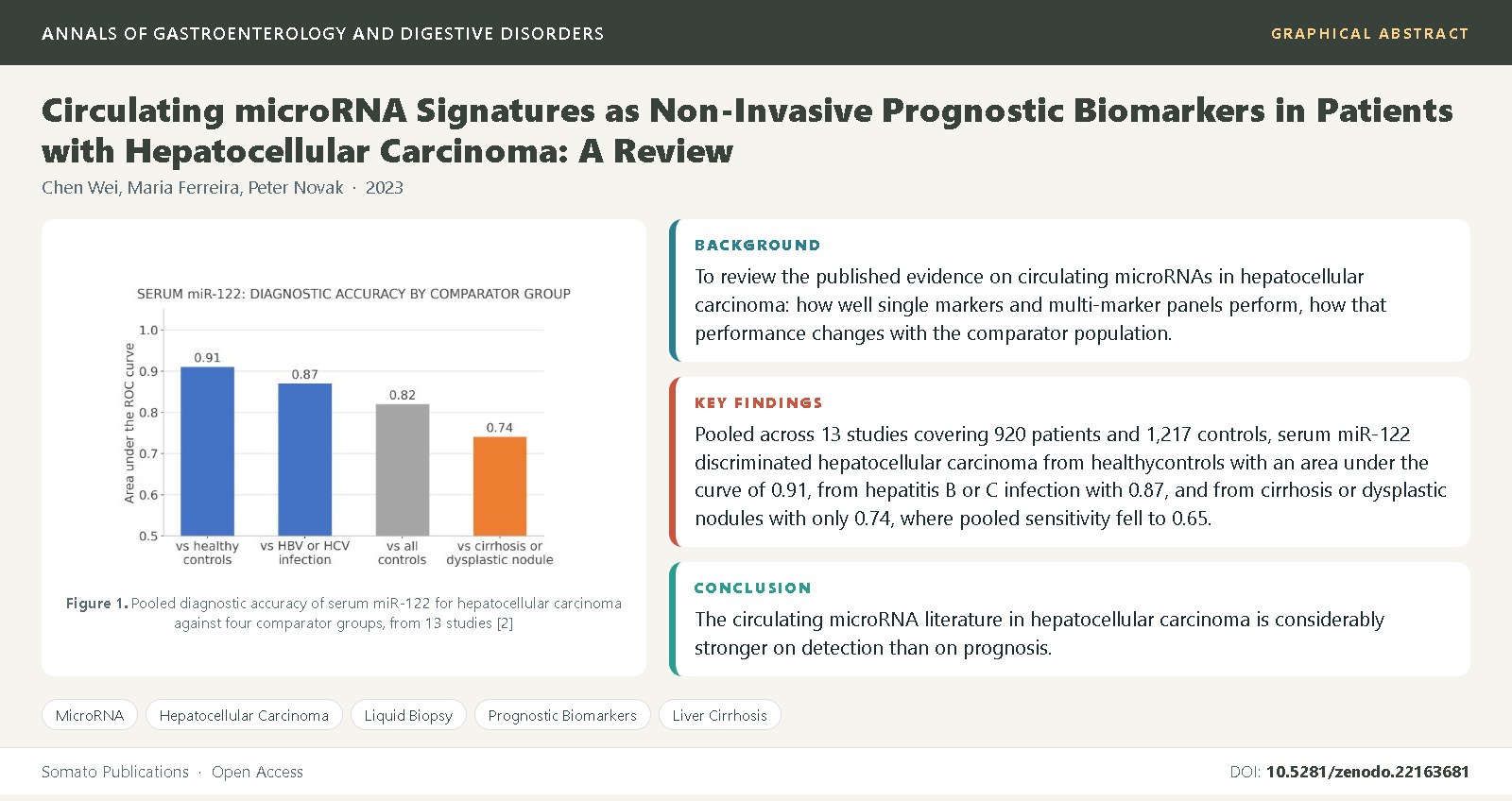
hepatology and oncology journals. Studies were eligible if they reported diagnostic performance of circulating microRNAs in hepatocellular carcinoma against a defined comparator, or outcomes stratified by circulating microRNA level. No new patient data were generated. Every accuracy estimate and effect size quoted is one published by the original investigators. Results: Pooled across 13 studies covering 920 patients and 1,217 controls, serum miR-122 discriminated hepatocellular carcinoma from healthy
controls with an area under the curve of 0.91, from hepatitis B or C infection with 0.87, and from cirrhosis or dysplastic nodules with only 0.74, where pooled sensitivity fell to 0.65. Multi-marker panels perform substantially better against the same difficult comparator: an eight-microRNA serum panel developed in 345 patients with hepatocellular carcinoma and 139 at-risk controls achieved an area under the curve of 0.99 with sensitivity of 97.7 per cent and specificity of 94.7 per cent, detecting 98 per cent of stage I cases. Prognostic evidence is thinner and less consistent, with individual cohorts reporting opposing directions of effect for the same microRNA. Conclusion: The circulating microRNA literature in hepatocellular carcinoma is considerably stronger on detection than on prognosis. Accuracy figures are only interpretable in relation to the comparator used, and the comparator that matters clinically is the cirrhotic surveillance population, against which single markers perform poorly and panels perform well. Prognostic claims rest largely on small single-centre cohorts with inconsistent findings, and should be treated as provisional. Abbreviations: HCC – Hepatocellular Carcinoma, miRNA – MicroRNA, AFP – Alpha-Fetoprotein, DCP – Des-Gamma Carboxyprothrombin, AUC – Area Under the Receiver Operating Characteristic Curve, ROC – Receiver Operating Characteristic, qRT-PCR – Quantitative Reverse Transcription Polymerase Chain Reaction, TACE – Transarterial Chemoembolization, OS – Overall Survival, PFS – Progression-Free Survival.
References
Yamamoto Y, Kondo S, Matsuzaki J, Esaki M, Okusaka T, et al. "Highly sensitive circulating microRNA panel for accurate detection of hepatocellular carcinoma in patients with liver disease". Hepatol Commun 4(2020):284-297.
Zhao XF, Li N, Lin DD, Sun LB. "Circulating microRNA-122 for the diagnosis of hepatocellular carcinoma: a meta-analysis". Biomed Res Int (2020):5353695.
Köberle V, Kronenberger B, Pleli T, Trojan J, Imelmann E, et al. "Serum microRNA-1 and microRNA-122 are prognostic markers in patients with hepatocellular carcinoma". Eur J Cancer 49(2013):3442-3449.
Xu Y, Bu X, Dai C, Shang C. "High serum microRNA-122 level is independently associated with higher overall survival rate in hepatocellular carcinoma patients". Tumour Biol 36(2015):4773-4776.
Kim SS, Nam JS, Cho HJ, Won JH, Kim JW, et al. "Plasma microRNA-122 as a predictive marker for treatment response following transarterial chemoembolization in patients with hepatocellular carcinoma". J Gastroenterol Hepatol 32(2017):199-207.
Ng KT, Lo CM, Wong N, Li CX, Qi X, et al. "Early-phase circulating miRNAs predict tumor recurrence and survival of hepatocellular carcinoma patients after liver transplantation". Oncotarget 7(2016):19824-19839.
Pelizzaro F, Cardin R, Sartori A, Imondi A, Penzo B, et al. "Circulating microRNA-21 and microRNA-122 as prognostic biomarkers in hepatocellular carcinoma patients treated with transarterial chemoembolization". Biomedicines 9(2021):890.
Zhang J, Chong CCN, Chen GG, Lai PBS. "A seven-microRNA expression signature predicts survival in hepatocellular carcinoma". PLoS One 10(2015):e0128628.
Zhuang C, Jiang W, Huang D, Xu L, Yang Q, et al. "Serum miR-21, miR-26a and miR-101 as potential biomarkers of hepatocellular carcinoma". Clin Res Hepatol Gastroenterol (2016).
Calin GA, Croce CM. "MicroRNA signatures in human cancers". Nat Rev Cancer 6(2006):857-866.
Oka H, Tamori A, Kuroki T, Kobayashi K, Yamamoto S. "Prospective study of alpha-fetoprotein in cirrhotic patients monitored for development of hepatocellular carcinoma". Hepatology 19(1994):61-66.
Marrero JA, Su GL, Wei W, Emick D, Conjeevaram HS, et al. "Des-gamma carboxyprothrombin can differentiate hepatocellular carcinoma from nonmalignant chronic liver disease in American patients". Hepatology 37(2003):1114-1121.
Seo SI, Kim HS, Kim WJ, Shin WG, Kim DJ, et al. "Diagnostic value of PIVKA-II and alpha-fetoprotein in hepatitis B virus-associated hepatocellular carcinoma". World J Gastroenterol 21(2015):3928-3935.
Urabe F, Matsuzaki J, Yamamoto Y, et al. "Large-scale circulating microRNA profiling for the liquid biopsy of prostate cancer". Clin Cancer Res 25(2019):3016-3025.
Yokoi A, Matsuzaki J, Yamamoto Y, et al. "Integrated extracellular microRNA profiling for ovarian cancer screening". Nat Commun 9(2018):4319.
Usuba W, Urabe F, Yamamoto Y, et al. "Circulating miRNA panels for specific and early detection in bladder cancer". Cancer Sci 110(2019):408-419.





