
Molecular Profiling and Prognostic Value of KRAS Gene Mutations in Tumor Samples and Liquid Biopsies from Patients with Pancreatic Ductal Adenocarcinoma
Keywords:
Pancreatic cancer, circulating tumor DNA, ctDNA, liquid biopsy, KRAS, genotyping, amplification-refractory mutation system, ARMS/HRMA, prognosisAbstract
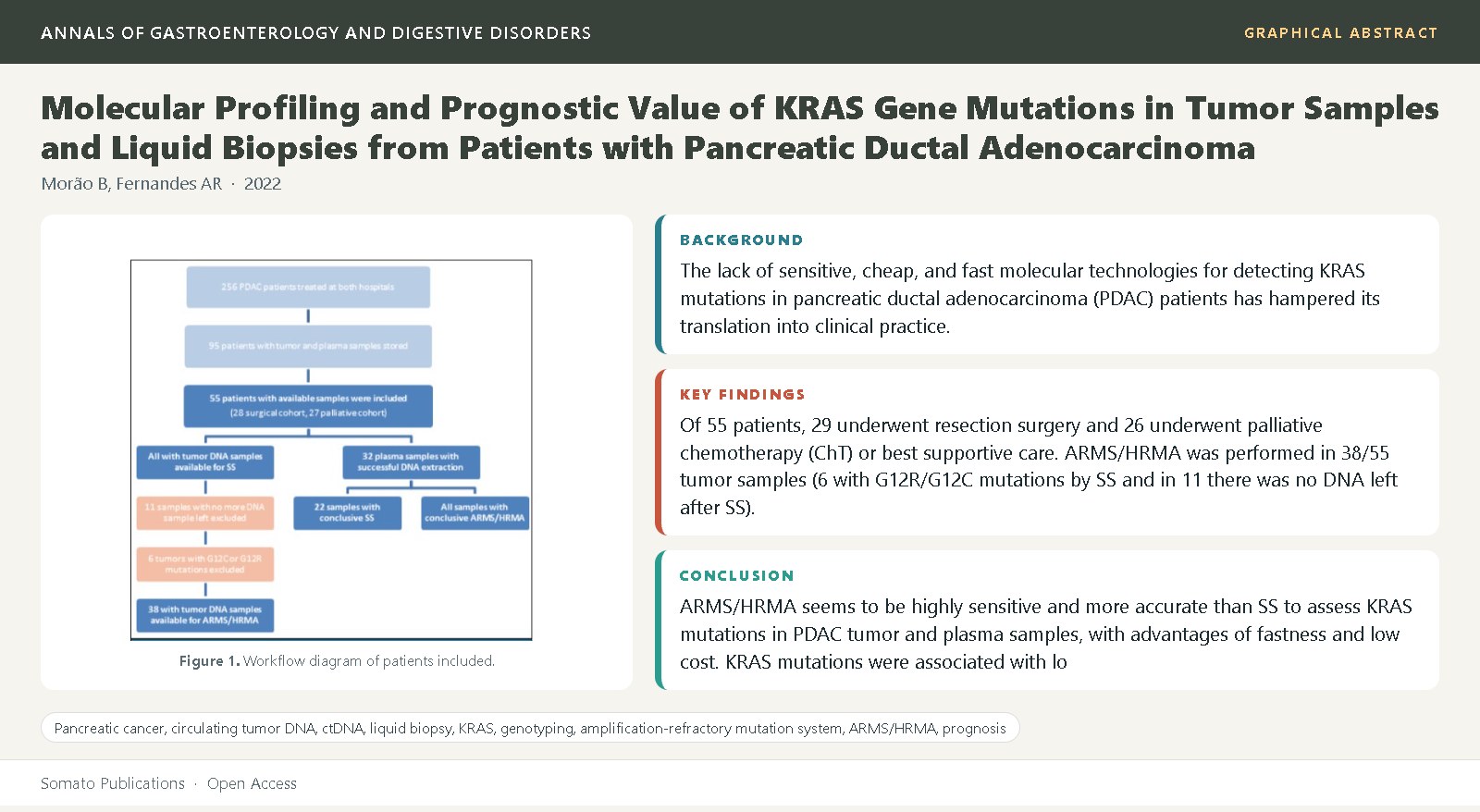
Introduction: The lack of sensitive, cheap, and fast molecular technologies for detecting KRAS mutations in pancreatic ductal adenocarcinoma (PDAC) patients has hampered its translation into clinical practice. We validated the fast single-step methodology based on amplification-refractory mutation system(ARMS) coupled with high resolution melting analysis(HRMA) to assess KRAS mutations and its prognostic value in PDAC patients. Methods: Prospective multicentric cohort study including PDAC patients with codon-12 KRAS mutational status determined by Sanger Sequencing (SS) on tumor and plasma samples collected at diagnosis. ARMS/HRMA was further applied to assess the two most frequent mutations (G12D/G12V). Primary endpoint was the frequency of KRAS mutations by both techniques and their concordance. Secondary endpoints were the association of KRAS mutations with progression free survival (PFS) and overall survival (OS). Results: Of 55 patients, 29 underwent resection surgery and 26 underwent palliative chemotherapy (ChT) or best supportive care. ARMS/HRMA was performed in 38/55 tumor samples (6 with G12R/G12C mutations by SS and in 11 there was no DNA left after SS). SS detected KRAS mutations in 23/38(60%) and ARMS/HRMA in 33/38(87%) tumor samples (G12D=18, G12V=12, G12V/G12D=3). DNA was successfully extracted in 32/55 plasma samples: SS genotyping was conclusive in 22/32(69%) and only detected a G12V mutation, while ARMS/HRMA was conclusive in all samples and detected mutations in 7 (G12V=3, G12D=3, G12V/G12D=1). Operated patients with KRAS-mutated tumors had lower PFS (5 vs 13 months, p<0.01) and OS (9 vs 14 months, p<0.01). ChT treated patients with KRAS-mutated ctDNA had lower PFS (1 vs 6 months, p=0.02) and lower OS (1 vs 8 months, p<0.01). Conclusions: ARMS/HRMA seems to be highly sensitive and more accurate than SS to assess KRAS mutations in PDAC tumor and plasma samples, with advantages of fastness and low cost. KRAS mutations were associated with lo
References
GBD 2017 (2019) Pancreatic Cancer Collaborators. The global, regional, and national burden of pancreatic cancer and its attributable risk factors in 195 countries and territories, 1990-2017: a systematic analysis for the Global Burden of Disease Study 2017. lancet Gastroenterol Hepatol, 4(12): 934-947.
Rahib, L., Smith, BD., Aizenberg, R., Rosenzweig, AB., Fleshman, JM., et al. (2014) Projecting Cancer Incidence and Deaths to 2030: The Unexpected Burden of Thyroid, Liver, and Pancreas Cancers in the United States. Cancer Res, 74(11): 2913-2921.
Rawla, P., Sunkara, T., Gaduputi, V. (2019) Epidemiology of Pancreatic Cancer: Global Trends, Etiology and Risk Factors. World J Oncol, 10(1): 10-27.
Khomiak, A., Brunner, M., Kordes, M., Lindblad, S., Miksch, RC., et al. (2020) Recent Discoveries of Diagnostic, Prognostic and Predictive Biomarkers for Pancreatic Cancer. Cancers (Basel), 12(11): 3234.
Giri, B., Sethi, V., Dudeja, V., Banerjee, S., Livingstone, A., et al. (2017) Genetics of pancreatic cyst-cancer progression. Curr Opin Gastroenterol, 33(5): 404-410.
Buscail, L., Bournet, B., Cordelier, P. (2020) Role of oncogenic KRAS in the diagnosis, prognosis and treatment of pancreatic cancer. Nat Rev Gastroenterol Hepatol, 17(3): 153-168.
Fan, Z., Fan, K., Yang, C., Huang, Q., Gong, Y., et al. (2018) Critical role of KRAS mutation in pancreatic ductal adenocarcinoma. Transl Cancer Res, 7(6): 1728-1736.
Huang, L., Guo, Z., Wang, F., Fu, L. (2021) KRAS mutation: from undruggable to druggable in cancer. Sig Transduct Target Ther, 6(1): 386.
Liberko, M., Kolostova, K., Szabo, A., Gurlich, R., Oliverius, M., et al. (2021) Circulating Tumor Cells, Circulating Tumor DNA and Other Blood-based Prognostic Scores in Pancreatic Ductal Adenocarcinoma – Mini-Review. In Vivo (Brooklyn), 35(1): 31-39.
Bournet, B., Muscari, F., Buscail, C., Assenat, E., Barthet, M., et al. (2016) KRAS G12D Mutation Subtype Is A Prognostic Factor for Advanced Pancreatic Adenocarcinoma. Clin Transl Gastroenterol, 7(3): E157.
Safi, S-A., Haeberle, L., Goering, W., Keitel, V., Fluegen, G., et al. (2022) Genetic Alterations Predict Long-Term Survival in Ductal Adenocarcinoma of the Pancreatic Head. Cancers (Basel), 14(3): 850.
Reddy, AV., Hill, CS., Sehgal, S., Ding, D., Hacker-Prietz, A., et al. (2021) Impact of somatic mutations on clinical and pathologic outcomes in borderline resectable and locally advanced pancreatic cancer treated with neoadjuvant chemotherapy and stereotactic body radiotherapy followed by surgical resection. Radiat Oncol J, 39(4): 304- 314.
Ako, S., Nouso, K., Kinugasa, H., Dohi, C., Matushita, H., et al. (2017) Utility of serum DNA as a marker for KRAS mutations in pancreatic cancer tissue. Pancreatology, 17(2): 285-290.
Cheng, H., Liu, C., Jiang, J., Luo, G., Lu, Y., et al. (2017) Analysis of ctDNA to predict prognosis and monitor treatment responses in metastatic pancreatic cancer patients. Int J Cancer, 140(10): 2344-2350.
Hadano, N., Murakami, Y., Uemura, K., Hashimoto, Y., Kondo. N., et al. (2016) Prognostic value of circulating tumour DNA in patients undergoing curative resection for pancreatic cancer. Br J Cancer, 115: 59-65.
Pietrasz, D., Pécuchet, N., Garlan, F., Didelot, A., Dubreuil, O., et al. (2017) Plasma Circulating Tumor DNA in Pancreatic Cancer Patients Is a Prognostic Marker. Clin cancer Res, 23(1): 116-123.
Watanabe, F., Suzuki, K., Tamaki, S., Abe, I., Endo, Y., et al. (2019) Longitudinal monitoring of KRAS-mutated circulating tumor DNA enables the prediction of prognosis and therapeutic responses in patients with pancreatic cancer. PLoS One, 14(12): e0227366.
Earl, J., Barreto, E., Castillo, ME., Fuentes, R., Rodrí- guez-Garrote, M., et al. (2021) Somatic Mutation Profiling in the Liquid Biopsy and Clinical Analysis of Hereditary and Familial Pancreatic Cancer Cases Reveals KRAS Negativity and a Longer Overall Survival. Cancers (Basel), 13(7): 1612.
Strickler, JH., Satake, H., Hollebecque, A., Sunakawa, Y., Tomasini, P., et al. (2022) First data for sotorasib in patients with pancreatic cancer with KRAS p.G12C mutation: A phase I/II study evaluating efficacy and safety. J Clin Oncol, 40(36): 360490-360490.
Sivapalan, L., Kocher, HM., Ross-Adams, H., Chelala, C. (2021) Molecular profiling of ctDNA in pancreatic cancer: Opportunities and challenges for clinical application. Pancreatology, 21(2): 363-378.
Bunduc, S., Gede, N., Váncsa, S., Lillik, V., Kiss, S., et al. (2021) Prognostic role of cell-free DNA biomarkers in pancreatic adenocarcinoma: A systematic review and meta-analysis. Crit Rev Oncol Hematol, 169.
Shackelford, RE., Whitling, NA., McNab, P., Japa, S., Coppola, D. (2012) KRAS Testing: A Tool for the Implementation of Personalized Medicine. Genes Cancer, 3(7-8): 459-466.
Reed, GH., Kent, JO., Wittwer, CT. (2007) High-resolution DNA melting analysis for simple and efficient molecular diagnostics. Pharmacogenomics, 8(6): 597-608.
Santos, S., Marques, V., Pires, M., Silveira, L., Oliveira, H., et al. (2012) High resolution melting: improvements in the genetic diagnosis of hypertrophic cardiomyopathy in a Portuguese cohort. BMC Med Genet, 13: 17.
Grunvald, MW., Jacobson, RA., Kuzel, TM., Pappas, SG., Masood, A. (2020) Current Status of Circulating Tumor DNA Liquid Biopsy in Pancreatic Cancer. Int J Mol Sci, 21(20): 7651.
Fang, Z., Meng, Q., Zhang, B., Shi, S., Liu, J., et al. (2021) Prognostic value of circulating tumor DNA in pancreatic cancer: a systematic review and meta-analysis. Aging (Albany NY), 13(2): 2031-2048.
Qi, Z-H., Xu, H-X., Zhang, S-R., Xu, JZ., Li, S., et al. (2018) The Significance of Liquid Biopsy in Pancreatic Cancer. J Cancer, 9(18): 3417-3426.
Guo, S., Shi, X., Shen, J., Gao, S., Wang, H., et al. (2020) Preoperative detection of KRAS G12D mutation in ctDNA is a powerful predictor for early recurrence of resectable PDAC patients. Br J Cancer, 122(6): 857-867.
Kruger, S., Heinemann, V., Ross, C., Diehl, F., Nagel, D., et al. (2018) Repeated mutKRAS ctDNA measurements represent a novel and promising tool for early response prediction and therapy monitoring in advanced pancreatic cancer. Ann Oncol Off J Eur Soc Med Oncol, 29(12): 2348-2355.
Lee, B., Lipton, L., Cohen, J., Tie, J., Javed, AA., et al. (2019) Circulating tumor DNA as a potential marker of adjuvant chemotherapy benefit following surgery for localized pancreatic cancer. Ann Oncol, 30(9): 1472-1478.
Bernard, V., Kim, DU., Anthony, F., Castillo, J., Allenson, K., et al. (2019) Circulating Nucleic Acids Are Associated With Outcomes of Patients With Pancreatic Cancer. Gastroenterology, 156(1): 108-118.e4
Patel, H., Okamura, R., Fanta, P., Patel, C., Lanman, RB., et al. (2019) Clinical correlates of blood-derived circulating tumor DNA in pancreatic cancer. J Hematol Oncol. 12(1): 1-12.





