
Diagnostic and Prognostic Significance of Microsatellite Instability in Endoscopic Biopsies from Patients with Gastric Adenocarcinoma: A Review
DOI:
https://doi.org/10.5281/zenodo.22163660Keywords:
Microsatellite Instability, Gastric Adenocarcinoma, Endoscopic Biopsy, Mismatch Repair, ImmunotherapyAbstract
Microsatellite instability decides treatment in gastric adenocarcinoma well before a stomach is removed. Chemotherapy is chosen, or withheld, on thestrength of a few millimetres of tissue taken at endoscopy, which makes the reliability of that small sample a clinical question rather than a laboratory one. Objectives: To review what published evidence shows about the accuracy of MSI and mismatch repair testing on endoscopic biopsies against the resection specimen, the prevalence of MSI-high disease across clinical settings, and the prognostic and predictive weight the result carries once obtained. Material and Methods: Narrative review of matched-sample diagnostic studies, randomised trial analyses and prospective cohorts indexed in PubMed and the major oncology journals. Studies were eligible if they reported paired biopsy and surgical MSI or MMR results, MSI-high prevalence in a defined gastric or gastroesophageal population, or outcomes stratified by MSI status. No new patient data were generated. All frequencies, hazard ratios and response rates quoted are those published by the original investigators. Results: In paired samples, endoscopic biopsy performed well against the resection specimen, with concordance of 96.2 per cent by PCR and 97.8 per cent by immunohistochemistry, and specificity of 98 per cent for both. Sensitivity was lower, at 85 and 86 per cent. Biopsy material was more often uninformative by IHC than by PCR. In a cohort restricted to MSI-high cases, discrepancy between biopsy and resection reached 19.7 per cent, consistent
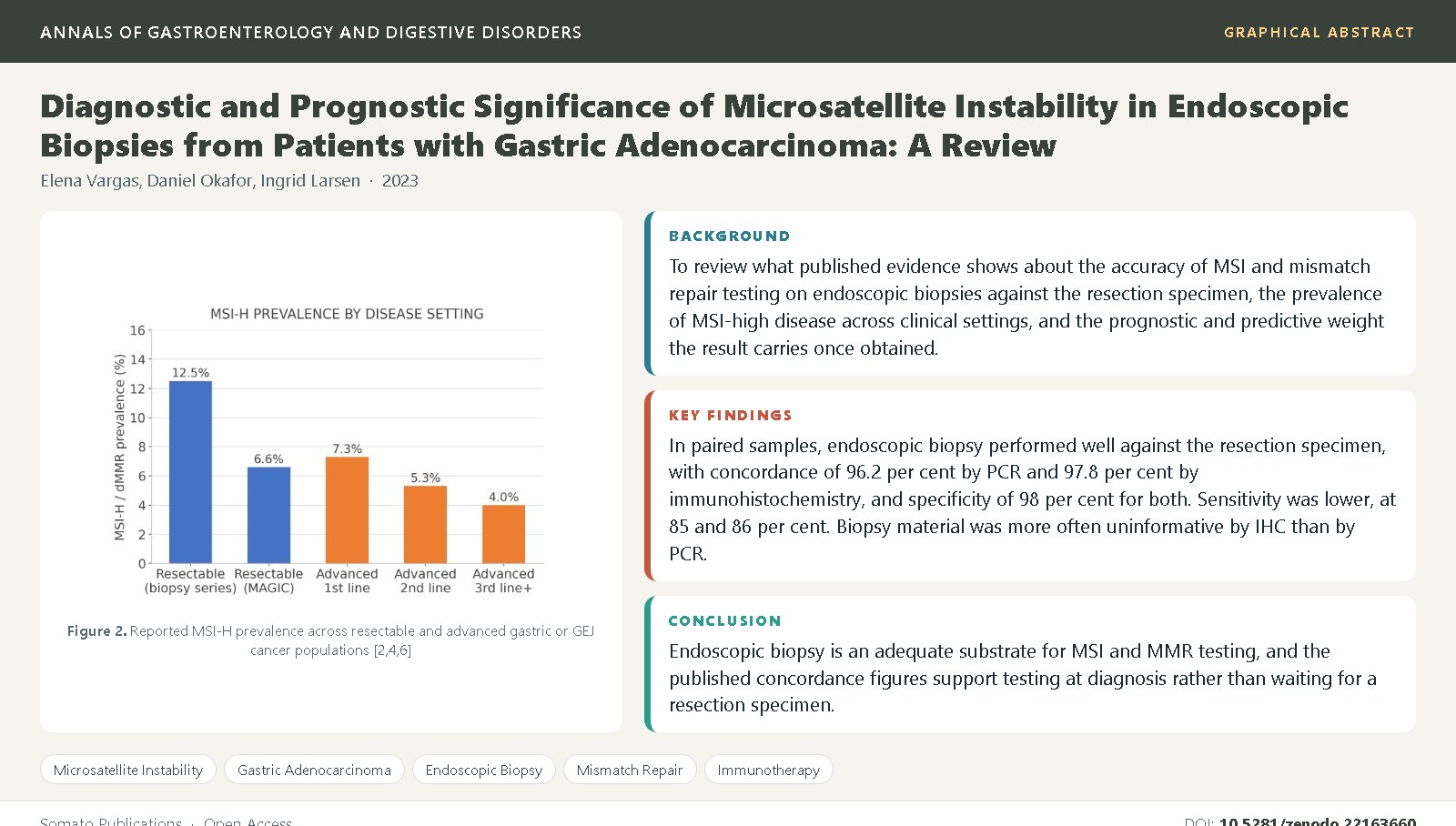
with clonal heterogeneity of mismatch repair loss. Prevalence falls as disease advances, from around 12 per cent in resectable series to 4.0 per cent in third-line trial populations. In the MAGIC trial, MSI-high or dMMR status was associated with better survival after surgery alone (HR 0.42) and worse survival when chemotherapy was added (HR 2.18, 95% CI 1.08-4.42), with median overall survival of 9.6 against 19.5 months in the chemotherapy arm. Response to pembrolizumab in MSI-high advanced disease reached 57.1 per cent in third line and above. Conclusion: Endoscopic biopsy is an adequate substrate for MSI and MMR testing, and the published concordance figures support testing at diagnosis rather than waiting for a resection specimen. The qualification is that errors are asymmetric: a positive biopsy result is close to definitive, while a negative one carries a real false-negative rate driven by sampling. Because a positive result may argue against chemotherapy and in favour of immunotherapy, that asymmetry has direct consequences for treatment.
Abbreviations: MSI – Microsatellite Instability, MSI-H – Microsatellite Instability-High, MSS – Microsatellite Stable, MMR – Mismatch Repair, dMMR – Deficient Mismatch Repair, pMMR – Proficient Mismatch Repair, IHC – Immunohistochemistry, PCR – Polymerase Chain Reaction, GEJ – Gastroesophageal Junction, ORR – Objective Response Rate, OS – Overall Survival, HR – Hazard Ratio.
References
Cunningham D, Allum WH, Stenning SP, et al. "Perioperative chemotherapy versus surgery alone for resectable gastroesophageal cancer". N Engl J Med 355(2006):11-20.
Smyth EC, Wotherspoon A, Peckitt C, et al. "Mismatch repair deficiency, microsatellite instability, and survival: an exploratory analysis of the Medical Research Council Adjuvant Gastric Infusional Chemotherapy (MAGIC) trial". JAMA Oncol 3(2017):1197-1203.
Choi YY, Kim H, Shin SJ, et al. "Microsatellite instability and programmed cell death-ligand 1 expression in stage II/III gastric cancer: post hoc analysis of the CLASSIC randomized controlled study". Ann Surg 270(2019):309-316.
Asesio N, Mhamdi Aloui N, Bonnereau J, Lehmann-Che J, Bouhidel F, et al. "Assessment of the reliability of MSI status and dMMR proteins deficiency screening on endoscopic biopsy material in esophagus and gastric adenocarcinoma". Dig Liver Dis 55(2023):1105-1113.
Fornaro L, Lonardi S, Catanese S, Nappo F, Pietrantonio F, et al. "Concordance of microsatellite instability and mismatch repair status in paired biopsies and surgical specimens of resectable gastroesophageal adenocarcinoma: time for a call to action". Gastric Cancer 26(2023):958-968.
Chao J, Fuchs CS, Shitara K, et al. "Assessment of pembrolizumab therapy for the treatment of microsatellite instability-high gastric or gastroesophageal junction cancer among patients in the KEYNOTE-059, KEYNOTE-061, and KEYNOTE-062 clinical trials". JAMA Oncol 7(2021):895-902.
Shitara K, Van Cutsem E, Bang YJ, et al. "Efficacy and safety of pembrolizumab or pembrolizumab plus chemotherapy vs chemotherapy alone for patients with first-line, advanced gastric cancer: the KEYNOTE-062 phase 3 randomized clinical trial". JAMA Oncol 6(2020):1571-1580.
Raimondi A, Lonardi S, Murgioni S, et al. "Tremelimumab and durvalumab as neoadjuvant or non-operative management strategy of patients with microsatellite instability-high resectable gastric or gastroesophageal junction adenocarcinoma: the INFINITY study by GONO". Ann Oncol 36(2025):285-296.
Fuchs CS, Doi T, Jang RW, et al. "KEYNOTE-059 cohort 1: efficacy and safety of pembrolizumab monotherapy in patients with previously treated advanced gastric cancer". J Clin Oncol 35(2017): abstract 4003.
Choi YY, Kim H, Yang HK, et al. "Clinical impact of microsatellite instability in patients with stage II and III gastric cancer: results from the CLASSIC trial". J Clin Oncol 35(2017): abstract 4022.
Smyth EC, Wotherspoon A, Peckitt C, Nankivell MG, Eltahir Z, et al. "Correlation between mismatch repair deficiency (MMRd), microsatellite instability (MSI) and survival in MAGIC". J Clin Oncol 34(2016): abstract 4064.





