
Comparative Analysis of TP53 Mutation Burden in Tissue Biopsies and Circulating Tumor DNA from Patients with Colorectal Carcinoma: A Review
DOI:
https://doi.org/10.5281/zenodo.22163629Keywords:
TP53, Colorectal Carcinoma, Liquid Biopsy, Circulating Tumour DNA, Molecular Residual DiseaseAbstract
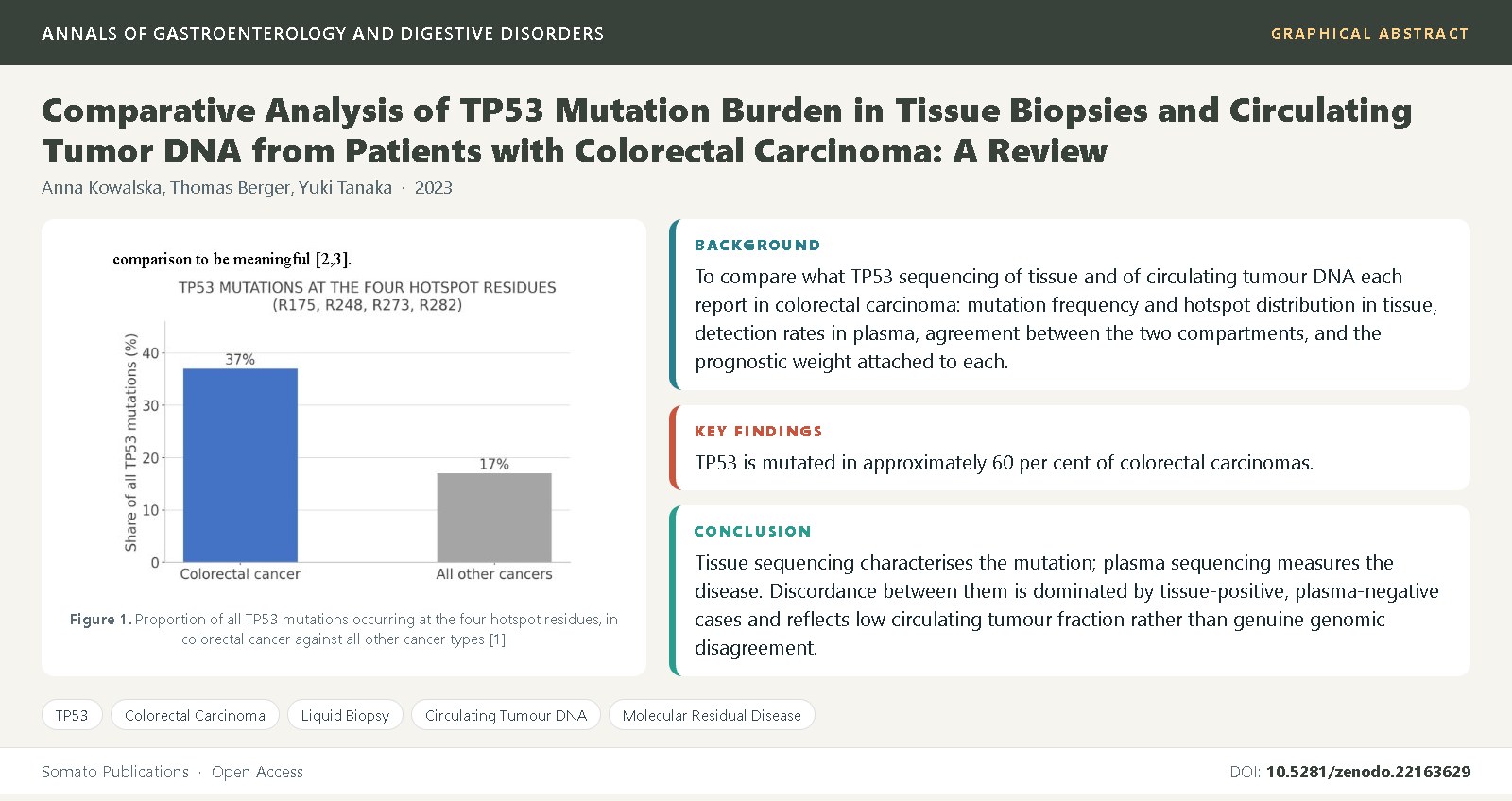
TP53 is the most frequently altered gene in colorectal carcinoma, and it can be read from a resected tumour, from an endoscopic biopsy, or from plasma. The word burden means something different in each. In tissue it refers to which residues are hit and how often; in plasma it refers to how much mutant DNA is circulating, which is a property of the disease rather than of the gene.
Objectives: To compare what TP53 sequencing of tissue and of circulating tumour DNA each report in colorectal carcinoma: mutation frequency and hotspot distribution in tissue, detection rates in plasma, agreement between the two compartments, and the prognostic weight attached to each. Material and Methods: Narrative review of primary cohort studies, prospective observational series and meta-analyses indexed in PubMed and the major oncology journals. Studies were eligible if they reported TP53 mutation frequency or residue distribution in colorectal tissue, detection of TP53 or ctDNA in plasma, matched tissue-plasma concordance, or outcomes stratified by mutation or ctDNA status. No new patient data were generated. Every frequency, hazard ratio and survival estimate quoted is one published by the original investigators, and the figures and tables reproduce reported values only. Results: TP53 is mutated in approximately 60 per cent of colorectal carcinomas. The disease is unusual in how tightly its mutations cluster: the four
hotspot residues R175, R248, R273 and R282 account for about 37 per cent of all TP53 mutations in colorectal cancer against 17 per cent across all other cancers, and tumours carrying R273 progress to metastasis more often and survive less well than those carrying R175. In 433 patients tested in both compartments, TP53 was found in 59.6 per cent overall, in tissue in 49.7 per cent, in ctDNA in 36.7 per cent and in both in 27.8 per cent, giving an overall concordance of 67.2 per cent and a positive concordance of 45.0 per cent that rose with circulating tumour fraction. Detectable ctDNA after surgery carried hazard ratios for recurrence of 10.98 immediately post-operatively and 32.02 during surveillance, and in 2,240 patients followed prospectively, positivity in the residual-disease window gave hazard ratios of 11.99 for disease-free and 9.68 for overall survival. Conclusion: Tissue sequencing characterises the mutation; plasma sequencing measures the disease. Discordance between them is dominated by tissue-positive, plasma-negative cases and reflects low circulating tumour fraction rather than genuine genomic disagreement. The prognostic signal from plasma is the larger of the two, but it is a signal about residual tumour rather than about TP53 itself, and the two readouts should be reported separately. Abbreviations: CRC – Colorectal Carcinoma, ctDNA – Circulating Tumour DNA, cfDNA – Cell-Free DNA, MRD – Molecular Residual Disease, NGS –
Next-Generation Sequencing, ddPCR – Droplet Digital Polymerase Chain Reaction, DFS – Disease-Free Survival, OS – Overall Survival, HR – Hazard Ratio, GOF – Gain of Function, ACT – Adjuvant Chemotherapy.
References
Hassin O, Nataraj NB, Shreberk-Shaked M, Aylon Y, Yaeger R, et al. "Different hotspot p53 mutants exert distinct phenotypes and predict outcome of colorectal cancer patients". Nat Commun 13(2022):2800.
Nakayama M, Oshima M. "Mutant p53 in colon cancer". J Mol Cell Biol 11(2019):267-276.
Sabapathy K, Lane DP. "Therapeutic targeting of p53: all mutants are equal, but some mutants are more equal than others". Nat Rev Clin Oncol 15(2018):13-30.
Kandoth C, et al. "Mutational landscape and significance across 12 major cancer types". Nature 502(2013):333-339.
Bieg-Bourne CC, Okamura R, Kurzrock R. "Concordance between TP53 alterations in blood and tissue: impact of time interval, biopsy site, cancer type and circulating tumor DNA burden". Mol Oncol (2020). doi: 10.1002/1878-0261.12672.
Bettegowda C, Sausen M, Leary RJ, et al. "Detection of circulating tumor DNA in early- and late-stage human malignancies". Sci Transl Med 6(2014):224ra24.
Molleví DG, Serrano T, Ginestà MM, Valls J, Torras J, et al. "Mutations in TP53 are a prognostic factor in colorectal hepatic metastases undergoing surgical resection". Carcinogenesis 28(2007):1241-1246.
Chen G, Peng J, Xiao Q, Wu HX, Wu X, et al. "Postoperative circulating tumor DNA as markers of recurrence risk in stages II to III colorectal cancer". J Hematol Oncol 14(2021). doi: 10.1186/s13045-021-01089-z.
Nakamura Y, Watanabe J, Akazawa N, Hirata K, Kataoka K, et al. "ctDNA-based molecular residual disease and survival in resectable colorectal cancer". Nat Med 30(2024):3272-3283.
Zheng J, Qin C, Wang Q, Tian D, Chen Z. "Circulating tumour DNA-based molecular residual disease detection in resectable cancers: a systematic review and meta-analysis". eBioMedicine (2024):105109.
Huang K, Qu H, Zhang X, Huang T, Sun X, et al. "Circulating tumor DNA sequencing for colorectal cancers: a comparative analysis of colon cancer and rectal cancer data". Cancer Biomark 26(2019):313-322.
Freed-Pastor WA, Prives C. "Mutant p53: one name, many proteins". Genes Dev 26(2012):1268-1286.
Rivlin N, Brosh R, Oren M, Rotter V. "Mutations in the p53 tumor suppressor gene: important milestones at the various steps of tumorigenesis". Genes Cancer 2(2011):466-474.
Halevy O, Michalovitz D, Oren M. "Different tumor-derived p53 mutants exhibit distinct biological activities". Science 250(1990):113-116.
Goldstein I, et al. "Understanding wild-type and mutant p53 activities in human cancer: new landmarks on the way to targeted therapies". Cancer Gene Ther 18(2011):2-11.
Turrell FK, et al. "Lung tumors with distinct p53 mutations respond similarly to p53 targeted therapy but exhibit genotype-specific statin sensitivity". Genes Dev 31(2017):1339-1353.
Wang C, Sandhu J, Tsao A, Fakih M. "Presence of concurrent TP53 mutations is necessary to predict poor outcomes within the SMAD4 mutated subgroup of metastatic colorectal cancer". Cancers 14(2022):3644.





