
Screening for Novel Probiotic Candidate: Survival, Antimicrobial, and Aggregation Properties of Lactobacillus Strains from Moroccan Dairy Product
Keywords:
Dairy products, Rep-PCR, Probiotics,, Stress conditions, Proteolytic activity, Lipolytic activityAbstract
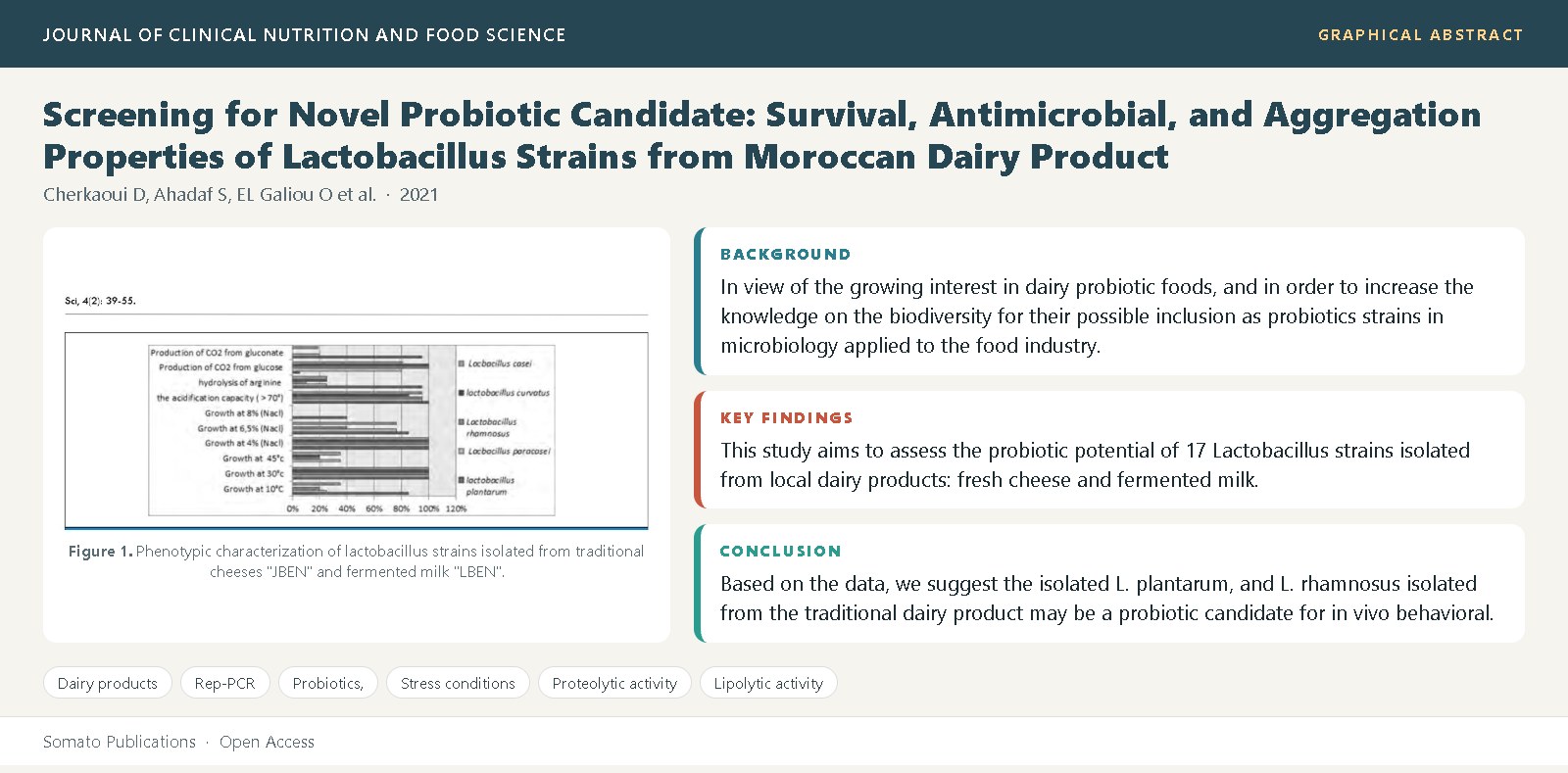
In view of the growing interest in dairy probiotic foods, and in order to increase the knowledge on the biodiversity for their
possible inclusion as probiotics strains in microbiology applied to the food industry. This study aims to assess the probiotic
potential of 17 Lactobacillus strains isolated from local dairy products: fresh cheese and fermented milk. First PCR amplification
of repetitive bacterial DNA fingerprints (rep-PCR) using the ERIC primers allowed the Lactobacillus strains to be grouped into
the species: L. plantarum, L. casei, L. paracasei, L. curvatus, and L. rhamnosus and showed a considerable degree of genomic
diversity. We evaluated Lactobacillus strains for sustained cell viability under different conditions similar to the environment
of the intestinal tract. We also assessed aggregation properties and antimicrobial activity. The results of the in vitro assessment
demonstrated that lactobacillus strains did not show the presence of any genes encoding virulence factors, also L. plantarum,
and L. rhamnosus remained functionally active under these experimental conditions, with an excellent survival capacity strain
under low pH and high bile salt concentration, a good antimicrobial activity and a good capacity to auto-aggregate with each other’s, and co-aggregate with pathogenic bacteria. Based on the data, we suggest the isolated L. plantarum, and L. rhamnosus
isolated from the traditional dairy product may be a probiotic candidate for in vivo behavioral.
References
Srairi, MT., Hasni Alaoui, I., Hamama, A. Faye, B. (2005) Relations entre pratiques d’élevage et qualité globale du lait de vache en étables suburbaines au Maroc. Revue Méd Vét 156(3): 155–162.
Benkerroum, N., Tamime, AY. (2004) Technology transfer of some Moroccan traditional dairy products (lben, jben and smen) to small industrial scale. Food Microbiology 21(4): 399–413.
Zamfir, M., Vancanneyt, M., Makras, L., Vaningelgem, F., Lefebvre, K., Pot, B., et al. (2006) Biodiversity of lactic acid bacteria in Romanian dairy products. Syst Appl Microbiol, 29(6): 487–495.
Turpin, W., Humblot, C., Tomas, M., Guyot, JP. (2010) Lactobacilli as multifaceted probiotics with poorly disclosed molecular mechanisms. Int J Food Microbiol, 143(3): 87-102.
Jara, J., Pérez-Ramos, A., Del Solar, G., Rodríguez, JM., Fernández, L., Orgaz, B. (2020). Role of Lactobacillus biofilms in Listeria monocytogenes adhesion to glass surfaces. International Journal of Food Microbiology, 334, 108804.
Madera, C., García, P., Jansen, T., Rodríguez, A., Suárez, JE. (2003) Characterization of technologically proficient wild Lactococcus lactis strains resistant to phage infection. Int J Food Microbiol, 86(3): 213–222.
Turroni, F., Ventura, M., Buttó, L., Duranti, S., O'Toole, P., Motherway, MC., et al. (2014) Molecular dialogue between the human gut microbiota and the host: A Lactobacillus and Bifidobacterium perspective. Cell Mol Life Sci, 71(2): 183–203.
Saulnier, DMA., Spinler, JK., Gibson, GR., Versalovic, J. (2009) Mechanisms of probiosis and prebiosis: considerations for enhanced functional foods. Curr Opin Biotechnol, 20(2): 135-141.
Del Re, B., Sgorbati, B., Miglioli, M., Palenzona, D. (2000) Adhesion, autoaggregation and hydrophobicity of 13 strains of Bifidobacterium longum. Lett Appl Microbiol, 31(6): 438-442.
Kassaa, IA., Hamze, M., Hober, D., Chihib, NE., Drider, D. (2014) Identification of vaginal lactobacilli with potential probiotic properties isolated from women in North Lebanon. Microbial Ecology, 67(3):722-734
Yousif, NMK., Dawyndt, P., Abriouel, H., Wijaya, A., Schillinger, U., Vancanneyt, M., et al. (2005) Molecular characterization, technological properties and safety aspects of enterococci from ‘Hussuwa’, an African fermented sorghum product. J Appl Microbiol, 98(1): 216-228.
Gevers, D., Huys, G., Swings, J. (2001) Applicability of rep-PCR fingerprinting for identification of Lactobacillus species, FEMS Microbiol Lett, 205(1): 31–36.
Labioui, H., Elmoualdi, L., El yachioui, M., Ouhssine, M. (2005) Sélection de souches de bactéries lactiques antibactériennes. Bull Soc pharm Bordeaux, 144: 237- 250.
Gordon, R., Haynes, W., Pang, C., (1973) The Genus Bacillus. In Handbook no 427. Edited by U. S. D. o. Agriculture. Washington, D.C.
Guiraud, JP., Galzy, P., (1980) L'analyse microbiologique dans les industries alimentaires. Les éditions de l'usine nouvelle : P 239.
Olasupo, NA., Schillinger, U., Holzapfel, WH. (2001) Studies on some technological properties of predominant lactic acid bacteria isolated from Nigerian fermented foods. Food Biotechnology, 15(3): 157–167.
Millette, M., Cornut, G., Dupont, C., Shareck, F., Archambault, D., Lacroix, M. (2008) Capacity of human nisin-and pediocin-producing lactic acid bacteria to reduce intestinal colonization by vancomycin-resistant enterococci. Journal of Applied Microbiology, 74(7): 1997-2003.
Lavilla-Lerma. L., Pérez-Pulido, R., Martínez-Bueno, M., Maqueda, M., Valdivia, E. (2013) Characterization of functional, safety, and gut survival related characteristics of Lactobacillus strains isolated from farm house goat’s milk cheeses. Int J Food Microbiol, 163(2-3): 136-145.
Marra, A., Dib-Hajj, F., Lamb, L., Kaczmarek, F., Shang, W., Beckius, G., et al. (2007) Enterococcal virulence determinants may be involved in resistance to clinical therapy. Diagn Microbiol Infect Dis, 58(1): 59–65.
Pinto, MG., Schuster, T., Briviba, K., Watzl, B., Holzapfel, WH., Franz, CM. (2007) Adhesive and chemokine stimulatory properties of potentially probiotic Lactobacillus strains. J Food Protect, 7(1): 125–134.
Vlková, E., Rada,V., Šmehilová, M., Killer, J. (2008) Autoaggregation and co- aggregation ability in bifidobacteria and clostridia. Folia Microbiol, 53(3): 263–269.
Toledo-Arana, A., Valle, J., Solano, C., Arrizubieta, MJ., Cucarella, C., Lamata, MB., et al. (2001) The enterococcal surface protein, Esp, is involved in Enterococcus faecalis biofilm formation. Appl Environ Microbiol, 67(10): 4538– 4545.
Kostinek, M., Ban-Koffi, L., Ottah-Atikpo, M., Teniola, D., Schillinger, U., Holzapfel, WH., et al. (2008) Diversity of predominant lactic acid bacteria associated with cocoa fermentation in Nigeria. Curr Microbiol, 56(4): 306–314.
Sánchez, I., Seseňa, S., Poveda, JM., Cabezas, L., Palop, L. (2005) Phenotypic and genotypic characterization of lactobacilli isolated from Spanish goat cheeses. Int J Food Microbiol, 102(3): 355–362.
Axelsson, LT (1993) Lactic Acid Bacteria: Classification and Physiology, New York: Marcel Dekker, 164.
Oneca, M., Irigoyen, A., Ortigosa, M., Torre, P (2003) PCR and RAPD identification of L. plantarum strains isolated from ovine milk and cheese. Geographical distribution of strains. FEMS Microbiology Letters, 227(2): 271–277.
Demarigny, Y., Beuvier, E., Dasen, A., Duboz, G. (1996) Influence of raw milk microflora on the characteristics of Swiss-type cheeses. 1. Evolution of microflora during ripening and characterization of facultatively heterofermentative lactobacilli. Lait, 76: 371–387.
Del Miraglia, GM., De Luca, MG. (2004) The role of probiotics in the clinical management of food allergy and atopic dermatitis. J Clin Gastroenterol, 38(6 Suppl): S84-S85.
Makras, L., De Vuyst, L. (2006) The in vitro inhibition of Gram-negative pathogenic bacteria by bifidobacteria is caused by the production of organic acids. Int Dairy J, 16(9): 1049–1057.
Parvez, S., Malik, KM., Ah Kang, S., Kim, HY. (2006) Probiotics and their fermented food products are beneficial for health. J Appl Microbiol, 100(6): 1171–1185.
Pisano, B., Patrignani, F., Cosentino, S., Elisabetta Guerzoni, M., Franz, C. Holzapfel, W. (2011) Diversity and functional properties of Lactobacillus plantarum-group strains isolated from Italian cheese products. Dairy Sci Technol, 91: 65–76.
Amaly, N., Benjouad, A., Bouksaim, M. (2011) Probiotic Potential of Lactobacillus strains Isolated from Known Popular Traditional Moroccan Dairy Products. British Microbiology Research Journal, 1(4), 79-94.
Hoque, MZ., Akter, F., Hossain, KM., Rahman, MSM., Billa, MM., Islam, KDM. (2010) Isolation, Identification and Analysis of Probiotic Properties of Lactobacillus Spp. From Selective Regional Yoghurts. World Journal of Dairy & Food Sciences, 5(1): 39-46.
Peres, CM., Alves, M., Hernandez-Mendoza, A., Moreira, L., Silva, S., Bronze, MR., et al. (2014) Novel isolates of lactobacilli from fermented Portuguese olive as potential probiotics. Food Science and Technology, 59(1): 234–246.
O'Toole, G., Kaplan, HB., Kolter, R. (2000) Biofilm formation as microbial development. Annu Rev Microbiol, 54: 49-79.
Fernández Ramírez, MD., Smid, EJ., Abee, T., Nierop Groot, MN. (2015) Characterisation of biofilms formed by Lactobacillus plantarum WCFS1 and food spoilage isolates. Int J Food Microbiol, 207: 23–29.
Metselaar, KI., Saá Ibusquiza, P., Ortiz Camargo, AR., Krieg, M., Zwietering, MH., den Besten, HMW., Abee, T. (2000) Performance of stress resistant variants of Listeria monocytogenes in mixed species biofilms with Lactobacillus plantarum. Int J Food Microbiol, 213: 24–30.
Van der Veen, S., Abee, T. (2011) Mixed species biofilms of Listeria monocytogenes and Lactobacillus plantarum show enhanced resistance to benzalkonium chloride and peracetic acid. Int J Food Microbiol, 144(3): 421–431.
Lee, IC., Caggianiello, G., van Swam, II., Taverne, N., Meijerink, M., Bron, PA., et al. (2016) Strain-specific features of extracellular polysaccharides and their impact on Lactobacillus plantarum-host interactions. Appl Environ Microbiol, 82(13): 3959–3970.
Terraf, MCL., Tomás, MSJ., Rault, L., Le Loir, Y., Even, S., Nader-Macías, MEF. (2016) Biofilms of vaginal Lactobacillus reuteri CRL 1324 and Lactobacillus rhamnosus CRL 1332: kinetics of formation and matrix characterization. Arch Microbiol, 198(7): 689–700.
Fernández Ramírez, MD., Masja, N., Nierop Groota, Eddy J., Smida, Pascal Holsd, Michiel Kleerebezema, Tjakko Abeea (2018) Role of cell surface composition and lysis in static biofilm formation by Lactobacillus plantarum WCFS1. Int J Food Microbiol, 271: 15–23.
Ward, LJH, Timmins, MJ. (1999) Differentiation of Lactobacillus casei, Lactobacillus paracasei and Lactobacillus rhamnosus by polymerase chain reaction. Lett Appl Microbiol, 29(2): 90-92.
Berthier, F., Ehrlich, SD. (1998) Rapid species identification within two groups of closely related lactobacilli using PCR primers that target the 16S/23S rRNA spacer region. FEMS Microbiol lett, 161(1): 97-106.
Roy, D., Sirois, S., Vincent, D. (2001) Molecular discrimination of lactobacilli used as starter and probiotic cultures by amplified ribosomal DNA restriction analysis. Curr Microbiol, 42(4): 282-289.
Dubernet, S., Desmasures, N., Guéguen, M. (2002) A PCR- based method for identification of lactobacilli at the genus level. FEMS Microbiol Lett, 214(2): 271-275.
Ke, D., Picard, FJ., Martineau, F., Ménard, C., Roy, PH., Ouellette, M., et al. (1999) Development of a PCR assay for rapid detection of enterococci. J Clin Microbiol, 37(11): 3497-3503.





