
Compliance and Tolerability of a 16-Hour Prolonged Nighttime Fasting Regimen in Healthy Males: a Preliminary Study
Keywords:
intermittent fasting, caloric restriction, health, longevity, preventative medicineAbstract
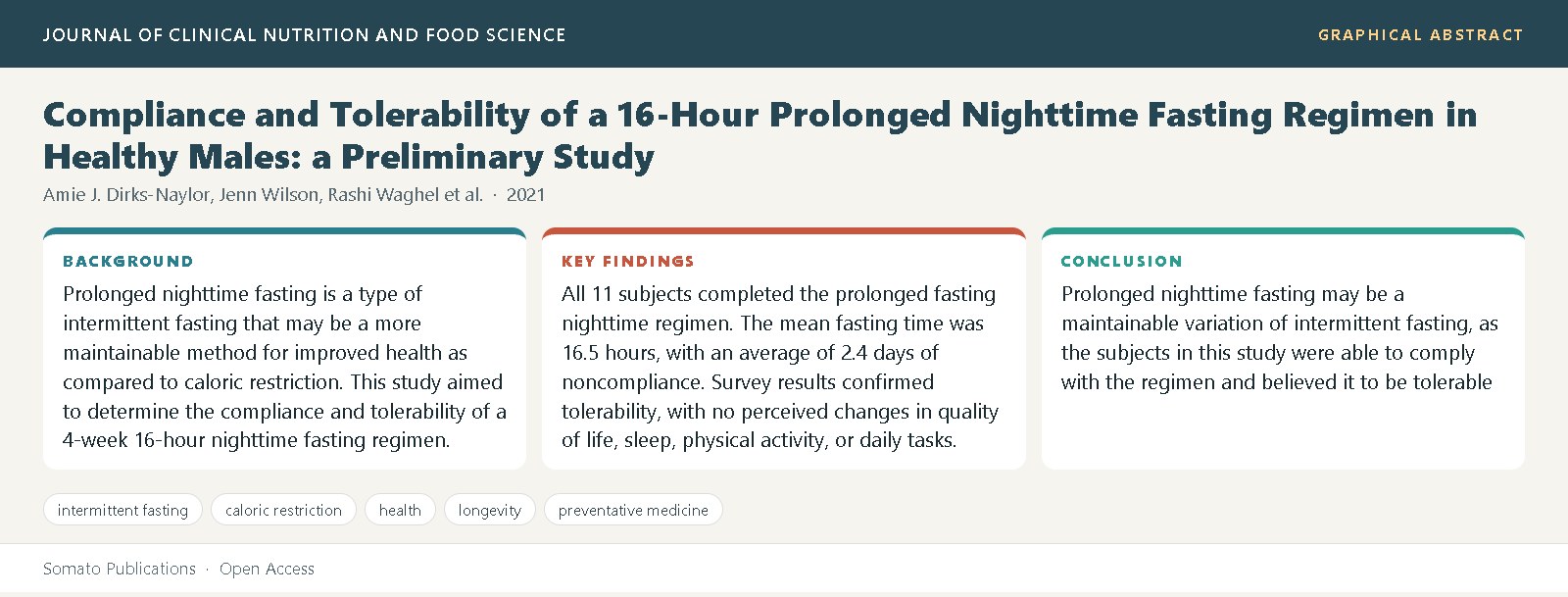
Background: Prolonged nighttime fasting is a type of intermittent fasting that may be a more maintainable method for
improved health as compared to caloric restriction. This study aimed to determine the compliance and tolerability of a 4-week
16-hour nighttime fasting regimen.Methods: Compliance and tolerability were assessed though a post-study survey and a compliance diary. Pre- and post-study health and longevity biomarkers were also assessed. Additionally, dietary intake was evaluated using the Automated SelfAdministered 24-Hour Recall and physical activity using the International Physical Activity Questionnaire.
Results: All 11 subjects completed the prolonged fasting nighttime regimen. The mean fasting time was 16.5 hours, with
an average of 2.4 days of noncompliance. Survey results confirmed tolerability, with no perceived changes in quality of life,
sleep, physical activity, or daily tasks. The regimen did not significantly impact any health parameters or biomarkers assessed,
except for a reduction of systolic blood pressure (p=0.03) and increased antioxidant capacity in the blood (p=0.001). Diastolic
blood pressure tended to decrease, but did not reach statistical significance (p=0.05)Conclusion: Prolonged nighttime fasting may be a maintainable variation of intermittent fasting, as the subjects in this study were able to comply with the regimen and believed it to be tolerable
References
Arroyo Johnson, C., Mincey, KD. (2016) Obesity Epidemiology Worldwide. Gastroenterol Clin North Am, 45(4): 571-579.
Chapel, JM., Ritchey, MD., Zhang, D., Wang, G. (2017) Prevalence and Medical Costs of Chronic Diseases Among Adult Medicaid Beneficiaries. Am J Prev Med, 53(6S2): S143-S154.
Dirks, AJ., Leeuwenburgh, C. (2006) Caloric restriction in humans: potential pitfalls and health concerns. Mech Ageing Dev, 127(1): 1-7.
Harvie, MN., Pegington, M., Mattson, MP., Frystyk, J., Dillon, B., Evans, G., et al. The effects of intermittent or continuous energy restriction on weight loss and metabolic disease risk markers: a randomized trial in young overweight women. Int J Obes (Lond), 35(5): 714-727.
Heilbronn, LK., Civitarese, AE., Bogacka, L., Smith, SR., Hulver, M., Ravussin, E. (2005) Glucose tolerance and skeletal muscle gene expression in response to alternate day fasting. Obes Res, 13(3): 574-581.
Heilbronn, LK., Smith, SR., Martin, CK., Anton, SD., Ravussin, E. (2005) Alternate day fasting in nonobese subjects: effects on body weight body composition and energy metabolism. Am J Clin Nutr, 81(1): 69-73.
Halberg, N., Henriksen, M., Söderhamn, N., Stallknecht, B., Ploug, T., Schjerling, P., et al. (2005) Effect of intermittent fasting and refeeding on insulin action in healthy men. J Appl Physiol (1985), 99(6): 2128-2136.
Wegman, MP., Guo, MH., Bennion, DM., Shankar, MN., Chrzanowski, SM., Goldberg, LA., et al. (2015) Practicality of intermittent fasting in humans and its effect on oxidative stress and genes related to aging and metabolism. Rejuvenation Res, 18(2): 162-172.
Faris, MA., Kacimi, S., Al-Kurd, RA., Fararjeh, MA., Bustanji, YK., Mohammad, MK., et al. (2012) Intermittent fasting during Ramadan attenuates proinflammatory cytokines and immune cells in healthy subjects. Nutr Res, 32(12): 947-955.
Faris, MA., Hussein, RN., Al-Kurd, RA., Al-Fararjeh, MA., Bustanji, YK., Mohammad, MK., et al. (2012) Impact of ramadan intermittent fasting on oxidative stress measured by urinary 15 f(2t) isoprostane. J Nutr Metab, 2012: 802924.
Ibrahim, WH., Habib, HM., Jarrar, AH., Al Baz, SA. (2008) Effect of Ramadan fasting on markers of oxidative stress and serum biochemical markers of cellular damage in healthy subjects. Ann Nutr Metab, 53(3-4): 175-181.
Aksungar, FB., Topkaya, AE., Akyildiz, M. (2007) Interleukin-6 C-reactive protein and biochemical parameters during prolonged intermittent fasting. Ann Nutr Metab, 51(1): 88-95.
Aksungar, FB., Eren, A., Ure, S., Teskin, O., Ates, G. (2005) Effects of intermittent fasting on serum lipid levels, coagulation status and plasma homocysteine levels. Ann Nutr Metab, 49(2): 77-82.
Trepanowski, J F., Bloomer, R J. (2010) The impact of religious fasting on human health. Nutr J, 9: 57.
Garaulet, M., Gomez-Abellan, P. (2014) Timing of food intake and obesity: a novel association. Physiol Behav, 134: 44-50.
Mattson, MP., Allison, DB., Fontana, L., Harvie, M., Longo, VD., Maliaisse, WJ., et al. (2014) Meal frequency and timing in health and disease. Proc Natl Acad Sci U S A, 111(47): 16647-16653.
Marinac, CR., Natarajan, L., Sears, DD., Gallo, LC., Hartman, SJ., Arredondo, E., et al. (2015) Prolonged Nightly Fasting and Breast Cancer Risk: Findings from NHANES (2009- 2010). Cancer Epidemiol Biomarkers Prev, 24(5): 783- 789.
Marinac, CR., Nelson, SH., Breen, CJ., Hartman, SJ., Natarajan, L., Pierce, JP., et al. (2017) Prolonged Nightly Fasting and Breast Cancer Prognosis. JAMA oncology, 2(8): 1049-1055.
Craig, CL., Marshall, AL., Sjostrom, M., Bauman, AE., Booth, ML., Ainsworth, BE., et al. (2003) International physical activity questionnaire: 12-country reliability and validity. Med Sci Sports Exerc, 35(8): 1381-1395.
Booth, M. (2000) Assessment of physical activity: an international perspective. Res Q Exerc Sport, 71: S114- 120.
Klempel, MC., Bhutani, S., Fitzgibbon, M., Freels, S., Varady, KA. (2010) Dietary and physical activity adaptations to alternate day modified fasting: implications for optimal weight loss. Nutr J, 9: 35.
Klempel, MC., Kroeger, CM., Varady, KA. (2013) Alternate day fasting (ADF) with a high-fat diet produces similar weight loss and cardio-protection as ADF with a low-fat diet. Metabolism, 62: 137-143.
Johnstone, AM., Faber, P., Gibney, ER., Elia, M., Horgan, G., Golden, BE., et al.(2002) Effect of an acute fast on energy compensation and feeding behaviour in lean men and women. Int J Obes Relat Metab Disord, 26(12): 1623- 1628.
Fuchs, FD., Whelton, PK. (2020) High Blood Pressure and Cardiovascular Disease. Hypertension, 75(2): 285-292.
Mills, KT., Stefanescu, A., He, J. (2020) The global epidemiology of hypertension. Nat Rev Nephrol, 16(4): 223-237.
Mozaffari, H., Daneshzad, E., Surkan, P. J., Azadbakht, L. (2018) Dietary Total Antioxidant Capacity and Cardiovascular Disease Risk Factors: A Systematic Review of Observational Studies. J Am Coll Nutr, 37(6): 533-545.
Gnanou, JV., Caszo, BA., Khalil, KM., Abdullah, SL., Knight, VF.,et al. (2015) Effects of Ramadan fasting on glucose homeostasis and adiponectin levels in healthy adult males. J Diabetes Metab Disord, 14: 55.





