
Improvement of Hyperphosphatemia in Patients Undergoing Chronic Hemodialysis Relying on Internet Online Dietary Guidance
Keywords:
Hemodialysis, Hyperphosphatemia, Serum phosphorus, Internet, Dietary guidance, ComplianceAbstract
Object: To explore the effect of Internet online dietary guidance on improving serum phosphate levels in hemodialysis
patients.Methods: A prospective cohort study enrolled 70 patients undergoing chronic hemodialysis from April 01, 2019 to May 31,
2019. The enrolled patients entered Intellkidney Nutrition WeChat Mini Program and uploaded their photographs of three
meals a day. The nutritionists carried out online assessment and intervention in a timely manner. After the 6-month follow
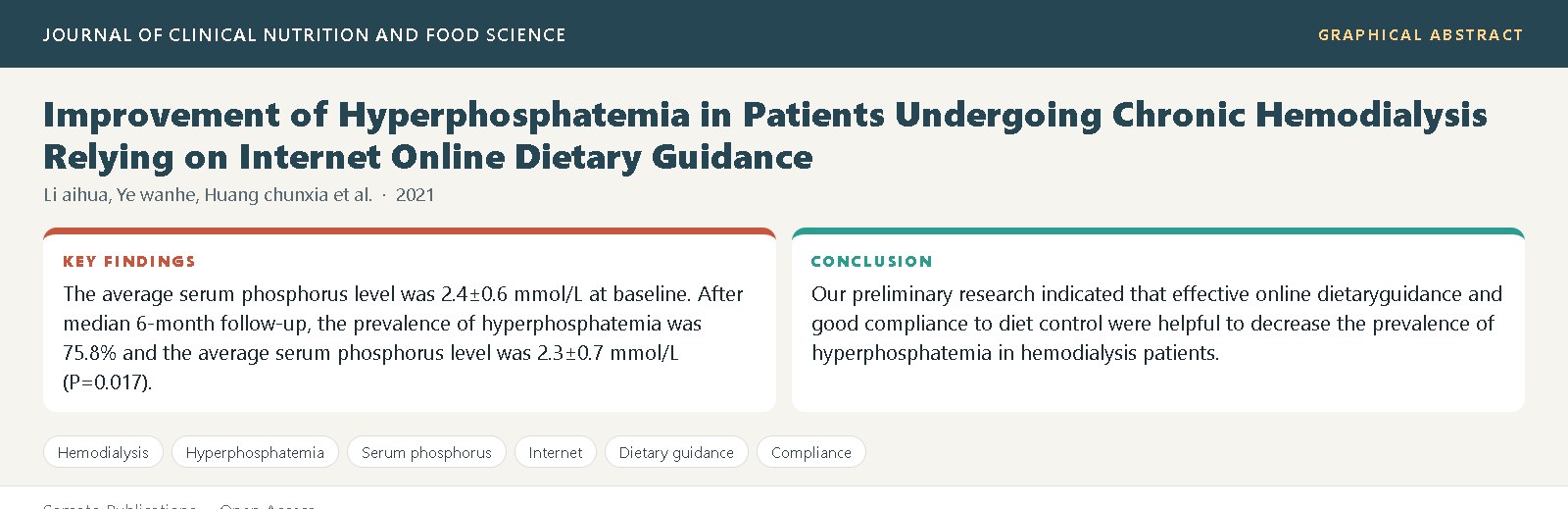
up period, improvement of hyperphosphatemia had been assessed due to different compliance.Results: The average serum phosphorus level was 2.4±0.6 mmol/L at baseline. After median 6-month follow-up, the prevalence of hyperphosphatemia was 75.8% and the average serum phosphorus level was 2.3±0.7 mmol/L (P=0.017). Compared to the general compliance group, the patients in the good compliance group presented a seemed higher level of serum phosphorus (2.6±0.6 versus 2.3±0.5mmol/L, P=0.055) at baseline but the levels of serum phosphorus and daily average dietary phosphorus intake were significantly reduced during follow-up. Adjusted gender, dietary parameters, serum iPTH and use of phosphorus-reducing drugs during follow-up, the multivariate Logistic analysis indicated that the decreaseof daily average calorie intake (per 1 Kcal/Kg/d, OR 3.003, 95%CI, 1.014-8.897, P=0.047) was independently associated with improvement of hyperphosphatemia. Conclusion: Our preliminary research indicated that effective online dietaryguidance and good compliance to diet control were helpful to decrease the prevalence of hyperphosphatemia in hemodialysis patients.
References
Wang, J., Bieber, BA., Hou, FF., Port, FK., Anand, S. (2019) Mineral and Bone Disorder and Management in the China Dialysis Outcomes and Practice Patterns Study. Chin Med J (Engl), 132(23): 2775-82.
Kidney Disease: Improving Global Outcomes (KDIGO) CKD-MBD Update Work Group. KDIGO 2017 Clinical Practice Guideline Update for the Diagnosis, Evaluation, Prevention, and Treatment of Chronic Kidney Disease- Mineral and Bone Disorder (CKD-MBD). Kidney Int Suppl, 7(1): 1-59.
Liu, ZH., Li, GS., Zhang, L., Chen, JH., Chen, XN., Zhao, JH., et al. (2019) Executive Summary: Clinical Practice Guideline of Chronic Kidney Disease-Mineral and Bone Disorder (CKD-MBD) in China. Kidney Dis (Basel), 5(4): 197-203.
National Kidney Foundation. (2003) K/DOQI Clinical Practice Guidelines for Bone Metabolism and Disease in Chronic Kidney Disease. Am J Kidney Dis, 42(4 Suppl 3): S1-S201.
Li, H., Long, Q., Shao, CH., Fan, H., Yuan, L., Huang, BH., et al. (2011) Effect of Short-Term Low-Protein Diet Supplemented With Keto Acids on Hyperphosphatemia in Maintenance Hemodialysis Patients. Blood Purif, 31(1- 3): 33-40.
Zuo, L., Wang, M., Hou, F., Yan, Y., Chen, N., Qian, J., et al. (2016) Anemia Management in the China Dialysis Outcomes and Practice Patterns Study. Blood Purif, 42(1):33-43.
Allawi Ali Abdulmajid Dyab. (2018) Malnutrition, Inflamation and Atherosclerosis (MIA Syndrome) in Patients With End Stage Renal Disease on Maintenance Hemodialysis (A Single Centre Experience). Diabetes Metab Syndr, 12(2): 91-97.
Pássaro, PG., D'Ávila, R. (2018) Nursing Educational Intervention for the Identification of Adverse Events in Hemodialysis. Rev Bras Enferm, 71(suppl4): 1507-1513.
Bunch, A., Vesga, JI., Camargo, DO., Corzo, L., Molano, AP., Devia, ME., et al. (2019) Remote Automated Peritoneal Dialysis Management in Colombia. Kidney Int Rep, 4(6): 873-876.
Afsar B. (2013) The Relation Between Internet and Social Media Use and the Demographic and Clinical Parameters, Quality of Life, Depression, Cognitive Function and Sleep Quality in Hemodialysis Patients: Social Media and Hemodialysis. Gen Hosp Psychiatry, 35(6): 625-630.
Hernandez, R., Burrows, B., Wilund, K., Cohnm M., Xum S., Moskowitzm JT. (2018) Feasibility of an Internet-based Positive Psychological Intervention for Hemodialysis Patients With Symptoms of Depression. Soc Work Health Care, 57(10): 864-879.
Fukagawa, M., Komaba, H., Onishi, Y., Fukuhara, S., Akizawa, T., Kurokawa, K. (2011) Mineral metabolism management in hemodialysis patients with secondary hyperparathyroidism in Japan: baseline data from the MBD-5D. Am J Nephrol, 33(5): 427-437.
Ye, X., Kooman, JP., van der Sande, FM., Raimann, JG., Usvyat, LA., Wang, Y., et l. (2019) Relationship between serum phosphate levels and survival in chronic hemodialysis patients: interactions with age, malnutrition and inflammation. Clin Kidney J, 14(1): 348-357.





