
Plasma Neurofilament Light Chain as a Marker of Axonal Injury in Traumatic Brain Injury
DOI:
https://doi.org/10.5281/zenodo.22310509Keywords:
Neurofilament light chain, Traumatic brain injury, Axonal injury, BiomarkerAbstract
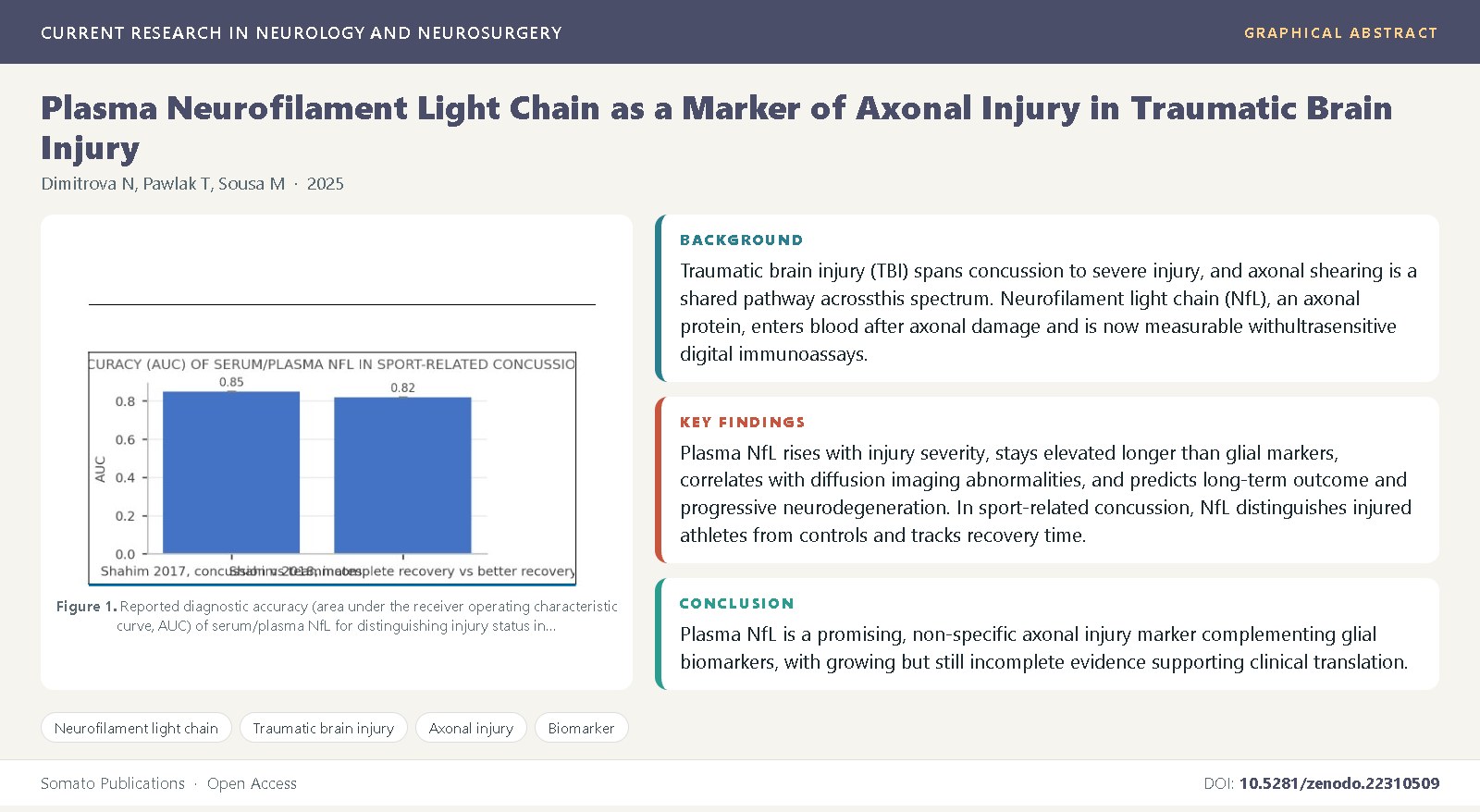
Background: Traumatic brain injury (TBI) spans concussion to severe injury, and axonal shearing is a shared pathway across
this spectrum. Neurofilament light chain (NfL), an axonal protein, enters blood after axonal damage and is now measurable with
ultrasensitive digital immunoassays. Objective: To synthesise published evidence on plasma NfL as a marker of axonal injury across the TBI severity spectrum. Methods: Narrative review of cohort studies, comparative biomarker studies, imaging-correlation studies and methodological reports. Findings: Plasma NfL rises with injury severity, stays elevated longer than glial markers, correlates with diffusion imaging abnormalities, and predicts long-term outcome and progressive neurodegeneration. In sport-related concussion, NfL distinguishes injured athletes from controls and tracks recovery time. Age, renal function and neurological comorbidity confound
interpretation, and NfL lacks injury-type specificity. Conclusions: Plasma NfL is a promising, non-specific axonal injury marker complementing glial biomarkers, with growing but still incomplete evidence supporting clinical translation.
References
Yuan, A., Rao, M.V., Veeranna, Nixon, R.A. (2017) Neurofilaments and Neurofilament Proteins in Health and Disease. Cold Spring Harbor Perspectives in Biology, 9(4): a018309.
Khalil, M., Teunissen, C.E., Otto, M., Piehl, F., Sormani, M.P., Gattringer, T., et al. (2018) Neurofilaments as biomarkers in neurological disorders. Nature Reviews Neurology, 14(10): 577-589.
Rissin, D.M., Kan, C.W., Campbell, T.G., Howes, S.C., Fournier, D.R., Song, L., et al. (2010) Single-molecule enzyme-linked immunosorbent assay detects serum proteins at subfemtomolar concentrations. Nature Biotechnology, 28(6): 595-599.
Zetterberg, H., Blennow, K. (2016) Fluid biomarkers for mild traumatic brain injury and related conditions. Nature Reviews Neurology, 12(10): 563-574.
Bacioglu, M., Maia, L.F., Preische, O., Schelle, J., Apel, A., Kaeser, S.A., et al. (2016) Neurofilament Light Chain in Blood and CSF as Marker of Disease Progression in Mouse Models and in Neurodegenerative Diseases. Neuron, 91(1): 56-66.
Simrén, J., Andreasson, U., Gobom, J., Suárez-Calvet, M., Borroni, B., Gillberg, C., et al. (2022) Establishment of reference values for plasma neurofilament light based on healthy individuals aged 5-90 years. Brain Communications, 4(4): fcac174.
Gaetani, L., Blennow, K., Calabresi, P., Di Filippo, M., Parnetti, L., Zetterberg, H. (2019) Neurofilament light chain as a biomarker in neurological disorders. Journal of Neurology, Neurosurgery, and Psychiatry, 90(8): 870-881.
Al Nimer, F., Thelin, E., Nyström, H., Dring, A.M., Svenningsson, A., Piehl, F., et al. (2015) Comparative Assessment of the Prognostic Value of Biomarkers in Traumatic Brain Injury Reveals an Independent Role for Serum Levels of Neurofilament Light. PLoS ONE, 10(7): e0132177.
Shahim, P., Gren, M., Liman, V., Andreasson, U., Norgren, N., Tegner, Y., et al. (2016) Serum neurofilament light protein predicts clinical outcome in traumatic brain injury. Scientific Reports, 6: 36791.
Shahim, P., Zetterberg, H., Tegner, Y., Blennow, K. (2017) Serum neurofilament light as a biomarker for mild traumatic brain injury in contact sports. Neurology, 88(19): 1788-1794.
Shahim, P., Tegner, Y., Marklund, N., Blennow, K., Zetterberg, H. (2018) Neurofilament light and tau as blood biomarkers for sports-related concussion. Neurology, 90(20): e1780-e1788.
Shahim, P., Politis, A., van der Merwe, A., Moore, B., Ekanayake, V., Lippa, S.M., et al. (2020) Time course and diagnostic utility of NfL, tau, GFAP, and UCH-L1 in subacute and chronic TBI. Neurology, 95(6): e623-e636.
Shahim, P., Politis, A., van der Merwe, A., Moore, B., Chou, Y.-Y., Pham, D.L., et al. (2020) Neurofilament light as a biomarker in traumatic brain injury. Neurology, 95(6): e610-e622.
Hossain, I., Mohammadian, M., Maanpää, H.-R., Takala, R.S.K., Tenovuo, O., van Gils, M., et al. (2023) Plasma neurofilament light admission levels and development of axonal pathology in mild traumatic brain injury. BMC Neurology, 23: 331.
Wang, K.K.W., Yang, Z., Zhu, T., Shi, Y., Rubenstein, R., Tyndall, J.A., Manley, G.T. (2018) An update on diagnostic and prognostic biomarkers for traumatic brain injury. Expert Review of Molecular Diagnostics, 18(2): 165-180.
Bazarian, J.J., Biberthaler, P., Welch, R.D., Lewis, L.M., Barzo, P., Bogner-Flatz, V., et al. (2018) Serum GFAP and UCH-L1 for prediction of absence of intracranial injuries on head CT (ALERT-TBI): a multicentre observational study. The Lancet Neurology, 17(9): 782-789.
Papa, L., Brophy, G.M., Welch, R.D., Lewis, L.M., Braga, C.F., Tan, C.N., et al. (2016) Time Course and Diagnostic Accuracy of Glial and Neuronal Blood Biomarkers GFAP and UCH-L1 in a Large Cohort of Trauma Patients With and Without Mild Traumatic Brain Injury. JAMA Neurology, 73(5): 551-560.
Korley, F.K., Jain, S., Sun, X., Puccio, A.M., Yue, J.K., Gardner, R.C., et al. (2022) Prognostic value of day-of-injury plasma GFAP and UCH-L1 levels for predicting functional recovery after traumatic brain injury in patients from the US TRACK-TBI cohort: an observational cohort study. The Lancet Neurology, 21(9): 803-813.
Asken, B.M., Yang, Z., Xu, H., Weber, A.G., Hayes, R.L., Bauer, R.M., et al. (2020) Acute Effects of Sport-Related Concussion on Serum Glial Fibrillary Acidic Protein, Ubiquitin C-Terminal Hydrolase L1, Total Tau, and Neurofilament Light Measured by a Multiplex Assay. Journal of Neurotrauma, 37(14): 1537-1545.
Graham, N.S.N., Zimmerman, K.A., Moro, F., Heslegrave, A., Maillard, S.A., Bernini, A., et al. (2021) Axonal marker neurofilament light predicts long-term outcomes and progressive neurodegeneration after traumatic brain injury. Science Translational Medicine, 13: eabg9922.
Yue, J.K., Yuh, E.L., Korley, F.K., Winkler, E.A., Sun, X., Puffer, R.C., et al. (2019) Association between plasma GFAP concentrations and MRI abnormalities in patients with CT-negative traumatic brain injury in the TRACK-TBI cohort: a prospective multicentre study. The Lancet Neurology, 18(10): 953-961.
McCrea, M., Broglio, S.P., McAllister, T.W., Gill, J., Giza, C.C., Huber, D.L., et al. (2020) Association of Blood Biomarkers With Acute Sport-Related Concussion in Collegiate Athletes: Findings From the NCAA and Department of Defense CARE Consortium. JAMA Network Open, 3(1): e1919771.
Verduyn, C., Bjerke, M., Duerinck, J., Engelborghs, S., Peers, K., Versijpt, J., D'haeseleer, M. (2021) CSF and Blood Neurofilament Levels in Athletes Participating in Physical Contact Sports. Neurology, 96(5): 705-715.
Laverse, E., Guo, T., Zimmerman, K., Foiani, M., Velani, B., Morrow, P., et al. (2020) Plasma glial fibrillary acidic protein and neurofilament light chain, but not tau, are biomarkers of sports-related mild traumatic brain injury. Brain Communications, 2(2): fcaa137.
Neselius, S., Brisby, H., Theodorsson, A., Blennow, K., Zetterberg, H., Marcusson, J. (2012) CSF-Biomarkers in Olympic Boxing: Diagnosis and Effects of Repetitive Head Trauma. PLoS ONE, 7(4): e33606.
Disanto, G., Barro, C., Benkert, P., Naegelin, Y., Schadelin, S., Giardiello, A., et al. (2017) Serum Neurofilament light: A biomarker of neuronal damage in multiple sclerosis. Annals of Neurology, 81(6): 857-870.
Akamine, S., Marutani, N., Kanayama, D., Gotoh, S., Maruyama, R., Yanagida, K., et al. (2020) Renal function is associated with blood neurofilament light chain level in older adults. Scientific Reports, 10: 20350.





