
Responsive Neurostimulation for Bitemporal Epilepsy: Seizure Outcomes and Device-Related Complications
DOI:
https://doi.org/10.5281/zenodo.22310493Keywords:
Responsive neurostimulation, Bitemporal epilepsy, Mesial temporal lobe epilepsy, Drug-resistant epilepsy, Device complicationsAbstract
Background: Bitemporal epilepsy, with independent seizure onsets from both mesial temporal structures, excludes most patients
from curative resection. Objective: To synthesize evidence on responsive neurostimulation (RNS) for bitemporal epilepsy, covering seizure outcomes, comparison with resective and ablative alternatives, and device-related complications.
Methods: Narrative review of pivotal RNS trials, long-term follow-up studies, bitemporal-specific cohorts, comparative surgical
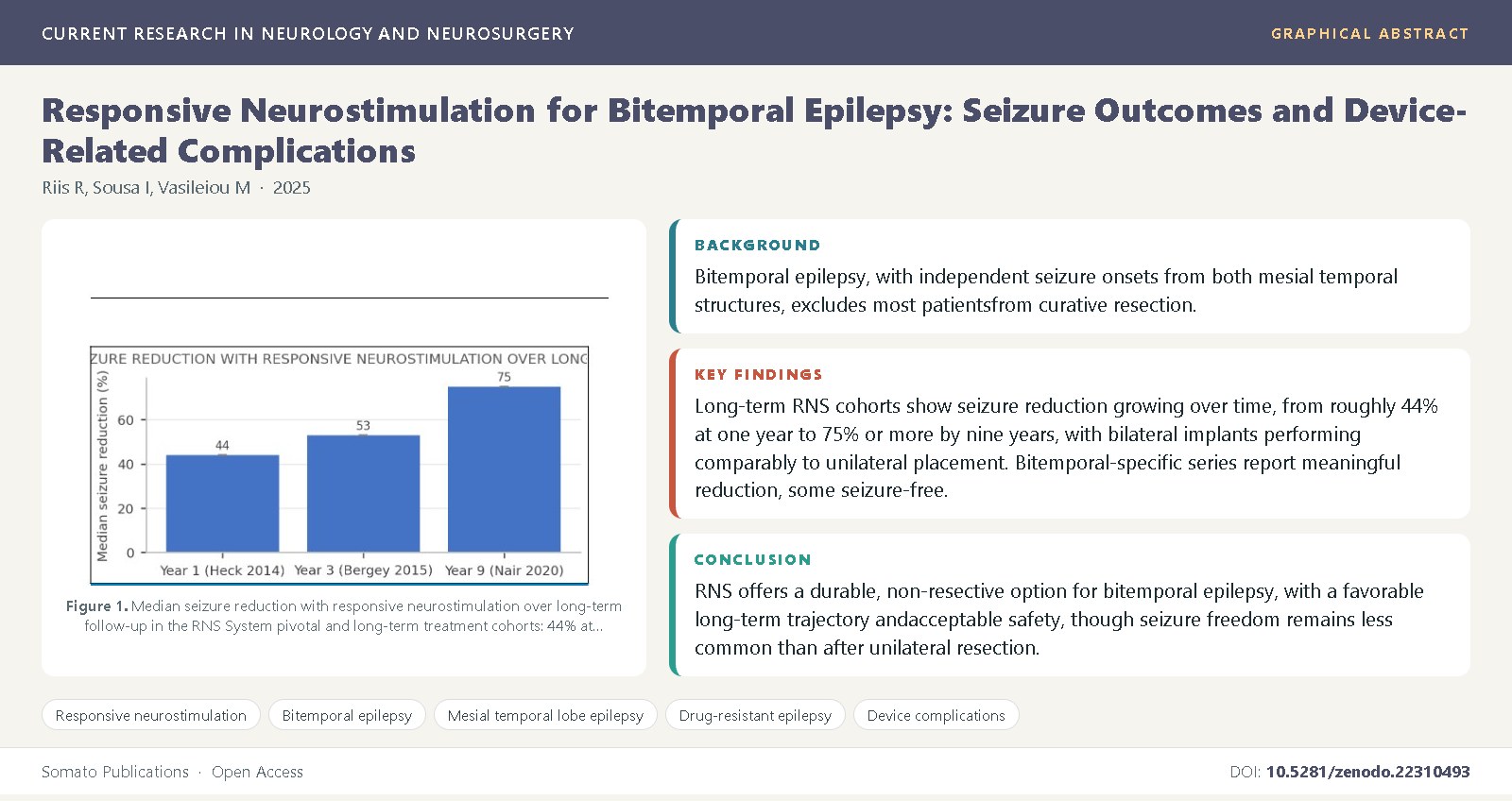
series, and safety analyses. Findings: Long-term RNS cohorts show seizure reduction growing over time, from roughly 44% at one year to 75% or more by nine years, with bilateral implants performing comparably to unilateral placement. Bitemporal-specific series report meaningful reduction, some seizure-free. Complications, chiefly infection and lead issues, affect a minority of implants.
Conclusions: RNS offers a durable, non-resective option for bitemporal epilepsy, with a favorable long-term trajectory and
acceptable safety, though seizure freedom remains less common than after unilateral resection.
References
Kwan, P., Arzimanoglou, A., Berg, A.T., Brodie, M.J., Allen Hauser, W., Mathern, G., Moshé, S.L., Perucca, E., Wiebe, S., French, J. (2010) Definition of drug resistant epilepsy: consensus proposal by the ad hoc Task Force of the ILAE Commission on Therapeutic Strategies. Epilepsia, 51(6): 1069-1077.
Wiebe, S., Blume, W.T., Girvin, J.P., Eliasziw, M. (2001) A Randomized, Controlled Trial of Surgery for Temporal-Lobe Epilepsy. New England Journal of Medicine, 345(5): 311-318.
Devinsky, O., Vezzani, A., O'Brien, T.J., Jette, N., Scheffer, I.E., de Curtis, M., Perucca, P. (2018) Epilepsy. Nature Reviews Disease Primers, 4: 18024.
Sirven, J.I., Malamut, B.L., O'Connor, M.J., Sperling, M.R. (1997) Outcome after temporal lobectomy in bilateral temporal lobe epilepsy. Annals of Neurology, 42(6): 873-878.
Aghakhani, Y., Liu, X., Jette, N., Wiebe, S. (2014) Epilepsy surgery in patients with bilateral temporal lobe seizures: A systematic review. Epilepsia, 55(12): 1892-1901.
King-Stephens, D., Mirro, E., Weber, P.B., Laxer, K.D., Van Ness, P.C., Salanova, V., Spencer, D.C., Heck, C.N., Goldman, A., Jobst, B., et al. (2015) Lateralization of mesial temporal lobe epilepsy with chronic ambulatory electrocorticography. Epilepsia, 56(6): 959-967.
Arain, A., Mirro, E., Brown, D., Peters, A., Newman, B., Richards, S., Rolston, J. (2023) Long-Term Intracranial EEG Lateralization of Epileptogenicity in Patients With Confirmed or Suspected Bilateral Mesial Temporal Lobe Onsets During Epilepsy Surgical Evaluation. Journal of Clinical Neurophysiology, 41(6): 493-500.
Fountas, K.N., Smith, J.R., Murro, A.M., Politsky, J., Park, Y.D., Jenkins, P.D. (2005) Implantation of a closed-loop stimulation in the management of medically refractory focal epilepsy: a technical note. Stereotactic and Functional Neurosurgery, 83(4): 153-158.
Sun, F.T., Morrell, M.J. (2014) The RNS System: responsive cortical stimulation for the treatment of refractory partial epilepsy. Expert Review of Medical Devices, 11(6): 563-572.
Jarosiewicz, B., Morrell, M. (2021) The RNS System: brain-responsive neurostimulation for the treatment of epilepsy. Expert Review of Medical Devices, 18(2): 129-138.
Morrell, M.J.; RNS System in Epilepsy Study Group (2011) Responsive cortical stimulation for the treatment of medically intractable partial epilepsy. Neurology, 77(13): 1295-1304.
Heck, C.N., King-Stephens, D., Massey, A.D., Nair, D.R., Jobst, B.C., Barkley, G.L., Salanova, V., Cole, A.J., Smith, M.C., Gwinn, R.P., et al. (2014) Two-year seizure reduction in adults with medically intractable partial onset epilepsy treated with responsive neurostimulation: final results of the RNS System Pivotal trial. Epilepsia, 55(3): 432-441.
Bergey, G.K., Morrell, M.J., Mizrahi, E.M., Goldman, A., King-Stephens, D., Nair, D., Srinivasan, S., Jobst, B., Gross, R.E., Shields, D.C., et al. (2015) Long-term treatment with responsive brain stimulation in adults with refractory partial seizures. Neurology, 84(8): 810-817.
Nair, D.R., Laxer, K.D., Weber, P.B., Murro, A.M., Park, Y.D., Barkley, G.L., Smith, B.J., Gwinn, R.P., Doherty, M.J., Noe, K.H., et al. (2020) Nine-year prospective efficacy and safety of brain-responsive neurostimulation for focal epilepsy. Neurology, 95(9): e1244-e1256.
Eliashiv, D., Rao, V.R., Jobst, B.C., Szaflarski, J.P., Rolston, J.D., Kaye, L.C., Ganguly, T.M., Bullinger, K., Dugan, P.C., Burdette, D.E., et al. (2026) Postapproval Study for Brain-Responsive Neurostimulation for Drug-Resistant Focal Epilepsy: Three-Year Efficacy and Interim Safety Results. Neurology, 106(9): e214875.
Geller, E.B., Skarpaas, T.L., Gross, R.E., Goodman, R.R., Barkley, G.L., Bazil, C.W., Berg, M.J., Bergey, G.K., Cash, S.S., Cole, A.J., et al. (2017) Brain-responsive neurostimulation in patients with medically intractable mesial temporal lobe epilepsy. Epilepsia, 58(6): 994-1004.
Malaga, I., et al. (2025) Neuropsychological and neurobehavioral outcomes of responsive neurostimulation in epilepsy: A systematic review and meta-analysis. Epilepsia, early view.
Loring, D.W., Kapur, R., Meador, K.J., Morrell, M.J. (2015) Differential neuropsychological outcomes following targeted responsive neurostimulation for partial-onset epilepsy. Epilepsia, 56(11): 1836-1844.
Spencer, D.C. (2016) Responsive Neurostimulation and Cognition. Epilepsy Currents, 16(2): 98-99.
Kokoszka, M.A., Panov, F., La Vega-Talbott, M., McGoldrick, P.E., Wolf, S.M., Ghatan, S. (2021) Responsive Neurostimulation of the Mesial Temporal White Matter in Bilateral Temporal Lobe Epilepsy. Neurosurgery, 88(2): E170-E176.
Gross, R.E., Stern, M.A., Willie, J.T., Fasano, R.E., Saindane, A.M., Soares, B.P., Pedersen, N.P., Drane, D.L. (2018) Stereotactic laser amygdalohippocampotomy for mesial temporal lobe epilepsy. Annals of Neurology, 83(3): 575-587.
Sperling, M.R., Gross, R.E., Kalayjian, L.A., et al. (2020) Stereotactic Laser Ablation for Mesial Temporal Lobe Epilepsy: A prospective, multicenter, single-arm study. Epilepsia, 61(6): 1183-1189.
Barbaro, N.M., Quigg, M., Ward, M.M., Chang, E.F., Broshek, D.K., Langfitt, J.T., Yan, G., Laxer, K.D., Cole, A.J., Sneed, P.K., et al. (2018) Radiosurgery versus open surgery for mesial temporal lobe epilepsy: the randomized, controlled ROSE trial. Epilepsia, 59(6): 1198-1207.
Englot, D.J. (2020) Responsive Neurostimulation in Epilepsy: Wall to Block Seizures or Bridge to Resection? Epilepsy Currents, 20(6): 345-347.
Ellens, N.R., Elisevich, K., Burdette, D.E., Patra, S.E. (2018) A Comparison of Vagal Nerve Stimulation and Responsive Neurostimulation for the Treatment of Medically Refractory Complex Partial Epilepsy. Stereotactic and Functional Neurosurgery, 96(4): 259-263.
Drees, C., McDermott, D., Sillau, S., Abosch, A., Ojemann, S., Schwarz, S., Brown, M.G. (2020) Seizure outcome with responsive neurostimulation (RNS) comparing strip versus depth leads. Epilepsy & Behavior, 112: 107402.
Suller Marti, A., Bottan, J.S., Gleichgerrcht, E., Garcia Losarcos, N., Mejía Pérez, S., Sabau, D., Vidaurre, J. (2026) Bitemporal Lobe Epilepsy: Evolving Diagnostic and Treatment Paradigms. Epilepsy Currents, early view.





