
Machine Learning Prediction of Shunt Dependency After Aneurysmal Subarachnoid Haemorrhage
DOI:
https://doi.org/10.5281/zenodo.22310481Keywords:
Machine learning, Shunt dependency, Hydrocephalus, Subarachnoid haemorrhage, External ventricular drainAbstract
Background: Chronic shunt-dependent hydrocephalus complicates a substantial minority of aneurysmal subarachnoid
haemorrhage (aSAH) survivors. Early identification could guide external ventricular drain (EVD) weaning and shunt timing.
Objective: To review published machine learning (ML) models predicting shunt dependency after aSAH alongside the clinical
scores and EVD-weaning strategies they are benchmarked against. Methods: Narrative review of derivation and validation studies, systematic reviews and meta-analyses, and EVD-management cohorts identified through PubMed, Crossref and journal searches.
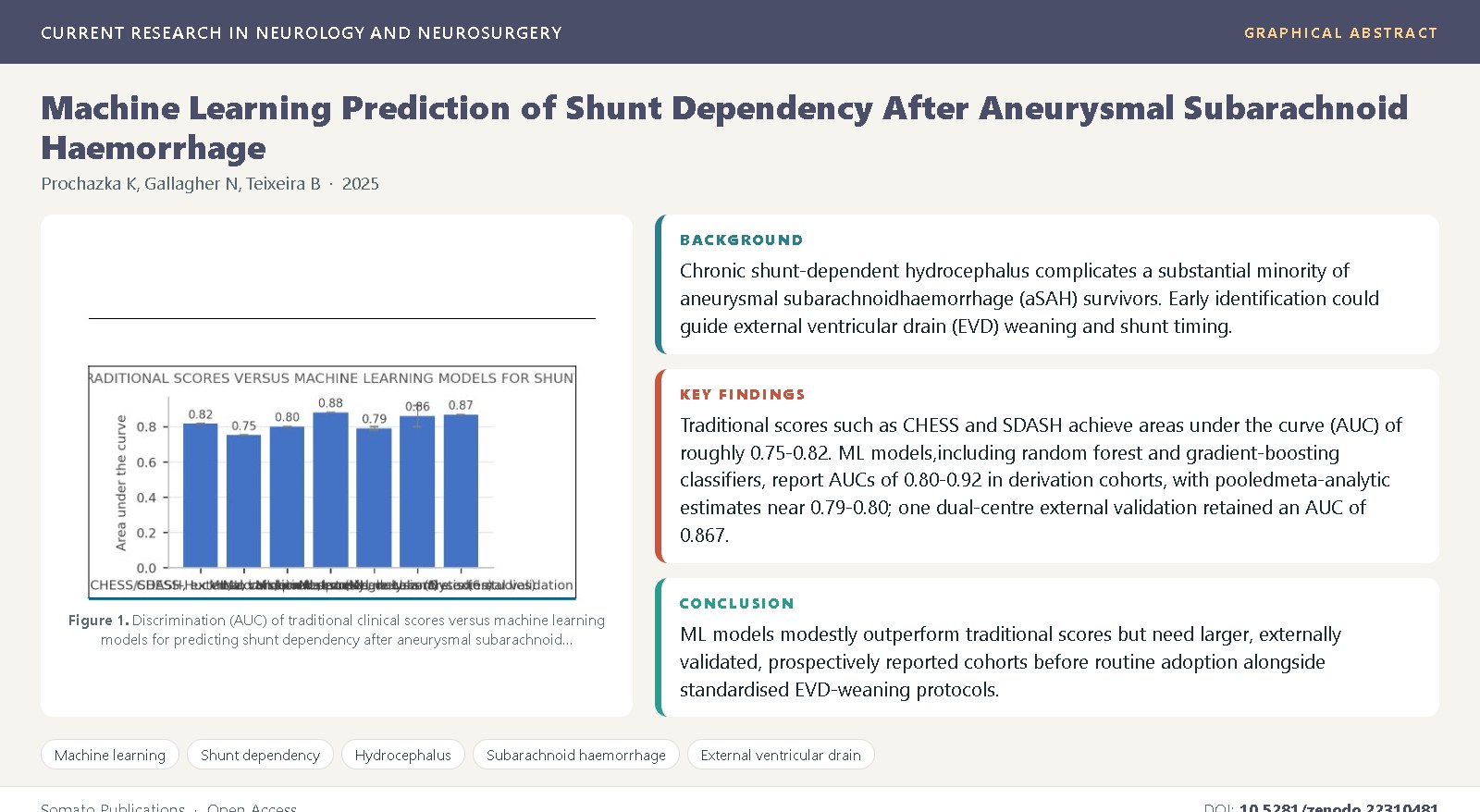
Findings: Traditional scores such as CHESS and SDASH achieve areas under the curve (AUC) of roughly 0.75-0.82. ML models,
including random forest and gradient-boosting classifiers, report AUCs of 0.80-0.92 in derivation cohorts, with pooled
meta-analytic estimates near 0.79-0.80; one dual-centre external validation retained an AUC of 0.867. Most studies remain
single-centre with heterogeneous predictors. Conclusions: ML models modestly outperform traditional scores but need larger, externally validated, prospectively reported cohorts before routine adoption alongside standardised EVD-weaning protocols.
References
Lawton, M.T., Vates, G.E. (2017) Subarachnoid Hemorrhage. New England Journal of Medicine, 377(3): 257-266.
Jabbarli, R., Bohrer, A.M., Pierscianek, D., Müller, D., Wrede, K.H., Dammann, P., El Hindy, N., Özkan, N., Sure, U., Müller, O. (2016) The CHESS score: a simple tool for early prediction of shunt dependency after aneurysmal subarachnoid hemorrhage. European Journal of Neurology, 23(5): 912-918.
Diesing, D., Wolf, S., Sommerfeld, J., Sarrafzadeh, A., Vajkoczy, P., Dengler, N.F. (2018) A novel score to predict shunt dependency after aneurysmal subarachnoid hemorrhage. Journal of Neurosurgery, 128(5): 1273-1279.
García-Armengol, R., Puyalto de Pablo, P., Misis, M., Rodríguez-Hernández, A., Julián, J.F., Pérez-Balaguero, A.C., Brugada-Bellsolà, F., Menendez, B., Cuadras, P., Rimbau, J. (2021) Validation of shunt dependency prediction scores after aneurysmal spontaneous subarachnoid hemorrhage. Acta Neurochirurgica, 163(3): 743-751.
Said, M., Gümüs, M., Rodemerk, J., Chihi, M., Rauschenbach, L., Dinger, T.F., Oppong, M.D., Dammann, P., Wrede, K.H., Sure, U., Jabbarli, R. (2023) The value of ventricular measurements in the prediction of shunt dependency after aneurysmal subarachnoid hemorrhage. Acta Neurochirurgica, 165(6): 1545-1555.
Mijderwijk, H.J., Fischer, I., Zhivotovskaya, A., Bostelmann, R., Steiger, H.J., Cornelius, J.F., Petridis, A.K. (2019) Prognostic Model for Chronic Shunt-Dependent Hydrocephalus After Aneurysmal Subarachnoid Hemorrhage. World Neurosurgery, 124: e572-e579.
McMahon, J.T., Malcolm, J.G., Douglas, J.M., Greven, A., Sadan, O., Samuels, O.B., Cawley, C.M., Barrow, D.L., Grossberg, J.A., Howard, B.M. (2025) Shunt-Dependent Hydrocephalus After Aneurysmal Subarachnoid Hemorrhage: Investigation of Prognostic Variables and Creation of a Stronger Predictive Model. World Neurosurgery, 195: 123659.
Kim, J.H., Kim, J.H., Kang, H.I., Kim, D.R., Moon, B.G., Kim, J.S. (2019) Risk Factors and Preoperative Risk Scoring System for Shunt-Dependent Hydrocephalus Following Aneurysmal Subarachnoid Hemorrhage. Journal of Korean Neurosurgical Society, 62(6): 643-648.
Torregrossa, F., Grasso, G. (2022) The Quest for Predictors of Shunt-Dependent Chronic Hydrocephalus After Aneurysmal Subarachnoid Hemorrhage. World Neurosurgery, 157: 96-98.
Sanusi, T.D., McLarnon, M., Abouharb, A. (2020) Risk factors of chronic shunt dependent hydrocephalus following aneurysmal subarachnoid haemorrhage. Clinical Neurology and Neurosurgery, 198: 106095.
Bae, I.S., Yi, H.J., Choi, K.S., Chun, H.J. (2014) Comparison of Incidence and Risk Factors for Shunt-dependent Hydrocephalus in Aneurysmal Subarachnoid Hemorrhage Patients. Journal of Cerebrovascular and Endovascular Neurosurgery, 16(2): 78-84.
Zheng, C., Huang, J., Wang, X., Ye, Q., Lin, C., Gu, X. (2026) Development and external validation of a machine learning model based on multimodal dynamic data for predicting shunt-dependent hydrocephalus after aneurysmal subarachnoid hemorrhage: a dual-center retrospective cohort study. Frontiers in Neurology, 17: 1837898.
Muscas, G., Matteuzzi, T., Becattini, E., et al. (2020) Development of machine learning models to prognosticate chronic shunt-dependent hydrocephalus after aneurysmal subarachnoid hemorrhage. Acta Neurochirurgica, 162(12): 3093-3105.
Frey, D., Hilbert, A., Früh, A., Madai, V.I., Kossen, T., Kiewitz, J., Sommerfeld, J., Vajkoczy, P., Unteroberdörster, M., Zihni, E., Brune, S.C., Wolf, S., Dengler, N.F. (2023) Enhancing the prediction for shunt-dependent hydrocephalus after aneurysmal subarachnoid hemorrhage using a machine learning approach. Neurosurgical Review, 46(1): 206.
Han, W., Yang, C., Liu, C., Wang, G., Tian, Q., Zhang, Z., Liao, J., Li, M. (2026) Deep learning-assisted prediction of hydrocephalus in preoperative-subarachnoid hemorrhage: a multi-center study. Quantitative Imaging in Medicine and Surgery, 16(3): 224.
Shu, L., Yan, H., Wu, Y., Yan, T., Yang, L., Zhang, S., Chen, Z., Liao, Q., Yang, L., Xiao, B., Ye, M., Lv, S., Wu, M., Zhu, X., Hu, P. (2024) Explainable machine learning in outcome prediction of high-grade aneurysmal subarachnoid hemorrhage. Aging, 16(5): 4654-4669.
Javadnia, P., Salimi, N., Shokri, B., Ramazani, Y., Moradinazar, M., Khaledian, N., Alimohammadi, E. (2025) The efficacy of machine learning algorithms in evaluating factors associated with shunt-dependent hydrocephalus after subarachnoid hemorrhage: a systematic review and meta-analysis. Neurosurgical Review, 48(1): 629.
Hajikarimloo, B., Mohammadzadeh, I., Habibi, M.A., Tos, S.M., Asgarzadeh, A., Tajvidi, M., Aghajani, S., Hashemi, R., Kooshki, A. (2026) Machine learning models in the prediction of chronic or shunt-dependent hydrocephalus following subarachnoid hemorrhage: A systematic review and meta-analysis. The Neuroradiology Journal, 39(1): 31-41.
Jabbarli, R., Pierscianek, D., Rölz, R., Reinhard, M., Darkwah Oppong, M., Scheiwe, C., Dammann, P., Kaier, K., Wrede, K.H., Shah, M., Zentner, J., Sure, U. (2018) Gradual External Ventricular Drainage Weaning Reduces The Risk of Shunt Dependency After Aneurysmal Subarachnoid Hemorrhage: A Pooled Analysis. Operative Neurosurgery, 15(5): 498-504.
Rao, S.S., Chung, D.Y., Wolcott, Z., Sheriff, F., Khawaja, A.M., Lee, H., Guanci, M.M., Leslie-Mazwi, T.M., Kimberly, W.T., Patel, A.B., Rordorf, G.A. (2020) Intermittent CSF drainage and rapid EVD weaning approach after subarachnoid hemorrhage: association with fewer VP shunts and shorter length of stay. Journal of Neurosurgery, 132(5): 1583-1588.
Chung, D.Y., Thompson, B.B., Kumar, M.A., et al. (2022) Association of External Ventricular Drain Wean Strategy with Shunt Placement and Length of Stay in Subarachnoid Hemorrhage: A Prospective Multicenter Study. Neurocritical Care, 36(2): 536-545.
Garcia, K.A. (2024) Standardized Criteria to Initiate External Ventricular Drain (EVD) Weaning in a Neurological Intensive Care Unit to Increase the Safety of EVD Discontinuation and Reduce the Need for a Shunt. Cureus, 16(4): e58362.
Perry, A., Graffeo, C.S., Kleinstern, G., Carlstrom, L.P., Link, M.J., Rabinstein, A.A. (2020) Quantitative Modeling of External Ventricular Drain Output to Predict Shunt Dependency in Aneurysmal Subarachnoid Hemorrhage. Neurocritical Care, 33(1): 218-229.
Noiphithak, R., Phumichard, T., Ratanavinitkul, W., Rukskul, P. (2023) Prediction of Permanent Shunt Dependency in Patients with Intraventricular Hemorrhage: Outcomes of Early External Ventricular Drainage Weaning Protocol. World Neurosurgery, 179: e575-e581.
Roth, C., Kaestner, S., Deinsberger, W., Hayek, M. (2016) Impact of External Ventricular Drainage Volumes on Shunt Dependency after Subarachnoid Hemorrhage. Journal of Neurological Surgery Part A: Central European Neurosurgery, 78(3): 227-230.
Merhavy, Z.I., Ferrelle, W., Vaddavalli, B., Ruxmohan, S. (2024) Rapid versus gradual external ventricular drain weaning: a general review of best practices. Journal of Neurocritical Care, 17(1): 1-6.
Collins, G.S., Reitsma, J.B., Altman, D.G., Moons, K.G.M. (2015) Transparent reporting of a multivariable prediction model for individual prognosis or diagnosis (TRIPOD): the TRIPOD statement. BMJ, 350: g7594.





