
Fluorescence-Guided Resection of High-Grade Glioma Using 5-Aminolevulinic Acid
DOI:
https://doi.org/10.5281/zenodo.22310507Keywords:
5-aminolevulinic acid, Fluorescence-guided surgery, High-grade glioma, Glioblastoma, Extent of resectionAbstract
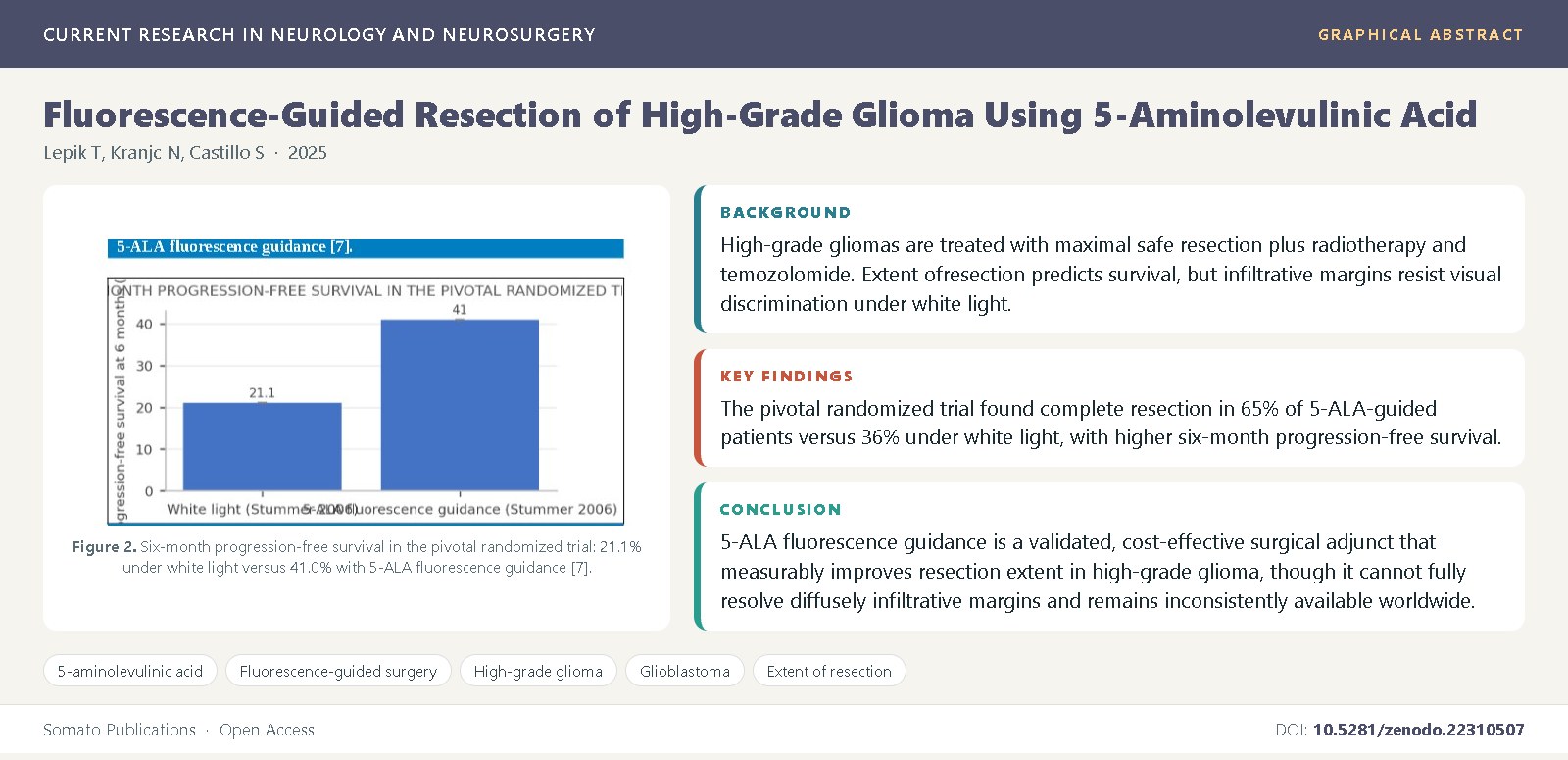
Background: High-grade gliomas are treated with maximal safe resection plus radiotherapy and temozolomide. Extent of
resection predicts survival, but infiltrative margins resist visual discrimination under white light. Objective: To review 5-aminolevulinic acid (5-ALA) fluorescence-guided resection of high-grade glioma, covering mechanism, the pivotal trial, comparative modalities, and limitations. Methods: Narrative review of randomized trials, long-term follow-up, systematic reviews, meta-analyses, and mechanistic and health-economic literature. Findings: The pivotal randomized trial found complete resection in 65% of 5-ALA-guided patients versus 36% under white light, with higher six-month progression-free survival. Subsequent meta-analyses, registries, and head-to-head trials againstintra operative MRI confirm greater resection extent and a favorable cost profile, alongside recognized limitations at infiltrative margins and uneven global access. Conclusions: 5-ALA fluorescence guidance is a validated, cost-effective surgical adjunct that measurably improves resection extent in high-grade glioma, though it cannot fully resolve diffusely infiltrative margins and remains inconsistently available worldwide.
References
Louis, D.N., Perry, A., Wesseling, P., Brat, D.J., Cree, I.A., Figarella-Branger, D., Hawkins, C., Ng, H.K., Pfister, S.M., Reifenberger, G., Soffietti, R., von Deimling, A., Ellison, D.W. (2021) The 2021 WHO classification of tumors of the central nervous system: a summary. Neuro-Oncology, 23(8): 1231-1251.
Stupp, R., Mason, W.P., van den Bent, M.J., Weller, M., Fisher, B., Taphoorn, M.J., Belanger, K., Brandes, A.A., Marosi, C., Bogdahn, U., Curschmann, J., Janzer, R.C., Ludwin, S.K., Gorlia, T., Allgeier, A., Lacombe, D., Cairncross, J.G., Eisenhauer, E., Mirimanoff, R.O. (2005) Radiotherapy plus concomitant and adjuvant temozolomide for glioblastoma. New England Journal of Medicine, 352(10): 987-996.
Sanai, N., Berger, M.S. (2008) Glioma extent of resection and its impact on patient outcome. Neurosurgery, 62(4): 753-766.
Stummer, W., Stepp, H., Möller, G., Ehrhardt, A., Leonhard, M., Reulen, H.J. (1998) Technical principles for protoporphyrin-IX-fluorescence guided microsurgical resection of malignant glioma tissue. Acta Neurochirurgica, 140(10): 995-1000.
Widhalm, G., Wolfsberger, S., Minchev, G., Woehrer, A., Krssak, M., Czech, T., Prayer, D., Asenbaum, S., Hainfellner, J.A., Knosp, E. (2010) 5-Aminolevulinic acid is a promising marker for detection of anaplastic foci in diffusely infiltrating gliomas with nonsignificant contrast enhancement. Cancer, 116(6): 1545-1552.
Kiesel, B., Freund, J., Reichert, D., et al. (2018) Systematic histopathological analysis of different 5-aminolevulinic acid-induced fluorescence levels in newly diagnosed glioblastomas. Journal of Neurosurgery, 129(2): 341-349.
Stummer, W., Pichlmeier, U., Meinel, T., Wiestler, O.D., Zanella, F., Reulen, H.J. (2006) Fluorescence-guided surgery with 5-aminolevulinic acid for resection of malignant glioma: a randomised controlled multicentre phase III trial. Lancet Oncology, 7(5): 392-401.
Stummer, W., Tonn, J.C., Mehdorn, H.M., Nestler, U., Franz, K., Goetz, C., Bink, A., Pichlmeier, U. (2011) Counterbalancing risks and gains from extended resections in malignant glioma surgery: a supplemental analysis from the randomized 5-aminolevulinic acid glioma resection study. Journal of Neurosurgery, 114(3): 613-623.
Stummer, W., Reulen, H.J., Meinel, T., Pichlmeier, U., Schumacher, W., Tonn, J.C., Rohde, V., Oppel, F., Turowski, B., Woiciechowsky, C., Franz, K., Pietsch, T. (2008) Extent of resection and survival in glioblastoma multiforme: identification of and adjustment for bias. Neurosurgery, 62(3): 564-576.
Sanai, N., Polley, M.Y., McDermott, M.W., Parsa, A.T., Berger, M.S. (2011) An extent of resection threshold for newly diagnosed glioblastomas. Journal of Neurosurgery, 115(1): 3-8.
Brown, T.J., Brennan, M.C., Li, M., Church, E.W., Brandmeir, N.J., Rakszawski, K.L., Patel, A.S., Rizk, E.B., Suki, D., Sawaya, R., Glantz, M. (2016) Association of the extent of resection with survival in glioblastoma: a systematic review and meta-analysis. JAMA Oncology, 2(11): 1460-1469.
Widhalm, G., Kiesel, B., Woehrer, A., Traub-Weidinger, T., Preusser, M., Marosi, C., Prayer, D., Hainfellner, J.A., Knosp, E., Wolfsberger, S. (2013) 5-Aminolevulinic acid induced fluorescence is a powerful intraoperative marker for precise histopathological grading of gliomas with non-significant contrast-enhancement. PLoS ONE, 8(10): e76988.
Schucht, P., Knittel, S., Slotboom, J., Seidel, K., Murek, M., Jilch, A., Raabe, A., Beck, J. (2013) 5-ALA complete resections go beyond MR contrast enhancement: shift corrected volumetric analysis of the extent of resection in surgery for glioblastoma. Acta Neurochirurgica, 156(2): 305-312.
Peters, D.R., Halimi, F., Ozduman, K., Levivier, M., Conti, A., Reyns, N., Tuleasca, C. (2023) Resection of the contrast-enhancing tumor in diffuse gliomas bordering eloquent areas using electrophysiology and 5-ALA fluorescence: evaluation of resection rates and neurological outcome - a systematic review and meta-analysis. Neurosurgical Review, 46(1): 185.
Senft, C., Bink, A., Franz, K., Vatter, H., Gasser, T., Seifert, V. (2011) Intraoperative MRI guidance and extent of resection in glioma surgery: a randomised, controlled trial. Lancet Oncology, 12(11): 997-1003.
Roder, C., Stummer, W., Coburger, J., Scherer, M., Haas, P., von der Brelie, C., Kamp, M.A., Löhr, M., Hamisch, C.A., Skardelly, M., Scholz, T., Schipmann, S., Rathert, J., Brand, C.M., Pala, A., Ernemann, U., Stockhammer, F., Gerlach, R., Kremer, P., Goldbrunner, R., Ernestus, R.I., Sabel, M., Rohde, V., Tabatabai, G., Martus, P., Bisdas, S., Ganslandt, O., Unterberg, A., Wirtz, C.R., Tatagiba, M. (2023) Intraoperative MRI-guided resection is not superior to 5-aminolevulinic acid guidance in newly diagnosed glioblastoma: a prospective controlled multicenter clinical trial. Journal of Clinical Oncology, 41(36): 5512-5523.
Coburger, J., Hagel, V., Wirtz, C.R., König, R. (2015) Surgery for glioblastoma: impact of the combined use of 5-aminolevulinic acid and intraoperative MRI on extent of resection and survival. PLoS ONE, 10(6): e0131872.
Golub, J.L., Hyde, D., Dogra, S., Nicholson, E., Kirkwood, K.A., Loftus, C.M., Gohel, B., Schwartz, T.H. (2020) Intraoperative MRI versus 5-ALA in high-grade glioma resection: a network meta-analysis. Journal of Neurosurgery, 134(2): 484-498.
Zhao, S., Wu, J., Wang, C., Liu, H., Dong, X., Shi, C., Shi, C., Liu, Y., Teng, L., Han, D., Chen, X., Yang, G., Wang, L., Shen, C., Li, H. (2013) Intraoperative fluorescence-guided resection of high-grade malignant gliomas using 5-aminolevulinic acid-induced porphyrins: a systematic review and meta-analysis of prospective studies. PLoS ONE, 8(5): e63682.
Barone, D.G., Lawrie, T.A., Hart, M.G. (2014) Image guided surgery for the resection of brain tumours. Cochrane Database of Systematic Reviews, 2014(1): CD009685.
Jenkinson, M.D., Barone, D.G., Bryant, A., Vale, L., Bulbeck, H., Lawrie, T.A., Hart, M.G., Watts, C. (2018) Intraoperative imaging technology to maximise extent of resection for glioma. Cochrane Database of Systematic Reviews, 1: CD012788.
Hadjipanayis, C.G., Widhalm, G., Stummer, W. (2015) What is the surgical benefit of utilizing 5-aminolevulinic acid for fluorescence-guided surgery of malignant gliomas? Neurosurgery, 77(5): 663-673.
Elliot, M., Ségaud, S., Lavrador, J.P., Vergani, F., Bhangoo, R., Ashkan, K., Xie, Y., Stasiuk, G.J., Vercauteren, T., Shapey, J. (2025) Fluorescence guidance in glioma surgery: a narrative review of current evidence and the drive towards objective margin differentiation. Cancers, 17(12): 2019.
Díez Valle, R., Slof, J., Galván, J., Arza, C., Romariz, C., Vidal, C. (2014) Observational, retrospective study of the effectiveness of 5-aminolevulinic acid in malignant glioma surgery in Spain (The VISIONA study). Neurología (English Edition), 29(3): 131-138.
Slof, J., Díez Valle, R., Galván, J. (2015) Cost-effectiveness of 5-aminolevulinic acid-induced fluorescence in malignant glioma surgery. Neurología (English Edition), 30(3): 163-168.
Eljamel, M.S., Goodman, C., Moseley, H. (2007) ALA and Photofrin fluorescence-guided resection and repetitive PDT in glioblastoma multiforme: a single centre Phase III randomised controlled trial. Lasers in Medical Science, 23(4): 361-367.
Schipmann, S., Müther, M., Stögbauer, L., Zimmer, S., Brokinkel, B., Holling, M., Grauer, O., Suero Molina, E., Warneke, N., Stummer, W. (2021) Combination of ALA-induced fluorescence-guided resection and intraoperative open photodynamic therapy for recurrent glioblastoma: case series on a promising dual strategy for local tumor control. Journal of Neurosurgery, 134(2): 426-436.





