
Prognostic Significance of TP53 Alterations in Patients with Therapy-Related Myeloid Neoplasms
DOI:
https://doi.org/10.5281/zenodo.22227599Keywords:
Therapy-Related Myeloid Neoplasm, TP53, Clonal Haematopoiesis, Variant Allele Frequency, PrognosisAbstract
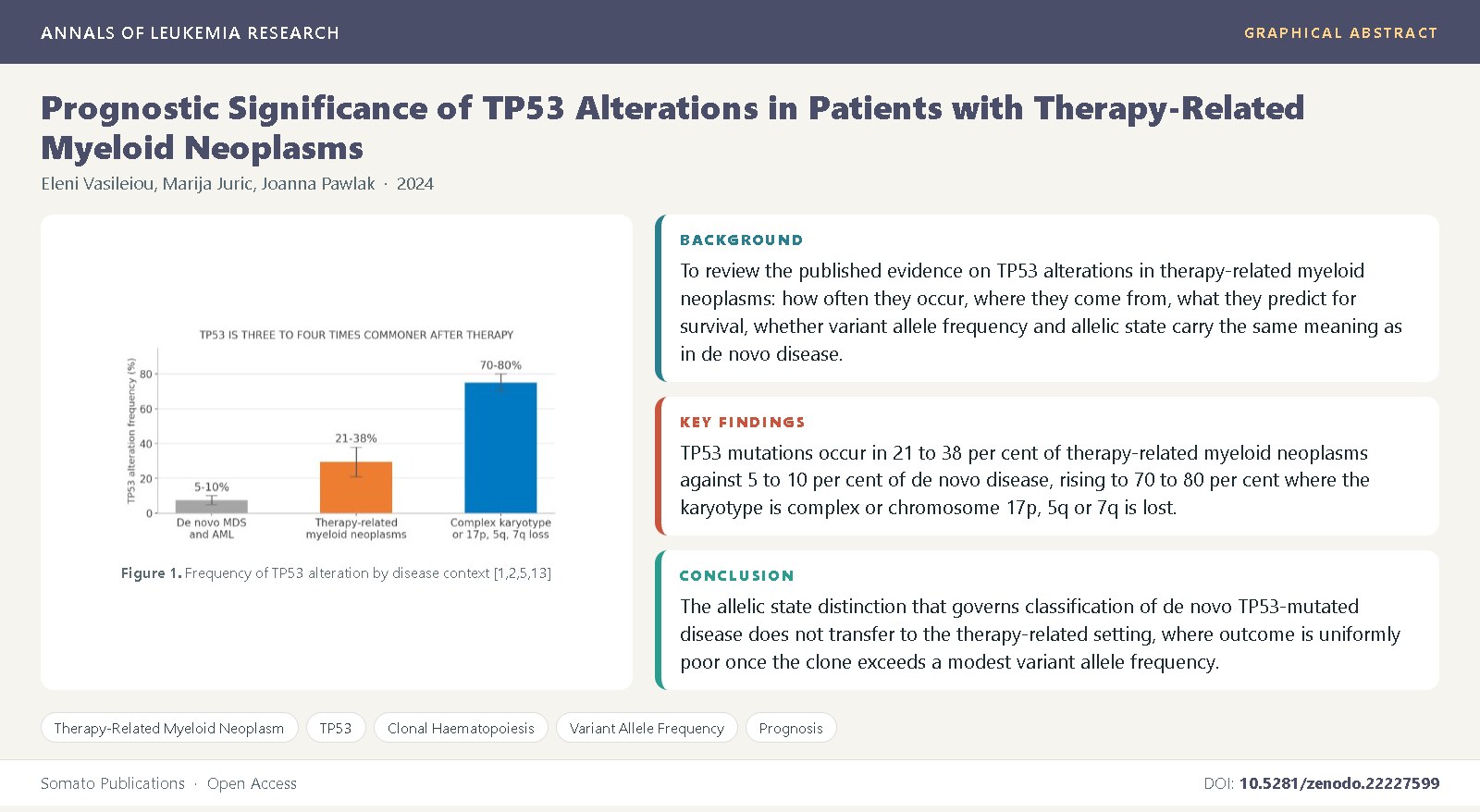
Therapy-related myeloid neoplasms are enriched for TP53 mutations three to four times over de novo disease, which for years was taken to mean that chemotherapy causes them. Sequencing showed otherwise: the mutant clone is usually present years before treatment, and cytotoxic therapy selects it rather than creating it. Objectives: To review the published evidence on TP53 alterations in therapy-related myeloid neoplasms: how often they occur, where they come from, what they predict for survival, whether variant allele frequency and allelic state carry the same meaning as in de novo disease, and what follows for classification. Material and Methods: Narrative review of sequencing studies, cohort analyses, classification documents and mechanistic work indexed in PubMed and the
major haematology and genetics journals. Studies were eligible if they reported TP53 alteration frequency, clonal origin or outcome in a defined therapy-related or de novo myeloid neoplasm population. No new patient data were generated and no patients were recruited; every estimate quoted is one published by the original investigators. Results: TP53 mutations occur in 21 to 38 per cent of therapy-related myeloid neoplasms against 5 to 10 per cent of de novo disease, rising to 70 to 80 per cent where the karyotype is complex or chromosome 17p, 5q or 7q is lost. Median overall survival was 6.1 months with mutation against 14.1 months without (p <
0.0001 univariate, p = 0.0020 multivariate). Whole-genome sequencing of therapy-related disease found the mutational burden and the proportion of chemotherapy-related transversions no higher than in de novo disease, and in four patients the exact mutation was detectable at 0.003 to 0.7 per cent in blood collected three to six years before the neoplasm appeared. In 488 patients, a variant allele frequency of 10 per cent or above, or loss of the TP53 locus, defined the poor-prognosis group, and single-hit and multi-hit disease carried equally poor outcome, unlike de novo disease. Conclusion: The allelic state distinction that governs classification of de novo TP53-mutated disease does not transfer to the therapy-related setting, where outcome is uniformly poor once the clone exceeds a modest variant allele frequency. Detecting these clones before cytotoxic treatment is the more consequential opportunity.
Abbreviations: t-MN – Therapy-Related Myeloid Neoplasm, t-AML – Therapy-Related Acute Myeloid Leukaemia, t-MDS – Therapy-Related Myelodysplastic Syndrome, VAF – Variant Allele Frequency, CH – Clonal Haematopoiesis, CHIP – Clonal Haematopoiesis of Indeterminate Potential, LOH – Loss of Heterozygosity, cnLOH – Copy-Neutral Loss of Heterozygosity, ICC – International Consensus Classification, WHO – World Health Organization, ELN – European LeukemiaNet, HSPC – Haematopoietic Stem and Progenitor Cell.
References
Godley, LA., Larson, RA. (2008) Therapy-related myeloid leukemia. Semin Oncol, 35(4): 418-429.
Ok, CY., Patel, KP., Garcia-Manero, G., Routbort, MJ., Peng, J., Tang, G., et al. (2015) TP53 mutation characteristics in therapy-related myelodysplastic syndromes and acute myeloid leukemia is similar to de novo diseases. J Hematol Oncol, 8: 45.
Wong, TN., Ramsingh, G., Young, AL., Miller, CA., Touma, W., Welch, JS., Lamprecht, TL., Shen, D., Hundal, J., Fulton, RS., et al. (2015) Role of TP53 mutations in the origin and evolution of therapy-related acute myeloid leukaemia. Nature, 518(7540): 552-555.
Soussi, T. (2000) The p53 tumor suppressor gene: from molecular biology to clinical investigation. Ann N Y Acad Sci, 910: 121-137.
Daver, NG., Maiti, A., Kadia, TM., Vyas, P., Majeti, R., Wei, AH., et al. (2022) TP53-mutated myelodysplastic syndrome and acute myeloid leukemia: biology, current therapy, and future directions. Cancer Discov, 12(11): 2516-2529.
Kantarjian, H., Kadia, T., DiNardo, C., Daver, N., Borthakur, G., Jabbour, E., et al. (2021) Acute myeloid leukemia: current progress and future directions. Blood Cancer J, 11: 41.
Döhner, H., Wei, AH., Appelbaum, FR., Craddock, C., DiNardo, CD., Dombret, H., et al. (2022) Diagnosis and management of AML in adults: 2022 recommendations from an international expert panel on behalf of the ELN. Blood, 140(12): 1345-1377.
Hart, SA., Lee, LA., Seegmiller, AC., Mason, EF. (2025) Diagnosis of TP53-mutated myeloid disease by the ICC and WHO fifth edition classifications. Blood Adv, 9(3): 445-454.
Kayser, S., Levis, MJ. (2021) Updates on targeted therapies for acute myeloid leukaemia. Br J Haematol, 196(2): 316-328.
Bejar, R., Stevenson, K., Abdel-Wahab, O., Galili, N., Nilsson, B., Garcia-Manero, G., et al. (2011) Clinical effect of point mutations in myelodysplastic syndromes. N Engl J Med, 364(26): 2496-2506.
Bowen, D., Groves, MJ., Burnett, AK., Patel, Y., Allen, C., Green, C., et al. (2009) TP53 gene mutation is frequent in patients with acute myeloid leukemia and complex karyotype, and is associated with very poor prognosis. Leukemia, 23(1): 203-206.
Papaemmanuil, E., Gerstung, M., Bullinger, L., Gaidzik, VI., Paschka, P., Roberts, ND., et al. (2016) Genomic classification and prognosis in acute myeloid leukemia. N Engl J Med, 374(23): 2209-2221.
Rücker, FG., Schlenk, RF., Bullinger, L., Kayser, S., Teleanu, V., Kett, H., et al. (2012) TP53 alterations in acute myeloid leukemia with complex karyotype correlate with specific copy number alterations, monosomal karyotype, and dismal outcome. Blood, 119(9): 2114-2121.
Klimovich, B., Merle, N., Neumann, M., Elmshäuser, S., Nist, A., Mernberger, M., Kazdal, D., Stenzinger, A., Timofeev, O., Stiewe, T. (2022) p53 partial loss-of-function mutations sensitize to chemotherapy. Oncogene, 41(7): 1011-1023.
Wong, TN., Miller, CA., Jotte, MRM., Bagegni, N., Baty, JD., Schmidt, AP., et al. (2018) Cellular stressors contribute to the expansion of hematopoietic clones of varying leukemic potential. Nat Commun, 9(1): 455.
Bolton, KL., Ptashkin, RN., Gao, T., Braunstein, L., Devlin, SM., Kelly, D., et al. (2020) Cancer therapy shapes the fitness landscape of clonal hematopoiesis. Nat Genet, 52(11): 1219-1226.
Kwan, TT., Oza, AM., Tinker, AV., Ray-Coquard, I., Oaknin, A., Aghajanian, C., et al. (2021) Preexisting TP53-variant clonal hematopoiesis and risk of secondary myeloid neoplasms in patients with high-grade ovarian cancer treated with rucaparib. JAMA Oncol, 7(12): 1772-1781.
Shah, MV., Tran, ENH., Shah, S., Chhetri, R., Baranwal, A., Ladon, D., et al. (2023) TP53 mutation variant allele frequency of ≥10% is associated with poor prognosis in therapy-related myeloid neoplasms. Blood Cancer J, 13(1): 51.
Lindsley, RC., Saber, W., Mar, BG., Redd, R., Wang, T., Haagenson, MD., et al. (2017) Prognostic mutations in myelodysplastic syndrome after stem-cell transplantation. N Engl J Med, 376(6): 536-547.
Bernard, E., Nannya, Y., Hasserjian, RP., Devlin, SM., Tuechler, H., Medina-Martinez, JS., et al. (2020) Implications of TP53 allelic state for genome stability, clinical presentation and outcomes in myelodysplastic syndromes. Nat Med, 26(10): 1549-1556.
Grob, T., Al Hinai, ASA., Sanders, MA., Kavelaars, FG., Rijken, M., Gradowska, PL., et al. (2022) Molecular characterization of mutant TP53 acute myeloid leukemia and high-risk myelodysplastic syndrome. Blood, 139(15): 2347-2354.
Schuurhuis, GJ., Heuser, M., Freeman, S., Béné, MC., Buccisano, F., Cloos, J., et al. (2018) Minimal/measurable residual disease in AML: a consensus document from the European LeukemiaNet MRD Working Party. Blood, 131(12): 1275-1291.
Heuser, M., Freeman, SD., Ossenkoppele, GJ., Buccisano, F., Hourigan, CS., Ngai, LL., et al. (2021) 2021 update on MRD in acute myeloid leukemia: a consensus document from the European LeukemiaNet MRD Working Party. Blood, 138(26): 2753-2767.
Mrózek, K., Kohlschmidt, J., Blachly, JS., Nicolet, D., Carroll, AJ., Archer, KJ., et al. (2023) Outcome prediction by the 2022 European LeukemiaNet genetic-risk classification for adults with acute myeloid leukemia: an Alliance study. Leukemia, 37(4): 788-798.
Jongen-Lavrencic, M., Grob, T., Hanekamp, D., Kavelaars, FG., al Hinai, A., Zeilemaker, A., et al. (2018) Molecular minimal residual disease in acute myeloid leukemia. N Engl J Med, 378(13): 1189-1199.





