
Venetoclax and Azacitidine Combination Therapy in Unfit Patients with Newly Diagnosed Acute Myeloid Leukemia
DOI:
https://doi.org/10.5281/zenodo.22227795Keywords:
Acute Myeloid Leukaemia, Venetoclax, Azacitidine, Febrile Neutropenia, Unfit PatientsAbstract
Adding venetoclax to azacitidine produced the first meaningful survival gain for patients unfit for intensive chemotherapy, and the regimen became standard within two years. Practice has since diverged from the trial protocol, and the modifications appear to work.
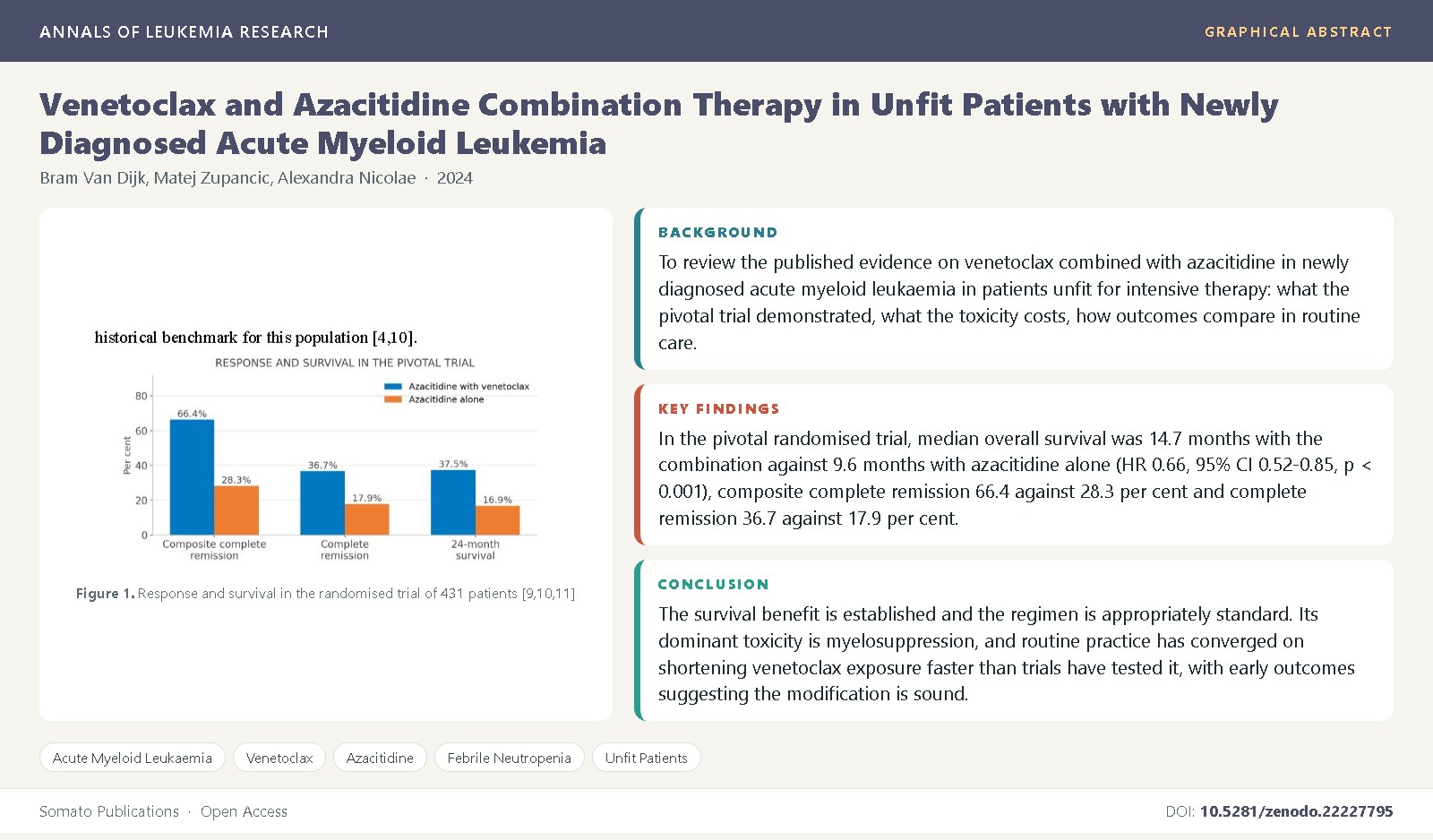
Objectives: To review the published evidence on venetoclax combined with azacitidine in newly diagnosed acute myeloid leukaemia in patients unfit for intensive therapy: what the pivotal trial demonstrated, what the toxicity costs, how outcomes compare in routine care, and what the modifications adopted in practice have achieved. Material and Methods: Narrative review of randomised trials, prospective real-world cohorts, retrospective series and consensus recommendations indexed in PubMed and the major haematology journals. Studies were eligible if they reported efficacy, toxicity or outcome of venetoclax-based combination therapy in a defined newly diagnosed acute myeloid leukaemia population unfit for intensive chemotherapy. No new patient data were generated and no patients were recruited; every estimate quoted is one published by the original investigators. Results: In the pivotal randomised trial, median overall survival was 14.7 months with the combination against 9.6 months with azacitidine alone (HR 0.66, 95% CI 0.52-0.85, p < 0.001), composite complete remission 66.4 against 28.3 per cent and complete remission 36.7 against 17.9 per cent. Grade 3 or higher febrile
neutropenia occurred in 42 against 19 per cent, neutropenia in 42 against 29 and thrombocytopenia in 45 against 38 per cent. In a prospective real-world cohort, median survival was 13.0 months (95% CI 11.4-15.7) and matched comparison against the trial population gave 14.8 against 14.9 months (p = 0.6), with 30-day mortality of 2.6 per cent against 7 per cent in the trial. Survival differed by genetic risk group at 24.5, 15.4 and 8.9 months. Shortening venetoclax from 28 days produced comparable remission rates with less febrile neutropenia in several series. Conclusion: The survival benefit is established and the regimen is appropriately standard. Its dominant toxicity is myelosuppression, and routine practice has converged on shortening venetoclax exposure faster than trials have tested it, with early outcomes suggesting the modification is sound. Abbreviations: AML – Acute Myeloid Leukaemia, ND – Newly Diagnosed, VEN – Venetoclax, AZA – Azacitidine, HMA – Hypomethylating Agent, LDAC – Low-Dose Cytarabine, CR – Complete Remission, CRi – Complete Remission with Incomplete Haematological Recovery, CRc – Composite Complete Remission, OS – Overall Survival, ELN – European LeukemiaNet, G-CSF – Granulocyte Colony-Stimulating Factor, HR – Hazard Ratio.
References
Deschler, B., Lübbert, M. (2006) Acute myeloid leukemia: epidemiology and etiology. Cancer, 107(9): 2099-2107.
Juliusson, G., Antunovic, P., Derolf, A., Lehmann, S., Möllgård, L., et al. (2009) Age and acute myeloid leukemia: real world data on decision to treat and outcomes from the Swedish Acute Leukemia Registry. Blood, 113(18): 4179-4187.
Thein, MS., Ershler, WB., Jemal, A., Yates, JW., Baer, MR. (2013) Outcome of older patients with acute myeloid leukemia: an analysis of SEER data over 3 decades. Cancer, 119(15): 2720-2727.
Dombret, H., Seymour, JF., Butrym, A., Wierzbowska, A., Selleslag, D., Jang, JH., et al. (2015) International phase 3 study of azacitidine vs conventional care regimens in older patients with newly diagnosed AML with >30% blasts. Blood, 126(3): 291-299.
Fenaux, P., Mufti, GJ., Hellström-Lindberg, E., Santini, V., Gattermann, N., et al. (2010) Azacitidine prolongs overall survival compared with conventional care regimens in elderly patients with low bone marrow blast count acute myeloid leukemia. J Clin Oncol, 28(4): 562-569.
Konopleva, M., Pollyea, DA., Potluri, J., Chyla, B., Hogdal, L., Busman, T., et al. (2016) Efficacy and biological correlates of response in a phase II study of venetoclax monotherapy in patients with acute myelogenous leukemia. Cancer Discov, 6(10): 1106-1117.
DiNardo, CD., Pratz, K., Pullarkat, V., Jonas, BA., Arellano, M., Becker, PS., et al. (2019) Venetoclax combined with decitabine or azacitidine in treatment-naive, elderly patients with acute myeloid leukemia. Blood, 133(1): 7-17.
Pollyea, DA., Amaya, M., Strati, P., Konopleva, MY. (2019) Venetoclax for AML: changing the treatment paradigm. Blood Adv, 3(24): 4326-4335.
DiNardo, CD., Jonas, BA., Pullarkat, V., Thirman, MJ., Garcia, JS., Wei, AH., et al. (2020) Azacitidine and venetoclax in previously untreated acute myeloid leukemia. N Engl J Med, 383(7): 617-629.
Döhner, H., Wei, AH., Appelbaum, FR., Craddock, C., DiNardo, CD., Dombret, H., et al. (2022) Diagnosis and management of AML in adults: 2022 recommendations from an international expert panel on behalf of the ELN. Blood, 140(12): 1345-1377.
Pratz, KW., Jonas, BA., Pullarkat, V., Recher, C., Schuh, AC., Thirman, MJ., et al. (2022) Long-term follow-up of VIALE-A: venetoclax and azacitidine in chemotherapy-ineligible untreated acute myeloid leukemia. Am J Hematol, 97(12): E403-E406.
Wei, AH., Montesinos, P., Ivanov, V., DiNardo, CD., Novak, J., Laribi, K., et al. (2020) Venetoclax plus LDAC for newly diagnosed AML ineligible for intensive chemotherapy: a phase 3 randomized placebo-controlled trial. Blood, 135(24): 2137-2145.
Novak, J., Salek, C., Zackova, D., Szotkowski, T., Culen, M., Doubek, M., et al. (2025) Real-world experience with venetoclax-based therapy in acute myeloid leukemia: insights from the Czech Republic. Clin Lymphoma Myeloma Leuk.
Palmieri, R., Piciocchi, A., Soddu, S., Candoni, A., Fracchiolla, NS., Borlenghi, E., et al. (2026) Real-world outcomes of venetoclax plus hypomethylating agents in unfit acute myeloid leukaemia: results of the GIMEMA AML2320 trial. Br J Haematol.
Nakamura, Y., Yokoyama, S., Yoshida, T., Ota, S., Kondo, T., Hashimoto, D., et al. (2025) Comparable outcomes with 14-, 21-, or standard 28-day venetoclax in the first cycle of azacitidine-venetoclax in untreated acute myeloid leukemia: real-world experience from the Hokkaido Leukemia Net. Blood Cancer J, 15: 108.
Döhner, H., Estey, E., Grimwade, D., Amadori, S., Appelbaum, FR., Büchner, T., et al. (2017) Diagnosis and management of AML in adults: 2017 ELN recommendations from an international expert panel. Blood, 129(4): 424-447.
Mrózek, K., Kohlschmidt, J., Blachly, JS., Nicolet, D., Carroll, AJ., Archer, KJ., et al. (2023) Outcome prediction by the 2022 European LeukemiaNet genetic-risk classification for adults with acute myeloid leukemia: an Alliance study. Leukemia, 37(4): 788-798.
Yamamoto, K., Shimizu, N., Kubota, S., Takahashi, N., Sakai, H., Ito, S., et al. (2023) Shorter duration of venetoclax administration to 14 days has same efficacy and better safety profile in treatment of acute myeloid leukemia. Ann Hematol, 102(3): 541-546.
Salamanca Cuenca, A., Cano Ferri, I., Navarro-Cubells, B., Solves Alcaina, P., Montesinos, P. (2025) Venetoclax with low-dose cytarabine, a forgotten combination in patients with acute myeloid leukemia ineligible for intensive chemotherapy: a systematic review. Front Oncol, 14: 1502207.
Kantarjian, H., Kadia, T., DiNardo, C., Daver, N., Borthakur, G., Jabbour, E., et al. (2021) Acute myeloid leukemia: current progress and future directions. Blood Cancer J, 11: 41.
Kayser, S., Levis, MJ. (2021) Updates on targeted therapies for acute myeloid leukaemia. Br J Haematol, 196(2): 316-328.
Lancet, JE., Uy, GL., Cortes, JE., Newell, LF., Lin, TL., Ritchie, EK., et al. (2018) CPX-351 versus conventional cytarabine plus daunorubicin in older patients with newly diagnosed secondary acute myeloid leukemia. J Clin Oncol, 36(26): 2684-2692.
Wei, AH., Döhner, H., Pocock, C., Montesinos, P., Afanasyev, B., Dombret, H., et al. (2020) Oral azacitidine maintenance therapy for acute myeloid leukemia in first remission. N Engl J Med, 383(26): 2526-2537.
Heuser, M., Ofran, Y., Boissel, N., Brunet Mauri, S., Craddock, C., Janssen, J., et al. (2020) Acute myeloid leukaemia in adult patients: ESMO clinical practice guidelines for diagnosis, treatment and follow-up. Ann Oncol, 31(6): 697-712.
Schuurhuis, GJ., Heuser, M., Freeman, S., Béné, MC., Buccisano, F., Cloos, J., et al. (2018) Minimal/measurable residual disease in AML: a consensus document from the European LeukemiaNet MRD Working Party. Blood, 131(12): 1275-1291.





