
Differentiation Syndrome and Early Mortality in Patients with Acute Promyelocytic Leukemia (APL) Treated with All-Trans Retinoic Acid
DOI:
https://doi.org/10.5281/zenodo.22213697Keywords:
Acute Promyelocytic Leukaemia, Differentiation Syndrome, All-Trans Retinoic Acid, Early Death, Corticosteroid ProphylaxisAbstract
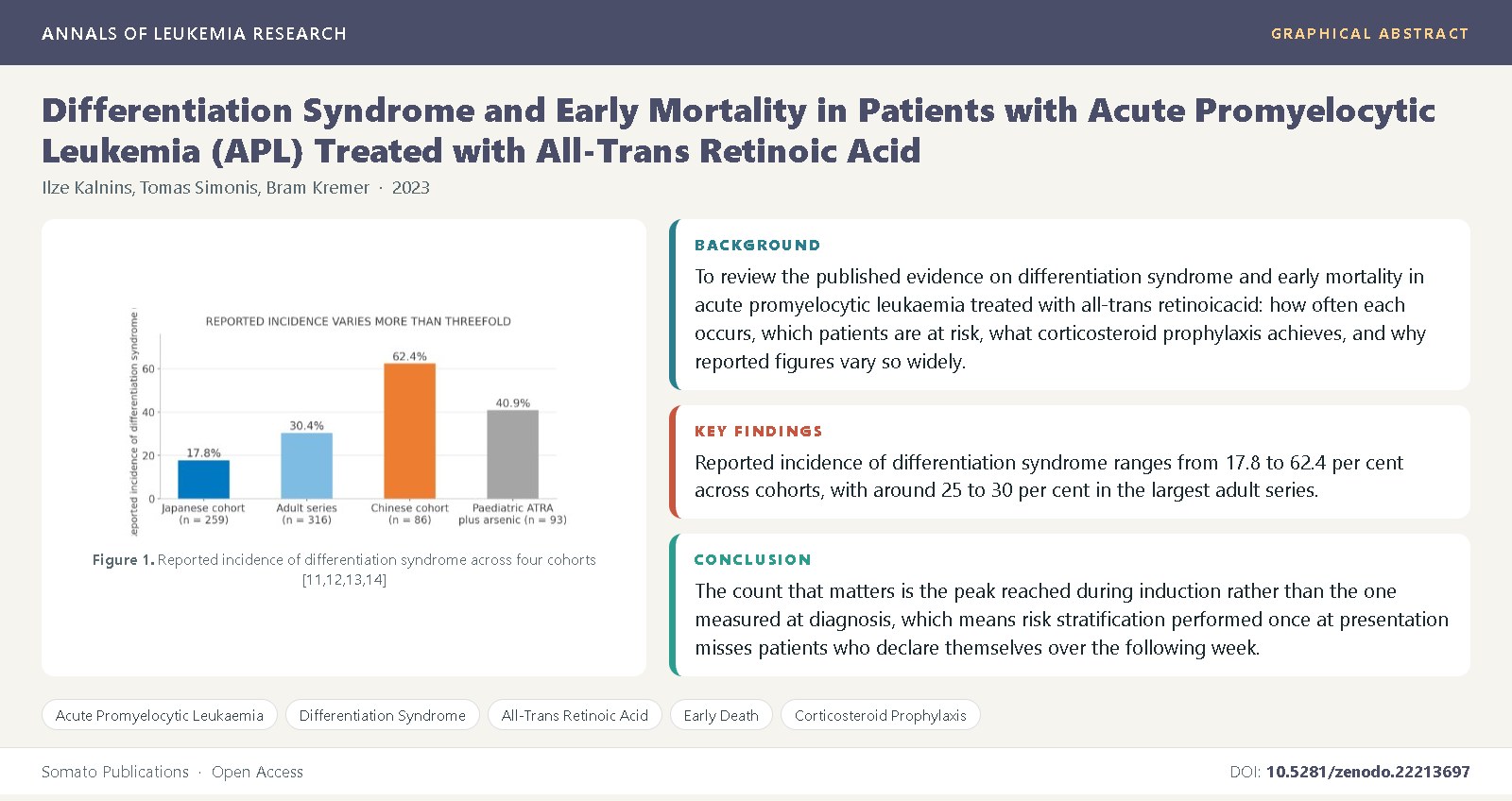
Acute promyelocytic leukaemia went from the most rapidly fatal form of leukaemia to the most curable within a decade, and the drug responsible brought its own lethal complication with it. Differentiation syndrome and early haemorrhagic death together account for almost all the mortality that remains in a disease with long-term survival above 80 per cent. Objectives: To review the published evidence on differentiation syndrome and early mortality in acute promyelocytic leukaemia treated with all-trans retinoic
acid: how often each occurs, which patients are at risk, what corticosteroid prophylaxis achieves, and why reported figures vary so widely. Material and Methods: Narrative review of cooperative group trials, registry analyses, single-centre cohorts and expert recommendations indexed in PubMed and the major haematology journals. Studies were eligible if they reported the incidence, risk factors or outcome of differentiation syndrome, or early mortality, in a defined population with acute promyelocytic leukaemia. No new patient data were generated and no patients were recruited; every estimate quoted is one published by the original investigators.
Results: Reported incidence of differentiation syndrome ranges from 17.8 to 62.4 per cent across cohorts, with around 25 to 30 per cent in the largest adult series. In 739 patients treated on two consecutive cooperative group protocols, severe but not moderate syndrome increased mortality, incidence was bimodal with peaksin the first and third weeks of therapy, and a white cell count above 5 x 10⁹/L together with an abnormal serum creatinine predicte dsevere disease. Corticosteroid prophylaxis reduced the odds of differentiation syndrome by roughly ninety per cent (OR 0.10, 95% CI 0.03-0.35). Early death remains the dominant residual problem: a registry analysis of 1,400 patients reported 17.3 per cent, rising with age, against 13.5 per cent in a trial-treated cohort. A peak white cell count above
43 x 109/L predicted both early death and differentiation syndrome better than the count at diagnosis, including among patients classified as low risk. Conclusion: The count that matters is the peak reached during induction rather than the one measured at diagnosis, which means risk stratification performed once at presentation misses patients who declare themselves over the following week. Corticosteroid prophylaxis is the intervention with the clearest effect and remains inconsistently applied. Abbreviations: APL – Acute Promyelocytic Leukaemia, ATRA – All-Trans Retinoic Acid, ATO – Arsenic Trioxide, DS – Differentiation Syndrome,
PML-RARA – Promyelocytic Leukaemia-Retinoic Acid Receptor Alpha, WBC – White Blood Cell Count, WBCdx – White Cell Count at Diagnosis, WBCmax – Peak White Cell Count, DIC – Disseminated Intravascular Coagulation, ICH – Intracranial Haemorrhage, CR – Complete Remission, OR – Odds Ratio.
References
Lo Coco, F., Diverio, D., Falini, B., Biondi, A., Nervi, C., Pelicci, PG. (1999) Genetic diagnosis and molecular monitoring in the management of acute promyelocytic leukemia. Blood, 94(1): 12-22.
Wang, ZY., Chen, Z. (2008) Acute promyelocytic leukemia: from highly fatal to highly curable. Blood, 111(5): 2505-2515.
Fenaux, P., Chastang, C., Degos, L. (1994) Treatment of newly diagnosed acute promyelocytic leukemia (APL) by a combination of all-trans retinoic acid (ATRA) and chemotherapy. Leukemia, 8(Suppl 2): S42-S47.
Warrell, RP Jr., Maslak, P., Eardley, A., Heller, G., Miller, WH., Frankel, SR. (1994) Treatment of acute promyelocytic leukemia with all-trans retinoic acid: an update of the New York experience. Leukemia, 8(Suppl 2): S33-S37.
Sanz, MA., Lo Coco, F., Martín, G., Avvisati, G., Rayón, C., Barbui, T., et al. (2000) Definition of relapse risk and role of nonanthracycline drugs for consolidation in patients with acute promyelocytic leukemia: a joint study of the PETHEMA and GIMEMA cooperative groups. Blood, 96(4): 1247-1253.
Frankel, SR., Eardley, A., Lauwers, G., Weiss, M., Warrell, RP Jr. (1992) The "retinoic acid syndrome" in acute promyelocytic leukemia. Ann Intern Med, 117(4): 292-296.
Frankel, SR., Eardley, A., Heller, G., Berman, E., Miller, WH Jr., Dmitrovsky, E., et al. (1994) All-trans retinoic acid for acute promyelocytic leukemia. Results of the New York study. Ann Intern Med, 120(4): 278-286.
Nicolls, MR., Terada, LS., Tuder, RM., Prindiville, SA., Schwarz, MI. (1998) Diffuse alveolar hemorrhage with underlying pulmonary capillaritis in the retinoic acid syndrome. Am J Respir Crit Care Med, 158(4): 1302-1305.
Montesinos, P., Bergua, JM., Vellenga, E., Rayón, C., Parody, R., de la Serna, J., León, A., Esteve, J., Milone, G., Debén, G., Rivas, C., González, M., Tormo, M., Díaz-Mediavilla, J., González, JD., Negri, S., Amutio, E., Brunet, S., Lowenberg, B., Sanz, MA. (2009) Differentiation syndrome in patients with acute promyelocytic leukemia treated with all-trans retinoic acid and anthracycline chemotherapy: characteristics, outcome, and prognostic factors. Blood, 113(4): 775-783.
Creutzig, U., Ritter, J., Budde, M., Sutor, A., Schellong, G. (1987) Early deaths due to hemorrhage and leukostasis in childhood acute myelogenous leukemia. Associations with hyperleukocytosis and acute monocytic leukemia. Cancer, 60(12): 3071-3079.
Sakaguchi, M., Yamaguchi, H., Najima, Y., Usuki, K., Ueki, T., Oh, I., et al. (2019) Progressive hyperleukocytosis is a relevant predictive marker for differentiation syndrome, early death, and subsequent relapse in acute promyelocytic leukemia. Sci Rep, 9: 11651.
Analysis of risk factors for differentiation syndrome in patients with acute promyelocytic leukemia. (2025) Medicine (Baltimore).
Wen, J., Xu, F., Zhou, Q., Shi, L., Liu, Y., Yue, J., Zhang, Y., Liang, X. (2023) Effects of peripheral blood leukocyte count and tumor necrosis factor-alpha on early death in acute promyelocytic leukemia. BMC Cancer, 23(1): 27.
Influence of white blood cell count trajectories on the risk of differentiation syndrome during induction therapy with all-trans-retinoic acid and arsenic trioxide in pediatric acute promyelocytic leukemia. (2025) Cancer Med.
Jimenez, JJ., Chale, RS., Abad, AC., Schally, AV. (2020) Acute promyelocytic leukemia (APL): a review of the literature. Oncotarget, 11(11): 992-1003.
Jeddi, R., Ghedira, H., Mnif, S., Gouider, E., Fenaux, P., Meddeb, B. (2010) High body mass index is an independent predictor of differentiation syndrome in patients with acute promyelocytic leukemia. Leuk Res, 34(4): 545-547.
Jeddi, R., Kacem, K., Ben Neji, H., Mnif, S., Gouider, E., Aissaoui, L., et al. (2008) Predictive factors of all-trans-retinoic acid related complications during induction therapy for acute promyelocytic leukemia. Hematology, 13(3): 142-146.
Yamamoto De Almeida, L., Pereira-Martins, DA., Lima, ASG., Baggio, MS., De Araujo Koury, LC., Lange, AP., et al. (2020) Interleukin-8 is not a predictive biomarker for the development of the acute promyelocytic leukemia differentiation syndrome. BMC Cancer, 20(1): 821.
Lo-Coco, F., Avvisati, G., Vignetti, M., Thiede, C., Orlando, SM., Iacobelli, S., et al. (2013) Retinoic acid and arsenic trioxide for acute promyelocytic leukemia. N Engl J Med, 369(2): 111-121.
Sanz, MA., Grimwade, D., Tallman, MS., Lowenberg, B., Fenaux, P., Estey, EH., et al. (2009) Management of acute promyelocytic leukemia: recommendations from an expert panel on behalf of the European LeukemiaNet. Blood, 113(9): 1875-1891.
Burnett, AK., Hills, RK., Grimwade, D., Jovanovic, JV., Craig, J., McMullin, MF., et al. (2013) Inclusion of chemotherapy in addition to anthracycline in the treatment of acute promyelocytic leukaemia does not improve outcomes: results of the MRC AML15 trial. Leukemia, 27(4): 843-851.
Douer, D., Preston-Martin, S., Chang, E., Nichols, PW., Watkins, KJ., Levine, AM. (1996) High frequency of acute promyelocytic leukemia among Latinos with acute myeloid leukemia. Blood, 87(1): 308-313.
Kantarjian, H., Kadia, T., DiNardo, C., Daver, N., Borthakur, G., Jabbour, E., et al. (2021) Acute myeloid leukemia: current progress and future directions. Blood Cancer J, 11: 41.
Platzbecker, U., Avvisati, G., Cicconi, L., Thiede, C., Paoloni, F., Vignetti, M., et al. (2017) Improved outcomes with retinoic acid and arsenic trioxide compared with retinoic acid and chemotherapy in non-high-risk acute promyelocytic leukemia: final results of the randomized Italian-German APL0406 trial. J Clin Oncol, 35(6): 605-612.
Shen, Z., Chen, G., Ni, J., Li, S., Xiong, SM., Qiu, QY., et al. (1997) Use of arsenic trioxide in the treatment of acute promyelocytic leukemia: clinical efficacy and pharmacokinetics in relapsed patients. Blood, 89(9): 3354-3360.
Ghavamzadeh, A., Alimoghaddam, K., Ghaffari, Sh., Rostami, S., Jahani, M., Hosseini, R., et al. (2005) Treatment of acute promyelocytic leukemia with arsenic trioxide without ATRA and/or chemotherapy. Ann Oncol, 17(1): 131-134.
Grimwade, D., Jovanovic, JV., Hills, RK., Nugent, EA., Patel, Y., Flora, R., et al. (2009) Prospective minimal residual disease monitoring to predict relapse of acute promyelocytic leukemia and to direct pre-emptive arsenic trioxide therapy. J Clin Oncol, 27(22): 3650-3658.
Gabert, J., Beillard, E., van der Velden, VH., Bi, W., Grimwade, D., Pallisgaard, N., et al. (2003) Standardization and quality control studies of real-time quantitative reverse transcriptase polymerase chain reaction of fusion gene transcripts for residual disease detection in leukemia: a Europe Against Cancer program. Leukemia, 17(12): 2318-2357.
Kayser, S., Levis, MJ. (2021) Updates on targeted therapies for acute myeloid leukaemia. Br J Haematol, 196(2): 316-328.
Biondi, A., Rovelli, A., Cantú-Rajnoldi, A., Fenu, S., Basso, G., Luciano, A., et al. (1994) Acute promyelocytic leukemia in children: experience of the Italian Pediatric Hematology and Oncology Group (AIEOP). Leukemia, 8(8): 1264-1268.
Cantú-Rajnoldi, A., Biondi, A., Jankovic, M., Masera, G., Rovelli, A., Uderzo, C., et al. (1993) Diagnosis and incidence of acute promyelocytic leukemia (FAB M3 and M3 variant) in childhood. Blood, 81(8): 2209-2211.
Iland, HJ., Seymour, JF., Wei, A. (2014) Optimal approach for high-risk acute promyelocytic leukemia. Curr Opin Hematol, 21(2): 102-113.
Ciftciler, R., Haznedaroglu, IC., Aksu, S., Ozcebe, O., Sayinalp, N., Malkan, UY., Buyukasik, Y. (2019) The factors affecting early death in newly diagnosed APL patients. Open Med (Wars), 14: 647-652.
Cai, P., Wu, Q., Wang, Y., Yang, X., Zhang, X., Chen, S. (2020) An effective early death scoring system for predicting early death risk in de novo acute promyelocytic leukemia. Leuk Lymphoma, 61(8): 1989-1995.
Micol, JB., Raffoux, E., Boissel, N., Lengline, E., Canet, E., Daniel, MT., et al. Management and treatment results in patients with acute promyelocytic leukaemia (APL) not enrolled in clinical trials. Eur J Cancer.





