
Effects of M2000 and Vitamin D3 in the Expression of IL-10, IFN-γ and IL-6 in Crohn’s Diseases
Keywords:
Vitamin D3, IL-6, IFN-γ, IL-10, M2000, Crohn’s diseaseAbstract
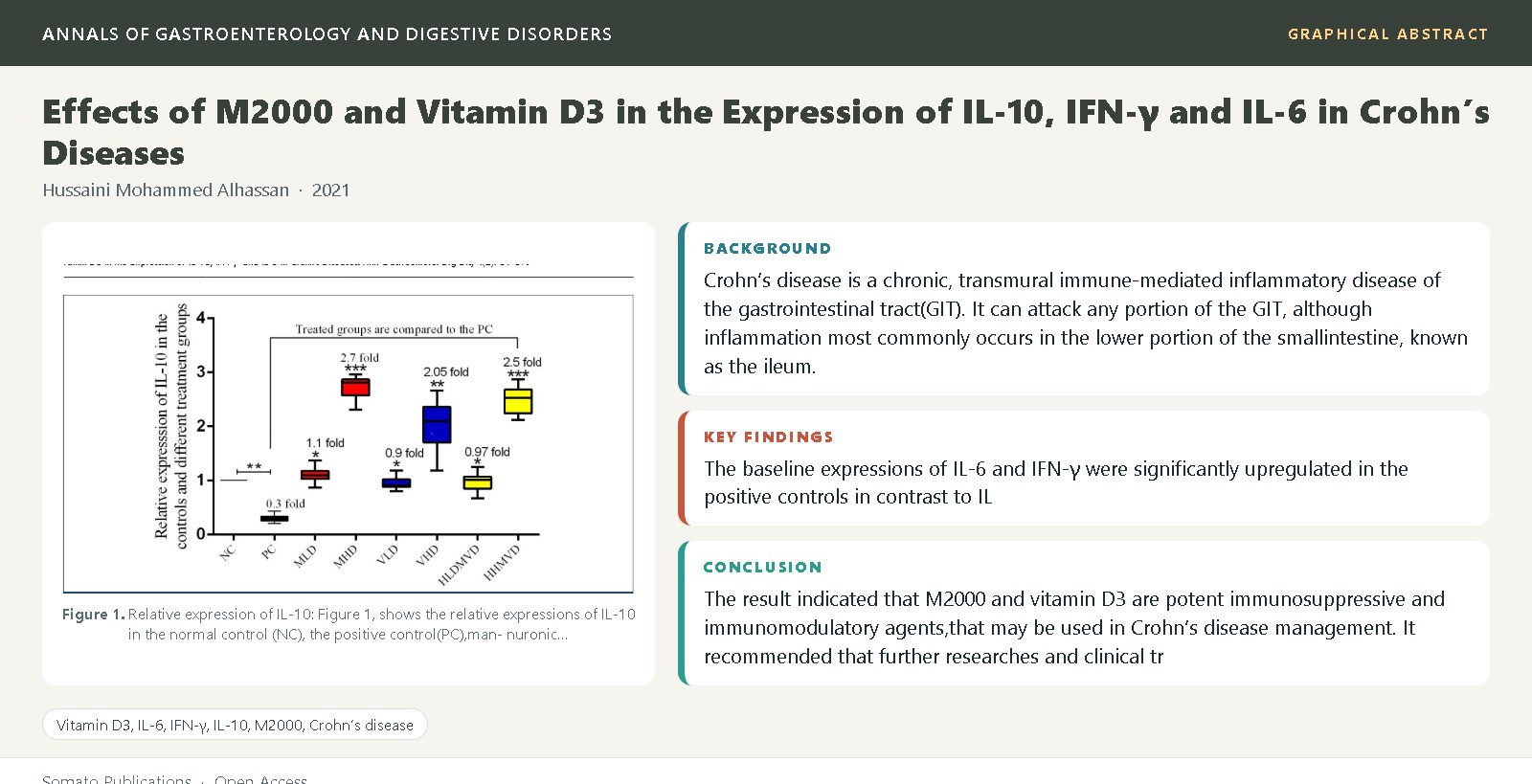
Background: Crohn’s disease is a chronic, transmural immune-mediated inflammatory disease of the gastrointestinal tract
(GIT). It can attack any portion of the GIT, although inflammation most commonly occurs in the lower portion of the small
intestine, known as the ileum. The disease can cause ulcerations within the intestine, which is capable of eroding into surrounding tissues, such as the bladder, vagina and the surface of the skin. Inflammation in Crohn’s disease is not limited to the
intestine, some Crohn’s disease patients have inflammation of the eyes and joints as well. This research aimed to assess the
efficacy of M2000 and vitamin D3 in the treatment of Crohn’s disease.
Materials and Methods: Fifteen (15) ml of blood was collected from 40 research participants. The PBMC was isolated, then
stimulated with LPS and incubated for 4 hours. The cells were later treated with various doses of M2000 and vitamin D3 and
incubated for 24 hours at optimum condition. The cells were harvested and centrifuged at 12,000g for 15 minutes. RNA was
extracted and converted to cDNA. Real-time PCR and ELISA were used for gene and cytokine expressions, respectively.
Results: The baseline expressions of IL-6 and IFN-γ were significantly upregulated in the positive controls in contrast to IL Conclusion: The result indicated that M2000 and vitamin D3 are potent immunosuppressive and immunomodulatory agents,
that may be used in Crohn’s disease management. It recommended that further researches and clinical tr
References
Boussorra, H., Sallami, S., Said, Y., Chebil, M., Najjar, T. (2013) Evaluation of urolithiasis in Crohn's disease in Tunisian patients. Tunis Med, 91(7): 440-443.
Feller, ER., Ribaudo, S., Jackson, ND. (2001) Gynecologic aspects of Crohn's disease. Am Fam Physician, 64(10): 1725-1729.
Veloso, FT. (2004) Review article: skin complications associated with inflammatory bowel disease. Aliment Pharmacol Ther, 20(suppl 4): 50-53.
Vermeire, S., Peeters, M., Vlietinck, R., Joossens, S., Hond, ED., Bulteel, V., et al. (2001) Anti-Saccharomyces cerevisiae antibodies (ASCA) phenotypes of IBD and intestinal permeability: a study in IBD families. Inflamm Bowel Dis, 7(1): 8-15.
Wirtz, S., Neurath, MF. (2007) Mouse models of inflammatory bowel disease. Adv Drug Deliv Rev, 59(11): 1073- 1083.
Rennick, DM., Fort, MM. (2000) Lessons from genetically engineered animal models XII IL-10-deficient (IL-10 (-/-) mice and intestinal inflammation. Am J Physiol Gastrointest Liver Physiol, 278(6): 829-833.
Melgar, S., YEUNG, MW., Bas, A., Forsberg, G., Suhr, O., OBerg, A., et al. (2003) Over expression of interleukin 10 in mucosal T cells of patients with active ulcerative colitis. Clin Exp Immunol, 134(1): 127-137.
Fedorak, RN., Nielsen, OH., Williams, NC., Malchow, H., Forbes, A., Stein, B., et al. (2001) Human recombinant interleukin-10 is safe and well tolerated but does not induce remission in steroid dependent Crohn's disease. Gastroenterology, 120(5): A127.
Latina, D., Fiasse, R. (2005) New insights into the cellular immunology of the intestine in relation to the pathophysiology of inflammatory bowel diseases. Acta Gastroenterol Belg, 69(4): 393-405.
Mizoguchi, A., Bhan, AK. (2006) A case for regulatory B cells. J Immunol, 176(2): 705-710.
Goetz, M., Atreya, R., Ghalibafian, M., Galle, PR., Neurath, MF. (2007) Exacerbation of ulcerative colitis after rituximab salvage therapy. Inflamm Bowel Dis, 13(11): 1365- 1368.
Salmi, M., Jalkanen, S. (2001) Human leukocyte subpopulations from inflamed gut bind to joint vasculature using distinct sets of adhesion molecules. J Immunol, 166(7): 4650-4657.
Hull, J., Ackerman, H., Isles, K., Usen, S., Pinder, M., Thomson, A., et al. (2001) Unusual haplotypic structure of IL8 a susceptibility locus for a common respiratory virus. Am J Hum Genet, 69(2): 413-419.
Zhu, J., Yamane, H., Cote-Sierra, J., Guo, L., Paul, WE. (2006) GATA 3 promotes Th2 responses through three different mechanisms: induction of Th2 cytokine production, selective growth of Th2 cells and inhibition of Th1 cell specific factors. Cell Res, 16(1): 3-10.
Fuss, IJ., Heller, F., Boirivant, M., Leon, F., Yoshida, M., Fichtner-Feigl, S., et al. (2004) Nonclassical CD1d-restricted NK T cells that produce IL-13 characterize an atypical Th2 response in ulcerative colitis. Journal of Clinical Investigation,113(10):1490-1497.
Garg, M., Lubel, J., Sparrow, M., Holt, S., Gibson, P. (2012) Vitamin D and inflammatory bowel disease–established concepts and future directions. Aliment PharmacolTher, 36(4):324-344.
Raman, M., Milestone, AN., Walters, JR., Hart, AL., Ghosh, S. (2011) Vitamin D and gastrointestinal diseases: inflammatory bowel disease and colorectal cancer. TherapAdv- Gastroenterol, 4(1):49-62.
Mirshafiey, A., Rehm, BH. (2009) Alginate and its comonomermannuronic acid: medical relevance as drugs. Alginates: Biology and Applications: Springer, 13: 229-260. 19.
Mirshafiey, A., Cuzzocrea, S., Rehm, B., Matsuo, H. (2005) M2000: a revolution in pharmacology. Med SciMonit, 11(8):PI53-PI63.
Mirshafiey, A., Rehm, B., Abhari, RS., Borzooy, Z., Sotoude, M., Razavi, A. (2007) Production of M2000 (β-d-mannuronic acid) and its therapeutic effect on experimental nephritis. Environ ToxicolPharmacol, 24(1):60-66.
Canning, MO., Grotenhuis, K., de Wit, H., Ruwhof, C., Drexhage, HA. (2001) 1-alpha, 25-dihydroxy vitamin D3 (1,25 (OH)2D3) hampers the maturation of fully active immature dendritic cells from monocytes. Eur J Endocrinol, 145(3):351-357.
Gombart, AF., Borregaard, N., Koeffler, HP. (2005) The human cathelicidin antimicrobial peptide (CAMP) gene is a direct target of the vitamin D receptor and is strongly up-regulated in myeloid cells by 1,25-dihydroxy vitamin D3. FASEB J, 19:1067-1077.
Schreiber, S., Fedorak, RN., Nielsen, OH., Wild, G., Williams, CN.,Nikolaus, S., et al. (2000) Safety and efficacy of recombinant human interleukin 10 in chronic active Crohn's disease. Gastroenterology, 119(6): 1461-1472.
Liang, SC., Tan, X-Y., Luxenberg, DP., Karim, R., Dunussi-Joannopoulos, K., Collins, M., et al. (2006) Interleukin (IL)-22 and IL-17 are coexpressed by Th17 cells and cooperatively enhance expression of antimicrobial peptides. J Exp Med, 203(10):2271-2279.
Papadakis, KA., Targan, SR. (2000) Role of cytokines in the pathogenesis of inflammatory bowel disease. Annu Rev Med, 51:289-298.
Boonstra, A., Barrat, FJ., Crain, C., Heath, VL., Savelkoul, HF., O’Garra, A. (2001) 1α, 25-dihydroxy vitamin D3 has a direct effect on naive CD4+ T cells to enhance the development of Th2 cells. J Immunol, 167(9):4974-4980.
Bartels, LE., Jørgensen, SP., Agnholt, J., Kelsen, J., Hvas, CL., Dahlerup, JF. (2007) 1, 25-dihydroxy vitamin D3 and dexamethasone increase interleukin-10 production in CD4+ T cells from patients with Crohn's disease. IntImmunopharmacol. 7(13):1755-64.





