
Molecular Detection of Clarithromycin Resistance in Gastric Biopsies and Stool Samples from Patients with Helicobacter pylori Infection: A Review
DOI:
https://doi.org/10.5281/zenodo.22179549Keywords:
Helicobacter pylori, Clarithromycin Resistance, 23S rRNA, Stool PCR, Antimicrobial StewardshipAbstract
Clarithromycin resistance is the single strongest predictor of eradication failure in Helicobacter pylori infection, and the conventional way of measuring it, culture with phenotypic susceptibility testing, requires endoscopy and often fails to grow the organism at all. Molecular detection of the responsible point mutations avoids both problems, and can be done on stool. Objectives: To review the published evidence on molecular detection of clarithromycin resistance in Helicobacter pylori: which mutations are targeted
and how often each occurs, how molecular testing on gastric biopsies compares with culture, how stool-based testing performs against biopsy-derived reference standards, and what susceptibility-guided treatment achieves. Material and Methods: Narrative review of diagnostic accuracy studies, assay evaluations, meta-analyses, consensus reports and guidelines indexed in PubMed and the major gastroenterology and clinical microbiology journals. Studies were eligible if they reported the prevalence or distribution of
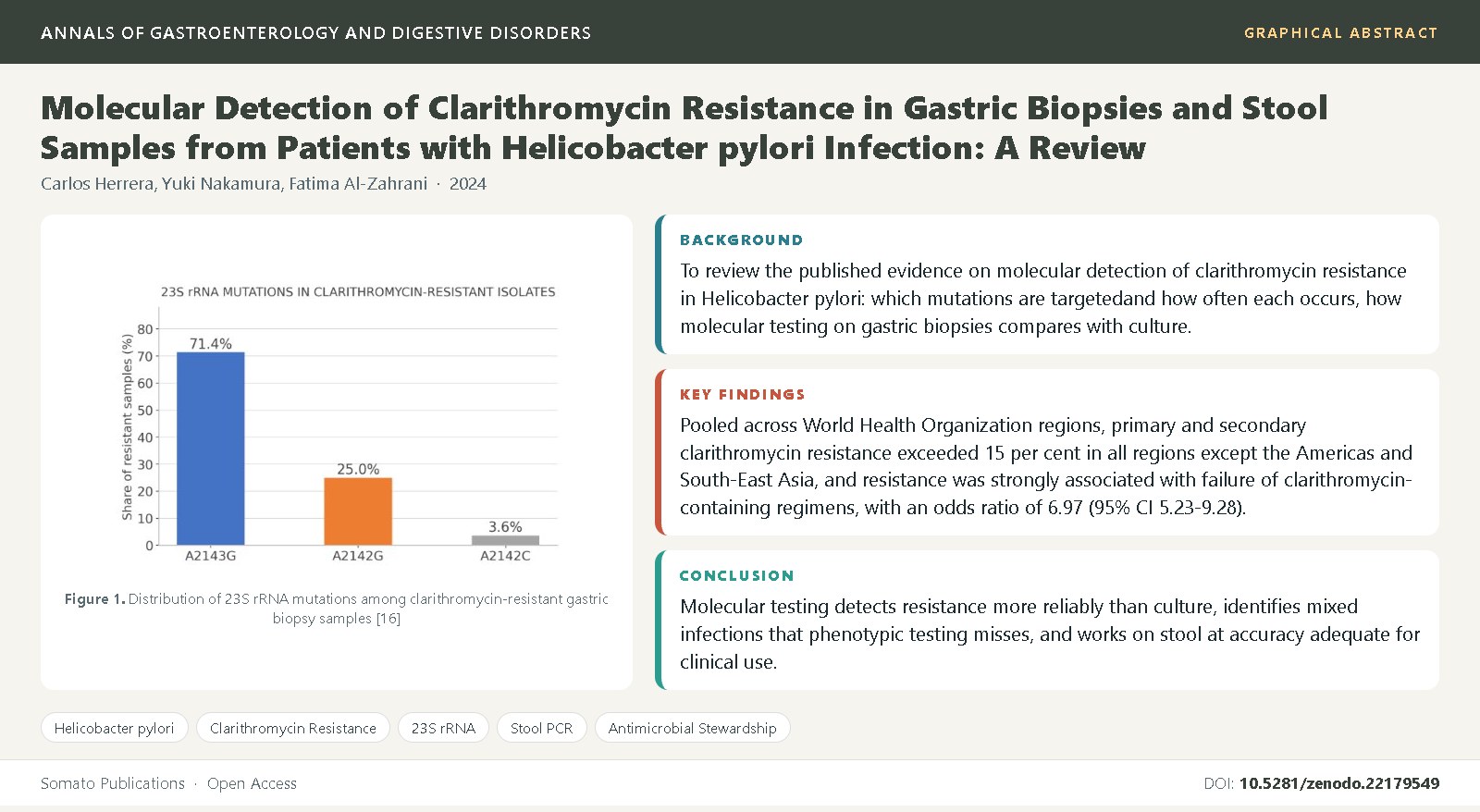
resistance-conferring mutations, the performance of a molecular assay against culture or sequencing, the accuracy of stool-based testing, or treatment outcomes stratified by resistance. No new patient data were generated; every frequency and accuracy estimate quoted is one published by the original investigators. Results: Pooled across World Health Organization regions, primary and secondary clarithromycin resistance exceeded 15 per cent in all regions except the Americas and South-East Asia, and resistance was strongly associated with failure of clarithromycin-containing regimens, with an odds ratio of 6.97 (95% CI 5.23-9.28). In a prospective study of 1,200 patients, 23S rRNA mutations were found in 17.5 per cent of PCR-positive gastric biopsies, distributed as A2143G in 71.4 per cent, A2142G in 25 per cent and A2142C in 3.6 per cent; mixed susceptible and resistant infections were present in 1.9 per cent
and were invisible to phenotypic testing. Pooling stool studies, PCR for clarithromycin resistance gave a sensitivity of 0.91 and a specificity of 0.97, with an area under the curve of 0.94. Conclusion: Molecular testing detects resistance more reliably than culture, identifies mixed infections that phenotypic testing misses, and works on stool at accuracy adequate for clinical use. Its principal limitation is what it cannot see: it reports the mutations it is designed to detect and nothing else, so a negative molecular result excludes the common mechanisms rather than excluding resistance. Abbreviations: H. pylori – Helicobacter pylori, CLR – Clarithromycin, MIC – Minimum Inhibitory Concentration, PCR – Polymerase Chain Reaction, RT-PCR – Real-Time Polymerase Chain Reaction, FRET – Fluorescence Resonance Energy Transfer, FISH – Fluorescence In Situ Hybridisation, rRNA – Ribosomal Ribonucleic Acid, WHO – World Health Organization, PPI – Proton Pump Inhibitor, OR – Odds Ratio, AUC – Area Under the Curve, FFPE – Formalin-Fixed Paraffin-Embedded.
References
Hooi JKY, Lai WJ, Ng WK, et al. "Global prevalence of Helicobacter pylori infection: systematic review and meta-analysis". Gastroenterology 153(2017):420-429.
Pounder RE, Ng D. "The prevalence of Helicobacter pylori infection in different countries". Aliment Pharmacol Ther 9(1995):33-39.
Malfertheiner P, Megraud F, O’Morain CA, et al. "Management of Helicobacter pylori infection: the Maastricht V/Florence Consensus Report". Gut 66(2017):6-30.
Malfertheiner P, Megraud F, Rokkas T, Gisbert JP, Liou JM, Schulz C, et al. "Management of Helicobacter pylori infection: the Maastricht VI/Florence consensus report". Gut 71(2022):1724-1762.
Sugano K, Tack J, Kuipers EJ, et al. "Kyoto global consensus report on Helicobacter pylori gastritis". Gut 64(2015):1353-1367.
Banks M, Graham D, Jansen M, et al. "British Society of Gastroenterology guidelines on the diagnosis and management of patients at risk of gastric adenocarcinoma". Gut 68(2019):1545-1575.
Gupta S, Li D, El Serag HB, et al. "AGA clinical practice guidelines on management of gastric intestinal metaplasia". Gastroenterology 158(2020):693-702.
Savoldi A, Carrara E, Graham DY, Conti M, Tacconelli E. "Prevalence of antibiotic resistance in Helicobacter pylori: a systematic review and meta-analysis in World Health Organization regions". Gastroenterology 155(2018):1372-1382.
Mégraud F. "Antibiotic resistance is the key element in treatment of Helicobacter pylori infection". Gastroenterology 155(2018):1300-1302.
Albasha AM, Elnosh MM, Osman EH, Zeinalabdin DM, Fadl AAM, Ali MA, Altayb HN. "Helicobacter pylori 23S rRNA gene A2142G, A2143G, T2182C, and C2195T mutations associated with clarithromycin resistance detected in Sudanese patients". BMC Microbiol 21(2021). doi: 10.1186/s12866-021-02096-3.
Shiotani A, Roy P, Lu H, Graham DY. "Helicobacter pylori diagnosis and therapy in the era of antimicrobial stewardship". Therap Adv Gastroenterol 14(2021). doi: 10.1177/17562848211064080.
Hays C, Delerue T, Lamarque D, et al. "Molecular diagnosis of Helicobacter pylori infection in gastric biopsies: evaluation of the Amplidiag H. pylori + ClariR assay". Helicobacter 24(2019):e12560.
Rolon RM, Cunningham SA, Mandrekar JN, et al. "Clinical evaluation of a real-time PCR assay for simultaneous detection of Helicobacter pylori and genotypic markers of clarithromycin resistance directly from stool". J Clin Microbiol 59(2021).
Fallone CA, Chiba N, van Zanten SV, et al. "The Toronto Consensus for the treatment of Helicobacter pylori infection in adults". Gastroenterology 151(2016):51-69.
Zorniak M, Sirtl S, Mahajan UM, et al. "Influence of COVID-19 pandemic on endoscopic procedures in two European large-capacity endoscopy units". Dig Dis (2021).
Pichon M, Pichard B, Barrioz T, Plouzeau C, Croquet V, et al. "Diagnostic accuracy of a noninvasive test for detection of Helicobacter pylori and resistance to clarithromycin in stool by the Amplidiag H. pylori+ClariR real-time PCR assay". J Clin Microbiol 58(2020):e01787-19.
Noguchi N, Rimbara E, Kato A, et al. "Detection of mixed clarithromycin-resistant and -susceptible Helicobacter pylori using nested PCR and direct sequencing of DNA extracted from faeces". J Med Microbiol 56(2007):1174-1180.
Gong RJ, Xu CX, Li H, Liu XM. "Polymerase chain reaction-based tests for detecting Helicobacter pylori clarithromycin resistance in stool samples: a meta-analysis". World J Clin Cases 9(2021):133-147.
Ren X, Shi Y, Suo B, Yao X, Lu H, Li C, Zhang Y, Zhou L, Tian X, Song Z. "Individualized diagnosis and eradication therapy for Helicobacter pylori infection based on gene detection of clarithromycin resistance in stool specimens: a systematic review and meta-analysis". Helicobacter 28(2023):e12958.
Osaki T, Mabe K, Zaman C, et al. "Usefulness of detection of clarithromycin-resistant Helicobacter pylori from fecal specimens for young adults treated with eradication therapy". Helicobacter 22(2017).
Kakiuchi T, Hashiguchi K, Imamura I, et al. "Assessment of a novel method to detect clarithromycin-resistant Helicobacter pylori using a stool antigen test reagent". (2020).
Venerito M, Schneider C, Costanzo R, et al. "Contribution of Helicobacter pylori infection to the risk of peptic ulcer bleeding in patients on nonsteroidal anti-inflammatory drugs, antiplatelet agents, anticoagulants, corticosteroids and selective serotonin reuptake inhibitors". Aliment Pharmacol Ther 47(2018):1464-1471.
Sung H, Ferlay J, Siegel RL, et al. "Global cancer statistics 2020: GLOBOCAN estimates of incidence and mortality worldwide for 36 cancers in 185 countries". CA Cancer J Clin 71(2021):209-249.
Lordick F, Carneiro F, Cascinu S, et al. "Gastric cancer: ESMO Clinical Practice Guideline for diagnosis, treatment and follow-up". Ann Oncol 33(2022):1005-1020.
Shah MA, Kennedy EB, Alarcon-Rozas AE, et al. "Immunotherapy and targeted therapy for advanced gastroesophageal cancer: ASCO guideline". J Clin Oncol 41(2023):1470-1491.
Asesio N, Mhamdi Aloui N, Bonnereau J, Lehmann-Che J, Bouhidel F, et al. "Assessment of the reliability of MSI status and dMMR proteins deficiency screening on endoscopic biopsy material in esophagus and gastric adenocarcinoma". Dig Liver Dis 55(2023):1105-1113.
Fornaro L, Lonardi S, Catanese S, Nappo F, Pietrantonio F, et al. "Concordance of microsatellite instability and mismatch repair status in paired biopsies and surgical specimens of resectable gastroesophageal adenocarcinoma". Gastric Cancer 26(2023):958-968.
Ogawa H, Abe H, Yagi K, Seto Y, Ushiku T. "Claudin-18 status and its correlation with HER2 and PD-L1 expression in gastric cancer with peritoneal dissemination". Gastric Cancer 27(2024):802-810.
Choi E, Shin J, Ryu MH, Kim HD, Park YS. "Heterogeneity of claudin 18.2 expression in metastatic gastric cancer". Sci Rep 14(2024):17648.
Choi YY, Kim H, Shin SJ, et al. "Microsatellite instability and programmed cell death-ligand 1 expression in stage II/III gastric cancer: post hoc analysis of the CLASSIC randomized controlled study". Ann Surg 270(2019):309-316.
Jun KH, Kim JH, Jung JH, Choi HJ, Chin HM. "Expression of claudin-7 and loss of claudin-18 correlate with poor prognosis in gastric cancer". Int J Surg 12(2014):156-162.





