
Molecular Characterisation and Therapeutic Implications of FGFR2 Fusions in Tissue and Circulating Tumor DNA from Patients with Intrahepatic Cholangiocarcinoma: A Review
DOI:
https://doi.org/10.5281/zenodo.22179497Keywords:
FGFR2 Fusion, Intrahepatic Cholangiocarcinoma, Liquid Biopsy, Molecular Diagnostics, Acquired ResistanceAbstract
FGFR2 fusion is the one alteration in intrahepatic cholangiocarcinoma that reliably changes what a patient is offered. Finding it is harder than the literature implies, because the fusion partner varies from case to case and most assays are built around partners they already know. Objectives: To review the published evidence on FGFR2 fusions in intrahepatic cholangiocarcinoma: how often they occur, how reliably the available assays detect them in tissue and in plasma, what response and survival have been reported with FGFR inhibition, and how acquired resistance emerges and is detected. Material and Methods: Narrative review of discovery studies, diagnostic accuracy and proficiency studies, prospective trials and correlative sequencing analyses indexed in PubMed and the major oncology and pathology journals. Studies were eligible if they reported the prevalence or architecture of FGFR2 fusions, the performance of a detection assay in tissue or plasma, outcomes with FGFR-directed therapy, or mechanisms of acquired resistance.
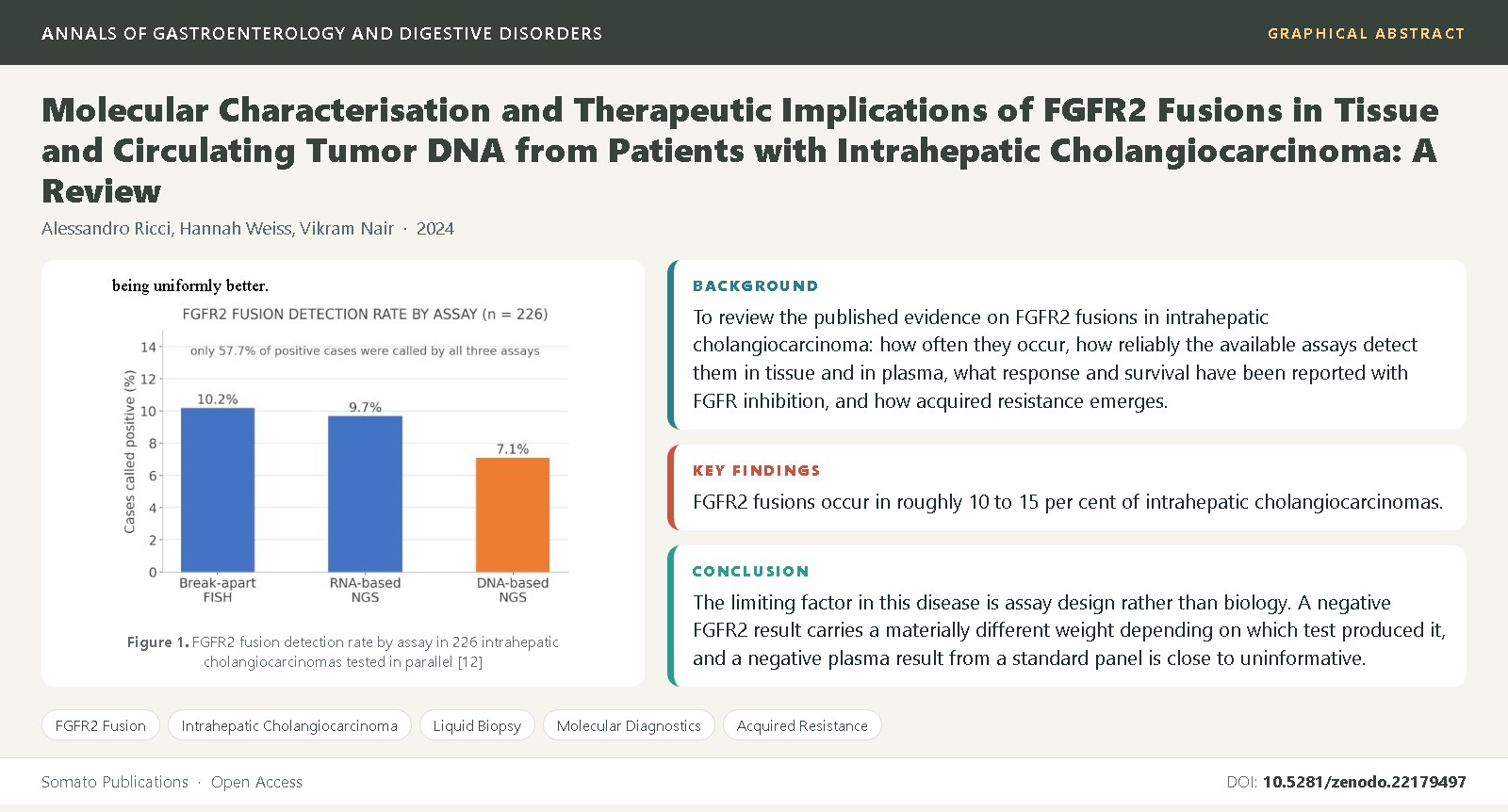
No new patient data were generated; every frequency, accuracy estimate and survival figure quoted is one published by the original investigators. Results: FGFR2 fusions occur in roughly 10 to 15 per cent of intrahepatic cholangiocarcinomas. In a series of 226 cases assayed three ways, detection rates were 10.2 per cent by break-apart FISH, 9.7 per cent by RNA-based sequencing and 7.1 per cent by DNA-based sequencing, and only 57.7 per cent of the cases called positive by any method were positive by all three. Against RNA sequencing as reference, FISH showed 95.2 per cent sensitivity and DNA sequencing 71.4 per cent. Plasma performs worse still with standard panels: among patients with a tissue-confirmed fusion, cell-free DNA recovered the fusion in 18 per cent overall, 58 per cent where the partner was BICC1 and 2 per cent where it was not. A custom panel tiling the FGFR2 intron recovered fusions in 88.9 per cent. Objective response with FGFR inhibition ranged from 23.1 per cent with infigratinib to 46.5 per cent with lirafugratinib, and median overall survival reached 17.5 months with pemigatinib and 21.7 months with futibatinib. Conclusion: The limiting factor in this disease is assay design rather than biology. A negative FGFR2 result carries a materially different weight depending on which test produced it, and a negative plasma result from a standard panel is close to uninformative. Plasma earns its place in serial
monitoring, where it detects the polyclonal resistance mutations that tissue rebiopsy cannot practically capture. Abbreviations: iCCA – Intrahepatic Cholangiocarcinoma, CCA – Cholangiocarcinoma, FGFR – Fibroblast Growth Factor Receptor, FGFRi – FGFR
Inhibitor, NGS – Next-Generation Sequencing, FISH – Fluorescence In Situ Hybridisation, IHC – Immunohistochemistry, cfDNA – Cell-Free DNA, ctDNA – Circulating Tumour DNA, FFPE – Formalin-Fixed Paraffin-Embedded, ORR – Objective Response Rate, DCR – Disease Control Rate, PFS – Progression-Free Survival, OS – Overall Survival, VAF – Variant Allele Frequency.
References
Banales JM, Marin JJG, Lamarca A, Rodrigues PM, Khan SA, Roberts LR, et al. "Cholangiocarcinoma 2020: the next horizon in mechanisms and management". Nat Rev Gastroenterol Hepatol 17(2020):557-588.
Khan SA, Tavolari S, Brandi G. "Cholangiocarcinoma: epidemiology and risk factors". Liver Int 39(2019):19-31.
Arai Y, Totoki Y, Hosoda F, Shirota T, Hama N, Nakamura H, et al. "Fibroblast growth factor receptor 2 tyrosine kinase fusions define a unique molecular subtype of cholangiocarcinoma". Hepatology 59(2014):1427-1434.
Graham RP, Barr Fritcher EG, Pestova E, Schulz J, Sitailo LA, Vasmatzis G, et al. "Fibroblast growth factor receptor 2 translocations in intrahepatic cholangiocarcinoma". Hum Pathol 45(2014):1630-1638.
Sia D, Losic B, Moeini A, Cabellos L, Hao K, Revill K, et al. "Massive parallel sequencing uncovers actionable FGFR2-PPHLN1 fusion and ARAF mutations in intrahepatic cholangiocarcinoma". Nat Commun 6(2015):6087.
Turner N, Grose R. "Fibroblast growth factor signalling: from development to cancer". Nat Rev Cancer 10(2010):116-129.
Brooks AN, Kilgour E, Smith PD. "Molecular pathways: fibroblast growth factor signaling: a new therapeutic opportunity in cancer". Clin Cancer Res 18(2012):1855-1862.
Abou-Alfa GK, Sahai V, Hollebecque A, Vaccaro G, Melisi D, Al-Rajabi R, et al. "Pemigatinib for previously treated, locally advanced or metastatic cholangiocarcinoma: a multicentre, open-label, phase 2 study". Lancet Oncol 21(2020):671-684.
Javle M, Lowery M, Shroff RT, et al. "Phase II study of BGJ398 in patients with FGFR-altered advanced cholangiocarcinoma". J Clin Oncol 36(2018):276-282.
Javle M, Roychowdhury S, Kelley RK, et al. "Infigratinib (BGJ398) in previously treated patients with advanced or metastatic cholangiocarcinoma with FGFR2 fusions or rearrangements: mature results from a multicentre, open-label, single-arm, phase 2 study". Lancet Gastroenterol Hepatol 6(2021):803-815.
Goyal L, Meric-Bernstam F, Hollebecque A, et al. "Futibatinib for FGFR2-rearranged intrahepatic cholangiocarcinoma". N Engl J Med 388(2023):228-239.
Cao Z, Yang Y, Liu S, Sun L, Liu Y, Luo Y, Wang J, Sun Y. "FGFR2 fusions assessed by NGS, FISH, and immunohistochemistry in intrahepatic cholangiocarcinoma". J Gastroenterol (2024). doi: 10.1007/s00535-024-02175-y.
Silverman IM, Li M, Murugesan K, Krook MA, Javle MM, Kelley RK, et al. "Validation and characterization of FGFR2 rearrangements in cholangiocarcinoma with comprehensive genomic profiling". J Mol Diagn 24(2022):351-364.
Neumann O, Lehmann U, Bartels S, Pfarr N, Albrecht T, Ilm K, et al. "First proficiency testing for NGS-based and combined NGS- and FISH-based detection of FGFR2 fusions in intrahepatic cholangiocarcinoma". J Pathol Clin Res 9(2023):100-107.
Ross JS, Wang K, Gay L, et al. "New routes to targeted therapy of intrahepatic cholangiocarcinomas revealed by next-generation sequencing". Oncologist 19(2014):235-242.
Lowery MA, Ptashkin R, Jordan E, Berger MF, Zehir A, Capanu M, et al. "Comprehensive molecular profiling of intrahepatic and extrahepatic cholangiocarcinomas: potential targets for intervention". Clin Cancer Res 24(2018):4154-4161.
Farshidfar F, Zheng S, Gingras MC, et al. "Integrative genomic analysis of cholangiocarcinoma identifies distinct IDH-mutant molecular profiles". Cell Rep 18(2017):2780-2794.
Cao J, Hu J, Liu S, Meric-Bernstam F, Abdel-Wahab R, Xu J, et al. "Intrahepatic cholangiocarcinoma: genomic heterogeneity between eastern and western patients". JCO Precis Oncol 4(2020):557-569.
Maruki Y, Morizane C, Arai Y, et al. "Molecular detection and clinicopathological characteristics of advanced/recurrent biliary tract carcinomas harboring the FGFR2 rearrangements: a prospective observational study (PRELUDE study)". J Gastroenterol 56(2021):250-260.
Berchuck JE, Facchinetti F, DiToro DF, Baiev I, Majeed U, Reyes S, et al. "The clinical landscape of cell-free DNA alterations in 1,671 patients with advanced biliary tract cancer". Ann Oncol 33(2022).
González-Medina A, Vila-Casadesús M, Gomez-Rey M, Fabregat-Franco C, Sierra A, et al. "Clinical value of liquid biopsy in patients with FGFR2 fusion-positive cholangiocarcinoma during targeted therapy". Clin Cancer Res 30(2024):4491-4504.
Subbiah V, Sahai V, Maglic D, et al. "RLY-4008, the first highly selective FGFR2 inhibitor with activity across FGFR2 alterations and resistance mutations". Cancer Discov 13(2023):2012-2031.
Hollebecque A, Borad MJ, Lu P, et al. "Efficacy and safety of lirafugratinib in FGFRi-naive cholangiocarcinoma patients harboring FGFR2 fusions/rearrangements". J Clin Oncol 44(2026): abstract 476.
Goyal L, Saha SK, Liu LY, Siravegna G, Leshchiner I, Ahronian LG, et al. "Polyclonal secondary FGFR2 mutations drive acquired resistance to FGFR inhibition in patients with FGFR2 fusion-positive cholangiocarcinoma". Cancer Discov 7(2017):252-263.
Goyal L, et al. "TAS-120 overcomes resistance to ATP-competitive FGFR inhibitors in patients with FGFR2 fusion-positive intrahepatic cholangiocarcinoma". Cancer Discov 9(2019):1064-1079.
Silverman IM, Hollebecque A, Friboulet L, Owens S, Newton RC, Zhen H, et al. "Clinicogenomic analysis of FGFR2-rearranged cholangiocarcinoma identifies correlates of response and mechanisms of resistance to pemigatinib". Cancer Discov 11(2021):326-339.
Borad MJ, Champion MD, Egan JB, et al. "Integrated genomic characterization reveals novel, therapeutically relevant drug targets in FGFR and EGFR pathways in sporadic intrahepatic cholangiocarcinoma". PLoS Genet 10(2014):e1004135.
Gu TL, Deng X, Huang F, Tucker M, Crosby K, Rimkunas V, et al. "Survey of tyrosine kinase signaling reveals ROS kinase fusions in human cholangiocarcinoma". PLoS One 6(2011):e15640.
Vijgen S, Terris B, Rubbia-Brandt L. "Pathology of intrahepatic cholangiocarcinoma". Hepatobiliary Surg Nutr 6(2017):22-34.
Chen L, et al. "Fibroblast growth factor receptor fusions in cancer: opportunities and challenges". J Exp Clin Cancer Res 40(2021):345.
Liang G, Liu Z, Wu J, Cai Y, Li X. "Anticancer molecules targeting fibroblast growth factor receptors". Trends Pharmacol Sci 33(2012):531-541.
Pellegrini L, Burke DF, von Delft F, Mulloy B, Blundell TL. "Crystal structure of fibroblast growth factor receptor ectodomain bound to ligand and heparin". Nature 407(2000):1029-1034.
Hoy SM. "Pemigatinib: first approval". Drugs 80(2020):923-929.
Syed YY. "Futibatinib: first approval". Drugs 82(2022):1737-1743.
Oishi N, et al. "Transcriptomic profiling reveals hepatic stem-like gene signatures and interplay of miR-200c and epithelial-mesenchymal transition in intrahepatic cholangiocarcinoma". Hepatology 56(2012):1792-1803.
Saha SK, et al. "Mutant IDH inhibits HNF-4alpha to block hepatocyte differentiation and promote biliary cancer". Nature 513(2014):110-114.





