
Methylation-Based Liquid Biopsy Markers for Early Detection of Malignant Transformation in Patients with Pancreatic Cystic Neoplasms: A Review
DOI:
https://doi.org/10.5281/zenodo.22163719Keywords:
DNA Methylation, Pancreatic Cystic Neoplasm, Liquid Biopsy, Intraductal Papillary Mucinous Neoplasm, Early DetectionAbstract
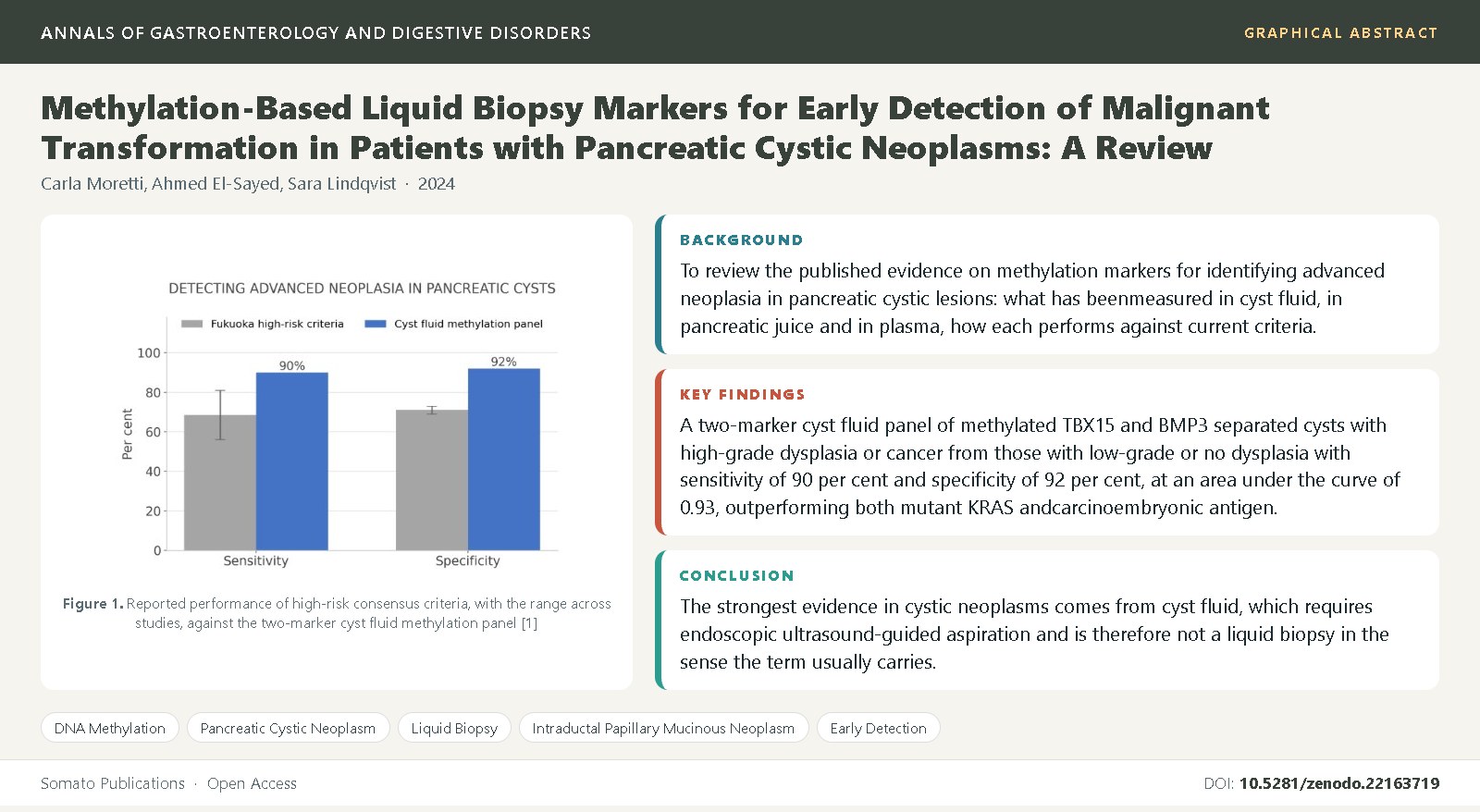
Pancreatic cysts are found incidentally in a large number of older adults, most will never become cancer, and the criteria used to decide who needs surgery are not accurate enough to separate the two groups. Methylation markers have been proposed as a solution. Whether they amount to a liquid biopsy depends on which fluid is being sampled, and that distinction is often lost. Objectives: To review the published evidence on methylation markers for identifying advanced neoplasia in pancreatic cystic lesions: what has been
measured in cyst fluid, in pancreatic juice and in plasma, how each performs against current criteria, and how far the evidence supports the phrase liquid biopsy as applied to this setting. Material and Methods: Narrative review of marker discovery and validation studies, diagnostic accuracy studies and management cohorts indexed in PubMed and the major gastroenterology and oncology journals. Studies were eligible if they reported the performance of DNA methylation markers for detecting advanced neoplasia or pancreatic cancer in a defined population, or compared molecular testing with conventional criteria. No new patient data were generated; every accuracy estimate quoted is one published by the original investigators. Results: A two-marker cyst fluid panel of methylated TBX15 and BMP3 separated cysts with high-grade dysplasia or cancer from those with low-grade or no dysplasia with sensitivity of 90 per cent and specificity of 92 per cent, at an area under the curve of 0.93, outperforming both mutant KRAS and
carcinoembryonic antigen. The Fukuoka high-risk criteria, against which this is measured, have reported sensitivity of 56 to 81 per cent and specificity of 69 to 73 per cent. A three-marker panel assayed in pancreatic juice detected all-stage pancreatic cancer with 83 per cent sensitivity at 86 per cent specificity. In plasma, a two-gene panel of methylated ADAMTS1 and BNC1 reached 97.3 per cent sensitivity and 91.6 per cent specificity for pancreatic cancer, at an area under the curve of 0.95 against 0.571 for CA 19-9. Conclusion: The strongest evidence in cystic neoplasms comes from cyst fluid, which requires endoscopic ultrasound-guided aspiration and is therefore not a liquid biopsy in the sense the term usually carries. The plasma data are genuinely non-invasive but were generated in patients with established pancreatic cancer rather than in cysts under surveillance. No published study has tested a plasma methylation panel prospectively in a cyst surveillance cohort, which is the study the field needs. Abbreviations: PCL – Pancreatic Cystic Lesion, IPMN – Intraductal Papillary Mucinous Neoplasm, MCN – Mucinous Cystic Neoplasm, HGD – High-Grade Dysplasia, LGD – Low-Grade Dysplasia, PDAC – Pancreatic Ductal Adenocarcinoma, MDM – Methylated DNA Marker, CF-MDM – Cyst Fluid Methylated DNA Marker, cfDNA – Cell-Free DNA, EUS-FNA – Endoscopic Ultrasound-Guided Fine Needle Aspiration, CEA – Carcinoembryonic Antigen, AUC – Area Under the Receiver Operating Characteristic Curve.
References
Majumder S, Taylor WR, Yab TC, Berger CK, Dukek BA, et al. "Novel methylated DNA markers discriminate advanced neoplasia in pancreatic cysts: marker discovery, tissue validation, and cyst fluid testing". Am J Gastroenterol 114(2019):1539-1549.
Tan MC, Basturk O, Brannon AR, Bhanot U, Scott SN, et al. "GNAS and KRAS mutations define separate progression pathways in intraductal papillary mucinous neoplasm-associated carcinoma". J Am Coll Surg 220(2015):845-854.
Verschuur AVD, Hackeng WM, Westerbeke F, et al. "DNA methylation profiling enables accurate classification of nonductal primary pancreatic neoplasms". Clin Gastroenterol Hepatol 22(2024):1245-1254.
Majumder S, Raimondo M, Taylor WR, et al. "Methylated DNA in pancreatic juice distinguishes patients with pancreatic cancer from controls". Clin Gastroenterol Hepatol 18(2020):676-683.
Eissa MAL, Lerner L, Abdelfatah E, Shankar N, Canner JK, et al. "Promoter methylation of ADAMTS1 and BNC1 as potential biomarkers for early detection of pancreatic cancer in blood". Clin Epigenetics 11(2019):59.
Springer S, Masica DL, Dal Molin M, Douville C, Thoburn CJ, et al. "A multimodality test to guide the management of patients with a pancreatic cyst". Sci Transl Med 11(2019):eaav4772.
Liu MC, Oxnard GR, Klein EA, Swanton C, Seiden MV. "Sensitive and specific multi-cancer detection and localization using methylation signatures in cell-free DNA". Ann Oncol 31(2020):745-759.
Sun Z, Baheti S, Middha S, et al. "SAAP-RRBS: streamlined analysis and annotation pipeline for reduced representation bisulfite sequencing". Bioinformatics 28(2012):2180-2181.





