
Fusobacterium nucleatum Abundance in Tumor Tissue and Stool Samples as a Prognostic Marker in Patients with Colorectal Carcinoma: A Review
DOI:
https://doi.org/10.5281/zenodo.22179515Keywords:
Fusobacterium nucleatum, Colorectal Carcinoma, Gut Microbiome, Faecal Biomarkers, ChemoresistanceAbstract
Fusobacterium nucleatum is an oral anaerobe that turns up, unexpectedly and repeatedly, inside colorectal tumours. Whether measuring it is clinically useful depends on where it is measured, and the tissue and stool literatures have been answering different questions while using the same organism as their subject. Objectives: To review the published evidence on F. nucleatum abundance in colorectal tumour tissue and in stool: what each has been shown to predict, how the two compartments differ in what they can detect, how reproducible the underlying measurements are, and what mechanism has been established. Material and Methods: Narrative review of discovery studies, cohort analyses, diagnostic accuracy studies, meta-analyses and mechanistic work indexed in PubMed and the major oncology, gastroenterology and microbiology journals. Studies were eligible if they reported F. nucleatum abundance or
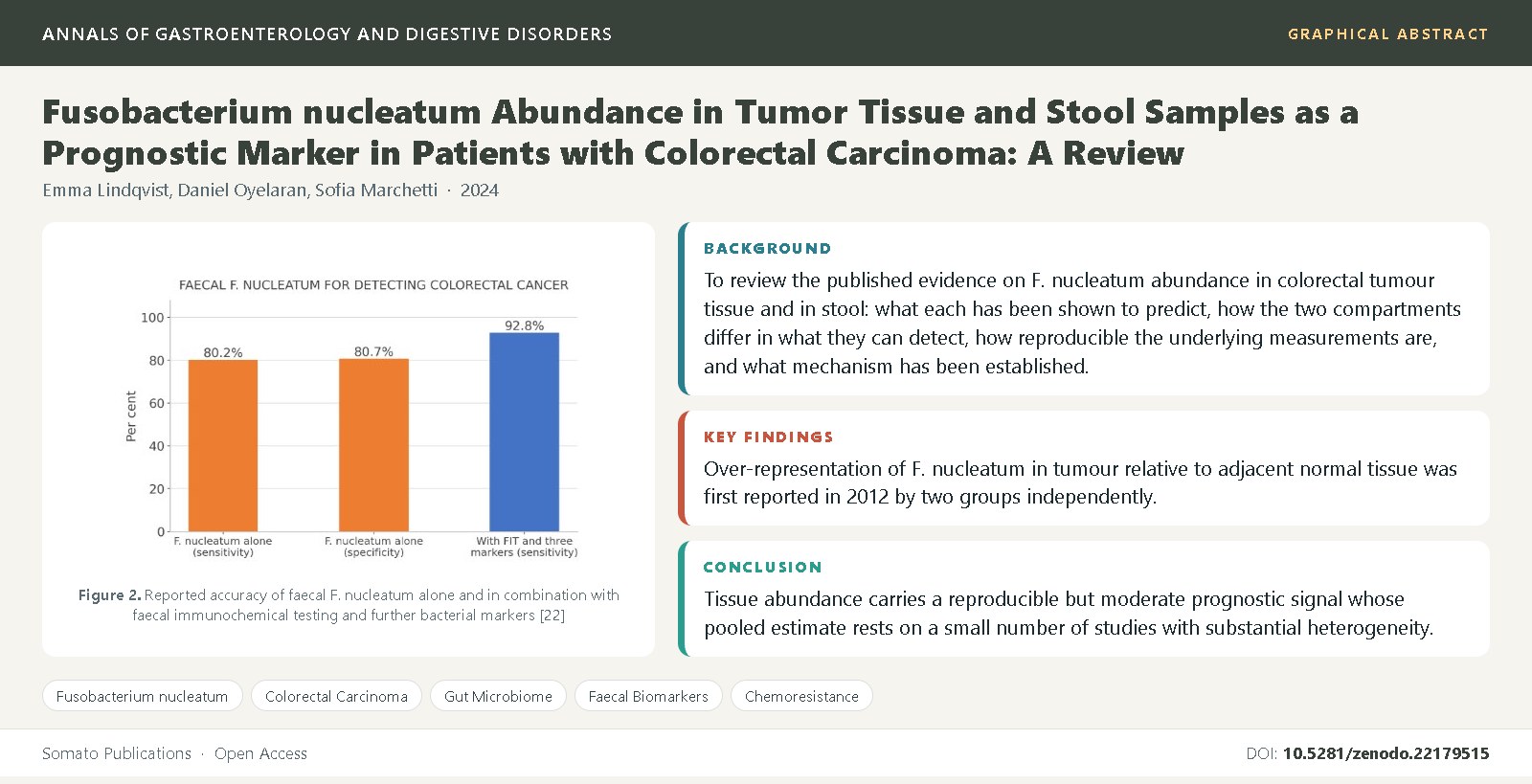
presence in colorectal tissue or stool with a defined comparator, outcomes stratified by that measure, or mechanism bearing on a clinical observation. No new patient data were generated; every frequency, accuracy estimate and effect size quoted is one published by the original investigators. Results: Over-representation of F. nucleatum in tumour relative to adjacent normal tissue was first reported in 2012 by two groups independently. A systematic review of 45 articles found substantially higher odds of the organism being present in colorectal tumour tissue than in control tissue, with a pooled odds ratio of 10.06, and an association between tumour positivity and worse overall survival, with a pooled hazard ratio of 1.87 across five studies which rose to 2.25 and lost all heterogeneity when the largest study was excluded. In stool, faecal F. nucleatum alone distinguished colorectal cancer from controls with 80.2 per cent sensitivity and 80.7 per cent specificity, rising to 92.8 per cent sensitivity when combined with faecal immunochemical testing and three further bacterial markers. Faecal abundance was 132 times higher in cancer than in controls but only 3.8 times higher in advanced adenoma. Mechanistically, the organism promotes chemoresistance through Toll-like receptor signalling and autophagy activation, and persists in matched liver metastases. Conclusion: Tissue abundance carries a reproducible but moderate prognostic signal whose pooled estimate rests on a small number of studies with substantial heterogeneity. Stool abundance performs respectably for detecting established cancer and poorly for the precursor lesions that screening exists to find. Neither measurement is yet ready to alter management, and the more immediately actionable finding is mechanistic rather than prognostic. Abbreviations: CRC – Colorectal Cancer, Fn – Fusobacterium nucleatum, FIT – Faecal Immunochemical Test, qPCR – Quantitative Polymerase Chain
Reaction, ddPCR – Droplet Digital Polymerase Chain Reaction, MSI – Microsatellite Instability, dMMR – Deficient Mismatch Repair, CIMP – CpG Island Methylator Phenotype, OS – Overall Survival, HR – Hazard Ratio, OR – Odds Ratio, TLR – Toll-Like Receptor.
References
Castellarin M, Warren RL, Freeman JD, Dreolini L, Krzywinski M, Strauss J, et al. "Fusobacterium nucleatum infection is prevalent in human colorectal carcinoma". Genome Res 22(2012):299-306.
Kostic AD, Gevers D, Pedamallu CS, Michaud M, Duke F, Earl AM, et al. "Genomic analysis identifies association of Fusobacterium with colorectal carcinoma". Genome Res 22(2012):292-298.
Brennan CA, Garrett WS. "Fusobacterium nucleatum: symbiont, opportunist and oncobacterium". Nat Rev Microbiol 17(2019):156-166.
Yu J, Chen Y, Fu X, Zhou X, Peng Y, Shi L, et al. "Invasive Fusobacterium nucleatum may play a role in the carcinogenesis of proximal colon cancer through the serrated neoplasia pathway". Int J Cancer 139(2016):1318-1326.
Nosho K, Sukawa Y, Adachi Y, Ito M, Mitsuhashi K, Kurihara H, et al. "Association of Fusobacterium nucleatum with immunity and molecular alterations in colorectal cancer". World J Gastroenterol 22(2016):557-566.
Ito M, Kanno S, Nosho K, et al. "Association of Fusobacterium nucleatum with clinical and molecular features in colorectal serrated pathway". Int J Cancer 137(2015):1258-1268.
Kostic AD, Chun E, Robertson L, et al. "Fusobacterium nucleatum potentiates intestinal tumorigenesis and modulates the tumor-immune microenvironment". Cell Host Microbe 14(2013):207-215.
Rubinstein MR, Wang X, Liu W, Hao Y, Cai G, Han YW. "Fusobacterium nucleatum promotes colorectal carcinogenesis by modulating E-cadherin/beta-catenin signaling via its FadA adhesin". Cell Host Microbe 14(2013):195-206.
Abed J, Emgård JE, Zamir G, Faroja M, Almogy G, Grenov A, et al. "Fap2 mediates Fusobacterium nucleatum colorectal adenocarcinoma enrichment by binding to tumor-expressed Gal-GalNAc". Cell Host Microbe 20(2016):215-225.
Gethings-Behncke C, Coleman HG, Jordao HWT, Longley DB, Crawford N, Murray LJ, Kunzmann AT. "Fusobacterium nucleatum in the colorectum and its association with cancer risk and survival: a systematic review and meta-analysis". Cancer Epidemiol Biomarkers Prev 29(2020):539-548.
Zhang X, et al. "Fecal Fusobacterium nucleatum for the diagnosis of colorectal tumor: a systematic review and meta-analysis". Cancer Med 8(2019):480-491.
Repass J, et al. "Replication study: Fusobacterium nucleatum infection is prevalent in human colorectal carcinoma". eLife 7(2018):e25801.
Mima K, Nishihara R, Qian ZR, et al. "Fusobacterium nucleatum in colorectal carcinoma tissue and patient prognosis". Gut 65(2016):1973-1980.
Tahara T, Yamamoto E, Suzuki H, et al. "Fusobacterium in colonic flora and molecular features of colorectal carcinoma". Cancer Res 74(2014):1311-1318.
Strauss J, Kaplan GG, Beck PL, et al. "Invasive potential of gut mucosa-derived Fusobacterium nucleatum positively correlates with IBD status of the host". Inflamm Bowel Dis 17(2011):1971-1978.
Purcell RV, Visnovska M, Biggs PJ, et al. "Distinct gut microbiome patterns associate with consensus molecular subtypes of colorectal cancer". Sci Rep 7(2017):11590.
Mima K, Sukawa Y, Nishihara R, et al. "Fusobacterium nucleatum and T cells in colorectal carcinoma". JAMA Oncol 1(2015):653-661.
Masugi Y, Nishihara R, Yang J, Mima K, da Silva A, Shi Y, et al. "Tumour CD274 (PD-L1) expression and T cells in colorectal cancer". Gut 66(2017):1463-1473.
Schwabe RF, Jobin C. "The microbiome and cancer". Nat Rev Cancer 13(2013):800-812.
Yu T, Guo F, Yu Y, Sun T, Ma D, Han J, et al. "Fusobacterium nucleatum promotes chemoresistance to colorectal cancer by modulating autophagy". Cell 170(2017):548-563.
Wong SH, Kwong TNY, Chow TC, Luk AKC, Dai RZW, Nakatsu G, et al. "Quantitation of faecal Fusobacterium improves faecal immunochemical test in detecting advanced colorectal neoplasia". Gut 66(2017):1441-1448.
Liang Q, Chiu J, Chen Y, Huang Y, Higashimori A, Fang J, et al. "Fecal bacteria act as novel biomarkers for noninvasive diagnosis of colorectal cancer". Clin Cancer Res 23(2017):2061-2070.
Marchesi JR, Dutilh BE, Hall N, et al. "Towards the human colorectal cancer microbiome". PLoS One 6(2011):e20447.
Suehiro Y, Sakai K, Nishioka M, et al. "Highly sensitive stool DNA testing of Fusobacterium nucleatum as a marker for detection of colorectal tumours in a Japanese population". Ann Clin Biochem 54(2017):86-91.
Zuraik AA, Daboul Y, Awama MA, Yazigi H, Kayasseh MA, Georges M. "Rapid detection of FadA in Fusobacterium nucleatum using the quantitative LAMP colorimetric phenol red method in stool samples from colorectal cancer patients". Sci Rep 14(2024). doi: 10.1038/s41598-024-62846-x.
Yu J, Feng Q, Wong SH, Zhang D, Liang QY, Qin Y, et al. "Metagenomic analysis of faecal microbiome as a tool towards targeted non-invasive biomarkers for colorectal cancer". Gut 66(2017):70-78.
Segata N, Izard J, Waldron L, Gevers D, Miropolsky L, Garrett WS, Huttenhower C. "Metagenomic biomarker discovery and explanation". Genome Biol 12(2011):R60.
Ramos A, Hemann MT. "Drugs, bugs, and cancer: Fusobacterium nucleatum promotes chemoresistance in colorectal cancer". Cell 170(2017):411-413.
Bullman S, Pedamallu CS, Sicinska E, Clancy TE, Zhang X, Cai D, et al. "Analysis of Fusobacterium persistence and antibiotic response in colorectal cancer". Science 358(2017):1443-1448.
Abreu MT, Peek RM Jr. "Gastrointestinal malignancy and the microbiome". Gastroenterology 146(2014):1534-1546.
Mira-Pascual L, Cabrera-Rubio R, Ocon S, et al. "Microbial mucosal colonic shifts associated with the development of colorectal cancer reveal the presence of different bacterial and archaeal biomarkers". J Gastroenterol 50(2015):167-179.
Momen-Heravi F, Babic A, Tworoger SS, Zhang L, Wu K, Smith-Warner SA, et al. "Periodontal disease, tooth loss and colorectal cancer risk: results from the Nurses’ Health Study". Int J Cancer 140(2017):646-652.
Wang HF, Li LF, Guo SH, Zeng QY, Ning F, Liu WL, et al. "Evaluation of antibody level against Fusobacterium nucleatum in the serological diagnosis of colorectal cancer". Sci Rep 6(2016):33440.





