
Spinal Cord Stimulation for Persistent Spinal Pain Syndrome After Lumbar Surgery
DOI:
https://doi.org/10.5281/zenodo.22310519Keywords:
Spinal cord stimulation, Persistent spinal pain syndrome, Failed back surgery syndrome, Neuromodulation, Lumbar spine surgeryAbstract
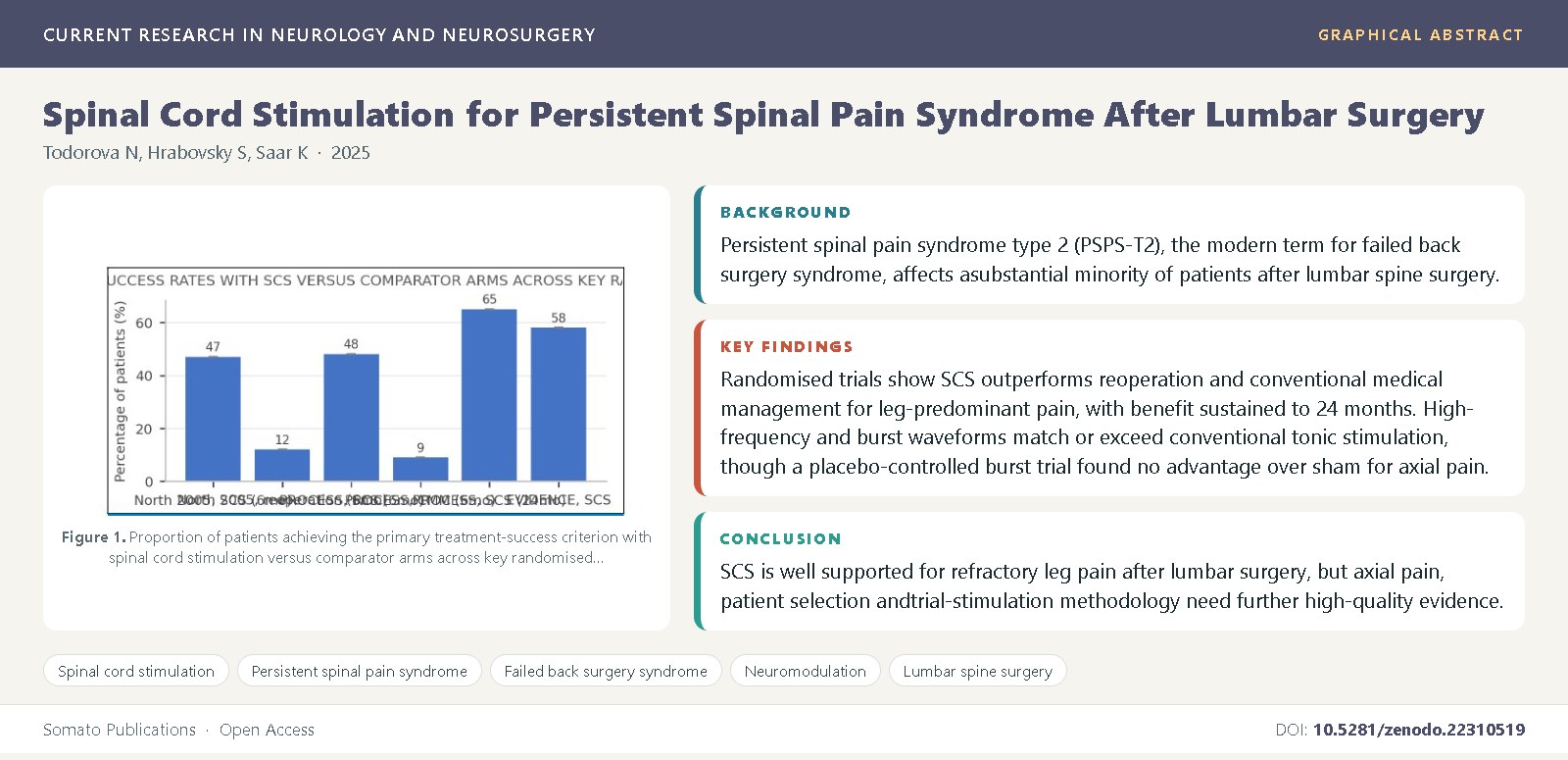
Background: Persistent spinal pain syndrome type 2 (PSPS-T2), the modern term for failed back surgery syndrome, affects a
substantial minority of patients after lumbar spine surgery. Objective: To synthesise randomised trials, waveform comparisons, durability data, patient selection practice and cost-effectiveness evidence for spinal cord stimulation (SCS) in PSPS-T2.
Methods: Narrative review of randomised controlled trials, long-term cohort follow-ups, consensus guidelines and
health-economic analyses. Findings: Randomised trials show SCS outperforms reoperation and conventional medical management for leg-predominant pain, with benefit sustained to 24 months. High-frequency and burst waveforms match or exceed conventional tonic stimulation, though a placebo-controlled burst trial found no advantage over sham for axial pain. Complications centre on lead migration and infection, and cost-effectiveness improves once device costs are amortised beyond two to three years.
Conclusions: SCS is well supported for refractory leg pain after lumbar surgery, but axial pain, patient selection and
trial-stimulation methodology need further high-quality evidence.
References
Christelis, N., Simpson, B., Russo, M., Stanton-Hicks, M., Barolat, G., Thomson, S., et al. (2021) Persistent Spinal Pain Syndrome: A Proposal for Failed Back Surgery Syndrome and ICD-11. Pain Medicine, 22(4): 807-818.
North, R.B., Kidd, D.H., Zahurak, M., James, C.S., Long, D.M. (1993) Spinal cord stimulation for chronic, intractable pain: experience over two decades. Neurosurgery, 32(3): 384-395.
North, R.B., Kidd, D.H., Farrokhi, F., Piantadosi, S.A. (2005) Spinal cord stimulation versus repeated lumbosacral spine surgery for chronic pain: a randomized, controlled trial. Neurosurgery, 56(1): 98-106.
North, R.B., Kidd, D., Shipley, J., Taylor, R.S. (2007) Spinal cord stimulation versus reoperation for failed back surgery syndrome: a cost effectiveness and cost utility analysis based on a randomized, controlled trial. Neurosurgery, 61(2): 361-368.
North, R.B., Kumar, K., Wallace, M.S., Henderson, J.M., Shipley, J., Hernandez, J., et al. (2011) Spinal cord stimulation versus re-operation in patients with failed back surgery syndrome: an international multicenter randomized controlled trial (EVIDENCE study). Neuromodulation, 14(4): 330-335.
Kumar, K., Taylor, R.S., Jacques, L., Eldabe, S., Meglio, M., Molet, J., et al. (2007) Spinal cord stimulation versus conventional medical management for neuropathic pain: a multicentre randomised controlled trial in patients with failed back surgery syndrome. Pain, 132(1-2): 179-188.
Kumar, K., Taylor, R.S., Jacques, L., Eldabe, S., Meglio, M., Molet, J., et al. (2008) The effects of spinal cord stimulation in neuropathic pain are sustained: a 24-month follow-up of the prospective randomized controlled multicenter trial of the effectiveness of spinal cord stimulation. Neurosurgery, 63(4): 762-770.
Rigoard, P., Basu, S., Desai, M., Taylor, R., Annemans, L., Tan, Y., et al. (2019) Multicolumn spinal cord stimulation for predominant back pain in failed back surgery syndrome patients: a multicenter randomized controlled trial. Pain, 160(6): 1410-1420.
Hara, S., Andresen, H., Solheim, O., Carlsen, S.M., Sundstrøm, T., Lønne, G., et al. (2022) Effect of Spinal Cord Burst Stimulation vs Placebo Stimulation on Disability in Patients With Chronic Radicular Pain After Lumbar Spine Surgery: A Randomized Clinical Trial. JAMA, 328(15): 1506-1514.
Kapural, L., Yu, C., Doust, M.W., Gliner, B.E., Vallejo, R., Sitzman, B.T., et al. (2015) Novel 10-kHz High-frequency Therapy (HF10 Therapy) Is Superior to Traditional Low-frequency Spinal Cord Stimulation for the Treatment of Chronic Back and Leg Pain: The SENZA-RCT Randomized Controlled Trial. Anesthesiology, 123(4): 851-860.
Kapural, L., Yu, C., Doust, M.W., Gliner, B.E., Vallejo, R., Sitzman, B.T., et al. (2016) Comparison of 10-kHz High-Frequency and Traditional Low-Frequency Spinal Cord Stimulation for the Treatment of Chronic Back and Leg Pain: 24-Month Results from a Multicenter, Randomized, Controlled Pivotal Trial. Neurosurgery, 79(5): 667-677.
Amirdelfan, K., Yu, C., Doust, M.W., Gliner, B.E., Morgan, D.M., Kapural, L., et al. (2018) Long-term quality of life improvement for chronic intractable back and leg pain patients using spinal cord stimulation: 12-month results from the SENZA-RCT. Quality of Life Research, 27(8): 2035-2044.
Van Buyten, J.P., Al-Kaisy, A., Smet, I., Palmisani, S., Smith, T. (2013) High-frequency spinal cord stimulation for the treatment of chronic back pain patients: results of a prospective multicenter European clinical study. Neuromodulation, 16(1): 59-65.
Al-Kaisy, A., Van Buyten, J.P., Smet, I., Palmisani, S., Pang, D., Smith, T. (2014) Sustained effectiveness of 10 kHz high-frequency spinal cord stimulation for patients with chronic, low back pain: 24-month results of a prospective multicenter study. Pain Medicine, 15(3): 347-354.
De Ridder, D., Vanneste, S., Plazier, M., van der Loo, E., Menovsky, T. (2010) Burst spinal cord stimulation: toward paresthesia-free pain suppression. Neurosurgery, 66(5): 986-990.
Deer, T., Slavin, K.V., Amirdelfan, K., North, R.B., Burton, A.W., Yearwood, T.L., et al. (2018) Success Using Neuromodulation With BURST (SUNBURST) Study: Results From a Prospective, Randomized Controlled Trial Using a Novel Burst Waveform. Neuromodulation, 21(1): 56-66.
Thomson, S.J., Tavakkolizadeh, M., Love-Jones, S., Patel, N.K., Gu, J.W., Bains, A., et al. (2018) Effects of Rate on Analgesia in Kilohertz Frequency Spinal Cord Stimulation: Results of the PROCO Randomized Controlled Trial. Neuromodulation, 21(1): 67-76.
Duarte, R.V., Nevitt, S., McNicol, E., Taylor, R.S., Buchser, E., North, R.B., Eldabe, S. (2020) Systematic review and meta-analysis of placebo/sham controlled randomised trials of spinal cord stimulation for neuropathic pain. Pain, 161(1): 24-35.
Deer, T.R., Mekhail, N., Provenzano, D., Pope, J., Krames, E., Leong, M., et al. (2014) The appropriate use of neurostimulation of the spinal cord and peripheral nervous system for the treatment of chronic pain and ischemic London: NICE. diseases: the Neuromodulation Appropriateness Consensus Committee. Neuromodulation, 17(6): 515-550.
Deer, T.R., Provenzano, D.A., Hanes, M., Pope, J.E., Thomson, S.J., Russo, M.A., et al. (2017) The Neurostimulation Appropriateness Consensus Committee (NACC) Recommendations for Trial Stimulation. Neuromodulation, 20(1): 1-9.
Cameron, T. (2004) Safety and efficacy of spinal cord stimulation for the treatment of chronic pain: a 20-year literature review. Journal of Neurosurgery: Spine, 100(3 Suppl): 254-267.
Eldabe, S., Buchser, E., Duarte, R.V. (2016) Complications of Spinal Cord Stimulation and Peripheral Nerve Stimulation Techniques: A Review of the Literature. Pain Medicine, 17(2): 325-336.
Bendersky, D., Yampolsky, C. (2014) Is Spinal Cord Stimulation Safe? A Review of Its Complications. World Neurosurgery, 82(6): 1359-1368.
Deer, T.R., Mekhail, N., Provenzano, D., Pope, J., Krames, E., Thomson, S., et al. (2014) The appropriate use of neurostimulation: avoidance and treatment of complications of neurostimulation therapies for the treatment of chronic pain. Neuromodulation, 17(6): 571-597.
Taylor, R.S., Taylor, R.J., Van Buyten, J.P., Buchser, E., North, R., Bayliss, S. (2004) The cost effectiveness of spinal cord stimulation in the treatment of pain: a systematic review of the literature. Journal of Pain and Symptom Management, 27(4): 370-378.
Kumar, K., Rizvi, S. (2013) Cost-effectiveness of spinal cord stimulation therapy in management of chronic pain. Pain Medicine, 14(11): 1631-1649.
National Institute for Health and Clinical Excellence. (2008) Spinal cord stimulation for chronic pain of neuropathic or ischaemic origin. NICE Technology Appraisal Guidance 159.





