
Anti-CD20 Therapy and Disability Progression in Relapsing Multiple Sclerosis
DOI:
https://doi.org/10.5281/zenodo.22310428Keywords:
Anti-CD20 therapy, Multiple sclerosis, Disability progression, B-cell depletion, PIRAAbstract
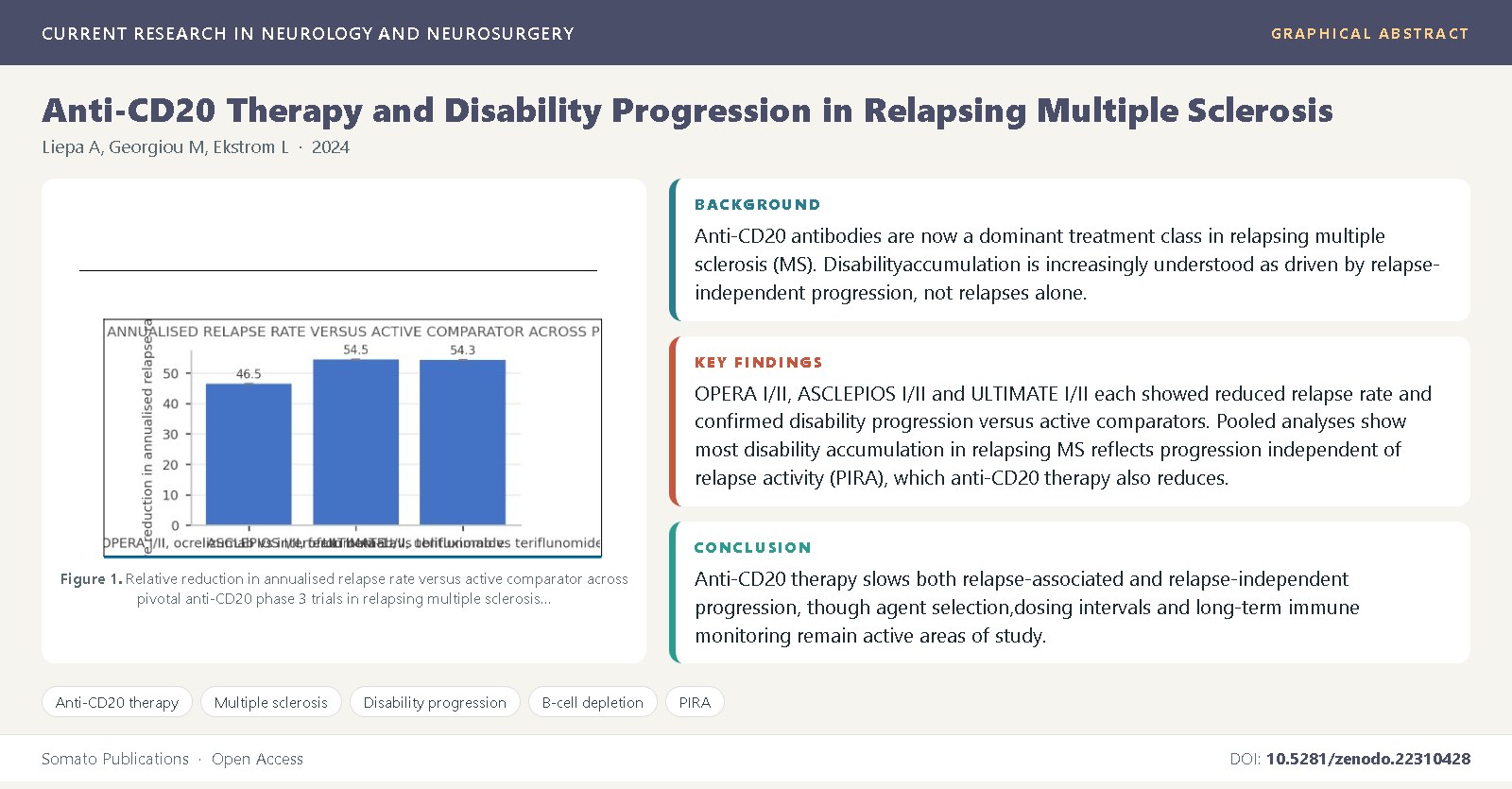
Background: Anti-CD20 antibodies are now a dominant treatment class in relapsing multiple sclerosis (MS). Disability
accumulation is increasingly understood as driven by relapse-independent progression, not relapses alone.
Objective: To review trial, mechanistic, comparative and safety evidence on anti-CD20 therapy and disability outcomes in
relapsing MS. Methods: Narrative review of randomised trials, extension studies, registries and mechanistic literature on rituximab,
ocrelizumab, ofatumumab and ublituximab. Findings: OPERA I/II, ASCLEPIOS I/II and ULTIMATE I/II each showed reduced relapse rate and confirmed disability progression versus active comparators. Pooled analyses show most disability accumulation in relapsing MS reflects progression independent of relapse activity (PIRA), which anti-CD20 therapy also reduces. Real-world Swedish cohorts and comparative registries broadly support efficacy across agents; long-term safety data highlight hypogammaglobulinemia and infection risk. Conclusions: Anti-CD20 therapy slows both relapse-associated and relapse-independent progression, though agent selection,
dosing intervals and long-term immune monitoring remain active areas of study.
References
Margoni, M., Preziosa, P., Filippi, M., Rocca, M.A. (2022) Anti-CD20 Therapies for Multiple Sclerosis: Current Status and Future Perspectives. Journal of Neurology, 269(3): 1316-1334.
Cross, A.H., Stark, J.L., Lauber, J., Ramsbottom, M.J., Lyons, J.A. (2006) Rituximab Reduces B Cells and T Cells in Cerebrospinal Fluid of Multiple Sclerosis Patients. Journal of Neuroimmunology, 180(1-2): 63-70.
Hauser, S.L., Waubant, E., Arnold, D.L., Vollmer, T., Antel, J., Fox, R.J., et al. (2008) B-Cell Depletion with Rituximab in Relapsing-Remitting Multiple Sclerosis. New England Journal of Medicine, 358(7): 676-688.
Hauser, S.L., Bar-Or, A., Comi, G., Giovannoni, G., Hartung, H.P., Hemmer, B., et al. (2017) Ocrelizumab versus Interferon Beta-1a in Relapsing Multiple Sclerosis. New England Journal of Medicine, 376(3): 221-234.
Hauser, S.L., Bar-Or, A., Cohen, J.A., Comi, G., Correale, J., Coyle, P.K., et al. (2020) Ofatumumab versus Teriflunomide in Multiple Sclerosis. New England Journal of Medicine, 383(6): 546-557.
Steinman, L., Fox, E., Hartung, H.P., Alvarez, E., Qian, P., Wray, S., et al. (2022) Ublituximab versus Teriflunomide in Relapsing Multiple Sclerosis. New England Journal of Medicine, 387(8): 704-714.
Cree, B.A.C., Hollenbach, J.A., Bove, R., Kirkish, G., Sacco, S., Caverzasi, E., et al. (2019) Silent Progression in Disease Activity-Free Relapsing Multiple Sclerosis. Annals of Neurology, 85(5): 653-666.
Kappos, L., Wolinsky, J.S., Giovannoni, G., Arnold, D.L., Wang, Q., Bernasconi, C., et al. (2020) Contribution of Relapse-Independent Progression vs Relapse-Associated Worsening to Overall Confirmed Disability Accumulation in Typical Relapsing Multiple Sclerosis in a Pooled Analysis of 2 Randomized Clinical Trials. JAMA Neurology, 77(9): 1132-1140.
Baker, D., Marta, M., Pryce, G., Giovannoni, G., Schmierer, K. (2017) Memory B Cells are Major Targets for Effective Immunotherapy in Relapsing Multiple Sclerosis. EBioMedicine, 16: 41-50.
Palanichamy, A., Jahn, S., Nickles, D., Derstine, M., Abounasr, A., Hauser, S.L., et al. (2014) Rituximab Efficiently Depletes Increased CD20-Expressing T Cells in Multiple Sclerosis Patients. The Journal of Immunology, 193(2): 580-586.
Gingele, S., Jacobus, T.L., Konen, F.F., Hummert, M.W., Suhs, K.W., Schwenkenbecher, P., et al. (2018) Ocrelizumab Depletes CD20+ T Cells in Multiple Sclerosis Patients. Cells, 8(1): 12.
Kappos, L., Li, D., Calabresi, P.A., O'Connor, P., Bar-Or, A., Barkhof, F., et al. (2011) Ocrelizumab in Relapsing-Remitting Multiple Sclerosis: A Phase 2, Randomised, Placebo-Controlled, Multicentre Trial. The Lancet, 378(9805): 1779-1787.
Montalban, X., Hauser, S.L., Kappos, L., Arnold, D.L., Bar-Or, A., Comi, G., et al. (2017) Ocrelizumab versus Placebo in Primary Progressive Multiple Sclerosis. New England Journal of Medicine, 376(3): 209-220.
Bar-Or, A., Wiendl, H., Montalban, X., Alvarez, E., Davydovskaya, M., Delgado, S.R., et al. (2022) Rapid and Sustained B-Cell Depletion with Subcutaneous Ofatumumab in Relapsing Multiple Sclerosis: APLIOS, a Randomized Phase-2 Study. Multiple Sclerosis Journal, 28(6): 910-924.
Kurtzke, J.F. (1983) Rating Neurologic Impairment in Multiple Sclerosis: An Expanded Disability Status Scale (EDSS). Neurology, 33(11): 1444-1452.
Sormani, M.P., Bruzzi, P. (2013) MRI Lesions as a Surrogate for Relapses in Multiple Sclerosis: A Meta-Analysis of Randomised Trials. The Lancet Neurology, 12(7): 669-676.
Havrdova, E., Arnold, D.L., Bar-Or, A., Comi, G., Hartung, H.P., Kappos, L., et al. (2018) No Evidence of Disease Activity (NEDA) Analysis by Epochs in Patients With Relapsing Multiple Sclerosis Treated With Ocrelizumab vs Interferon Beta-1a. Multiple Sclerosis Journal - Experimental, Translational and Clinical, 4(1): 2055217318760642.
Salzer, J., Svenningsson, R., Alping, P., Novakova, L., Björck, A., Fink, K., et al. (2016) Rituximab in Multiple Sclerosis. Neurology, 87(20): 2074-2081.
Granqvist, M., Boremalm, M., Poorghobad, A., Svenningsson, A., Salzer, J., Frisell, T., Piehl, F. (2018) Comparative Effectiveness of Rituximab and Other Initial Treatment Choices for Multiple Sclerosis. JAMA Neurology, 75(3): 320-327.
Roos, I., Hughes, S., McDonnell, G., Malpas, C.B., Sharmin, S., et al. (2023) Rituximab vs Ocrelizumab in Relapsing-Remitting Multiple Sclerosis. JAMA Neurology, 80(8): 789-798.
Torkildsen, O., Brustad, H.K., Hogestol, E.A., Alstadhaug, K.B., Bhan, A., Flemmen, H.O., et al. (2026) Rituximab versus Ocrelizumab in Newly Diagnosed Relapsing Multiple Sclerosis. New England Journal of Medicine, 395(1): 44-53.
Hartung, H.P., Benedict, R.H.B., Berger, T., Bermel, R.A., Brochet, B., Carroll, W.M., et al. (2024) Ocrelizumab in Early-Stage Relapsing-Remitting Multiple Sclerosis: The Phase IIIb ENSEMBLE 4-Year, Single-Arm, Open-Label Trial. Neurology, 103(12): e210049.
Hauser, S.L., Kappos, L., Montalban, X., Craveiro, L., Chognot, C., Hughes, R., et al. (2021) Safety of Ocrelizumab in Patients With Relapsing and Primary Progressive Multiple Sclerosis. Neurology, 97(16): e1546-e1559.
Perriguey, M., Maarouf, A., Stellmann, J.P., Rico, A., Boutiere, C., Demortiere, S., et al. (2022) Hypogammaglobulinemia and Infections in Patients With Multiple Sclerosis Treated With Rituximab. Neurology - Neuroimmunology & Neuroinflammation, 9(1): e1115.
Kang, C., Blair, H.A. (2021) Ofatumumab: A Review in Relapsing Forms of Multiple Sclerosis. Drugs, 82(1): 55-62.
Frisell, T., Hedberg, S., Piehl, F. (2026) Comparable Infection Risk of Ocrelizumab and Rituximab in Multiple Sclerosis in a Nationwide Swedish Cohort Study. Annals of Neurology, Epub ahead of print.





