
Intraoperative Neurophysiological Monitoring in Intramedullary Spinal Cord Tumour Surgery
DOI:
https://doi.org/10.5281/zenodo.22310425Keywords:
Intramedullary spinal cord tumour, Intraoperative neurophysiological monitoring, Motor evoked potentials, D-wave, Total intravenous anaesthesiaAbstract
Background: Intramedullary spinal cord tumours (IMSCTs) sit within eloquent tracts, so resection risks worsened weakness.
Intraoperative neurophysiological monitoring (IONM) — somatosensory evoked potentials, the epidural D-wave, muscle motor
evoked potentials (mMEPs) and free-running or triggered electromyography — gives surgeons real-time feedback on cord
integrity. Objective: To review evidence on IONM modalities, alarm criteria, anaesthesia and outcomes in IMSCT surgery.
Methods: Narrative review of cohort studies, systematic reviews, meta-analyses and position statements.
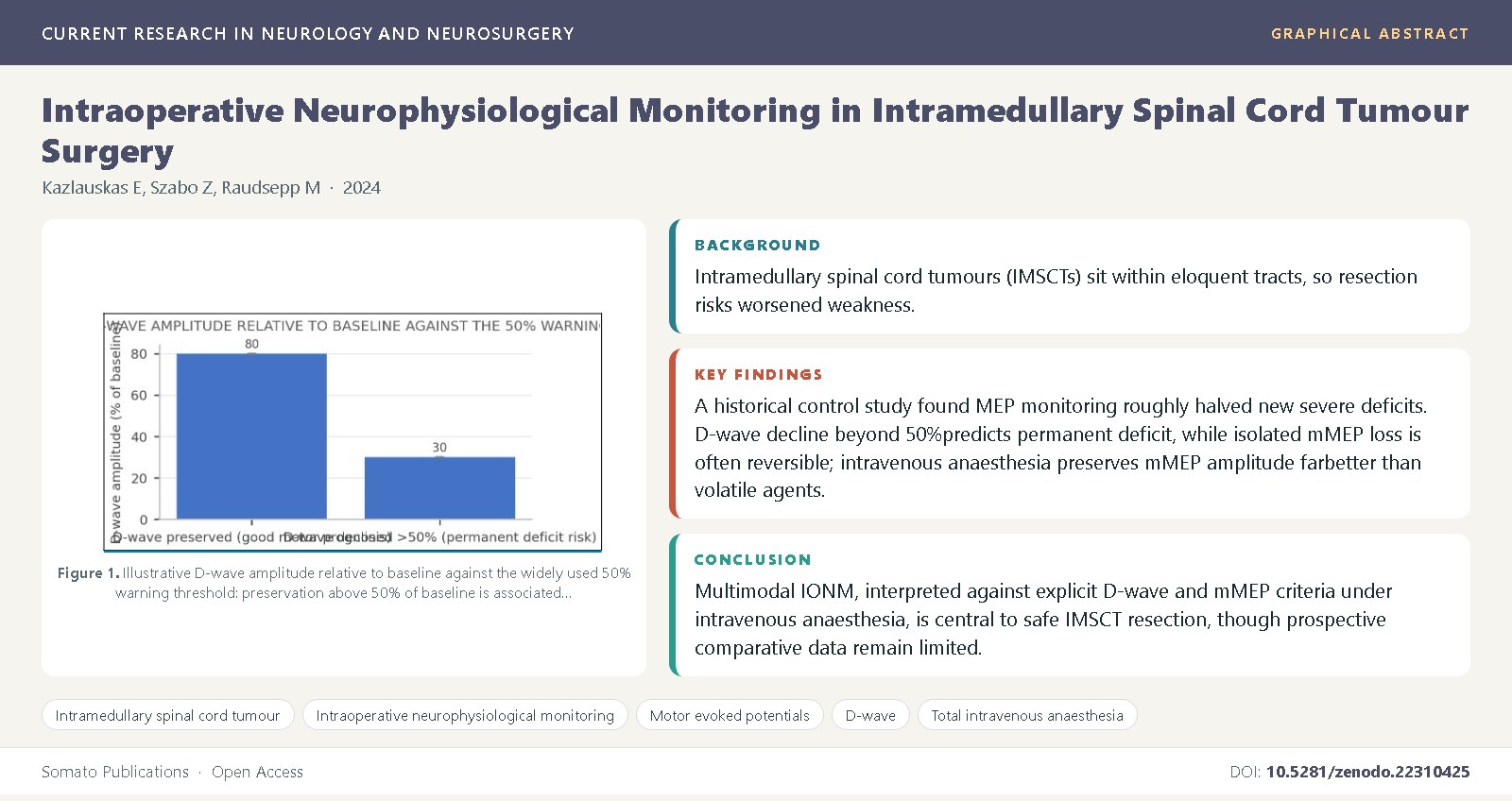
Findings: A historical control study found MEP monitoring roughly halved new severe deficits. D-wave decline beyond 50%
predicts permanent deficit, while isolated mMEP loss is often reversible; intravenous anaesthesia preserves mMEP amplitude far
better than volatile agents. Multicentre cohorts and meta-analyses link protocol-driven IONM to reduced permanent morbidity
across paediatric and adult series. Conclusions: Multimodal IONM, interpreted against explicit D-wave and mMEP criteria under intravenous anaesthesia, is central to safe IMSCT resection, though prospective comparative data remain limited.
References
Kothbauer, K.F., Deletis, V., Epstein, F.J. (1998) Motor-evoked potential monitoring for intramedullary spinal cord tumor surgery: correlation of clinical and neurophysiological data in a series of 100 consecutive procedures. Neurosurgical Focus, 4(5): E3.
Sala, F., Palandri, G., Basso, E., Lanteri, P., Deletis, V., Faccioli, F., Bricolo, A. (2006) Motor evoked potential monitoring improves outcome after surgery for intramedullary spinal cord tumors: a historical control study. Neurosurgery, 58(6): 1129-1143.
Choi, I., Hyun, S.J., Kang, J.K., Rhim, S.C. (2014) Combined muscle motor and somatosensory evoked potentials for intramedullary spinal cord tumour surgery. Yonsei Medical Journal, 55(4): 1063.
Sala, F., Bricolo, A., Faccioli, F., Lanteri, P., Gerosa, M. (2007) Surgery for intramedullary spinal cord tumors: the role of intraoperative (neuro)physiological monitoring. European Spine Journal, 16(Suppl 2): 130-139.
Leppanen, R.E. (2005) Intraoperative Monitoring of Segmental Spinal Nerve Root Function with Free-Run and Electrically-Triggered Electromyography and Spinal Cord Function with Reflexes and F-Responses. Journal of Clinical Monitoring and Computing, 19(6): 437-461.
Skinner, S.A., Nagib, M., Bergman, T.A., Maxwell, R.E., Msangi, G. (2005) The initial use of free-running electromyography to detect early motor tract injury during resection of intramedullary spinal cord lesions. Neurosurgery, 56(4 Suppl): ONS-299-ONS-313.
Sutter, M., Eggspuehler, A., Grob, D., Jeszenszky, D., Benini, A., Porchet, F., Mueller, A., Dvorak, J. (2007) The validity of multimodal intraoperative monitoring (MIOM) in surgery of 109 spine and spinal cord tumors. European Spine Journal, 16(Suppl 2): 197-208.
MacDonald, D.B., Skinner, S., Shils, J., Yingling, C. (2013) Intraoperative motor evoked potential monitoring - a position statement by the American Society of Neurophysiological Monitoring. Clinical Neurophysiology, 124(12): 2291-2316.
Costa, P., Peretta, P., Faccani, G. (2013) Relevance of intraoperative D wave in spine and spinal cord surgeries. European Spine Journal, 22(4): 840-848.
Zurita Perea, S.N., Alvarez Abut, P.A., Seidel, K. (2024) A Concise Guide to D-Wave Monitoring during Intramedullary Spinal Cord Tumour Surgery. Medicina, 60(8): 1242.
Thomas, S., Addanki, R.N.D., Murugan, C.K., Anetakis, K.M., Lee, B.B., Balzer, J.R., Thirumala, P.D. (2026) A Systematic Review and Meta-Analysis to Compare the Diagnostic Accuracy of Direct-Waves and Myogenic Motor-Evoked Potential Neuromonitoring During Intramedullary Spinal Cord Tumor Resection. Operative Neurosurgery, 30(4): 513-524.
Jiang, K., Al-Mistarehi, A.H., Zaitoun, K.J., Weber-Levine, C., Xia, Y., Mendelson, B.Z., Ksabi, N.L., Papali, P., Neerumalla, S., Antar, A., Hersh, A.M., Davidar, A.D., Pennington, Z., Gokaslan, Z.L., Lim, M., Lin, S.C., Lo, S.F.L., Witham, T., Sciubba, D.M., Jallo, G., Wolinsky, J.P., Weingart, J., Theodore, N., Lubelski, D. (2026) Utility of direct wave intraoperative neuromonitoring for intramedullary spinal cord tumor resection. Journal of Neurosurgery: Spine, ahead of print: 1-10.
Olmsted, Z.T., Ryu, B., Phayal, G., Green, R., Lo, S.F.L., Sciubba, D.M., Silverstein, J.W., D'Amico, R.S. (2023) Direct Wave Intraoperative Neuromonitoring for Spinal Tumor Resection: A Focused Review. World Neurosurgery: X, 17: 100139.
Park, H., Kim, W., Sim, J., Myeong, H.S., Choi, Y.D., Kwak, G., Kim, B.E., Park, J., Kim, S.M., Kim, K., Park, H.P., Kim, J.H., Lee, C.H., Chung, C.K., Kim, C.H. (2025) The Role of D-Wave Monitoring in Motor-Evoked Potential Loss During Intramedullary Spinal Cord Tumors Resection. Neurospine, 22(3): 650-662.
Kurokawa, R., Kim, P., Itoki, K., Yamamoto, S., Shingo, T., Kawamoto, T., Kawamoto, S. (2018) False-Positive and False-Negative Results of Motor Evoked Potential Monitoring During Surgery for Intramedullary Spinal Cord Tumors. Operative Neurosurgery, 14(3): 279-287.
Nuwer, M.R., Emerson, R.G., Galloway, G., Legatt, A.D., Lopez, J., Minahan, R., Yamada, T., Goodin, D.S., Armon, C., Chaudhry, V., Gronseth, G.S., Harden, C.L. (2012) Evidence-based guideline update: intraoperative spinal monitoring with somatosensory and transcranial electrical motor evoked potentials. Neurology, 78(8): 585-589.
Sloan, T.B., Toleikis, J.R., Toleikis, S.C., Koht, A. (2015) Intraoperative neurophysiological monitoring during spine surgery with total intravenous anesthesia or balanced anesthesia with 3% desflurane. Journal of Clinical Monitoring and Computing, 29(1): 77-85.
Wang, A.C., Than, K.D., Etame, A.B., La Marca, F., Park, P. (2009) Impact of anesthesia on transcranial electric motor evoked potential monitoring during spine surgery: a review of the literature. Neurosurgical Focus, 27(4): E7.
Sahinovic, M.M., Gadella, M.C., Shils, J., Dulfer, S.E., Drost, G. (2021) Anesthesia and intraoperative neurophysiological spinal cord monitoring. Current Opinion in Anaesthesiology, 34(5): 590-596.
Kim, M.H., Park, J., Park, Y.G., Cho, Y.E., Kim, D., Lee, D.J., Kwak, K.W., Lee, J., Han, D.W. (2025) Comparison of intraoperative neurophysiological monitoring between propofol and remimazolam during total intravenous anesthesia in cervical spine surgery: a prospective, double-blind, randomized controlled trial. Korean Journal of Anesthesiology, 78(1): 16-29.
Cheng, J.S., Ivan, M.E., Stapleton, C.J., Quinones-Hinojosa, A., Gupta, N., Auguste, K.I. (2014) Intraoperative changes in transcranial motor evoked potentials and somatosensory evoked potentials predicting outcome in children with intramedullary spinal cord tumors. Journal of Neurosurgery: Pediatrics, 13(6): 591-599.
Rijs, K., Klimek, M., Scheltens-de Boer, M., Biesheuvel, K., Harhangi, B.S. (2019) Intraoperative Neuromonitoring in Patients with Intramedullary Spinal Cord Tumor: A Systematic Review, Meta-Analysis, and Case Series. World Neurosurgery, 125: 498-510.
Mirza, A.B., Gebreyohanes, A., Knight, J., Bartram, J., Vastani, A., Kalaitzoglou, D., Lavrador, J.P., Kailaya-Vasan, A., Maratos, E., Bell, D., Thomas, N., Gullan, R., Malik, I., Grahovac, G. (2022) Prognostic factors for surgically managed intramedullary spinal cord tumours: a single-centre case series. Acta Neurochirurgica, 164(10): 2605-2622.
Rashad, S., Elwany, A., Farhoud, A. (2017) Surgery for spinal intramedullary tumors: technique, outcome and factors affecting resectability. Neurosurgical Review, 41(2): 503-511.
Tropeano, M.P., Rossini, Z., Franzini, A., Capo, G., Olei, S., De Robertis, M., Milani, D., Fornari, M., Pessina, F. (2023) Multimodal Intraoperative Neurophysiological Monitoring in Intramedullary Spinal Cord Tumors: A 10-Year Single Center Experience. Cancers, 16(1): 111.
Siller, S., Duell, S., Reyhaniye, D., Kramer, J., Harter, P.N., Ringel, F., Zausinger, S., Tonn, J.C., Szelenyi, A. (2026) Quality-of-life and detailed functional outcome after IONM-aided microsurgical resection of cervical and thoracic intramedullary spinal cord tumors in adults. Acta Neurochirurgica, 168(1): 86.
Scibilia, A., Terranova, C., Rizzo, V., Raffa, G., Morelli, A., Esposito, F., Mallamace, R., Buda, G., Conti, A., Quartarone, A., Germano, A. (2016) Intraoperative neurophysiological mapping and monitoring in spinal tumor surgery: sirens or indispensable tools? Neurosurgical Focus, 41(2): E18.
Behmanesh, B., Gessler, F., Dützmann, S., Dubinski, D., Imoehl, L., Seifert, V., Setzer, M., Marquardt, G. (2017) Natural history of intramedullary spinal cord ependymoma in patients preferring nonoperative treatment. Journal of Neuro-Oncology, 135(1): 93-98.





