
Decompressive Craniectomy in Malignant Middle Cerebral Artery Infarction: Functional Outcomes at One Year
DOI:
https://doi.org/10.5281/zenodo.22310441Keywords:
Decompressive craniectomy, Malignant middle cerebral artery infarction, Modified Rankin Scale, Functional outcome, HemicraniectomyAbstract
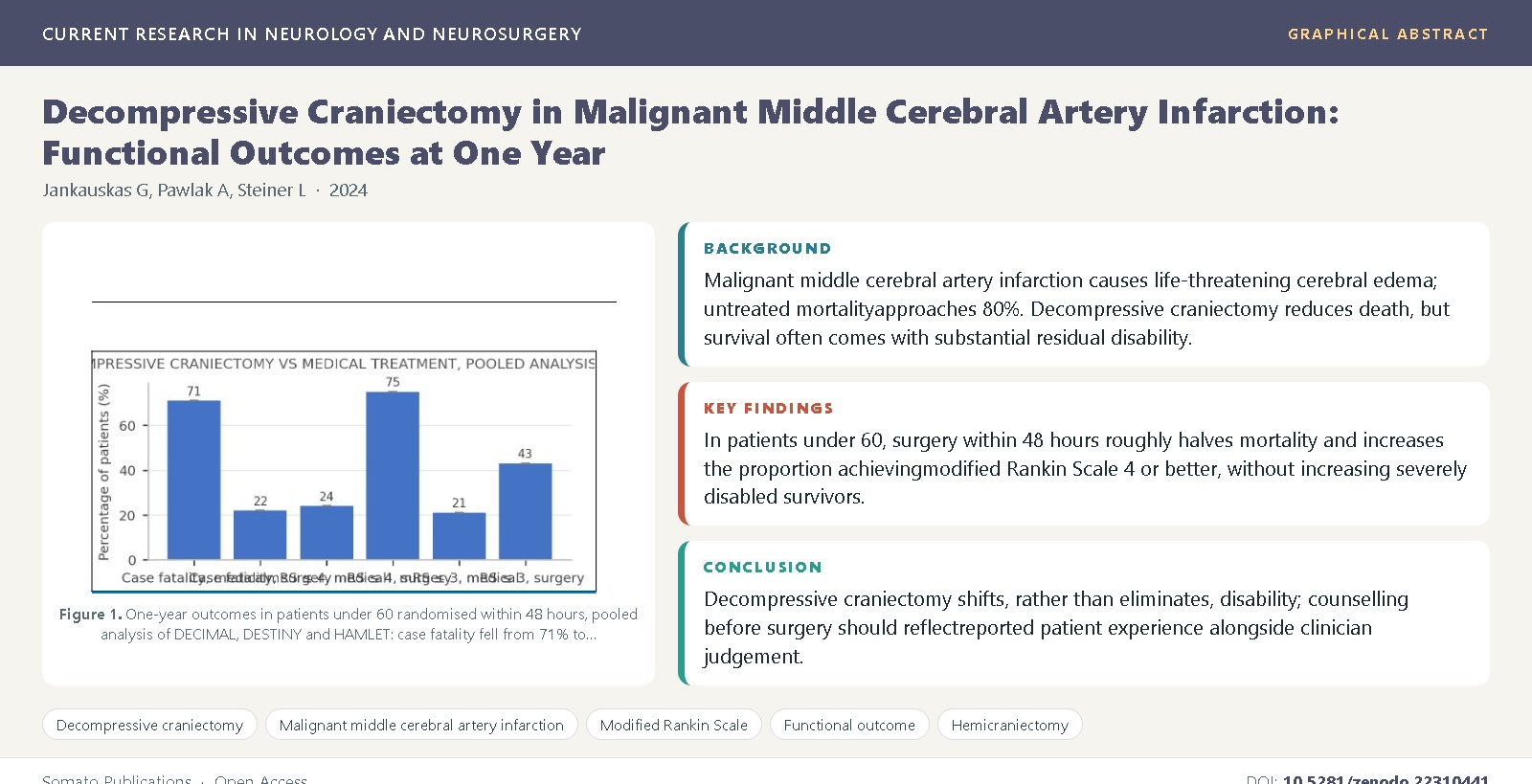
Background: Malignant middle cerebral artery infarction causes life-threatening cerebral edema; untreated mortality
approaches 80%. Decompressive craniectomy reduces death, but survival often comes with substantial residual disability.
Objective: To synthesise trial and cohort evidence on one-year functional outcome after decompressive craniectomy for
malignant middle cerebral artery infarction. Methods: Narrative review of pivotal trials (DECIMAL, DESTINY, HAMLET, DESTINY II, HeADDFIRST), their pooled and individual-patient-data meta-analyses, and quality-of-life and patient-perspective studies.
Findings: In patients under 60, surgery within 48 hours roughly halves mortality and increases the proportion achieving
modified Rankin Scale 4 or better, without increasing severely disabled survivors. In patients over 60, DESTINY II confirmed a
large survival benefit but little gain in independence; most survivors remained moderately to severely disabled. Quality-of-life and
retrospective-consent studies show many survivors and caregivers nonetheless endorse the decision to operate.
Conclusions: Decompressive craniectomy shifts, rather than eliminates, disability; counselling before surgery should reflect
reported patient experience alongside clinician judgement.
References
Gupta, R., Connolly, E.S., Mayer, S., Elkind, M.S.V. (2004) Hemicraniectomy for Massive Middle Cerebral Artery Territory Infarction: A Systematic Review. Stroke, 35(2): 539-543.
Vahedi, K., Vicaut, E., Mateo, J., Kurtz, A., Orabi, M., Guichard, J.P., et al. (2007) Sequential-Design, Multicenter, Randomized, Controlled Trial of Early Decompressive Craniectomy in Malignant Middle Cerebral Artery Infarction (DECIMAL Trial). Stroke, 38(9): 2506-2517.
Jüttler, E., Schwab, S., Schmiedek, P., Unterberg, A., Hennerici, M., Woitzik, J., et al. (2007) Decompressive Surgery for the Treatment of Malignant Infarction of the Middle Cerebral Artery (DESTINY): A Randomized, Controlled Trial. Stroke, 38(9): 2518-2525.
Hofmeijer, J., Amelink, G.J., Algra, A., van Gijn, J., Macleod, M.R., Kappelle, L.J., van der Worp, H.B. (2006) Hemicraniectomy after middle cerebral artery infarction with life-threatening Edema trial (HAMLET). Protocol for a randomised controlled trial of decompressive surgery in space-occupying hemispheric infarction. Trials, 7: 29.
Hofmeijer, J., Kappelle, L.J., Algra, A., Amelink, G.J., van Gijn, J., van der Worp, H.B. (2009) Surgical decompression for space-occupying cerebral infarction (the Hemicraniectomy After Middle Cerebral Artery infarction with Life-threatening Edema Trial [HAMLET]): a multicentre, open, randomised trial. Lancet Neurology, 8(4): 326-333.
Hofmeijer, J., van der Worp, H.B., Kappelle, L.J., Algra, A. (2009) Reassessment of the HAMLET study. Lancet Neurology, 8(6): 505-506.
Frank, J.I., Schumm, L.P., Wroblewski, K., Chyatte, D., Rosengart, A.J., Kordeck, C., Thisted, R.A. (2014) Hemicraniectomy and Durotomy Upon Deterioration From Infarction-Related Swelling Trial: Randomized Pilot Clinical Trial. Stroke, 45(3): 781-787.
Vahedi, K., Hofmeijer, J., Juettler, E., Vicaut, E., George, B., Algra, A., et al. (2007) Early decompressive surgery in malignant infarction of the middle cerebral artery: a pooled analysis of three randomised controlled trials. Lancet Neurology, 6(3): 215-222.
Powers, W.J., Rabinstein, A.A., Ackerson, T., Adeoye, O.M., Bambakidis, N.C., Becker, K., et al. (2019) Guidelines for the Early Management of Patients With Acute Ischemic Stroke: 2019 Update to the 2018 Guidelines for the Early Management of Acute Ischemic Stroke. Stroke, 50(12): e344-e418.
Reinink, H., Jüttler, E., Hacke, W., Hofmeijer, J., Vicaut, E., Vahedi, K., et al. (2021) Surgical Decompression for Space-Occupying Hemispheric Infarction: A Systematic Review and Individual Patient Meta-analysis of Randomized Clinical Trials. JAMA Neurology, 78(2): 208-216.
Xu, L., Lu, T., Tao, X., Wang, D., Liu, W., Li, J., Liu, B. (2017) Decompressive craniectomy for malignant middle cerebral artery infarctions: a meta-analysis. Chinese Neurosurgical Journal, 3: 19.
Dower, A., Mulcahy, M., Maharaj, M., Chen, H., Lim, C.E., Li, Y., Sheridan, M. (2022) Surgical decompression for malignant cerebral oedema after ischaemic stroke. Cochrane Database of Systematic Reviews, (11): CD014989.
Jüttler, E., Unterberg, A., Woitzik, J., Bösel, J., Amiri, H., Sakowitz, O.W., et al. (2014) Hemicraniectomy in Older Patients with Extensive Middle-Cerebral-Artery Stroke. New England Journal of Medicine, 370(12): 1091-1100.
Neugebauer, H., Jüttler, E. (2014) Hemicraniectomy for malignant middle cerebral artery infarction: current status and future directions. International Journal of Stroke, 9(3): 460-467.
Vibbert, M., Mayer, S.A. (2010) Early Decompressive Hemicraniectomy Following Malignant Ischemic Stroke: The Crucial Role of Timing. Current Neurology and Neuroscience Reports, 10(1): 1-3.
Kastrau, F., Wolter, M., Huber, W., Block, F. (2005) Recovery from aphasia after hemicraniectomy for infarction of the speech-dominant hemisphere: case reports and review of the literature. Stroke, 36(4): 825-829.
Curry, W.T., Sethi, M.K., Ogilvy, C.S., Carter, B.S. (2005) Factors associated with outcome after hemicraniectomy for large middle cerebral artery territory infarction. Neurosurgery, 56(4): 681-692.
Foerch, C., Lang, J.M., Krause, J., Raabe, A., Sitzer, M., Seifert, V., et al. (2004) Functional impairment, disability, and quality of life outcome after decompressive hemicraniectomy in malignant middle cerebral artery infarction. Journal of Neurosurgery, 101(2): 248-254.
Woertgen, C., Erban, P., Rothoerl, R.D., Bein, T., Horn, M., Brawanski, A. (2004) Quality of life after decompressive craniectomy in patients suffering from supratentorial brain ischemia. Acta Neurochirurgica, 146(7): 691-695.
Skoglund, T.S., Eriksson-Ritzén, C., Sörbo, A., Jensen, C., Rydenhag, B. (2008) Health status and life satisfaction after decompressive craniectomy for malignant middle cerebral artery infarction. Acta Neurologica Scandinavica, 117(5): 305-310.
Benejam, B., Sahuquillo, J., Poca, M.A., Frascheri, L., Solana, E., Delgado, P., Junqué, C. (2009) Quality of life and neurobehavioral changes in survivors of malignant middle cerebral artery infarction. Journal of Neurology, 256(7): 1126-1133.
Rahme, R., Zuccarello, M., Kleindorfer, D., Adeoye, O.M., Ringer, A.J. (2012) Decompressive hemicraniectomy for malignant middle cerebral artery territory infarction: is life worth living? Journal of Neurosurgery, 117(4): 749-754.
Ragoschke-Schumm, A., Junk, C., Lesmeister, M., Walter, S., Behnke, S., Schumm, J., Fassbender, K. (2015) Retrospective Consent to Hemicraniectomy after Malignant Stroke among the Elderly, Despite Impaired Functional Outcome. Cerebrovascular Diseases, 40(5-6): 286-292.
Malm, J., Bergenheim, A.T., Enblad, P., Hardemark, H.G., Koskinen, L.O., Naredi, S., et al. (2006) The Swedish Malignant Middle Cerebral Artery Infarction Study: long-term results from a prospective study of hemicraniectomy combined with standardized neurointensive care. Acta Neurologica Scandinavica, 113(1): 25-30.
Klein, A., Kuehner, C., Schwarz, S. (2012) Attitudes in the General Population Towards Hemi-Craniectomy for Middle Cerebral Artery (MCA) Infarction. A Population-Based Survey. Neurocritical Care, 16(3): 456-461.
Neugebauer, H., Schnabl, M., Lulé, D., Heuschmann, P.U., Jüttler, E. (2017) Attitudes of Patients and Relatives Toward Disability and Treatment in Malignant MCA Infarction. Neurocritical Care, 26(2): 311-318.
Honeybul, S., Ho, K.M., Blacker, D.J. (2016) ORACLE Stroke Study: Opinion Regarding Acceptable Outcome Following Decompressive Hemicraniectomy for Ischemic Stroke. Neurosurgery, 79(1): 39-45.





