
Replicative Senescence Markers in Serially Passaged Human Mesenchymal Stromal Cells
DOI:
https://doi.org/10.5281/zenodo.22274369Keywords:
Mesenchymal stromal cells; Replicative senescence; Serial passage; Methylation drift; Cell therapy manufacturingAbstract
Background: Every therapeutic mesenchymal stromal cell lot is expanded for weeks, but the identity criteria used to release
it say nothing about how many divisions it has already spent.
Objective: To examine what serial-passage studies have measured, and which readouts could serve as release specifications
or potency inputs.
Methods: Narrative review of serial-passage cohorts, telomere and methylation studies, and functional assays.
Findings: Expansion capacity spans roughly 8 to 86 cumulative population doublings across published cohorts.
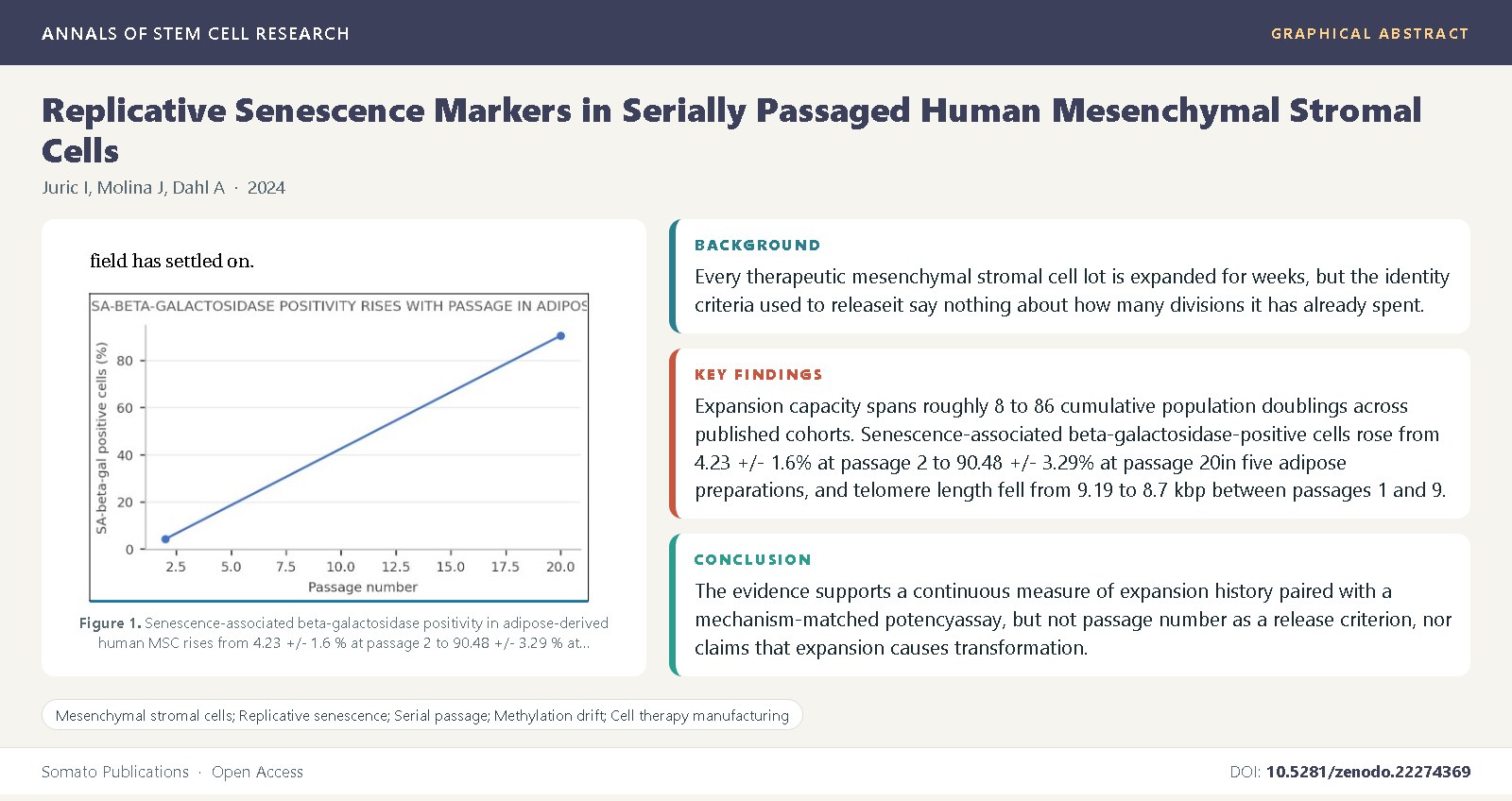
Senescence-associated beta-galactosidase-positive cells rose from 4.23 +/- 1.6% at passage 2 to 90.48 +/- 3.29% at passage 20
in five adipose preparations, and telomere length fell from 9.19 to 8.7 kbp between passages 1 and 9.
Conclusions: The evidence supports a continuous measure of expansion history paired with a mechanism-matched potency
assay, but not passage number as a release criterion, nor claims that expansion causes transformation.
References
Dominici, M., Le Blanc, K., Mueller, I., Slaper-Cortenbach, I., Marini, F.C., Krause, D., et al. (2006) Minimal criteria for defining multipotent mesenchymal stromal cells. The International Society for Cellular Therapy position statement. Cytotherapy, 8(4): 315-317.
Wagner, W., Horn, P., Castoldi, M., Diehlmann, A., Bork, S., Saffrich, R., et al. (2008) Replicative senescence of mesenchymal stem cells: a continuous and organized process. PLoS ONE, 3(5): e2213.
Wagner, W., Bork, S., Lepperdinger, G., Joussen, S., Ma, N., Strunk, D., et al. (2010) How to track cellular aging of mesenchymal stromal cells? Aging, 2(4): 224-230.
Weng, Z., Wang, Y., Ouchi, T., Liu, H., Qiao, X., Wu, C., et al. (2022) Mesenchymal stem/stromal cell senescence: hallmarks, mechanisms, and combating strategies. Stem Cells Translational Medicine, 11(4): 356-371.
Wagner, W., Bork, S., Horn, P., Krunic, D., Walenda, T., Diehlmann, A., et al. (2009) Aging and replicative senescence have related effects on human stem and progenitor cells. PLoS ONE, 4(6): e5846.
Mohyeddin Bonab, M., Alimoghaddam, K., Talebian, F., Ghaffari, S.H., Ghavamzadeh, A., Nikbin, B. (2006) Aging of mesenchymal stem cell in vitro. BMC Cell Biology, 7(1): 14.
Schellenberg, A., Lin, Q., Schuler, H., Koch, C.M., Joussen, S., Denecke, B., et al. (2011) Replicative senescence of mesenchymal stem cells causes DNA-methylation changes which correlate with repressive histone marks. Aging, 3(9): 873-888.
Estrada, J.C., Torres, Y., Benguria, A., Dopazo, A., Roche, E., Carrera-Quintanar, L., et al. (2013) Human mesenchymal stem cell-replicative senescence and oxidative stress are closely linked to aneuploidy. Cell Death & Disease, 4(6): e691.
Legzdina, D., Romanauska, A., Nikulshin, S., Kozlovska, T., Berzins, U. (2016) Characterization of senescence of culture-expanded human adipose-derived mesenchymal stem cells. International Journal of Stem Cells, 9(1): 124-136.
Siegel, G., Kluba, T., Hermanutz-Klein, U., Bieback, K., Northoff, H., Schafer, R. (2013) Phenotype, donor age and gender affect function of human bone marrow-derived mesenchymal stromal cells. BMC Medicine, 11(1): 146.
Baxter, M.A., Wynn, R.F., Jowitt, S.N., Wraith, J.E., Fairbairn, L.J., Bellantuono, I. (2004) Study of telomere length reveals rapid aging of human marrow stromal cells following in vitro expansion. Stem Cells, 22(5): 675-682.
Bertolo, A., Baur, M., Guerrero, J., Poetzel, T., Stoyanov, J. (2019) Autofluorescence is a reliable in vitro marker of cellular senescence in human mesenchymal stromal cells. Scientific Reports, 9(1): 2074.
Shibata, K.R., Aoyama, T., Shima, Y., Fukiage, K., Otsuka, S., Furu, M., et al. (2007) Expression of the p16INK4A gene is associated closely with senescence of human mesenchymal stem cells and is potentially silenced by DNA methylation during in vitro expansion. Stem Cells, 25(9): 2371-2382.
Dimri, G.P., Lee, X., Basile, G., Acosta, M., Scott, G., Roskelley, C., et al. (1995) A biomarker that identifies senescent human cells in culture and in aging skin in vivo. Proceedings of the National Academy of Sciences, 92(20): 9363-9367.
Debacq-Chainiaux, F., Erusalimsky, J.D., Campisi, J., Toussaint, O. (2009) Protocols to detect senescence-associated beta-galactosidase (SA-betagal) activity, a biomarker of senescent cells in culture and in vivo. Nature Protocols, 4(12): 1798-1806.
Choudhery, M.S., Badowski, M., Muise, A., Pierce, J., Harris, D.T. (2014) Donor age negatively impacts adipose tissue-derived mesenchymal stem cell expansion and differentiation. Journal of Translational Medicine, 12(1): 8.
Yang, Y.-H.K., Ogando, C.R., See, C.W., Chang, T.-Y., Barabino, G.A. (2018) Changes in phenotype and differentiation potential of human mesenchymal stem cells aging in vitro. Stem Cell Research & Therapy, 9(1): 131.
Redaelli, S., Bentivegna, A., Foudah, D., Miloso, M., Redondo, J., Riva, G., et al. (2012) From cytogenomic to epigenomic profiles: monitoring the biologic behavior of in vitro cultured human bone marrow mesenchymal stem cells. Stem Cell Research & Therapy, 3(6): 47.
Tarte, K., Gaillard, J., Lataillade, J.-J., Fouillard, L., Becker, M., Mossafa, H., et al. (2010) Clinical-grade production of human mesenchymal stromal cells: occurrence of aneuploidy without transformation. Blood, 115(8): 1549-1553.
Rubio, D., Garcia-Castro, J., Martin, M.C., de la Fuente, R., Cigudosa, J.C., Lloyd, A.C., et al. (2005) Spontaneous human adult stem cell transformation. Cancer Research, 65(8): 3035-3039. [RETRACTED]
Rosland, G.V., Svendsen, A., Torsvik, A., Sobala, E., McCormack, E., Immervoll, H., et al. (2009) Long-term cultures of bone marrow-derived human mesenchymal stem cells frequently undergo spontaneous malignant transformation. Cancer Research, 69(13): 5331-5339.
Torsvik, A., Rosland, G.V., Svendsen, A., Molven, A., Immervoll, H., McCormack, E., et al. (2010) Spontaneous malignant transformation of human mesenchymal stem cells reflects cross-contamination: putting the research field on track - letter. Cancer Research, 70(15): 6393-6396.
Bork, S., Pfister, S., Witt, H., Horn, P., Korn, B., Ho, A.D., et al. (2010) DNA methylation pattern changes upon long-term culture and aging of human mesenchymal stromal cells. Aging Cell, 9(1): 54-63.
Franzen, J., Zirkel, A., Blake, J., Rath, B., Benes, V., Papantonis, A., et al. (2017) Senescence-associated DNA methylation is stochastically acquired in subpopulations of mesenchymal stem cells. Aging Cell, 16(1): 183-191.
Koch, C.M., Joussen, S., Schellenberg, A., Lin, Q., Zenke, M., Wagner, W. (2012) Monitoring of cellular senescence by DNA-methylation at specific CpG sites. Aging Cell, 11(2): 366-369.
Koch, C.M., Wagner, W. (2013) Epigenetic biomarker to determine replicative senescence of cultured cells. Methods in Molecular Biology, 1048: 309-321.
Horvath, S. (2013) DNA methylation age of human tissues and cell types. Genome Biology, 14(10): R115.
DiGirolamo, C.M., Stokes, D., Colter, D., Phinney, D.G., Class, R., Prockop, D.J. (1999) Propagation and senescence of human marrow stromal cells in culture: a simple colony-forming assay identifies samples with the greatest potential to propagate and differentiate. British Journal of Haematology, 107(2): 275-281.
Stenderup, K., Justesen, J., Clausen, C., Kassem, M. (2003) Aging is associated with decreased maximal life span and accelerated senescence of bone marrow stromal cells. Bone, 33(6): 919-926.
Loisel, S., Dulong, J., Menard, C., Renoud, M.-L., Meziere, N., Bezier, I., et al. (2017) Brief report: proteasomal indoleamine 2,3-dioxygenase degradation reduces the immunosuppressive potential of clinical grade-mesenchymal stromal cells undergoing replicative senescence. Stem Cells, 35(5): 1431-1436.
Coppe, J.-P., Desprez, P.-Y., Krtolica, A., Campisi, J. (2010) The senescence-associated secretory phenotype: the dark side of tumor suppression. Annual Review of Pathology: Mechanisms of Disease, 5(1): 99-118.
Severino, V., Alessio, N., Farina, A., Sandomenico, A., Cipollaro, M., Peluso, G., et al. (2013) Insulin-like growth factor binding proteins 4 and 7 released by senescent cells promote premature senescence in mesenchymal stem cells. Cell Death & Disease, 4(11): e911.
Galipeau, J., Krampera, M., Barrett, J., Dazzi, F., Deans, R.J., DeBruijn, J., et al. (2016) International Society for Cellular Therapy perspective on immune functional assays for mesenchymal stromal cells as potency release criterion for advanced phase clinical trials. Cytotherapy, 18(2): 151-159.





