
Cancer Stem Cell Markers and Therapy Resistance in Triple-Negative Breast Carcinoma
DOI:
https://doi.org/10.5281/zenodo.22274734Keywords:
Cancer stem cells; Triple-negative breast carcinoma; Aldehyde dehydrogenase; Chemotherapy resistance; Tumour heterogeneityAbstract
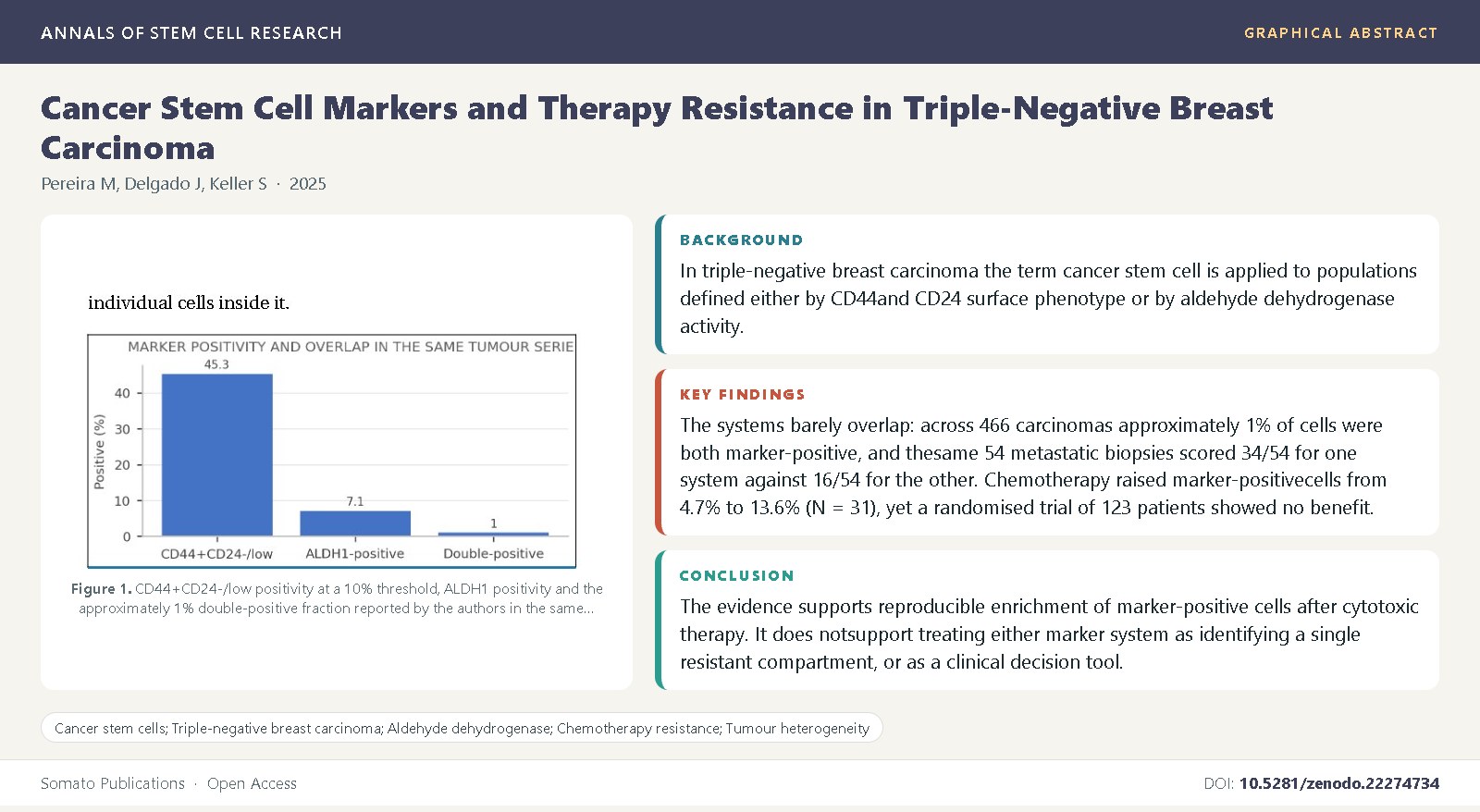
Background: In triple-negative breast carcinoma the term cancer stem cell is applied to populations defined either by CD44
and CD24 surface phenotype or by aldehyde dehydrogenase activity.
Objective: To test whether the two marker systems identify the same cells, and whether the measurements support claims
about chemoresistance, prognosis and targeted treatment.
Methods: Narrative review of marker-scoring series, functional assays, prognostic meta-analyses and one randomised trial.
Findings: The systems barely overlap: across 466 carcinomas approximately 1% of cells were both marker-positive, and the
same 54 metastatic biopsies scored 34/54 for one system against 16/54 for the other. Chemotherapy raised marker-positive
cells from 4.7% to 13.6% (N = 31), yet a randomised trial of 123 patients showed no benefit.
Conclusions: The evidence supports reproducible enrichment of marker-positive cells after cytotoxic therapy. It does not
support treating either marker system as identifying a single resistant compartment, or as a clinical decision tool.
References
Lehmann, B.D., Bauer, J.A., Chen, X., Sanders, M.E., Chakravarthy, A.B., Shyr, Y., et al. (2011) Identification of human triple-negative breast cancer subtypes and preclinical models for selection of targeted therapies. Journal of Clinical Investigation, 121(7): 2750-2767.
Al-Hajj, M., Wicha, M.S., Benito-Hernandez, A., Morrison, S.J., Clarke, M.F. (2003) Prospective identification of tumorigenic breast cancer cells. Proceedings of the National Academy of Sciences, 100(7): 3983-3988.
Ginestier, C., Hur, M.H., Charafe-Jauffret, E., Monville, F., Dutcher, J., Brown, M., et al. (2007) ALDH1 is a marker of normal and malignant human mammary stem cells and a predictor of poor clinical outcome. Cell Stem Cell, 1(5): 555-567.
Kreso, A., Dick, J.E. (2014) Evolution of the cancer stem cell model. Cell Stem Cell, 14(3): 275-291.
Batlle, E., Clevers, H. (2017) Cancer stem cells revisited. Nature Medicine, 23(10): 1124-1134.
Ricardo, S., Vieira, A.F., Gerhard, R., Leitão, D., Pinto, R., Cameselle-Teijeiro, J.F., et al. (2011) Breast cancer stem cell markers CD44, CD24 and ALDH1: expression distribution within intrinsic molecular subtype. Journal of Clinical Pathology, 64(11): 937-946.
Goldstein, L.J., Mansutti, M., Levy, C., Chang, J.C., Henry, S., Fernandez-Perez, I., et al. (2021) A randomized, placebo-controlled phase 2 study of paclitaxel in combination with reparixin compared to paclitaxel alone as front-line therapy for metastatic triple-negative breast cancer (fRida). Breast Cancer Research and Treatment, 190(2): 265-275.
Honeth, G., Bendahl, P.-O., Ringnér, M., Saal, L.H., Gruvberger-Saal, S.K., Lövgren, K., et al. (2008) The CD44+/CD24- phenotype is enriched in basal-like breast tumors. Breast Cancer Research, 10(3): R53.
Sheridan, C., Kishimoto, H., Fuchs, R.K., Mehrotra, S., Bhat-Nakshatri, P., Turner, C.H., et al. (2006) CD44+/CD24- breast cancer cells exhibit enhanced invasive properties: an early step necessary for metastasis. Breast Cancer Research, 8(5): R59.
Fillmore, C.M., Kuperwasser, C. (2008) Human breast cancer cell lines contain stem-like cells that self-renew, give rise to phenotypically diverse progeny and survive chemotherapy. Breast Cancer Research, 10(2): R25.
Dontu, G., Abdallah, W.M., Foley, J.M., Jackson, K.W., Clarke, M.F., Kawamura, M.J., et al. (2003) In vitro propagation and transcriptional profiling of human mammary stem/progenitor cells. Genes & Development, 17(10): 1253-1270.
Pastrana, E., Silva-Vargas, V., Doetsch, F. (2011) Eyes wide open: a critical review of sphere-formation as an assay for stem cells. Cell Stem Cell, 8(5): 486-498.
Quintana, E., Shackleton, M., Sabel, M.S., Fullen, D.R., Johnson, T.M., Morrison, S.J. (2008) Efficient tumour formation by single human melanoma cells. Nature, 456(7222): 593-598.
Charafe-Jauffret, E., Ginestier, C., Iovino, F., Tarpin, C., Diebel, M., Esterni, B., et al. (2010) Aldehyde dehydrogenase 1-positive cancer stem cells mediate metastasis and poor clinical outcome in inflammatory breast cancer. Clinical Cancer Research, 16(1): 45-55.
Hu, Y., Smyth, G.K. (2009) ELDA: extreme limiting dilution analysis for comparing depleted and enriched populations in stem cell and other assays. Journal of Immunological Methods, 347(1-2): 70-78.
Mani, S.A., Guo, W., Liao, M.-J., Eaton, E.N., Ayyanan, A., Zhou, A.Y., et al. (2008) The epithelial-mesenchymal transition generates cells with properties of stem cells. Cell, 133(4): 704-715.
Chaffer, C.L., Brueckmann, I., Scheel, C., Kaestli, A.J., Wiggins, P.A., Rodrigues, L.O., et al. (2011) Normal and neoplastic nonstem cells can spontaneously convert to a stem-like state. Proceedings of the National Academy of Sciences, 108(19): 7950-7955.
Gupta, P.B., Fillmore, C.M., Jiang, G., Shapira, S.D., Tao, K., Kuperwasser, C., et al. (2011) Stochastic state transitions give rise to phenotypic equilibrium in populations of cancer cells. Cell, 146(4): 633-644.
Li, X., Lewis, M.T., Huang, J., Gutierrez, C., Osborne, C.K., Wu, M.-F., et al. (2008) Intrinsic resistance of tumorigenic breast cancer cells to chemotherapy. JNCI: Journal of the National Cancer Institute, 100(9): 672-679.
Lee, H.E., Kim, J.H., Kim, Y.J., Choi, S.Y., Kim, S.-W., Kang, E., et al. (2011) An increase in cancer stem cell population after primary systemic therapy is a poor prognostic factor in breast cancer. British Journal of Cancer, 104(11): 1730-1738.
Bhola, N.E., Balko, J.M., Dugger, T.C., Kuba, M.G., Sánchez, V., Sanders, M., et al. (2013) TGF-beta inhibition enhances chemotherapy action against triple-negative breast cancer. Journal of Clinical Investigation, 123(3): 1348-1358.
Creighton, C.J., Li, X., Landis, M., Dixon, J.M., Neumeister, V.M., Sjolund, A., et al. (2009) Residual breast cancers after conventional therapy display mesenchymal as well as tumor-initiating features. Proceedings of the National Academy of Sciences, 106(33): 13820-13825.
Echeverria, G.V., Ge, Z., Seth, S., Zhang, X., Jeter-Jones, S., Zhou, X., et al. (2019) Resistance to neoadjuvant chemotherapy in triple-negative breast cancer mediated by a reversible drug-tolerant state. Science Translational Medicine, 11(488): eaav0936.
Kim, C., Gao, R., Sei, E., Brandt, R., Hartman, J., Hatschek, T., et al. (2018) Chemoresistance evolution in triple-negative breast cancer delineated by single-cell sequencing. Cell, 173(4): 879-893.e13.
Phillips, T.M., McBride, W.H., Pajonk, F. (2006) The response of CD24-/low/CD44+ breast cancer-initiating cells to radiation. JNCI: Journal of the National Cancer Institute, 98(24): 1777-1785.
Diehn, M., Cho, R.W., Lobo, N.A., Kalisky, T., Dorie, M.J., Kulp, A.N., et al. (2009) Association of reactive oxygen species levels and radioresistance in cancer stem cells. Nature, 458(7239): 780-783.
Zhou, L., Jiang, Y., Yan, T., Di, G., Shen, Z., Shao, Z., et al. (2010) The prognostic role of cancer stem cells in breast cancer: a meta-analysis of published literatures. Breast Cancer Research and Treatment, 122(3): 795-801.
Liu, Y., Lv, D., Duan, J., Xu, S., Zhang, J., Yang, X., et al. (2014) ALDH1A1 expression correlates with clinicopathologic features and poor prognosis of breast cancer patients: a systematic review and meta-analysis. BMC Cancer, 14(1): 444.
Abraham, B.K., Fritz, P., McClellan, M., Hauptvogel, P., Athelogou, M., Brauch, H. (2005) Prevalence of CD44+/CD24-/low cells in breast cancer may not be associated with clinical outcome but may favor distant metastasis. Clinical Cancer Research, 11(3): 1154-1159.
Idowu, M.O., Kmieciak, M., Dumur, C., Burton, R.S., Grimes, M.M., Powers, C.N., et al. (2012) CD44+/CD24-/low cancer stem/progenitor cells are more abundant in triple-negative invasive breast carcinoma phenotype and are associated with poor outcome. Human Pathology, 43(3): 364-373.
Kida, K., Ishikawa, T., Yamada, A., Shimada, K., Narui, K., Sugae, S., et al. (2016) Effect of ALDH1 on prognosis and chemoresistance by breast cancer subtype. Breast Cancer Research and Treatment, 156(2): 261-269.
Goldstein, L.J., Perez, R.P., Yardley, D., Han, L.K., Reuben, J.M., Gao, H., et al. (2020) A window-of-opportunity trial of the CXCR1/2 inhibitor reparixin in operable HER-2-negative breast cancer. Breast Cancer Research, 22(1): 4.
Tanei, T., Morimoto, K., Shimazu, K., Kim, S.J., Tanji, Y., Taguchi, T., et al. (2009) Association of breast cancer stem cells identified by aldehyde dehydrogenase 1 expression with resistance to sequential paclitaxel and epirubicin-based chemotherapy for breast cancers. Clinical Cancer Research, 15(12): 4234-4241.





