
Biomanufacturing and Scale-Up of Clinical-Grade Induced Pluripotent Stem Cell Lines
DOI:
https://doi.org/10.5281/zenodo.22274707Keywords:
Induced pluripotent stem cells; Biomanufacturing; Bioreactor expansion; Genomic stability; Good manufacturing practiceAbstract
Background: Clinical use of induced pluripotent stem cells depends on manufacturing lines that regulators accept as starting
material and expanding them reproducibly to the numbers dosing schedules demand.
Objective: To identify where the binding constraints on clinical-grade production now sit, across expansion, genomic
stability, residual undifferentiated cell testing and sourcing strategy.
Methods: Narrative review of bioprocess studies, genomic stability screens, release-testing reports and regulatory guidance.
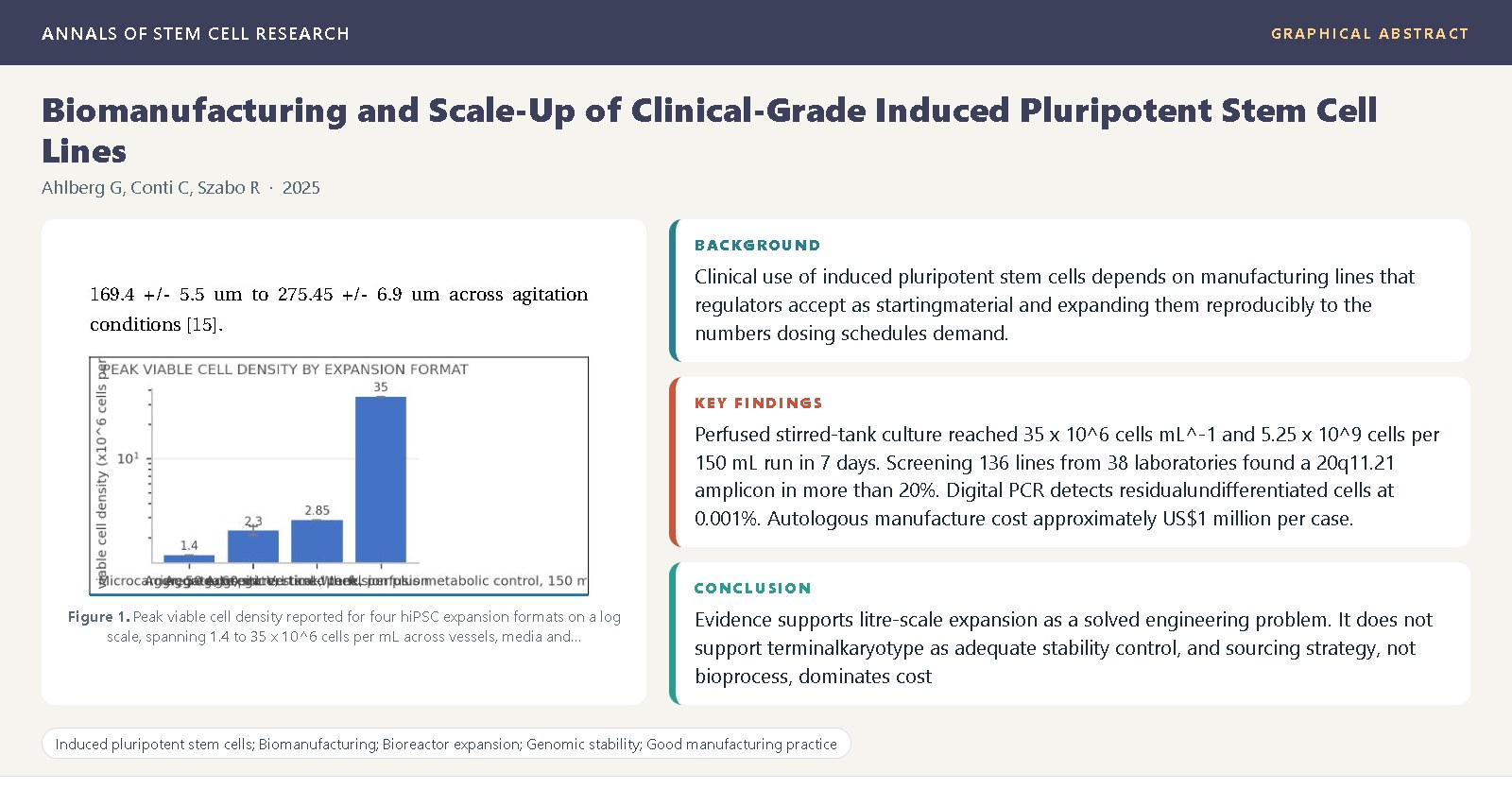
Findings: Perfused stirred-tank culture reached 35 x 10^6 cells mL^-1 and 5.25 x 10^9 cells per 150 mL run in 7 days.
Screening 136 lines from 38 laboratories found a 20q11.21 amplicon in more than 20%. Digital PCR detects residual
undifferentiated cells at 0.001%. Autologous manufacture cost approximately US$1 million per case.
Conclusions: Evidence supports litre-scale expansion as a solved engineering problem. It does not support terminal
karyotype as adequate stability control, and sourcing strategy, not bioprocess, dominates cost
References
Baghbaderani, B.A., Tian, X., Neo, B.H., Burkall, A., Dimezzo, T., Sierra, G., et al. (2015) cGMP-manufactured human induced pluripotent stem cells are available for pre-clinical and clinical applications. Stem Cell Reports, 5(4): 647-659.
Sullivan, S., Stacey, G.N., Akazawa, C., Aoyama, N., Baptista, R., Bedford, P., et al. (2018) Quality control guidelines for clinical-grade human induced pluripotent stem cell lines. Regenerative Medicine, 13(7): 859-866.
Andrews, P., Baker, D., Benvinisty, N., Miranda, B., Bruce, K., Brustle, O., et al. (2015) Points to consider in the development of seed stocks of pluripotent stem cells for clinical applications: International Stem Cell Banking Initiative (ISCBI). Regenerative Medicine, 10(sup2): 1-44.
Manstein, F., Ullmann, K., Kropp, C., Halloin, C., Triebert, W., Franke, A., et al. (2021) High density bioprocessing of human pluripotent stem cells by metabolic control and in silico modeling. Stem Cells Translational Medicine, 10(7): 1063-1080.
Kwok, C.K., Ueda, Y., Kadari, A., Gunther, K., Ergun, S., Heron, A., et al. (2018) Scalable stirred suspension culture for the generation of billions of human induced pluripotent stem cells using single-use bioreactors. Journal of Tissue Engineering and Regenerative Medicine, 12(2): e1076-e1087.
Umekage, M., Sato, Y., Takasu, N. (2019) Overview: an iPS cell stock at CiRA. Inflammation and Regeneration, 39(1): 17.
Fusaki, N., Ban, H., Nishiyama, A., Saeki, K., Hasegawa, M. (2009) Efficient induction of transgene-free human pluripotent stem cells using a vector based on Sendai virus, an RNA virus that does not integrate into the host genome. Proceedings of the Japan Academy, Series B, 85(8): 348-362.
Okita, K., Matsumura, Y., Sato, Y., Okada, A., Morizane, A., Okamoto, S., et al. (2011) A more efficient method to generate integration-free human iPS cells. Nature Methods, 8(5): 409-412.
Warren, L., Manos, P.D., Ahfeldt, T., Loh, Y.-H., Li, H., Lau, F., et al. (2010) Highly efficient reprogramming to pluripotency and directed differentiation of human cells with synthetic modified mRNA. Cell Stem Cell, 7(5): 618-630.
Schlaeger, T.M., Daheron, L., Brickler, T.R., Entwisle, S., Chan, K., Cianci, A., et al. (2015) A comparison of non-integrating reprogramming methods. Nature Biotechnology, 33(1): 58-63.
Beers, J., Linask, K.L., Chen, J.A., Siniscalchi, L.I., Lin, Y., Zheng, W., et al. (2015) A cost-effective and efficient reprogramming platform for large-scale production of integration-free human induced pluripotent stem cells in chemically defined culture. Scientific Reports, 5: 11319.
Baghbaderani, B.A., Syama, A., Sivapatham, R., Pei, Y., Mukherjee, O., Fellner, T., et al. (2016) Detailed characterization of human induced pluripotent stem cells manufactured for therapeutic applications. Stem Cell Reviews and Reports, 12(4): 394-420.
Badenes, S.M., Fernandes, T.G., Cordeiro, C.S.M., Boucher, S., Kuninger, D., Vemuri, M.C., et al. (2016) Defined Essential 8 medium and vitronectin efficiently support scalable xeno-free expansion of human induced pluripotent stem cells in stirred microcarrier culture systems. PLOS ONE, 11(3): e0151264.
Nogueira, D.E.S., Rodrigues, C.A.V., Carvalho, M.S., Miranda, C.C., Hashimura, Y., Jung, S., et al. (2019) Strategies for the expansion of human induced pluripotent stem cells as aggregates in single-use Vertical-Wheel bioreactors. Journal of Biological Engineering, 13(1): 74.
Borys, B.S., Dang, T., So, T., Rohani, L., Revay, T., Walsh, T., et al. (2021) Overcoming bioprocess bottlenecks in the large-scale expansion of high-quality hiPSC aggregates in vertical-wheel stirred suspension bioreactors. Stem Cell Research & Therapy, 12(1): 55.
Kropp, C., Kempf, H., Halloin, C., Robles-Diaz, D., Franke, A., Scheper, T., et al. (2016) Impact of feeding strategies on the scalable expansion of human pluripotent stem cells in single-use stirred tank bioreactors. Stem Cells Translational Medicine, 5(10): 1289-1301.
Amps, K., Andrews, P.W., Anyfantis, G., Armstrong, L., Avery, S., Baharvand, H., et al. (2011) Screening ethnically diverse human embryonic stem cells identifies a chromosome 20 minimal amplicon conferring growth advantage. Nature Biotechnology, 29(12): 1132-1144.
Avery, S., Hirst, A.J., Baker, D., Lim, C.Y., Alagaratnam, S., Skotheim, R.I., et al. (2013) BCL-XL mediates the strong selective advantage of a 20q11.21 amplification commonly found in human embryonic stem cell cultures. Stem Cell Reports, 1(5): 379-386.
Merkle, F.T., Ghosh, S., Kamitaki, N., Mitchell, J., Avior, Y., Mello, C., et al. (2017) Human pluripotent stem cells recurrently acquire and expand dominant negative P53 mutations. Nature, 545(7653): 229-233.
Andrews, P.W., Barbaric, I., Benvenisty, N., Draper, J.S., Ludwig, T., Merkle, F.T., et al. (2022) The consequences of recurrent genetic and epigenetic variants in human pluripotent stem cells. Cell Stem Cell, 29(12): 1624-1636.
Baker, D., Hirst, A.J., Gokhale, P.J., Juarez, M.A., Williams, S., Wheeler, M., et al. (2016) Detecting genetic mosaicism in cultures of human pluripotent stem cells. Stem Cell Reports, 7(5): 998-1012.
Assou, S., Girault, N., Plinet, M., Bouckenheimer, J., Sansac, C., Combe, M., et al. (2020) Recurrent genetic abnormalities in human pluripotent stem cells: definition and routine detection in culture supernatant by targeted droplet digital PCR. Stem Cell Reports, 14(1): 1-8.
European Medicines Agency, Committee for Advanced Therapies (2011) Reflection paper on stem cell-based medicinal products. EMA/CAT/571134/2009, adopted 14 January 2011, effective 14 January 2011. Jurisdiction: European Union.
US Food and Drug Administration, Center for Biologics Evaluation and Research (2008) Guidance for FDA reviewers and sponsors: content and review of chemistry, manufacturing, and control (CMC) information for human somatic cell therapy investigational new drug applications (INDs). CBER, April 2008. Jurisdiction: United States.
Sato, Y., Bando, H., Di Piazza, M., Gowing, G., Herberts, C., Jackman, S., et al. (2019) Tumorigenicity assessment of cell therapy products: the need for global consensus and points to consider. Cytotherapy, 21(11): 1095-1111.
Kuroda, T., Yasuda, S., Kusakawa, S., Hirata, N., Kanda, Y., Suzuki, K., et al. (2012) Highly sensitive in vitro methods for detection of residual undifferentiated cells in retinal pigment epithelial cells derived from human iPS cells. PLoS ONE, 7(5): e37342.
Kuroda, T., Yasuda, S., Matsuyama, S., Tano, K., Kusakawa, S., Sawa, Y., et al. (2015) Highly sensitive droplet digital PCR method for detection of residual undifferentiated cells in cardiomyocytes derived from human pluripotent stem cells. Regenerative Therapy, 2: 17-23.
Tano, K., Yasuda, S., Kuroda, T., Saito, H., Umezawa, A., Sato, Y. (2014) A novel in vitro method for detecting undifferentiated human pluripotent stem cells as impurities in cell therapy products using a highly efficient culture system. PLoS ONE, 9(10): e110496.
Allison, T.F., Andrews, P.W., Avior, Y., Barbaric, I., Benvenisty, N., Bock, C., et al. (2018) Assessment of established techniques to determine developmental and malignant potential of human pluripotent stem cells. Nature Communications, 9(1): 1925.
Li, R., Hornberger, K., Dutton, J.R., Hubel, A. (2020) Cryopreservation of human iPS cell aggregates in a DMSO-free solution - an optimization and comparative study. Frontiers in Bioengineering and Biotechnology, 8: 1.
Kim, J.-H., Kawase, E., Bharti, K., Karnieli, O., Arakawa, Y., Stacey, G. (2022) Perspectives on the cost of goods for hPSC banks for manufacture of cell therapies. npj Regenerative Medicine, 7(1): 54.
Taylor, C.J., Peacock, S., Chaudhry, A.N., Bradley, J.A., Bolton, E.M. (2012) Generating an iPSC bank for HLA-matched tissue transplantation based on known donor and recipient HLA types. Cell Stem Cell, 11(2): 147-152.
Xu, H., Wang, B., Ono, M., Kagita, A., Fujii, K., Sasakawa, N., et al. (2019) Targeted disruption of HLA genes via CRISPR-Cas9 generates iPSCs with enhanced immune compatibility. Cell Stem Cell, 24(4): 566-578.e7.
Deuse, T., Hu, X., Gravina, A., Wang, D., Tediashvili, G., De, C., et al. (2019) Hypoimmunogenic derivatives of induced pluripotent stem cells evade immune rejection in fully immunocompetent allogeneic recipients. Nature Biotechnology, 37(3): 252-258.





