
Extracellular Matrix Composition and Retention of Stemness in Cultured Progenitor Cells
DOI:
https://doi.org/10.5281/zenodo.22274429Keywords:
Extracellular matrix; Substrate stiffness; Stem cell fate; Cell culture substrates; Mesenchymal stromal cellsAbstract
Background: Progenitor cells lose potency on tissue-culture plastic, and both substrate mechanics and matrix composition
have been proposed as the instruction that preserves it.
Objective: To examine where the mechanical and compositional literatures conflict, and what a substrate specification must
state to be reproducible.
Methods: Narrative review of hydrogel differentiation, tethering and defined-substrate culture studies.
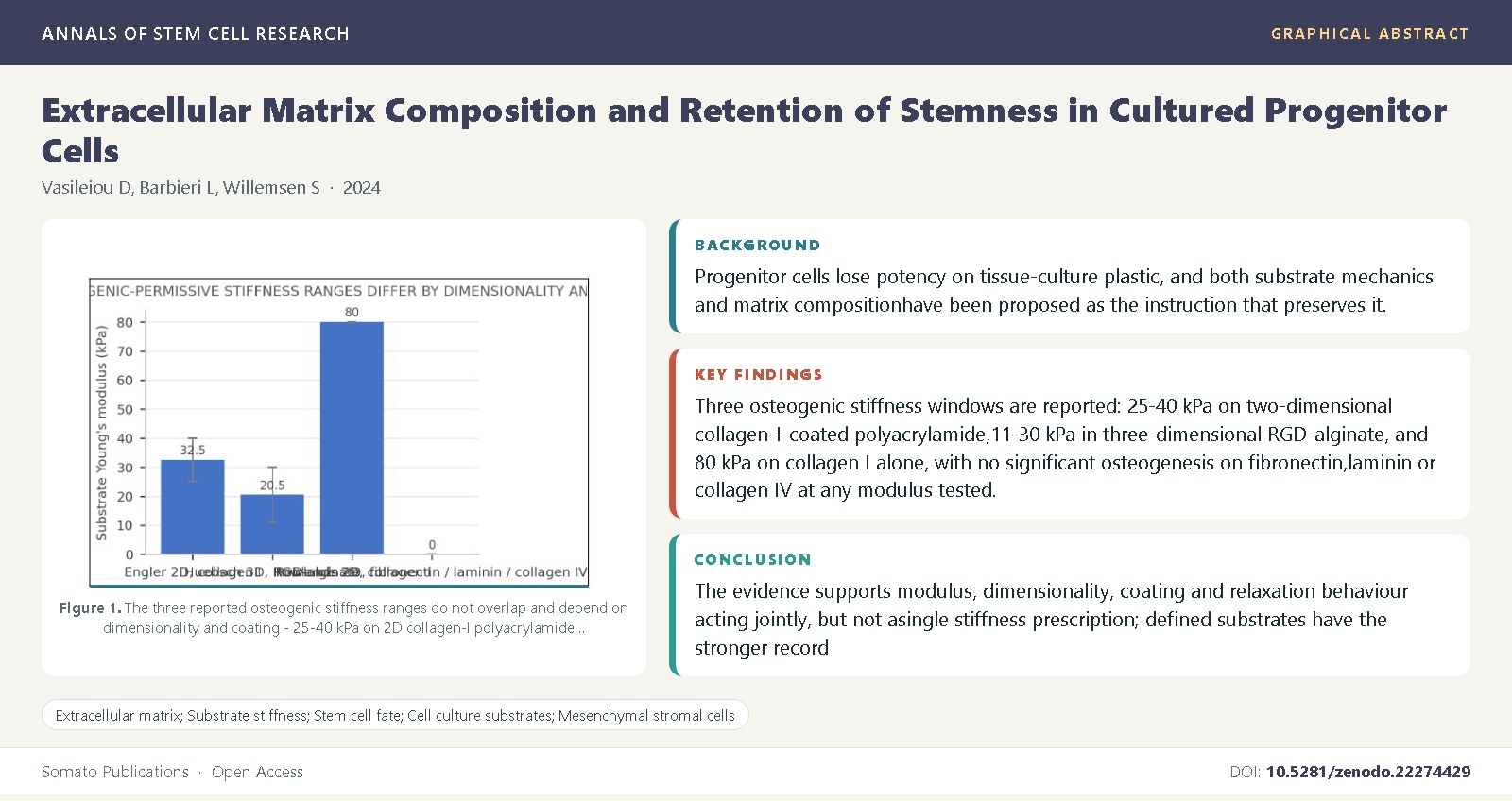
Findings: Three osteogenic stiffness windows are reported: 25-40 kPa on two-dimensional collagen-I-coated polyacrylamide,
11-30 kPa in three-dimensional RGD-alginate, and 80 kPa on collagen I alone, with no significant osteogenesis on fibronectin,
laminin or collagen IV at any modulus tested. Recombinant laminin-511 supported self-renewal for 20 passages at
approximately 97% OCT4-positive.
Conclusions: The evidence supports modulus, dimensionality, coating and relaxation behaviour acting jointly, but not a
single stiffness prescription; defined substrates have the stronger record
References
Lai, Y., Sun, Y., Skinner, C.M., Son, E.L., Lu, Z., Tuan, R.S., et al. (2010) Reconstitution of marrow-derived extracellular matrix ex vivo: a robust culture system for expanding large-scale highly functional human mesenchymal stem cells. Stem Cells and Development, 19(7): 1095-1107.
Pelham, R.J., Wang, Y.L. (1997) Cell locomotion and focal adhesions are regulated by substrate flexibility. Proceedings of the National Academy of Sciences of the United States of America, 94(25): 13661-13665.
Discher, D.E., Janmey, P., Wang, Y.L. (2005) Tissue cells feel and respond to the stiffness of their substrate. Science, 310(5751): 1139-1143.
Engler, A.J., Sen, S., Sweeney, H.L., Discher, D.E. (2006) Matrix elasticity directs stem cell lineage specification. Cell, 126(4): 677-689.
Ludwig, T.E., Levenstein, M.E., Jones, J.M., Berggren, W.T., Mitchen, E.R., Frane, J.L., et al. (2006) Derivation of human embryonic stem cells in defined conditions. Nature Biotechnology, 24(2): 185-187.
Rodin, S., Domogatskaya, A., Strom, S., Hansson, E.M., Chien, K.R., Inzunza, J., et al. (2010) Long-term self-renewal of human pluripotent stem cells on human recombinant laminin-511. Nature Biotechnology, 28(6): 611-615.
Melkoumian, Z., Weber, J.L., Weber, D.M., Fadeev, A.G., Zhou, Y., Dolley-Sonneville, P., et al. (2010) Synthetic peptide-acrylate surfaces for long-term self-renewal and cardiomyocyte differentiation of human embryonic stem cells. Nature Biotechnology, 28(6): 606-610.
Watt, F.M., Huck, W.T.S. (2013) Role of the extracellular matrix in regulating stem cell fate. Nature Reviews Molecular Cell Biology, 14(8): 467-473.
Vining, K.H., Mooney, D.J. (2017) Mechanical forces direct stem cell behaviour in development and regeneration. Nature Reviews Molecular Cell Biology, 18(12): 728-742.
Huebsch, N., Arany, P.R., Mao, A.S., Shvartsman, D., Ali, O.A., Bencherif, S.A., et al. (2010) Harnessing traction-mediated manipulation of the cell/matrix interface to control stem-cell fate. Nature Materials, 9(6): 518-526.
Rowlands, A.S., George, P.A., Cooper-White, J.J. (2008) Directing osteogenic and myogenic differentiation of MSCs: interplay of stiffness and adhesive ligand presentation. American Journal of Physiology. Cell Physiology, 295(4): C1037-C1044.
Engler, A., Bacakova, L., Newman, C., Hategan, A., Griffin, M., Discher, D. (2004) Substrate compliance versus ligand density in cell on gel responses. Biophysical Journal, 86(1 Pt 1): 617-628.
Cukierman, E., Pankov, R., Stevens, D.R., Yamada, K.M. (2001) Taking cell-matrix adhesions to the third dimension. Science, 294(5547): 1708-1712.
Khetan, S., Guvendiren, M., Legant, W.R., Cohen, D.M., Chen, C.S., Burdick, J.A. (2013) Degradation-mediated cellular traction directs stem cell fate in covalently crosslinked three-dimensional hydrogels. Nature Materials, 12(5): 458-465.
Elosegui-Artola, A., Oria, R., Chen, Y., Kosmalska, A., Perez-Gonzalez, C., Castro, N., et al. (2016) Mechanical regulation of a molecular clutch defines force transmission and transduction in response to matrix rigidity. Nature Cell Biology, 18(5): 540-548.
Trappmann, B., Gautrot, J.E., Connelly, J.T., Strange, D.G.T., Li, Y., Oyen, M.L., et al. (2012) Extracellular-matrix tethering regulates stem-cell fate. Nature Materials, 11(7): 642-649.
Wen, J.H., Vincent, L.G., Fuhrmann, A., Choi, Y.S., Hribar, K.C., Taylor-Weiner, H., et al. (2014) Interplay of matrix stiffness and protein tethering in stem cell differentiation. Nature Materials, 13(10): 979-987.
Chaudhuri, O., Gu, L., Darnell, M., Klumpers, D., Bencherif, S.A., Weaver, J.C., et al. (2015) Substrate stress relaxation regulates cell spreading. Nature Communications, 6: 6365.
Chaudhuri, O., Gu, L., Klumpers, D., Darnell, M., Bencherif, S.A., Weaver, J.C., et al. (2016) Hydrogels with tunable stress relaxation regulate stem cell fate and activity. Nature Materials, 15(3): 326-334.
Chaudhuri, O., Cooper-White, J., Janmey, P.A., Mooney, D.J., Shenoy, V.B. (2020) Effects of extracellular matrix viscoelasticity on cellular behaviour. Nature, 584(7822): 535-546.
Dupont, S., Morsut, L., Aragona, M., Enzo, E., Giulitti, S., Cordenonsi, M., et al. (2011) Role of YAP/TAZ in mechanotransduction. Nature, 474(7350): 179-183.
Panciera, T., Azzolin, L., Cordenonsi, M., Piccolo, S. (2017) Mechanobiology of YAP and TAZ in physiology and disease. Nature Reviews Molecular Cell Biology, 18(12): 758-770.
Yang, C., Tibbitt, M.W., Basta, L., Anseth, K.S. (2014) Mechanical memory and dosing influence stem cell fate. Nature Materials, 13(6): 645-652.
Chowdhury, F., Na, S., Li, D., Poh, Y.C., Tanaka, T.S., Wang, F., et al. (2010) Material properties of the cell dictate stress-induced spreading and differentiation in embryonic stem cells. Nature Materials, 9(1): 82-88.
Gilbert, P.M., Havenstrite, K.L., Magnusson, K.E., Sacco, A., Leonardi, N.A., Kraft, P., et al. (2010) Substrate elasticity regulates skeletal muscle stem cell self-renewal in culture. Science, 329(5995): 1078-1081.
Rodin, S., Antonsson, L., Niaudet, C., Simonson, O.E., Salmela, E., Hansson, E.M., et al. (2014) Clonal culturing of human embryonic stem cells on laminin-521/E-cadherin matrix in defined and xeno-free environment. Nature Communications, 5: 3195.
Miyazaki, T., Futaki, S., Suemori, H., Taniguchi, Y., Yamada, M., Kawasaki, M., et al. (2012) Laminin E8 fragments support efficient adhesion and expansion of dissociated human pluripotent stem cells. Nature Communications, 3: 1236.
Braam, S.R., Zeinstra, L., Litjens, S., Ward-van Oostwaard, D., van den Brink, S., van Laake, L., et al. (2008) Recombinant vitronectin is a functionally defined substrate that supports human embryonic stem cell self-renewal via alphavbeta5 integrin. Stem Cells, 26(9): 2257-2265.
Chen, G., Gulbranson, D.R., Hou, Z., Bolin, J.M., Ruotti, V., Probasco, M.D., et al. (2011) Chemically defined conditions for human iPSC derivation and culture. Nature Methods, 8(5): 424-429.
Chen, X.D., Dusevich, V., Feng, J.Q., Manolagas, S.C., Jilka, R.L. (2007) Extracellular matrix made by bone marrow cells facilitates expansion of marrow-derived mesenchymal progenitor cells and prevents their differentiation into osteoblasts. Journal of Bone and Mineral Research, 22(12): 1943-1956.
Prewitz, M.C., Seib, F.P., von Bonin, M., Friedrichs, J., Stissel, A., Niehage, C., et al. (2013) Tightly anchored tissue-mimetic matrices as instructive stem cell microenvironments. Nature Methods, 10(8): 788-794.
Pereira, A.R., Trivanovic, D., Stahlhut, P., Rudert, M., Groll, J., Herrmann, M. (2022) Preservation of the naive features of mesenchymal stromal cells in vitro: comparison of cell- and bone-derived decellularized extracellular matrix. Journal of Tissue Engineering, 13: 20417314221074453.





