
Neural Stem Cell Differentiation Under Hypoxic Culture Conditions
DOI:
https://doi.org/10.5281/zenodo.22237991Keywords:
neural stem cells; hypoxia; oxygen tension; dopaminergic differentiation; HIFAbstract
Background: Brain tissue sits far below the incubator’s oxygen tension, so cells cultured at atmospheric oxygen are held in
conditions their niche never provides.
Objective: To review the effects of lowered oxygen on neural stem cell proliferation and differentiation, and why laboratories
disagree.
Methods: Narrative review of oxygen measurement in brain and culture, of HIF signalling, and of differentiation across
oxygen tensions.
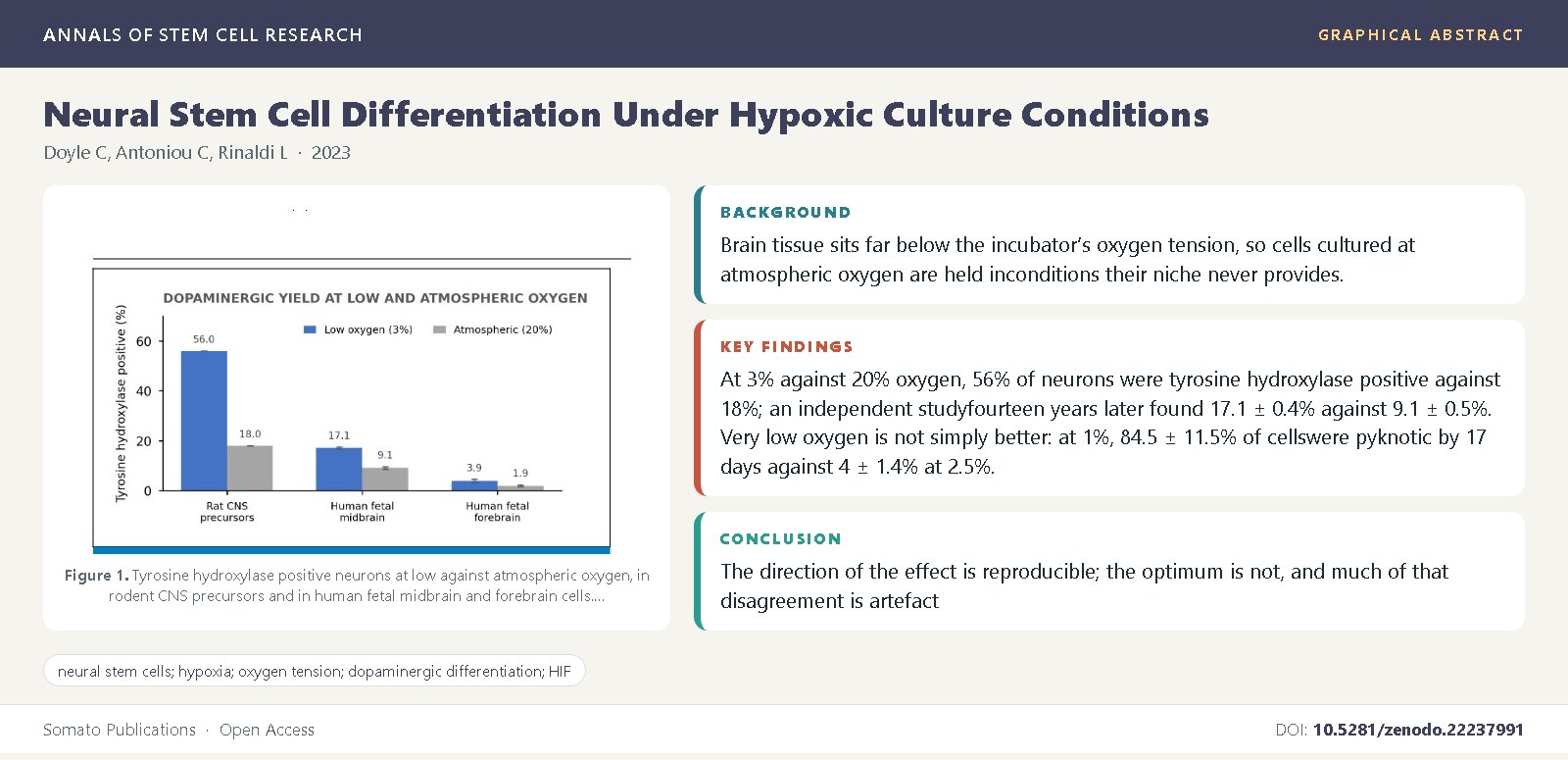
Findings: At 3% against 20% oxygen, 56% of neurons were tyrosine hydroxylase positive against 18%; an independent study
fourteen years later found 17.1 ± 0.4% against 9.1 ± 0.5%. Very low oxygen is not simply better: at 1%, 84.5 ± 11.5% of cells
were pyknotic by 17 days against 4 ± 1.4% at 2.5%. Laboratories report incubator setpoints, not pericellular oxygen.
Conclusions: The direction of the effect is reproducible; the optimum is not, and much of that disagreement is artefact
References
Place, T.L., Domann, F.E., Case, A.J. (2017) Limitations of oxygen delivery to cells in culture: an underappreciated problem in basic and translational research. Free Radic Biol Med, 113: 311-322.
Zhang, K., Zhu, L., Fan, M. (2011) Oxygen, a key factor regulating cell behavior during neurogenesis and cerebral diseases. Front Mol Neurosci, 4: 5.
Ivanovic, Z. (2009) Hypoxia or in situ normoxia: the stem cell paradigm. J Cell Physiol, 219(2): 271-275.
Wion, D., Christen, T., Barbier, E.L., Coles, J.A. (2009) PO2 matters in stem cell culture. Cell Stem Cell, 5(3): 242-243.
Keeley, T.P., Mann, G.E. (2019) Defining physiological normoxia for improved translation of cell physiology to animal models and humans. Physiol Rev, 99(1): 161-234.
Ndubuizu, O., LaManna, J.C. (2007) Brain tissue oxygen concentration measurements. Antioxid Redox Signal, 9(8): 1207-1220.
Erecinska, M., Silver, I.A. (2001) Tissue oxygen tension and brain sensitivity to hypoxia. Respir Physiol, 128(3): 263-276.
Mohyeldin, A., Garzon-Muvdi, T., Quinones-Hinojosa, A. (2010) Oxygen in stem cell biology: a critical component of the stem cell niche. Cell Stem Cell, 7(2): 150-161.
Simon, M.C., Keith, B. (2008) The role of oxygen availability in embryonic development and stem cell function. Nat Rev Mol Cell Biol, 9(4): 285-296.
Metzen, E., Wolff, M., Fandrey, J., Jelkmann, W. (1995) Pericellular PO2 and O2 consumption in monolayer cell cultures. Respir Physiol, 100(2): 101-106.
Al-Ani, A., Toms, D., Kondro, D., Thundathil, J., Yu, Y., Ungrin, M. (2018) Oxygenation in cell culture: critical parameters for reproducibility are routinely not reported. PLoS One, 13(10): e0204269.
Semenza, G.L. (2012) Hypoxia-inducible factors in physiology and medicine. Cell, 148(3): 399-408.
Keith, B., Johnson, R.S., Simon, M.C. (2012) HIF1alpha and HIF2alpha: sibling rivalry in hypoxic tumour growth and progression. Nat Rev Cancer, 12(1): 9-22.
Tomita, S., Ueno, M., Sakamoto, M., Kitahama, Y., Ueki, M., Maekawa, N., et al. (2003) Defective brain development in mice lacking the Hif-1alpha gene in neural cells. Mol Cell Biol, 23(19): 6739-6749.
Li, L., Candelario, K.M., Thomas, K., Wang, R., Wright, K., Messier, A., et al. (2014) Hypoxia inducible factor-1alpha (HIF-1alpha) is required for neural stem cell maintenance and vascular stability in the adult mouse SVZ. J Neurosci, 34(50): 16713-16719.
Covello, K.L., Kehler, J., Yu, H., Gordan, J.D., Arsham, A.M., Hu, C.J., et al. (2006) HIF-2alpha regulates Oct-4: effects of hypoxia on stem cell function, embryonic development, and tumor growth. Genes Dev, 20(5): 557-570.
Gustafsson, M.V., Zheng, X., Pereira, T., Gradin, K., Jin, S., Lundkvist, J., et al. (2005) Hypoxia requires Notch signaling to maintain the undifferentiated cell state. Dev Cell, 9(5): 617-628.
Mazumdar, J., O’Brien, W.T., Johnson, R.S., LaManna, J.C., Chavez, J.C., Klein, P.S., et al. (2010) O2 regulates stem cells through Wnt/beta-catenin signalling. Nat Cell Biol, 12(10): 1007-1013.
Arthur, S.A., Blaydes, J.P., Houghton, F.D. (2019) Glycolysis regulates human embryonic stem cell self-renewal under hypoxia through HIF-2alpha and the glycolytic sensors CTBPs. Stem Cell Reports, 12(4): 728-742.
Studer, L., Csete, M., Lee, S.H., Kabbani, N., Walikonis, J., Wold, B., et al. (2000) Enhanced proliferation, survival, and dopaminergic differentiation of CNS precursors in lowered oxygen. J Neurosci, 20(19): 7377-7383.
Morrison, S.J., Csete, M., Groves, A.K., Melega, W., Wold, B., Anderson, D.J. (2000) Culture in reduced levels of oxygen promotes clonogenic sympathoadrenal differentiation by isolated neural crest stem cells. J Neurosci, 20(19): 7370-7376.
Milosevic, J., Schwarz, S.C., Krohn, K., Poppe, M., Storch, A., Schwarz, J. (2005) Low atmospheric oxygen avoids maturation, senescence and cell death of murine mesencephalic neural precursors. J Neurochem, 92(4): 718-729.
Krabbe, C., Bak, S.T., Jensen, P., von Linstow, C., Martinez Serrano, A., Hansen, C., et al. (2014) Influence of oxygen tension on dopaminergic differentiation of human fetal stem cells of midbrain and forebrain origin. PLoS One, 9(5): e96465.
Pistollato, F., Chen, H.L., Schwartz, P.H., Basso, G., Panchision, D.M. (2007) Oxygen tension controls the expansion of human CNS precursors and the generation of astrocytes and oligodendrocytes. Mol Cell Neurosci, 35(3): 424-435.
Wagenfuhr, L., Meyer, A.K., Braunschweig, L., Marrone, L., Storch, A. (2015) Brain oxygen tension controls the expansion of outer subventricular zone-like basal progenitors in the developing mouse brain. Development, 142(17): 2904-2915.
Stacpoole, S.R.L., Bilican, B., Webber, D.J., Luzhynskaya, A., He, X.L., Compston, A., et al. (2011) Derivation of neural precursor cells from human ES cells at 3% O2 is efficient, enhances survival and presents no barrier to regional specification and functional differentiation. Cell Death Differ, 18(6): 1016-1023.
Ezashi, T., Das, P., Roberts, R.M. (2005) Low O2 tensions and the prevention of differentiation of hES cells. Proc Natl Acad Sci U S A, 102(13): 4783-4788.
Santilli, G., Lamorte, G., Carlessi, L., Ferrari, D., Rota Nodari, L., Binda, E., et al. (2010) Mild hypoxia enhances proliferation and multipotency of human neural stem cells. PLoS One, 5(1): e8575.
Parrinello, S., Samper, E., Krtolica, A., Goldstein, J., Melov, S., Campisi, J. (2003) Oxygen sensitivity severely limits the replicative lifespan of murine fibroblasts. Nat Cell Biol, 5(8): 741-747.
Jagannathan, L., Cuddapah, S., Costa, M. (2016) Oxidative stress under ambient and physiological oxygen tension in tissue culture. Curr Pharmacol Rep, 2(2): 64-72.





