
Haematopoietic Stem Cell Mobilisation Regimens and Graft Composition in Autologous Transplantation
DOI:
https://doi.org/10.5281/zenodo.22237987Keywords:
mobilisation; plerixafor; CD34; autologous transplantation; graft compositionAbstract
Background: Autologous transplantation needs a graft collected by apheresis after mobilisation, and the regimen determines
whether enough cells are obtained, and at what cost.
Objective: To review mobilisation regimens, the definition of poor mobilisation, and whether graft composition beyond CD34
count predicts anything.
Methods: Narrative review of randomised trials, consensus documents and comparative cohorts.
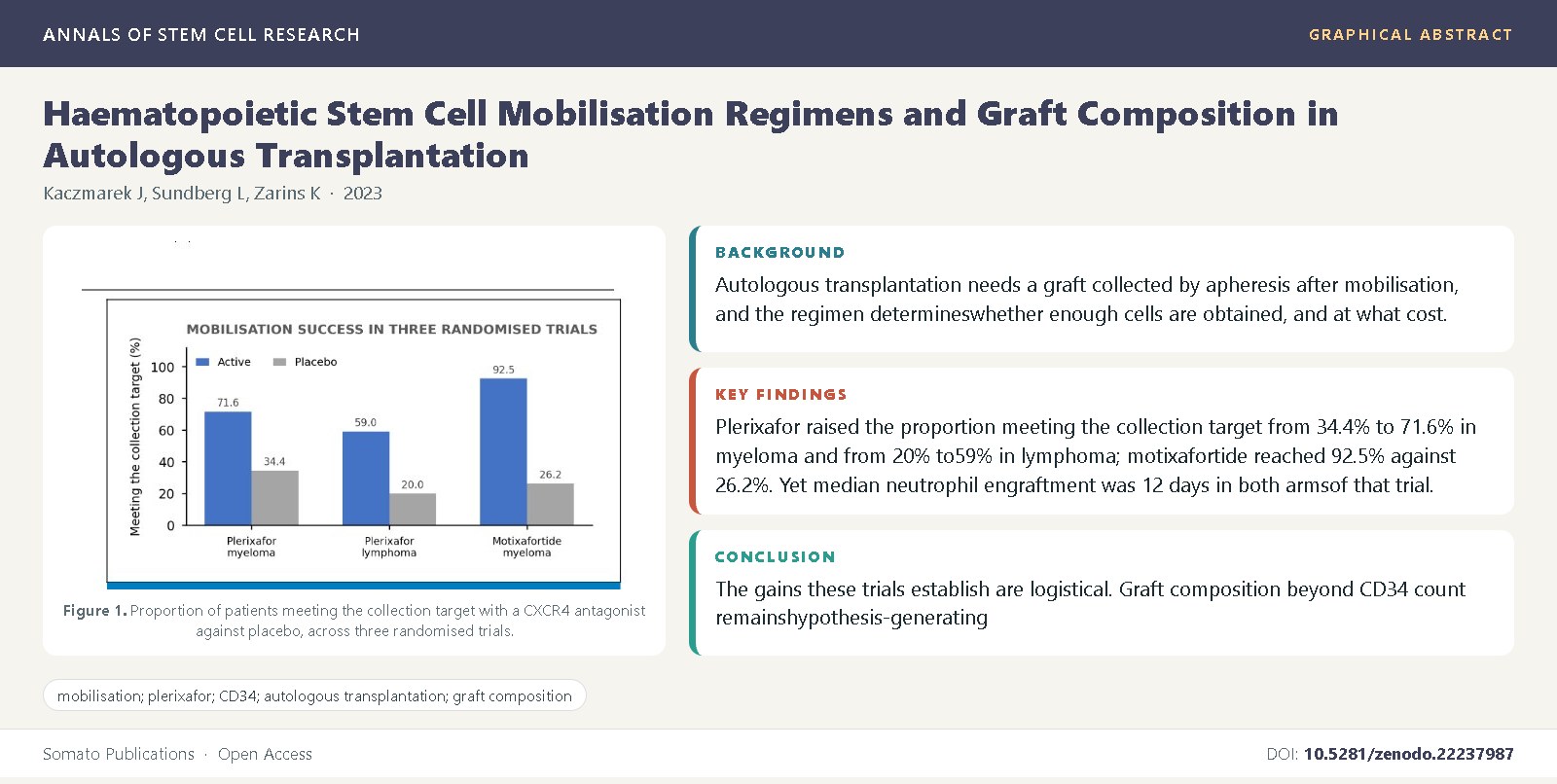
Findings: Plerixafor raised the proportion meeting the collection target from 34.4% to 71.6% in myeloma and from 20% to
59% in lymphoma; motixafortide reached 92.5% against 26.2%. Yet median neutrophil engraftment was 12 days in both arms
of that trial. Chemomobilisation also collects more cells without changing engraftment, and CD34 subsets predict worse than
total CD34 dose.
Conclusions: The gains these trials establish are logistical. Graft composition beyond CD34 count remains
hypothesis-generating
References
Weaver, C.H., Hazelton, B., Birch, R., Palmer, P., Allen, C., Schwartzberg, L., et al. (1995) An analysis of engraftment kinetics as a function of the CD34 content of peripheral blood progenitor cell collections in 692 patients after the administration of myeloablative chemotherapy. Blood, 86(10): 3961-3969.
Bensinger, W., Appelbaum, F., Rowley, S., Storb, R., Sanders, J., Lilleby, K., et al. (1995) Factors that influence collection and engraftment of autologous peripheral-blood stem cells. J Clin Oncol, 13(10): 2547-2555.
Perez-Simon, J.A., Martin, A., Caballero, D., Corral, M., Nieto, M.J., Gonzalez, M., et al. (1999) Clinical significance of CD34+ cell dose in long-term engraftment following autologous peripheral blood stem cell transplantation. Bone Marrow Transplant, 24(12): 1279-1283.
Narayanasami, U., Kanteti, R., Morelli, J., Klekar, A., Al-Olama, A., Keating, C., et al. (2001) Randomized trial of filgrastim versus chemotherapy and filgrastim mobilization of hematopoietic progenitor cells for rescue in autologous transplantation. Blood, 98(7): 2059-2064.
Gertz, M.A., Kumar, S.K., Lacy, M.Q., Dispenzieri, A., Hayman, S.R., Buadi, F.K., et al. (2009) Comparison of high-dose CY and growth factor with growth factor alone for mobilization of stem cells for transplantation in patients with multiple myeloma. Bone Marrow Transplant, 43(8): 619-625.
Zannetti, B.A., Saraceni, F., Cellini, C., Fabbri, E., Monaco, F., Guarini, A., et al. (2021) Low-dose cyclophosphamide versus intermediate-high-dose cyclophosphamide versus granulocyte colony-stimulating factor alone for stem cell mobilization in multiple myeloma in the era of novel agents: a multicenter retrospective study. Transplant Cell Ther, 27(3): 244.e1-244.e8.
DiPersio, J.F., Stadtmauer, E.A., Nademanee, A., Micallef, I.N.M., Stiff, P.J., Kaufman, J.L., et al. (2009) Plerixafor and G-CSF versus placebo and G-CSF to mobilize hematopoietic stem cells for autologous stem cell transplantation in patients with multiple myeloma. Blood, 113(23): 5720-5726.
DiPersio, J.F., Micallef, I.N., Stiff, P.J., Bolwell, B.J., Maziarz, R.T., Jacobsen, E., et al. (2009) Phase III prospective randomized double-blind placebo-controlled trial of plerixafor plus granulocyte colony-stimulating factor compared with placebo plus granulocyte colony-stimulating factor for autologous stem-cell mobilization and transplantation for patients with non-Hodgkin’s lymphoma. J Clin Oncol, 27(28): 4767-4773.
Hubel, K., Fresen, M.M., Apperley, J.F., Basak, G.W., Douglas, K.W., Gabriel, I.H., et al. (2012) European data on stem cell mobilization with plerixafor in non-Hodgkin’s lymphoma, Hodgkin’s lymphoma and multiple myeloma patients. A subgroup analysis of the European Consortium of stem cell mobilization. Bone Marrow Transplant, 47(8): 1046-1050.
Crees, Z.D., Rettig, M.P., Jayasinghe, R.G., Stockerl-Goldstein, K., Larson, S.M., Arpad, I., et al. (2023) Motixafortide and G-CSF to mobilize hematopoietic stem cells for autologous transplantation in multiple myeloma: a randomized phase 3 trial. Nat Med, 29(4): 869-879.
Olivieri, A., Marchetti, M., Lemoli, R., Tarella, C., Iacone, A., Lanza, F., et al. (2012) Proposed definition of poor mobilizer in lymphoma and multiple myeloma: an analytic hierarchy process by ad hoc working group Gruppo Italiano Trapianto di Midollo Osseo. Bone Marrow Transplant, 47(3): 342-351.
Piccirillo, N., Vacca, M., Lanti, A., Ipsevich, F., Maresca, M. (2012) Poor mobilizer: a retrospective study on proven and predicted incidence according to GITMO criteria. Transfus Apher Sci, 47(2): 217-221.
Wuchter, P., Ran, D., Bruckner, T., Schmitt, T., Witzens-Harig, M., Neben, K., et al. (2010) Poor mobilization of hematopoietic stem cells-definitions, incidence, risk factors, and impact on outcome of autologous transplantation. Biol Blood Marrow Transplant, 16(4): 490-499.
Miyazaki, K., Suzuki, K. (2018) Poor mobilizer and its countermeasures. Transfus Apher Sci, 57(5): 623-627.
Mohty, M., Hubel, K., Kroger, N., Aljurf, M., Apperley, J., Basak, G.W., et al. (2014) Autologous haematopoietic stem cell mobilisation in multiple myeloma and lymphoma patients: a position statement from the European Group for Blood and Marrow Transplantation. Bone Marrow Transplant, 49(7): 865-872.
Costa, L.J., Alexander, E.T., Hogan, K.R., Schaub, C., Fouts, T.V., Stuart, R.K. (2011) Development and validation of a decision-making algorithm to guide the use of plerixafor for autologous hematopoietic stem cell mobilization. Bone Marrow Transplant, 46(1): 64-69.
Yuan, S., Nademanee, A., Kaniewski, M., Palmer, J., Shayani, S., Wang, S. (2014) Efficacy of just-in-time plerixafor rescue for Hodgkin’s lymphoma patients with poor peripheral blood stem cell mobilization. Transfusion, 54(8): 2015-2021.
Basak, G.W., Mikala, G., Koristek, Z., Jaksic, O., Basic-Kinda, S., Cegledi, A., et al. (2011) Plerixafor to rescue failing chemotherapy-based stem cell mobilization: it’s not too late. Leuk Lymphoma, 52(9): 1711-1719.
Bilgin, Y.M., de Greef, G.E. (2016) Plerixafor for stem cell mobilization. Curr Opin Hematol, 23(1): 67-71.
Giralt, S., Costa, L., Schriber, J., DiPersio, J., Maziarz, R., McCarty, J., et al. (2014) Optimizing autologous stem cell mobilization strategies to improve patient outcomes: consensus guidelines and recommendations. Biol Blood Marrow Transplant, 20(3): 295-308.
Kumar, S., Dispenzieri, A., Lacy, M.Q., Hayman, S.R., Buadi, F.K., Gastineau, D.A., et al. (2007) Impact of lenalidomide therapy on stem cell mobilization and engraftment post-peripheral blood stem cell transplantation in patients with newly diagnosed myeloma. Leukemia, 21(9): 2035-2042.
Lazzaro, C., Castagna, L., Lanza, F., Laszlo, D., Milone, G., Pierelli, L., et al. (2021) Chemotherapy-based versus chemotherapy-free stem cell mobilization (+/- plerixafor) in multiple myeloma patients: an Italian cost-effectiveness analysis. Bone Marrow Transplant, 56(8): 1876-1887.
Stewart, D.A., Guo, D., Luider, J., Auer, I., Klassen, J., Ching, E., et al. (1999) Factors predicting engraftment of autologous blood stem cells: CD34+ subsets inferior to the total CD34+ cell dose. Bone Marrow Transplant, 23(12): 1237-1243.
Porrata, L.F., Litzow, M.R., Inwards, D.J., Gastineau, D.A., Moore, S.B., Pineda, A.A., et al. (2004) Infused peripheral blood autograft absolute lymphocyte count correlates with day 15 absolute lymphocyte count and clinical outcome after autologous peripheral hematopoietic stem cell transplantation in non-Hodgkin’s lymphoma. Bone Marrow Transplant, 33(3): 291-298.
Porrata, L.F., Gastineau, D.A., Padley, D., Bundy, K., Markovic, S.N. (2003) Re-infused autologous graft natural killer cells correlates with absolute lymphocyte count recovery after autologous stem cell transplantation. Leuk Lymphoma, 44(6): 997-1000.
Porrata, L.F., Inwards, D.J., Ansell, S.M., Micallef, I.N., Johnston, P.B., Hogan, W.J., et al. (2015) Infused autograft lymphocyte-to-monocyte ratio and survival in T-cell lymphoma post-autologous peripheral blood hematopoietic stem cell transplantation. J Hematol Oncol, 8: 80.
Kansagra, A., Inwards, D.J., Ansell, S.M., Micallef, I.N., Johnston, P.B., Hogan, W.J., et al. (2018) Infusion of autograft natural killer cell/CD14+HLA-DR dim cell ratio predicts survival in lymphoma post autologous stem cell transplantation. Bone Marrow Transplant, 53(2): 146-154.
Porrata, L.F. (2022) The impact of infused autograft absolute numbers of immune effector cells on survival post-autologous stem cell transplantation. Cells, 11(14): 2197.
Porrata, L.F., Inwards, D.J., Ansell, S.M., Micallef, I.N., Johnston, P.B., Villasboas, J.C., et al. (2022) Impact of autograft-absolute lymphocyte count on survival in double/triple hit lymphomas post-autologous stem cell transplantation. Leuk Lymphoma, 63(10): 2436-2443.





