
Induced Pluripotent Stem Cell-Derived Cardiomyocytes as a Model for Drug Cardiotoxicity Screening
DOI:
https://doi.org/10.5281/zenodo.22237966Keywords:
induced pluripotent stem cells; cardiomyocytes; cardiotoxicity; proarrhythmia; safety pharmacologyAbstract
Background: Cardiomyocytes derived from human induced pluripotent stem cells offer a human cardiac substrate for safety
pharmacology, and have been adopted faster than they have been validated.
Objective: To review what these cells have been shown to predict, the assay platforms used, and the limitations that qualify
the result.
Methods: Narrative review of differentiation and maturation studies, assay development, and the blinded multisite
validation work.
Findings: A ten-site blinded study of 28 drugs separated low-risk from higher-risk compounds with an area under the curve
of 0.872, and a consortium study reported 81% sensitivity and 87% specificity. Against this, the cell line contributed more
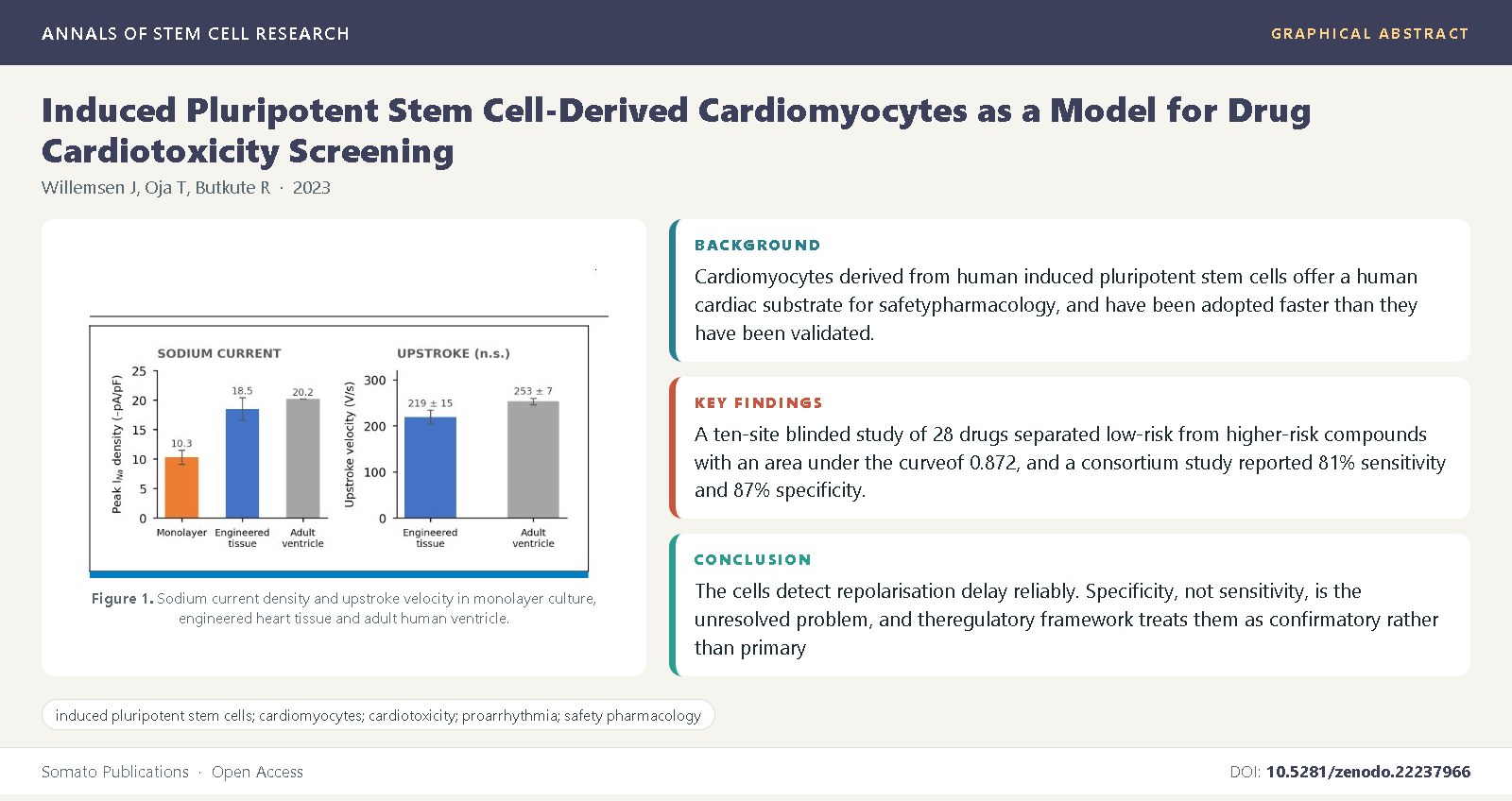
variance than the testing site, and monolayer cells carry roughly half the sodium current density of adult myocardium.
Conclusions: The cells detect repolarisation delay reliably. Specificity, not sensitivity, is the unresolved problem, and the
regulatory framework treats them as confirmatory rather than primary
References
Takahashi, K., Tanabe, K., Ohnuki, M., Narita, M., Ichisaka, T., Tomoda, K., et al. (2007) Induction of pluripotent stem cells from adult human fibroblasts by defined factors. Cell, 131(5): 861-872.
Zhang, J., Wilson, G.F., Soerens, A.G., Koonce, C.H., Yu, J., Palecek, S.P., et al. (2009) Functional cardiomyocytes derived from human induced pluripotent stem cells. Circ Res, 104(4): e30-e41.
Lian, X., Hsiao, C., Wilson, G., Zhu, K., Hazeltine, L.B., Azarin, S.M., et al. (2012) Robust cardiomyocyte differentiation from human pluripotent stem cells via temporal modulation of canonical Wnt signaling. Proc Natl Acad Sci U S A, 109(27): E1848-E1857.
Burridge, P.W., Matsa, E., Shukla, P., Lin, Z.C., Churko, J.M., Ebert, A.D., et al. (2014) Chemically defined generation of human cardiomyocytes. Nat Methods, 11(8): 855-860.
Yang, X., Pabon, L., Murry, C.E. (2014) Engineering adolescence: maturation of human pluripotent stem cell-derived cardiomyocytes. Circ Res, 114(3): 511-523.
Veerman, C.C., Kosmidis, G., Mummery, C.L., Casini, S., Verkerk, A.O., Bellin, M. (2015) Immaturity of human stem-cell-derived cardiomyocytes in culture: fatal flaw or soluble problem?. Stem Cells Dev, 24(9): 1035-1052.
Lemoine, M.D., Mannhardt, I., Breckwoldt, K., Prondzynski, M., Flenner, F., Ulmer, B., et al. (2017) Human iPSC-derived cardiomyocytes cultured in 3D engineered heart tissue show physiological upstroke velocity and sodium current density. Sci Rep, 7(1): 5464.
Ronaldson-Bouchard, K., Ma, S.P., Yeager, K., Chen, T., Song, L., Sirabella, D., et al. (2018) Advanced maturation of human cardiac tissue grown from pluripotent stem cells. Nature, 556(7700): 239-243.
Correia, C., Koshkin, A., Duarte, P., Hu, D., Teixeira, A., Domian, I., et al. (2017) Distinct carbon sources affect structural and functional maturation of cardiomyocytes derived from human pluripotent stem cells. Sci Rep, 7(1): 8590.
Navarrete, E.G., Liang, P., Lan, F., Sanchez-Freire, V., Simmons, C., Gong, T., et al. (2013) Screening drug-induced arrhythmia using human induced pluripotent stem cell-derived cardiomyocytes and low-impedance microelectrode arrays. Circulation, 128(11 Suppl 1): S3-S13.
Hortigon-Vinagre, M.P., Zamora, V., Burton, F.L., Green, J., Gintant, G.A., Smith, G.L. (2016) The use of ratiometric fluorescence measurements of the voltage sensitive dye Di-4-ANEPPS to examine action potential characteristics and drug effects on human induced pluripotent stem cell-derived cardiomyocytes. Toxicol Sci, 154(2): 320-331.
Sala, L., van Meer, B.J., Tertoolen, L.G.J., Bakkers, J., Bellin, M., Davis, R.P., et al. (2018) MUSCLEMOTION: a versatile open software tool to quantify cardiomyocyte and cardiac muscle contraction in vitro and in vivo. Circ Res, 122(3): e5-e16.
Mannhardt, I., Eder, A., Dumotier, B., Prondzynski, M., Kraemer, E., Traebert, M., et al. (2017) Blinded contractility analysis in hiPSC-cardiomyocytes in engineered heart tissue format: comparison with human atrial trabeculae. Toxicol Sci, 158(1): 164-175.
Guo, L., Abrams, R.M.C., Babiarz, J.E., Cohen, J.D., Kameoka, S., Sanders, M.J., et al. (2011) Estimating the risk of drug-induced proarrhythmia using human induced pluripotent stem cell-derived cardiomyocytes. Toxicol Sci, 123(1): 281-289.
Qu, Y., Vargas, H.M. (2015) Proarrhythmia risk assessment in human induced pluripotent stem cell-derived cardiomyocytes using the Maestro MEA platform. Toxicol Sci, 147(1): 286-295.
Colatsky, T., Fermini, B., Gintant, G., Pierson, J.B., Sager, P., Sekino, Y., et al. (2016) The Comprehensive in Vitro Proarrhythmia Assay (CiPA) initiative - update on progress. J Pharmacol Toxicol Methods, 81: 15-20.
Blinova, K., Stohlman, J., Vicente, J., Chan, D., Johannesen, L., Hortigon-Vinagre, M.P., et al. (2017) Comprehensive translational assessment of human-induced pluripotent stem cell derived cardiomyocytes for evaluating drug-induced arrhythmias. Toxicol Sci, 155(1): 234-247.
Blinova, K., Dang, Q., Millard, D., Smith, G., Pierson, J., Guo, L., et al. (2018) International multisite study of human-induced pluripotent stem cell-derived cardiomyocytes for drug proarrhythmic potential assessment. Cell Rep, 24(13): 3582-3592.
Ando, H., Yoshinaga, T., Yamamoto, W., Asakura, K., Uda, T., Taniguchi, T., et al. (2017) A new paradigm for drug-induced torsadogenic risk assessment using human iPS cell-derived cardiomyocytes. J Pharmacol Toxicol Methods, 84: 111-127.
Millard, D., Dang, Q., Shi, H., Zhang, X., Strock, C., Kraushaar, U., et al. (2018) Cross-site reliability of human induced pluripotent stem cell-derived cardiomyocyte based safety assays using microelectrode arrays: results from a blinded CiPA pilot study. Toxicol Sci, 164(2): 550-562.
Moretti, A., Bellin, M., Welling, A., Jung, C.B., Lam, J.T., Bott-Fluegel, L., et al. (2010) Patient-specific induced pluripotent stem-cell models for long-QT syndrome. N Engl J Med, 363(15): 1397-1409.
Burridge, P.W., Li, Y.F., Matsa, E., Wu, H., Ong, S.G., Sharma, A., et al. (2016) Human induced pluripotent stem cell-derived cardiomyocytes recapitulate the predilection of breast cancer patients to doxorubicin-induced cardiotoxicity. Nat Med, 22(5): 547-556.
Sharma, A., Burridge, P.W., McKeithan, W.L., Serrano, R., Shukla, P., Sayed, N., et al. (2017) High-throughput screening of tyrosine kinase inhibitor cardiotoxicity with human induced pluripotent stem cells. Sci Transl Med, 9(377).
Gintant, G., Burridge, P., Gepstein, L., Harding, S., Herron, T., Hong, C., et al. (2019) Use of human induced pluripotent stem cell-derived cardiomyocytes in preclinical cancer drug cardiotoxicity testing: a scientific statement from the American Heart Association. Circ Res, 125(10): e75-e92.
Kilpinen, H., Goncalves, A., Leha, A., Afzal, V., Alasoo, K., Ashford, S., et al. (2017) Common genetic variation drives molecular heterogeneity in human iPSCs. Nature, 546(7658): 370-375.
Huo, J., Kamalakar, A., Yang, X., Word, B., Stockbridge, N., Lyn-Cook, B., et al. (2016) Evaluation of batch variations in induced pluripotent stem cell-derived human cardiomyocytes from 2 major suppliers. Toxicol Sci, 156(1): kfw235.
Gintant, G., Fermini, B., Stockbridge, N., Strauss, D. (2017) The evolving roles of human iPSC-derived cardiomyocytes in drug safety and discovery. Cell Stem Cell, 21(1): 14-17.
Strauss, D.G., Wu, W.W., Li, Z., Koerner, J., Garnett, C. (2021) Translational models and tools to reduce clinical trials and improve regulatory decision making for QTc and proarrhythmia risk (ICH E14/S7B updates). Clin Pharmacol Ther, 109(2): 319-333.





