
Serum-Free Expansion Media and Genomic Stability of Human Mesenchymal Stromal Cells: A Review
DOI:
https://doi.org/10.5281/zenodo.22237878Keywords:
mesenchymal stromal cells; serum-free medium; platelet lysate; genomic stability; senescenceAbstract
Background: Clinical doses of mesenchymal stromal cells require weeks of expansion, historically in fetal bovine serum.
Replacing it raised a second question: whether culture destabilises the genome.
Objective: To review human platelet lysate and defined serum-free media as replacements for fetal bovine serum, and the
evidence on genomic stability.
Methods: Narrative review of comparative culture studies and of cytogenetic, array and sequencing analyses of expanded
MSCs.
Findings: Platelet lysate matches or exceeds fetal bovine serum for proliferation and supports clinical-scale production, with
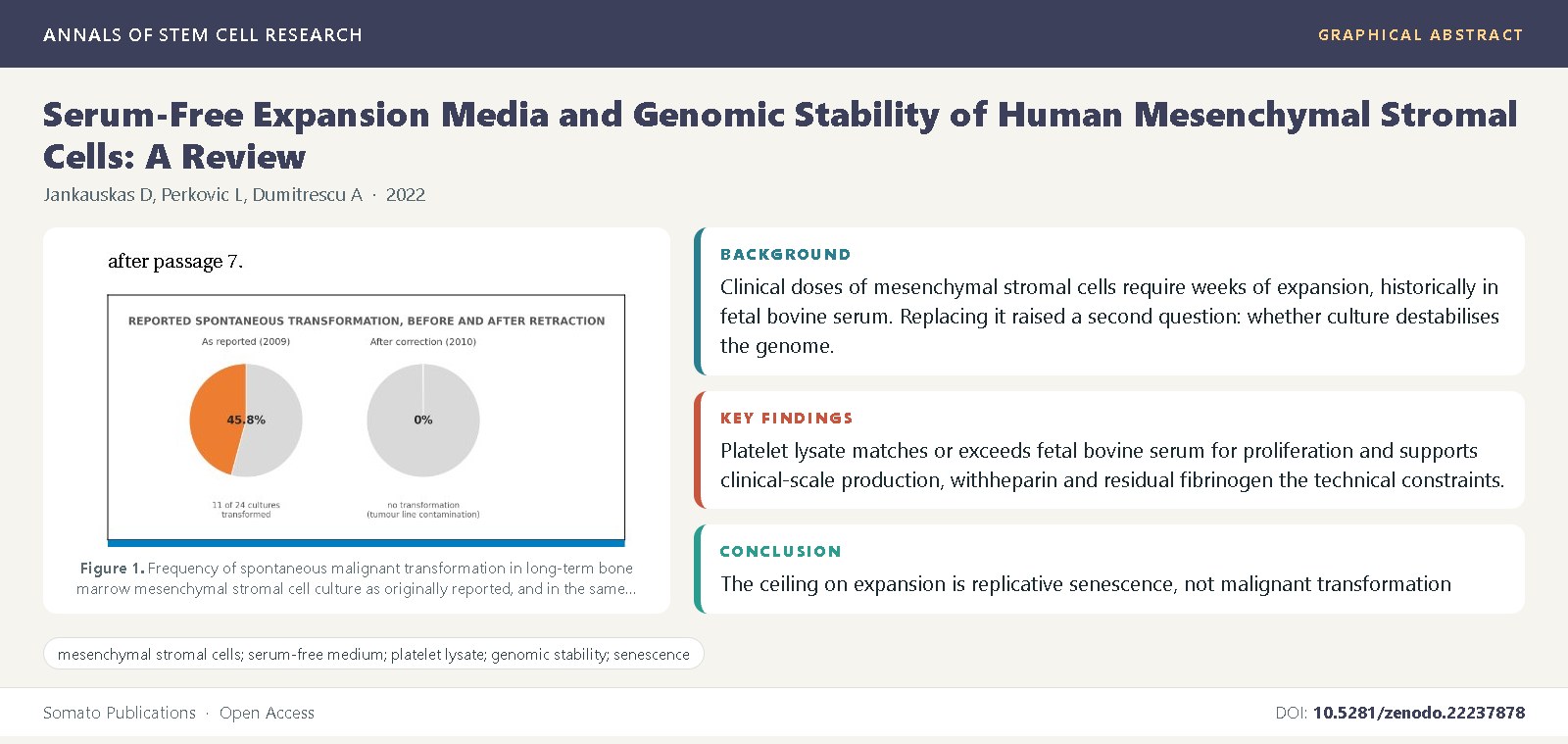
heparin and residual fibrinogen the technical constraints. The early reports of spontaneous malignant transformation
reflected cross-contamination with tumour lines, and one was retracted; aneuploidy occurs without transformation.
Conclusions: The ceiling on expansion is replicative senescence, not malignant transformation
References
Spees, J.L., Gregory, C.A., Singh, H., Tucker, H.A., Peister, A., Lynch, P.J., et al. (2004) Internalized antigens must be removed to prepare hypoimmunogenic mesenchymal stem cells for cell and gene therapy. Mol Ther, 9(5): 747-756.
Sundin, M., Ringden, O., Sundberg, B., Nava, S., Gotherstrom, C., Le Blanc, K. (2007) No alloantibodies against mesenchymal stromal cells, but presence of anti-fetal calf serum antibodies, after transplantation in allogeneic hematopoietic stem cell recipients. Haematologica, 92(9): 1208-1215.
Shahdadfar, A., Fronsdal, K., Haug, T., Reinholt, F.P., Brinchmann, J.E. (2005) In vitro expansion of human mesenchymal stem cells: choice of serum is a determinant of cell proliferation, differentiation, gene expression, and transcriptome stability. Stem Cells, 23(9): 1357-1366.
Dominici, M., Le Blanc, K., Mueller, I., Slaper-Cortenbach, I., Marini, F., Krause, D., et al. (2006) Minimal criteria for defining multipotent mesenchymal stromal cells. The International Society for Cellular Therapy position statement. Cytotherapy, 8(4): 315-317.
Doucet, C., Ernou, I., Zhang, Y., Llense, J.R., Begot, L., Holy, X., et al. (2005) Platelet lysates promote mesenchymal stem cell expansion: a safety substitute for animal serum in cell-based therapy applications. J Cell Physiol, 205(2): 228-236.
Schallmoser, K., Bartmann, C., Rohde, E., Reinisch, A., Kashofer, K., Stadelmeyer, E., et al. (2007) Human platelet lysate can replace fetal bovine serum for clinical-scale expansion of functional mesenchymal stromal cells. Transfusion, 47(8): 1436-1446.
Bieback, K., Hecker, A., Kocaomer, A., Lannert, H., Schallmoser, K., Strunk, D., et al. (2009) Human alternatives to fetal bovine serum for the expansion of mesenchymal stromal cells from bone marrow. Stem Cells, 27(9): 2331-2341.
Hemeda, H., Giebel, B., Wagner, W. (2014) Evaluation of human platelet lysate versus fetal bovine serum for culture of mesenchymal stromal cells. Cytotherapy, 16(2): 170-180.
Hemeda, H., Kalz, J., Walenda, G., Lohmann, M., Wagner, W. (2013) Heparin concentration is critical for cell culture with human platelet lysate. Cytotherapy, 15(9): 1174-1181.
Laner-Plamberger, S., Lener, T., Schmid, D., Streif, D.A., Salzer, T., Oller, M., et al. (2015) Mechanical fibrinogen-depletion supports heparin-free mesenchymal stem cell propagation in human platelet lysate. J Transl Med, 13(1): 354.
Schallmoser, K., Henschler, R., Gabriel, C., Koh, M.B.C., Burnouf, T. (2020) Production and quality requirements of human platelet lysate: a position statement from the Working Party on Cellular Therapies of the International Society of Blood Transfusion. Trends Biotechnol, 38(1): 13-23.
Bieback, K., Fernandez-Munoz, B., Pati, S., Schafer, R. (2019) Gaps in the knowledge of human platelet lysate as a cell culture supplement for cell therapy: a joint publication from the AABB and the International Society for Cell & Gene Therapy. Transfusion, 59(11): 3448-3460.
Burnouf, T., Strunk, D., Koh, M.B.C., Schallmoser, K. (2016) Human platelet lysate: replacing fetal bovine serum as a gold standard for human cell propagation?. Biomaterials, 76: 371-387.
Chase, L.G., Lakshmipathy, U., Solchaga, L.A., Rao, M.S., Vemuri, M.C. (2010) A novel serum-free medium for the expansion of human mesenchymal stem cells. Stem Cell Res Ther, 1(1): 8.
Jung, S., Sen, A., Rosenberg, L., Behie, L.A. (2012) Human mesenchymal stem cell culture: rapid and efficient isolation and expansion in a defined serum-free medium. J Tissue Eng Regen Med, 6(5): 391-403.
Fekete, N., Rojewski, M.T., Furst, D., Kreja, L., Ignatius, A., Dausend, J., et al. (2012) GMP-compliant isolation and large-scale expansion of bone marrow-derived MSC. PLoS One, 7(8): e43255.
Rubio, D., Garcia-Castro, J., Martin, M.C., de la Fuente, R., Cigudosa, J.C., Lloyd, A.C., et al. (2005) Spontaneous human adult stem cell transformation. Cancer Res, 65(8): 3035-3039.
Rosland, G.V., Svendsen, A., Torsvik, A., Sobala, E., McCormack, E., Immervoll, H., et al. (2009) Long-term cultures of bone marrow-derived human mesenchymal stem cells frequently undergo spontaneous malignant transformation. Cancer Res, 69(13): 5331-5339.
Torsvik, A., Rosland, G.V., Svendsen, A., Molven, A., Immervoll, H., McCormack, E., et al. (2010) Spontaneous malignant transformation of human mesenchymal stem cells reflects cross-contamination: putting the research field on track - letter. Cancer Res, 70(15): 6393-6396.
Bernardo, M.E., Zaffaroni, N., Novara, F., Cometa, A.M., Avanzini, M.A., Moretta, A., et al. (2007) Human bone marrow-derived mesenchymal stem cells do not undergo transformation after long-term in vitro culture and do not exhibit telomere maintenance mechanisms. Cancer Res, 67(19): 9142-9149.
Tarte, K., Gaillard, J., Lataillade, J.J., Fouillard, L., Becker, M., Mossafa, H., et al. (2010) Clinical-grade production of human mesenchymal stromal cells: occurrence of aneuploidy without transformation. Blood, 115(8): 1549-1553.
Kim, M., Rhee, J.K., Choi, H., Kwon, A., Kim, J., Lee, G.D., et al. (2017) Passage-dependent accumulation of somatic mutations in mesenchymal stromal cells during in vitro culture revealed by whole genome sequencing. Sci Rep, 7(1): 14508.
Wagner, W., Horn, P., Castoldi, M., Diehlmann, A., Bork, S., Saffrich, R., et al. (2008) Replicative senescence of mesenchymal stem cells: a continuous and organized process. PLoS One, 3(5): e2213.
Estrada, J.C., Albo, C., Benguria, A., Dopazo, A., Lopez-Romero, P., Carrera-Quintanar, L., et al. (2012) Culture of human mesenchymal stem cells at low oxygen tension improves growth and genetic stability by activating glycolysis. Cell Death Differ, 19(5): 743-755.
Barkholt, L., Flory, E., Jekerle, V., Lucas-Samuel, S., Ahnert, P., Bisset, L., et al. (2013) Risk of tumorigenicity in mesenchymal stromal cell-based therapies - bridging scientific observations and regulatory viewpoints. Cytotherapy, 15(7): 753-759.
Neri, S. (2019) Genetic stability of mesenchymal stromal cells for regenerative medicine applications: a fundamental biosafety aspect. Int J Mol Sci, 20(10): 2406.





