
Chondrogenic Potential of Synovium-Derived Progenitor Cells in Three-Dimensional Culture: A Review
DOI:
https://doi.org/10.5281/zenodo.22237773Keywords:
synovium; mesenchymal stromal cells; chondrogenesis; three-dimensional culture; hypertrophyAbstract
Background: Synovium-derived mesenchymal stromal cells outperform other adult sources in cartilage-forming assays, and
three-dimensional culture is required for a chondrocytic phenotype at all.
Objective: To review the evidence for synovial superiority, the three-dimensional systems used, and the hypertrophy that
limits it.
Methods: Narrative review of studies comparing mesenchymal sources for chondrogenesis and of three-dimensional culture
of synovial cells.
Findings: Synovium yields roughly a hundredfold more colonies per nucleated cell than bone marrow, and retains
chondrogenic capacity where other sources lose it. Hypoxia at 5% oxygen raises SOX9, COL2A1 and ACAN 1.4- to 2.3-fold while
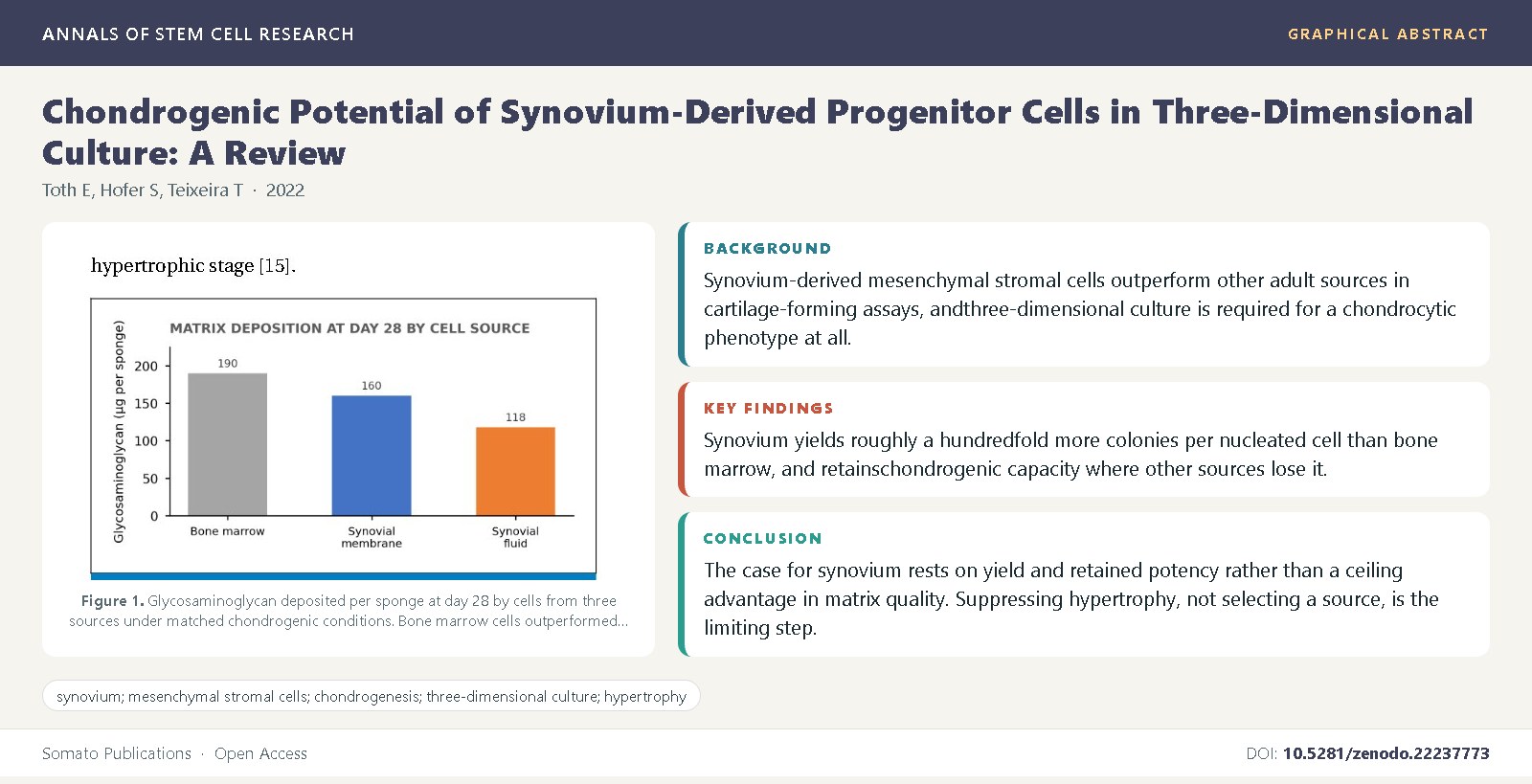
suppressing COL10A1, though one three-way comparison found bone marrow cells deposited the most glycosaminoglycan.
Conclusions: The case for synovium rests on yield and retained potency rather than a ceiling advantage in matrix quality.
Suppressing hypertrophy, not selecting a source, is the limiting step.
References
Dominici, M., Le Blanc, K., Mueller, I., Slaper-Cortenbach, I., Marini, F., Krause, D., et al. (2006) Minimal criteria for defining multipotent mesenchymal stromal cells. The International Society for Cellular Therapy position statement. Cytotherapy, 8(4): 315-317.
De Bari, C., Dell’Accio, F., Tylzanowski, P., Luyten, F.P. (2001) Multipotent mesenchymal stem cells from adult human synovial membrane. Arthritis Rheum, 44(8): 1928-1942.
Sakaguchi, Y., Sekiya, I., Yagishita, K., Muneta, T. (2005) Comparison of human stem cells derived from various mesenchymal tissues: superiority of synovium as a cell source. Arthritis Rheum, 52(8): 2521-2529.
Johnstone, B., Hering, T.M., Caplan, A.I., Goldberg, V.M., Yoo, J.U. (1998) In vitro chondrogenesis of bone marrow-derived mesenchymal progenitor cells. Exp Cell Res, 238(1): 265-272.
Mackay, A.M., Beck, S.C., Murphy, J.M., Barry, F.P., Chichester, C.O., Pittenger, M.F. (1998) Chondrogenic differentiation of cultured human mesenchymal stem cells from marrow. Tissue Eng, 4(4): 415-428.
Yoshimura, H., Muneta, T., Nimura, A., Yokoyama, A., Koga, H., Sekiya, I. (2007) Comparison of rat mesenchymal stem cells derived from bone marrow, synovium, periosteum, adipose tissue, and muscle. Cell Tissue Res, 327(3): 449-462.
Mochizuki, T., Muneta, T., Sakaguchi, Y., Nimura, A., Yokoyama, A., Koga, H., et al. (2006) Higher chondrogenic potential of fibrous synovium- and adipose synovium-derived cells compared with subcutaneous fat-derived cells. Arthritis Rheum, 54(3): 843-853.
Katagiri, K., Matsukura, Y., Muneta, T., Ozeki, N., Mizuno, M., Katano, H., et al. (2017) Fibrous synovium releases higher numbers of mesenchymal stem cells than adipose synovium in a suspended synovium culture model. Arthroscopy, 33(4): 800-810.
Segawa, Y., Muneta, T., Makino, H., Nimura, A., Mochizuki, T., Ju, Y.J., et al. (2009) Mesenchymal stem cells derived from synovium, meniscus, anterior cruciate ligament, and articular chondrocytes share similar gene expression profiles. J Orthop Res, 27(4): 435-441.
Koga, H., Muneta, T., Nagase, T., Nimura, A., Ju, Y.J., Mochizuki, T., et al. (2008) Comparison of mesenchymal tissues-derived stem cells for in vivo chondrogenesis: suitable conditions for cell therapy of cartilage defects in rabbit. Cell Tissue Res, 333(2): 207-215.
Jones, B.A., Pei, M. (2012) Synovium-derived stem cells: a tissue-specific stem cell for cartilage engineering and regeneration. Tissue Eng Part B Rev, 18(4): 301-311.
Sekiya, I., Muneta, T., Horie, M., Koga, H. (2015) Arthroscopic transplantation of synovial stem cells improves clinical outcomes in knees with cartilage defects. Clin Orthop Relat Res, 473(7): 2316-2326.
Shirasawa, S., Sekiya, I., Sakaguchi, Y., Yagishita, K., Ichinose, S., Muneta, T. (2006) In vitro chondrogenesis of human synovium-derived mesenchymal stem cells: optimal condition and comparison with bone marrow-derived cells. J Cell Biochem, 97(1): 84-97.
Sekiya, I., Larson, B.L., Vuoristo, J.T., Reger, R.L., Prockop, D.J. (2005) Comparison of effect of BMP-2, -4, and -6 on in vitro cartilage formation of human adult stem cells from bone marrow stroma. Cell Tissue Res, 320(2): 269-276.
Shintani, N., Siebenrock, K.A., Hunziker, E.B. (2013) TGF-beta1 enhances the BMP-2-induced chondrogenesis of bovine synovial explants and arrests downstream differentiation at an early stage of hypertrophy. PLoS One, 8(1): e53086.
Ando, W., Tateishi, K., Hart, D.A., Katakai, D., Tanaka, Y., Nakata, K., et al. (2007) Cartilage repair using an in vitro generated scaffold-free tissue-engineered construct derived from porcine synovial mesenchymal stem cells. Biomaterials, 28(36): 5462-5470.
Shimomura, K., Ando, W., Moriguchi, Y., Sugita, N., Yasui, Y., Koizumi, K., et al. (2015) Next generation mesenchymal stem cell-based cartilage repair using scaffold-free tissue engineered constructs generated with synovial mesenchymal stem cells. Cartilage, 6(2): 13S-29S.
Suzuki, S., Muneta, T., Tsuji, K., Ichinose, S., Makino, H., Umezawa, A., et al. (2012) Properties and usefulness of aggregates of synovial mesenchymal stem cells as a source for cartilage regeneration. Arthritis Res Ther, 14(3): R136.
Pei, M., Zhang, Y., Li, J., Chen, D. (2013) Antioxidation of decellularized stem cell matrix promotes human synovium-derived stem cell-based chondrogenesis. Stem Cells Dev, 22(6): 889-900.
Kondo, S., Muneta, T., Nakagawa, Y., Koga, H., Watanabe, T., Tsuji, K., et al. (2017) Transplantation of autologous synovial mesenchymal stem cells promotes meniscus regeneration in aged primates. J Orthop Res, 35(6): 1274-1282.
Bae, H.C., Park, H.J., Wang, S.Y., Yang, H.R., Lee, M.C., Han, H.S. (2018) Hypoxic condition enhances chondrogenesis in synovium-derived mesenchymal stem cells. Biomater Res, 22(1): 28.
Ge, Y., Li, Y., Wang, Z., Li, L., Teng, H., Jiang, Q. (2021) Effects of mechanical compression on chondrogenesis of human synovium-derived mesenchymal stem cells in agarose hydrogel. Front Bioeng Biotechnol, 9: 697281.
Pelttari, K., Winter, A., Steck, E., Goetzke, K., Hennig, T., Ochs, B.G., et al. (2006) Premature induction of hypertrophy during in vitro chondrogenesis of human mesenchymal stem cells correlates with calcification and vascular invasion after ectopic transplantation in SCID mice. Arthritis Rheum, 54(10): 3254-3266.
Pei, M., Chen, D., Li, J., Wei, L. (2009) Histone deacetylase 4 promotes TGF-beta1-induced synovium-derived stem cell chondrogenesis but inhibits chondrogenically differentiated stem cell hypertrophy. Differentiation, 78(5): 260-268.
Fischer, J., Dickhut, A., Rickert, M., Richter, W. (2010) Human articular chondrocytes secrete parathyroid hormone-related protein and inhibit hypertrophy of mesenchymal stem cells in coculture during chondrogenesis. Arthritis Rheum, 62(9): 2696-2706.
Kohno, Y., Mizuno, M., Ozeki, N., Katano, H., Komori, K., Fujii, S., et al. (2017) Yields and chondrogenic potential of primary synovial mesenchymal stem cells are comparable between rheumatoid arthritis and osteoarthritis patients. Stem Cell Res Ther, 8(1): 115.
Neybecker, P., Henrionnet, C., Pape, E., Grossin, L., Mainard, D., Galois, L., et al. (2020) Respective stemness and chondrogenic potential of mesenchymal stem cells isolated from human bone marrow, synovial membrane, and synovial fluid. Stem Cell Res Ther, 11(1): 316.





