
Cryopreservation Protocols and Post-Thaw Viability of Haematopoietic Stem Cell Grafts: A Review
DOI:
https://doi.org/10.5281/zenodo.22237740Keywords:
haematopoietic stem cells; cryopreservation; dimethyl sulfoxide; post-thaw viability; engraftmentAbstract
Background: Autologous haematopoietic grafts are routinely frozen under a protocol that is inherited rather than optimised.
Objective: To review the evidence on cryoprotectant concentration, freezing method and storage, and on what post-thaw
assays predict.
Methods: Narrative review of clinical and laboratory studies of progenitor cell cryopreservation.
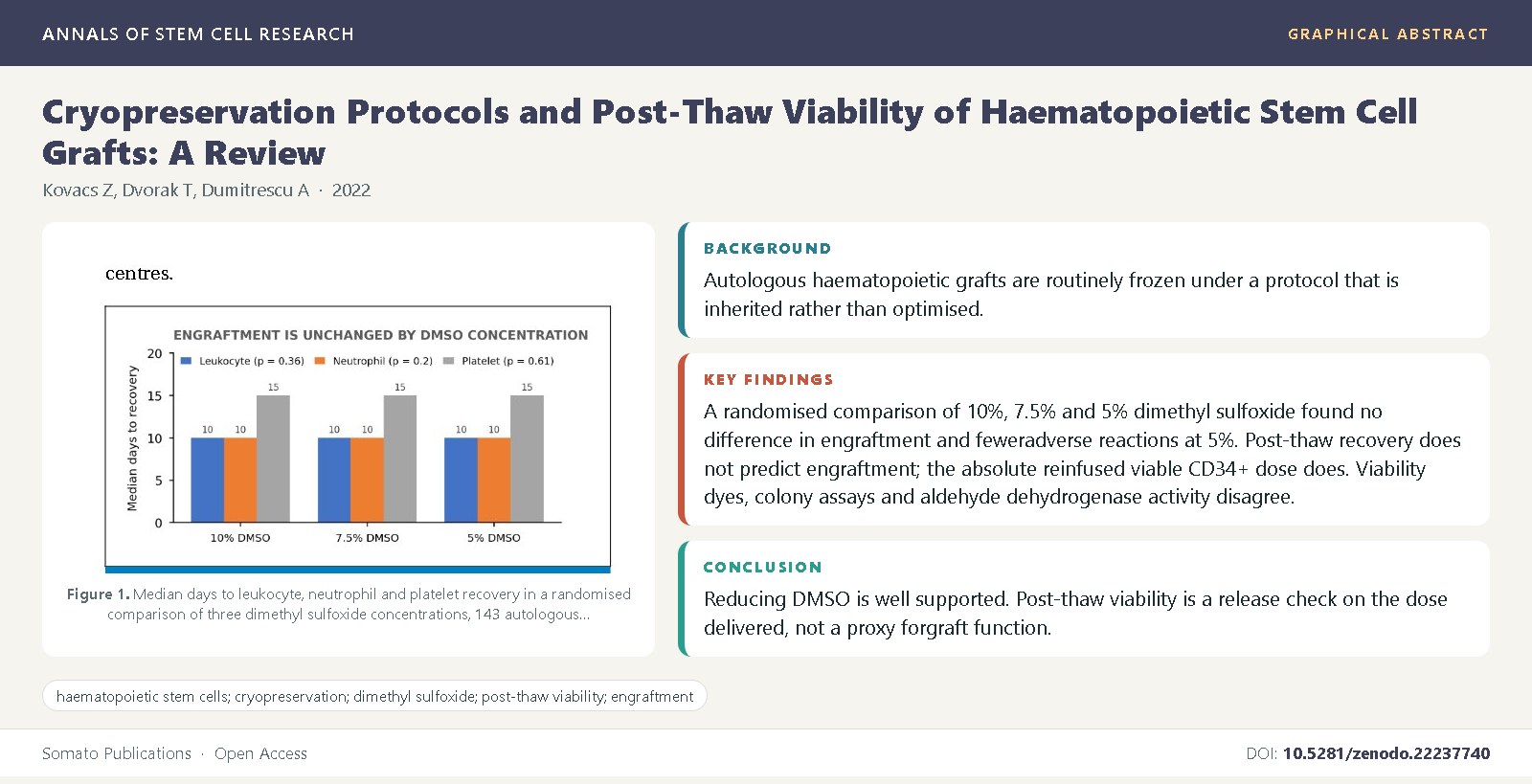
Findings: A randomised comparison of 10%, 7.5% and 5% dimethyl sulfoxide found no difference in engraftment and fewer
adverse reactions at 5%. Post-thaw recovery does not predict engraftment; the absolute reinfused viable CD34+ dose does.
Viability dyes, colony assays and aldehyde dehydrogenase activity disagree.
Conclusions: Reducing DMSO is well supported. Post-thaw viability is a release check on the dose delivered, not a proxy for
graft function.
References
Mitrus, I., Smagur, A., Fidyk, W., Czech, M., Prokop, M., Chwieduk, A., et al. (2018) Reduction of DMSO concentration in cryopreservation mixture from 10% to 7.5% and 5% has no impact on engraftment after autologous peripheral blood stem cell transplantation: results of a prospective, randomized study. Bone Marrow Transplant, 53(3): 274-280.
Bennett, B., Cohen, J.B., Gordon, M.J., Manzoor, B., Mackenzie, E., Rivera, D., et al. (2024) Impact of lower concentrations of dimethyl sulfoxide on cryopreservation of autologous hematopoietic stem cells: a systematic review and meta-analysis of controlled clinical studies. Cytotherapy, 26(5): 482-489.
Galmes, A., Besalduch, J., Bargay, J., Novo, A., Morey, M., Guerra, J.M., et al. (1996) Cryopreservation of hematopoietic progenitor cells with 5-percent dimethyl sulfoxide at -80 degrees C without rate-controlled freezing. Transfusion, 36(9): 794-797.
Scheinkonig, C., Kappicht, S., Kolb, H.J., Schleuning, M. (2004) Adoption of long-term cultures to evaluate the cryoprotective potential of trehalose for freezing hematopoietic stem cells. Bone Marrow Transplant, 34(6): 531-536.
Kaushal, R., Jahan, S., McGregor, C., Pineault, N. (2022) Dimethyl sulfoxide-free cryopreservation solutions for hematopoietic stem cell grafts. Cytotherapy, 24(3): 272-281.
Rowley, S.D., Bensinger, W.I., Gooley, T.A., Buckner, C.D. (1994) Effect of cell concentration on bone marrow and peripheral blood stem cell cryopreservation. Blood, 83(9): 2731-2736.
Hornberger, K., Yu, G., McKenna, D., Hubel, A. (2019) Cryopreservation of hematopoietic stem cells: emerging assays, cryoprotectant agents, and technology to improve outcomes. Transfus Med Hemother, 46(3): 188-196.
Montanari, M., Capelli, D., Poloni, A., Massidda, D., Brunori, M., Spitaleri, L., et al. (2003) Long-term hematologic reconstitution after autologous peripheral blood progenitor cell transplantation: a comparison between controlled-rate freezing and uncontrolled-rate freezing at -80 degrees C. Transfusion, 43(1): 42-49.
Pelham-Webb, B., Devlin, S., Scaradavou, A. (2025) Passive freezing is equivalent to controlled-rate freezing for hematopoietic progenitor cell engraftment. Cytotherapy, 27(9): 1145-1149.
Broxmeyer, H.E., Srour, E.F., Hangoc, G., Cooper, S., Anderson, S.A., Bodine, D.M. (2003) High-efficiency recovery of functional hematopoietic progenitor and stem cells from human cord blood cryopreserved for 15 years. Proc Natl Acad Sci U S A, 100(2): 645-650.
Makhani, S.S., Bhatt, N.S., Hamilton, B.K., Auletta, J.J., Chhabra, S., Costa, L.J., et al. (2022) Sustained hematopoietic engraftment potential after prolonged storage of cryopreserved hematopoietic stem cells used in salvage autologous stem cell transplantation. Transplant Cell Ther, 28(6): 306.e1-306.e7.
Hunt, C.J. (2011) Cryopreservation of human stem cells for clinical application: a review. Transfus Med Hemother, 38(2): 107-123.
Pinar, I.E., Sahin, M., Gursoy, V., Ersal, T., Budak, F., Ozkocaman, V., et al. (2025) Viable and functional: long-term -80 degrees C cryopreservation sustains CD34+ integrity and transplant success. J Clin Med, 14(19): 7032.
Sutherland, D.R., Anderson, L., Keeney, M., Nayar, R., Chin-Yee, I. (1996) The ISHAGE guidelines for CD34+ cell determination by flow cytometry. J Hematother, 5(3): 213-226.
Keeney, M., Chin-Yee, I., Weir, K., Popma, J., Nayar, R., Sutherland, D.R. (1998) Single platform flow cytometric absolute CD34+ cell counts based on the ISHAGE guidelines. Cytometry, 34(2): 61-70.
Shoulars, K., Noldner, P., Troy, J.D., Cheatham, L., Parrish, A., Page, K., et al. (2016) Development and validation of a rapid, aldehyde dehydrogenase bright-based cord blood potency assay. Blood, 127(19): 2346-2354.
Yang, H., Acker, J.P., Cabuhat, M., McGann, L.E. (2005) Effect of dimethyl sulfoxide on post-thaw viability assessment of CD45+ and CD34+ cells of umbilical cord blood and mobilized peripheral blood. Cryobiology, 51(2): 165-175.
Frandberg, S., Boreus, L., Rolfson, O., Palmqvist, L., Wikstrom, K. (2018) The aldehyde dehydrogenase cord blood potency assay excludes early apoptotic cells. Transfusion, 58(6): 1452-1457.
Rimac, V., Bojanic, I., Dabelic, S., Golubic Cepulic, B. (2023) Variable recovery of cryopreserved hematopoietic stem cells and leukocyte subpopulations in leukapheresis products. Transfus Apher Sci, 62(5): 103763.
Yang, H., Acker, J.P., Cabuhat, M., Letcher, B., Larratt, L., McGann, L.E. (2005) Association of post-thaw viable CD34+ cells and CFU-GM with time to hematopoietic engraftment. Bone Marrow Transplant, 35(9): 881-887.
Abrahamsen, J.F., Wentzel-Larsen, T., Bruserud, O. (2004) Autologous transplantation: the viable transplanted CD34+ cell dose measured post-thaw does not predict engraftment kinetics better than the total CD34+ cell dose measured pre-freeze in patients that receive more than 2 x 10(6) CD34+ cells/kg. Cytotherapy, 6(4): 356-362.
Lee, S., Kim, S., Kim, H., Baek, E.J., Jin, H., Kim, J., et al. (2008) Post-thaw viable CD34+ cell count is a valuable predictor of haematopoietic stem cell engraftment in autologous peripheral blood stem cell transplantation. Vox Sang, 94(2): 146-152.
Bensinger, W., Appelbaum, F., Rowley, S., Storb, R., Sanders, J., Lilleby, K., et al. (1995) Factors that influence collection and engraftment of autologous peripheral-blood stem cells. J Clin Oncol, 13(10): 2547-2555.
Windrum, P., Morris, T.C.M., Drake, M.B., Niederwieser, D., Ruutu, T. (2005) Variation in dimethyl sulfoxide use in stem cell transplantation: a survey of EBMT centres. Bone Marrow Transplant, 36(7): 601-603.
Syme, R., Bewick, M., Stewart, D., Porter, K., Chadderton, T., Gluck, S. (2004) The role of depletion of dimethyl sulfoxide before autografting: on hematologic recovery, side effects, and toxicity. Biol Blood Marrow Transplant, 10(2): 135-141.
Rubinstein, P., Dobrila, L., Rosenfield, R.E., Adamson, J.W., Migliaccio, G., Migliaccio, A.R., et al. (1995) Processing and cryopreservation of placental/umbilical cord blood for unrelated bone marrow reconstitution. Proc Natl Acad Sci U S A, 92(22): 10119-10122.
Snowden, J.A., McGrath, E., Duarte, R.F., Saccardi, R., Orchard, K., Worel, N., et al. (2017) JACIE accreditation for blood and marrow transplantation: past, present and future directions of an international model for healthcare quality improvement. Bone Marrow Transplant, 52(10): 1367-1371.





