
Comparative Immunomodulatory Capacity of Adipose- and Umbilical Cord-Derived Mesenchymal Stromal Cells: A Review
DOI:
https://doi.org/10.5281/zenodo.22237725Keywords:
mesenchymal stromal cells; adipose tissue; umbilical cord; immunomodulation; potency assayAbstract
Background: Mesenchymal stromal cells (MSCs) suppress immune responses in vitro, and adipose tissue and umbilical cord
have largely displaced bone marrow as the source. Whether origin determines potency is contested.
Objective: To review head-to-head comparisons of adipose- and umbilical cord-derived cells, and why they disagree.
Methods: Narrative review of studies comparing MSCs from two or more tissue sources under matched conditions.
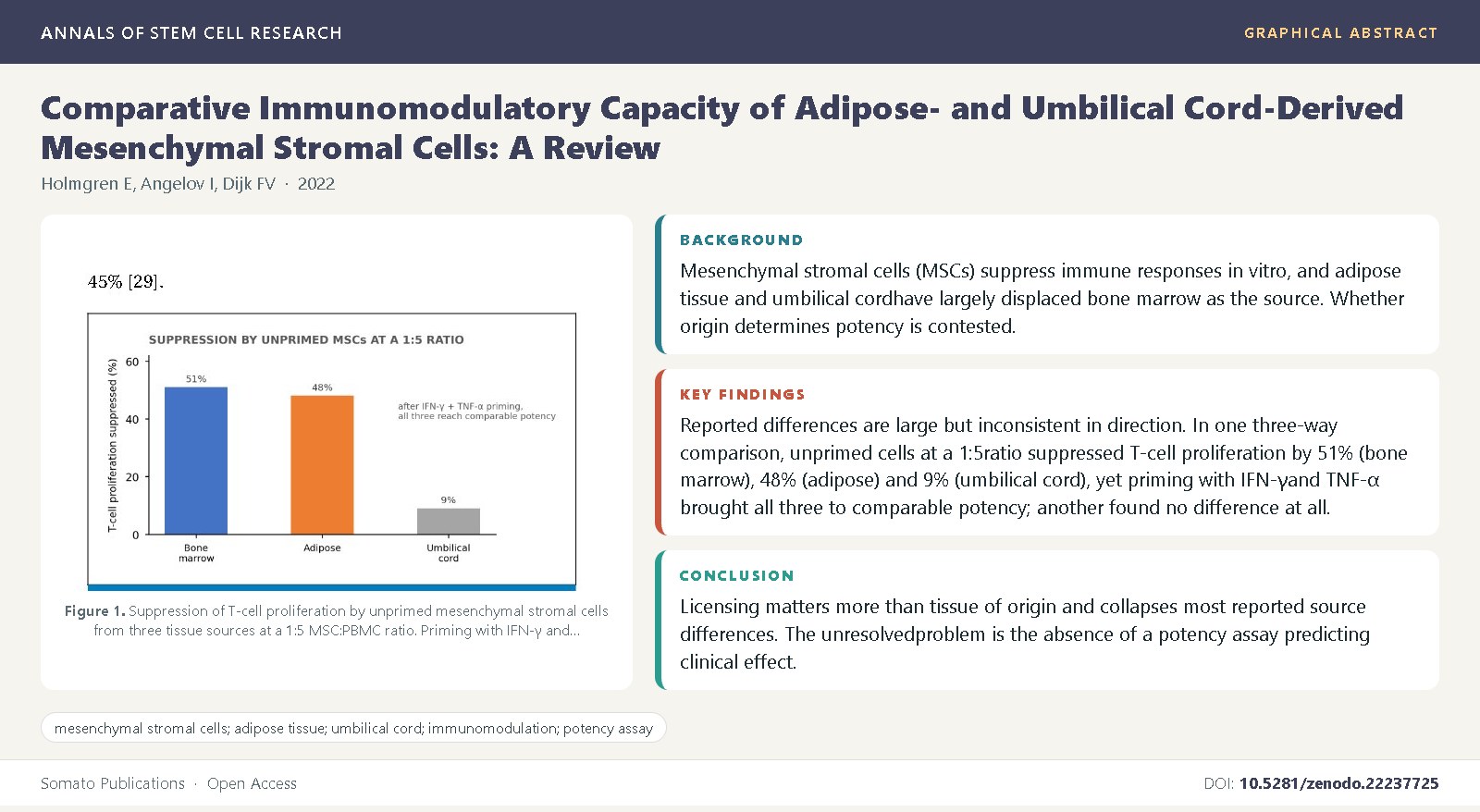
Findings: Reported differences are large but inconsistent in direction. In one three-way comparison, unprimed cells at a 1:5
ratio suppressed T-cell proliferation by 51% (bone marrow), 48% (adipose) and 9% (umbilical cord), yet priming with IFN-γ
and TNF-α brought all three to comparable potency; another found no difference at all. Suppression is soluble-factor
mediated, indoleamine 2,3-dioxygenase dominating in human cells and nitric oxide synthase in murine ones.
Conclusions: Licensing matters more than tissue of origin and collapses most reported source differences. The unresolved
problem is the absence of a potency assay predicting clinical effect.
References
Di Nicola, M., Carlo-Stella, C., Magni, M., Milanesi, M., Longoni, P.D., Matteucci, P., et al. (2002) Human bone marrow stromal cells suppress T-lymphocyte proliferation induced by cellular or nonspecific mitogenic stimuli. Blood, 99(10): 3838-3843.
Viswanathan, S., Shi, Y., Galipeau, J., Krampera, M., Leblanc, K., Martin, I., et al. (2019) Mesenchymal stem versus stromal cells: International Society for Cell & Gene Therapy Mesenchymal Stromal Cell committee position statement on nomenclature. Cytotherapy, 21(10): 1019-1024.
Dominici, M., Le Blanc, K., Mueller, I., Slaper-Cortenbach, I., Marini, F., Krause, D., et al. (2006) Minimal criteria for defining multipotent mesenchymal stromal cells. The International Society for Cellular Therapy position statement. Cytotherapy, 8(4): 315-317.
Aggarwal, S., Pittenger, M.F. (2005) Human mesenchymal stem cells modulate allogeneic immune cell responses. Blood, 105(4): 1815-1822.
Meisel, R., Zibert, A., Laryea, M., Godel, U., Daubener, W., Dilloo, D. (2004) Human bone marrow stromal cells inhibit allogeneic T-cell responses by indoleamine 2,3-dioxygenase-mediated tryptophan degradation. Blood, 103(12): 4619-4621.
Ren, G., Zhang, L., Zhao, X., Xu, G., Zhang, Y., Roberts, A.I., et al. (2008) Mesenchymal stem cell-mediated immunosuppression occurs via concerted action of chemokines and nitric oxide. Cell Stem Cell, 2(2): 141-150.
Su, J., Chen, X., Huang, Y., Li, W., Li, J., Cao, K., et al. (2014) Phylogenetic distinction of iNOS and IDO function in mesenchymal stem cell-mediated immunosuppression in mammalian species. Cell Death Differ, 21(3): 388-396.
Nemeth, K., Leelahavanichkul, A., Yuen, P.S.T., Mayer, B., Parmelee, A., Doi, K., et al. (2009) Bone marrow stromal cells attenuate sepsis via prostaglandin E2-dependent reprogramming of host macrophages to increase their interleukin-10 production. Nat Med, 15(1): 42-49.
Spaggiari, G.M., Capobianco, A., Abdelrazik, H., Becchetti, F., Mingari, M.C., Moretta, L. (2008) Mesenchymal stem cells inhibit natural killer-cell proliferation, cytotoxicity, and cytokine production: role of indoleamine 2,3-dioxygenase and prostaglandin E2. Blood, 111(3): 1327-1333.
Davies, L.C., Heldring, N., Kadri, N., Le Blanc, K. (2017) Mesenchymal stromal cell secretion of programmed death-1 ligands regulates T cell mediated immunosuppression. Stem Cells, 35(3): 766-776.
English, K., Ryan, J.M., Tobin, L., Murphy, M.J., Barry, F.P., Mahon, B.P. (2009) Cell contact, prostaglandin E2 and transforming growth factor beta 1 play non-redundant roles in human mesenchymal stem cell induction of CD4+CD25High forkhead box P3+ regulatory T cells. Clin Exp Immunol, 156(1): 149-160.
Melief, S.M., Schrama, E., Brugman, M.H., Tiemessen, M.M., Hoogduijn, M.J., Fibbe, W.E., et al. (2013) Multipotent stromal cells induce human regulatory T cells through a novel pathway involving skewing of monocytes toward anti-inflammatory macrophages. Stem Cells, 31(9): 1980-1991.
Reis, M., Mavin, E., Nicholson, L., Green, K., Dickinson, A.M., Wang, X.N. (2018) Mesenchymal stromal cell-derived extracellular vesicles attenuate dendritic cell maturation and function. Front Immunol, 9: 2538.
Chinnadurai, R., Copland, I.B., Patel, S.R., Galipeau, J. (2014) IDO-independent suppression of T cell effector function by IFN-gamma-licensed human mesenchymal stromal cells. J Immunol, 192(4): 1491-1501.
Prasanna, S.J., Gopalakrishnan, D., Shankar, S.R., Vasandan, A.B. (2010) Pro-inflammatory cytokines, IFN-gamma and TNF-alpha, influence immune properties of human bone marrow and Wharton jelly mesenchymal stem cells differentially. PLoS One, 5(2): e9016.
Francois, M., Copland, I.B., Yuan, S., Romieu-Mourez, R., Waller, E.K., Galipeau, J. (2012) Cryopreserved mesenchymal stromal cells display impaired immunosuppressive properties as a result of heat-shock response and impaired interferon-gamma licensing. Cytotherapy, 14(2): 147-152.
Melief, S.M., Zwaginga, J.J., Fibbe, W.E., Roelofs, H. (2013) Adipose tissue-derived multipotent stromal cells have a higher immunomodulatory capacity than their bone marrow-derived counterparts. Stem Cells Transl Med, 2(6): 455-463.
Ribeiro, A., Laranjeira, P., Mendes, S., Velada, I., Leite, C., Andrade, P., et al. (2013) Mesenchymal stem cells from umbilical cord matrix, adipose tissue and bone marrow exhibit different capability to suppress peripheral blood B, natural killer and T cells. Stem Cell Res Ther, 4(5): 125.
Jin, H.J., Bae, Y.K., Kim, M., Kwon, S., Jeon, H.B., Choi, S.J., et al. (2013) Comparative analysis of human mesenchymal stem cells from bone marrow, adipose tissue, and umbilical cord blood as sources of cell therapy. Int J Mol Sci, 14(9): 17986-18001.
Mattar, P., Bieback, K. (2015) Comparing the immunomodulatory properties of bone marrow, adipose tissue, and birth-associated tissue mesenchymal stromal cells. Front Immunol, 6: 560.
Gregoire, C., Ritacco, C., Hannon, M., Seidel, L., Delens, L., Belle, L., et al. (2019) Comparison of mesenchymal stromal cells from different origins for the treatment of graft-vs.-host-disease in a humanized mouse model. Front Immunol, 10: 619.
Hori, A., Takahashi, A., Miharu, Y., Yamaguchi, S., Sugita, M., Mukai, T., et al. (2024) Superior migration ability of umbilical cord-derived mesenchymal stromal cells toward activated lymphocytes in comparison with those of bone marrow and adipose-derived MSCs. Front Cell Dev Biol, 12: 1329218.
Fiori, A., Uhlig, S., Kluter, H., Bieback, K. (2021) Human adipose tissue-derived mesenchymal stromal cells inhibit CD4+ T cell proliferation and induce regulatory T cells as well as CD127 expression on CD4+CD25+ T cells. Cells, 10(1): 58.
Kizilay Mancini, O., Shum-Tim, D., Stochaj, U., Correa, J.A., Colmegna, I. (2015) Age, atherosclerosis and type 2 diabetes reduce human mesenchymal stromal cell-mediated T-cell suppression. Stem Cell Res Ther, 6(1): 140.
Hansen, S.B., Hojgaard, L.D., Kastrup, J., Ekblond, A., Follin, B., Juhl, M. (2022) Optimizing an immunomodulatory potency assay for mesenchymal stromal cell. Front Immunol, 13: 1085312.
Galipeau, J., Krampera, M., Barrett, J., Dazzi, F., Deans, R.J., DeBruijn, J., et al. (2016) International Society for Cellular Therapy perspective on immune functional assays for mesenchymal stromal cells as potency release criterion for advanced phase clinical trials. Cytotherapy, 18(2): 151-159.
Le Blanc, K., Frassoni, F., Ball, L., Locatelli, F., Roelofs, H., Lewis, I., et al. (2008) Mesenchymal stem cells for treatment of steroid-resistant, severe, acute graft-versus-host disease: a phase II study. Lancet, 371(9624): 1579-1586.
Panes, J., Garcia-Olmo, D., Van Assche, G., Colombel, J.F., Reinisch, W., Baumgart, D.C., et al. (2016) Expanded allogeneic adipose-derived mesenchymal stem cells (Cx601) for complex perianal fistulas in Crohn’s disease: a phase 3 randomised, double-blind controlled trial. Lancet, 388(10051): 1281-1290.
Kurtzberg, J., Abdel-Azim, H., Carpenter, P., Chaudhury, S., Horn, B., Mahadeo, K., et al. (2020) A phase 3, single-arm, prospective study of remestemcel-L, ex vivo culture-expanded adult human mesenchymal stromal cells for the treatment of pediatric patients who failed to respond to steroid treatment for acute graft-versus-host disease. Biol Blood Marrow Transplant, 26(5): 845-854.





