
Regulatory Pathways and Ethical Oversight of Advanced Therapy Medicinal Products in Europe
DOI:
https://doi.org/10.5281/zenodo.22274784Keywords:
Advanced therapy medicinal products; Marketing authorisation; Hospital exemption; Conditional approval; European Union regulationAbstract
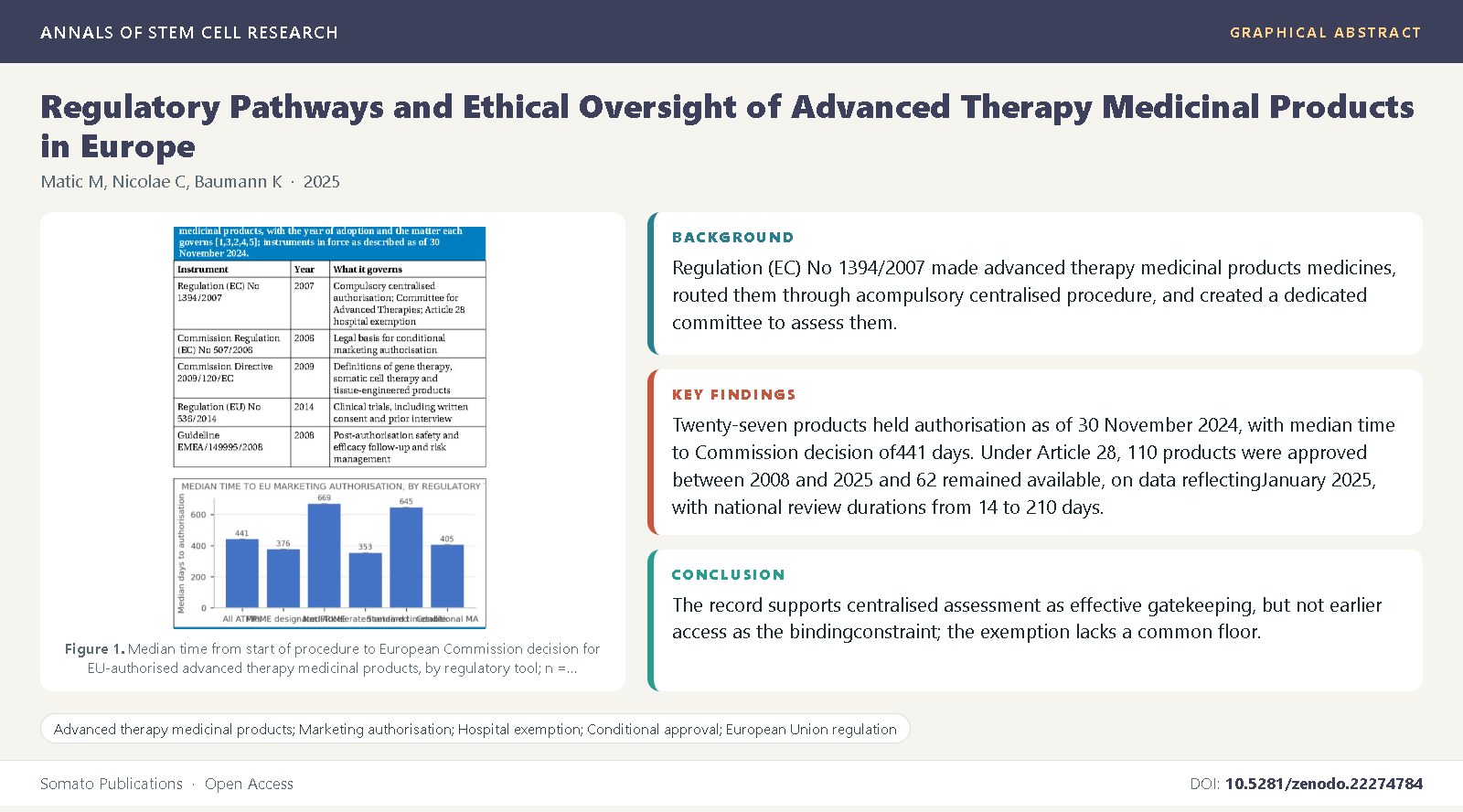
Background: Regulation (EC) No 1394/2007 made advanced therapy medicinal products medicines, routed them through a
compulsory centralised procedure, and created a dedicated committee to assess them.
Objective: To judge the framework on its authorisations, withdrawals and hospital exemption.
Methods: Narrative review of legal instruments, authorisation-timeline analyses and comparative regulatory literature.
Findings: Twenty-seven products held authorisation as of 30 November 2024, with median time to Commission decision of
441 days. Under Article 28, 110 products were approved between 2008 and 2025 and 62 remained available, on data reflecting
January 2025, with national review durations from 14 to 210 days.
Conclusions: The record supports centralised assessment as effective gatekeeping, but not earlier access as the binding
constraint; the exemption lacks a common floor.
References
European Parliament and Council (2007) Regulation (EC) No 1394/2007 of 13 November 2007 on advanced therapy medicinal products and amending Directive 2001/83/EC and Regulation (EC) No 726/2004. Official Journal of the European Union, L324: 121-137.
European Commission (2009) Commission Directive 2009/120/EC of 14 September 2009 amending Directive 2001/83/EC on the Community code relating to medicinal products for human use as regards advanced therapy medicinal products. Official Journal of the European Union, L242: 3.
European Commission (2006) Commission Regulation (EC) No 507/2006 of 29 March 2006 on the conditional marketing authorisation for medicinal products for human use falling within the scope of Regulation (EC) No 726/2004. Official Journal of the European Union, L92: 6.
European Parliament and Council (2014) Regulation (EU) No 536/2014 of 16 April 2014 on clinical trials on medicinal products for human use, and repealing Directive 2001/20/EC. Official Journal of the European Union, L158: 1.
European Medicines Agency, Committee for Advanced Therapies (2008) Guideline on safety and efficacy follow-up and risk management of advanced therapy medicinal products, EMEA/149995/2008. European Medicines Agency, London.
Detela, G., Lodge, A. (2019) EU regulatory pathways for ATMPs: standard, accelerated and adaptive pathways to marketing authorisation. Molecular Therapy - Methods and Clinical Development, 13: 205-232.
Iglesias-Lopez, C., Agusti, A., Obach, M., Vallano, A. (2019) Regulatory framework for advanced therapy medicinal products in Europe and United States. Frontiers in Pharmacology, 10: 921.
Mebarki, M., Madelaine, I., Larghero, J., de Jorna, R. (2022) Advanced therapy medicinal products: regulatory framework, hospital and pharmaceutical circuits in Europe and France. Therapies, 77(2): 185-190.
Alaburde, S., Ivaska, J., Kaspute, G., Ivaskiene, T. (2025) Impact of regulatory measures on the approval timelines of advanced therapy medicinal products by the European Medicines Agency. Frontiers in Medicine, 12: 1623689.
European Medicines Agency, Committee for Advanced Therapies (2025) CAT quarterly highlights and approved ATMPs, December 2025. European Medicines Agency, Amsterdam.
Mohan, R., Reckelbus, M., Borry, P. (2025) Regional disparities in access to gene therapies in the European Union, the United States, Japan, and China. Personalized Medicine, 22(4): 267-273.
Eichler, H.G., Oye, K., Baird, L.G., Abadie, E., Brown, J., Drum, C.L., et al. (2012) Adaptive licensing: taking the next step in the evolution of drug approval. Clinical Pharmacology and Therapeutics, 91(3): 426-437.
Cuende, N., Boniface, C., Bravery, C., Forte, M., Giordano, R., Hildebrandt, M., et al. (2014) The puzzling situation of hospital exemption for advanced therapy medicinal products in Europe and stakeholders concerns. Cytotherapy, 16(12): 1597-1600.
Ivaskiene, T., Mauricas, M., Ivaska, J. (2016) Hospital exemption for advanced therapy medicinal products: issue in application in the European Union Member States. Current Stem Cell Research and Therapy, 12(1): 45-51.
Hills, A., Awigena-Cook, J., Genenz, K., Ostertag, M., Butler, S., Eggimann, A.V., et al. (2020) An assessment of the hospital exemption landscape across European Member States: regulatory frameworks, use and impact. Cytotherapy, 22(12): 772-779.
Cuende, N., Ciccocioppo, R., Forte, M., Galipeau, J., Ikonomou, L., Levine, B.L., et al. (2022) Patient access to and ethical considerations of the application of the European Union hospital exemption rule for advanced therapy medicinal products. Cytotherapy, 24(7): 686-690.
European Commission, Directorate-General for Health and Food Safety and European Health and Digital Executive Agency (2025) Study on the hospital exemption: final report. Publications Office of the European Union, Luxembourg, HW-01-25-034-EN-N.
Timon, M., Ruiz, S. (2025) Hospital exemption for advanced therapy medicinal products in Spain. Human Gene Therapy, 36(17-18): 1095-1098.
Maruyama, Y., Kasai, M., Fujiwara, Y., Asano, J., Jotatsu, Y. (2019) Experiences from Japan: conditional and time-limited approval - an early approval scheme for regenerative medical products. Cell and Gene Therapy Insights, 5(6): 561-568.
Sipp, D. (2015) Conditional approval: Japan lowers the bar for regenerative medicine products. Cell Stem Cell, 16(4): 353-356.
McCabe, C., Sipp, D. (2016) Undertested and overpriced: Japan issues first conditional approval of stem cell product. Cell Stem Cell, 18(4): 436-437.
Noda, S., Kobayashi, Y., Okura, N., Shinohara, K., Asano, J., Matsumoto, J. (2025) Regulatory advancements in Japans conditional and time-limited approval scheme for regenerative medical products: the first guidance on the approval scheme and the second review for full approval of the first conditional and time-limited approved cellular product, HeartSheet. Cytotherapy, 27(6): 700-708.
Hakariya, H., Ozaki, A., Kaneda, Y., Tanimoto, T. (2025) Japans conditional/time-limited early approval system in regenerative medicine: a case study of rise and falls of autologous skeletal myoblast sheets. Clinical Pharmacology and Therapeutics, 117(5): 1171-1174.
Smith, J.A., Brindley, D.A. (2017) Conditional approval pathways: the special case of global regenerative medicine regulation. Rejuvenation Research, 20(1): 1-3.
Coppens, D.G.M., de Wilde, S., Guchelaar, H.J., De Bruin, M.L., Leufkens, H.G.M., Meij, P., et al. (2018) A decade of marketing approval of gene and cell-based therapies in the United States, European Union and Japan: an evaluation of regulatory decision-making. Cytotherapy, 20(6): 769-778.
Iglesias-Lopez, C., Obach, M., Vallano, A., Agusti, A. (2021) Comparison of regulatory pathways for the approval of advanced therapies in the European Union and the United States. Cytotherapy, 23(3): 261-274.
Berger, I., Ahmad, A., Bansal, A., Kapoor, T., Sipp, D., Rasko, J.E.J. (2016) Global distribution of businesses marketing stem cell-based interventions. Cell Stem Cell, 19(2): 158-162.
Bauer, G., Elsallab, M., Abou-El-Enein, M. (2018) Concise Review: A comprehensive analysis of reported adverse events in patients receiving unproven stem cell-based interventions. Stem Cells Translational Medicine, 7(9): 676-685.
Bianco, P., Sipp, D. (2014) Regulation: sell help not hope. Nature, 510(7505): 336-337.
Turner, L. (2021) The American stem cell sell in 2021: U.S. businesses selling unlicensed and unproven stem cell interventions. Cell Stem Cell, 28(11): 1891-1895.
Turner, L. (2020) Preying on public fears and anxieties in a pandemic: businesses selling unproven and unlicensed stem cell treatments for COVID-19. Cell Stem Cell, 26(6): 806-810.
Dulak, J., Pecyna, M. (2023) Unproven cell interventions in Poland and the exploitation of European Union law on advanced therapy medicinal products. Stem Cell Reports, 18(8): 1610-1620.





