
FLT3-ITD Allelic Ratio and Response to Midostaurin-Based Induction in Newly Diagnosed Acute Myeloid Leukemia
DOI:
https://doi.org/10.5281/zenodo.22227573Keywords:
Acute Myeloid Leukaemia, FLT3-ITD, Allelic Ratio, Midostaurin, Risk StratificationAbstract
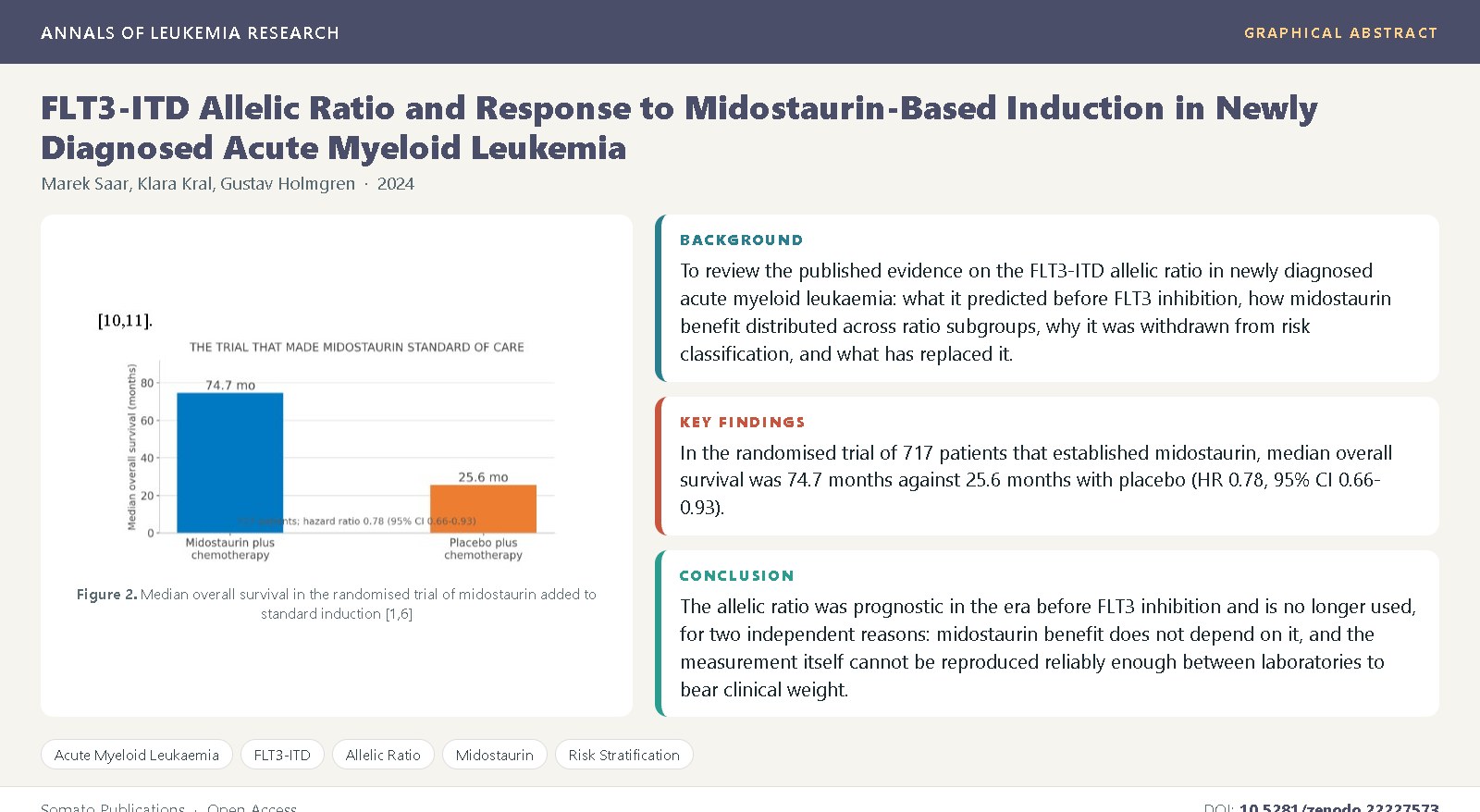
The FLT3-ITD allelic ratio was central to risk classification for five years and has now been removed from it. The trial that established midostaurin as standard of care had already shown that benefit did not track the ratio, and the measurement proved too poorly reproducible between laboratories to survive. Objectives: To review the published evidence on the FLT3-ITD allelic ratio in newly diagnosed acute myeloid leukaemia: what it predicted before FLT3 inhibition, how midostaurin benefit distributed across ratio subgroups, why it was withdrawn from risk classification, and what has replaced it. Material and Methods: Narrative review of randomised trials, correlative analyses, consensus classifications and validation studies indexed in PubMed and the
major haematology journals. Studies were eligible if they reported outcomes stratified by FLT3-ITD allelic ratio, the effect of FLT3-directed therapy in defined mutation subgroups, or the performance of risk classifications incorporating the ratio. No new patient data were generated and no patients were recruited; every estimate quoted is one published by the original investigators. Results: In the randomised trial of 717 patients that established midostaurin, median overall survival was 74.7 months against 25.6 months with placebo (HR 0.78, 95% CI 0.66-0.93). Benefit was similar across mutation subgroups, with hazard ratios of 0.65 (95% CI 0.39-1.08) for FLT3-TKD, 0.81 (0.60-1.11) for low allelic ratio ITD and 0.80 (0.57-1.12) for high allelic ratio ITD, so the ratio did not identify who benefited. The 2017 classification had defined four NPM1/FLT3-ITD genotypes using a ratio cutoff of 0.5, and retrospective analysis confirmed both that these genotypes separated survival and that midostaurin benefited all three resulting risk groups. Five-year survival on midostaurin was 73, 52 and 43 per cent in favourable, intermediate and adverse groups. The 2022 revision removed the allelic ratio entirely, citing limited reproducibility, and now assigns all FLT3-ITD disease to intermediate risk irrespective of ratio or NPM1 status. Conclusion: The allelic ratio was prognostic in the era before FLT3 inhibition and is no longer used, for two independent reasons: midostaurin benefit does not depend on it, and the measurement itself cannot be reproduced reliably enough between laboratories to bear clinical weight. Abbreviations: AML – Acute Myeloid Leukaemia, FLT3 – FMS-Like Tyrosine Kinase 3, ITD – Internal Tandem Duplication, TKD – Tyrosine Kinase Domain, AR – Allelic Ratio, NPM1 – Nucleophosmin 1, ELN – European LeukemiaNet, MRD – Measurable Residual Disease, alloHCT – Allogeneic Haematopoietic Cell Transplantation, CR1 – First Complete Remission, OS – Overall Survival, EFS – Event-Free Survival, TKI – Tyrosine Kinase Inhibitor.
References
Stone, RM., Mandrekar, SJ., Sanford, BL., Laumann, K., Geyer, S., Bloomfield, CD., et al. (2017) Midostaurin plus chemotherapy for acute myeloid leukemia with a FLT3 mutation. N Engl J Med, 377(5): 454-464.
Kantarjian, H., Kadia, T., DiNardo, C., Daver, N., Borthakur, G., Jabbour, E., et al. (2021) Acute myeloid leukemia: current progress and future directions. Blood Cancer J, 11: 41.
Kayser, S., Levis, MJ. (2021) Updates on targeted therapies for acute myeloid leukaemia. Br J Haematol, 196(2): 316-328.
Döhner, H., Estey, E., Grimwade, D., Amadori, S., Appelbaum, FR., Büchner, T., et al. (2017) Diagnosis and management of AML in adults: 2017 ELN recommendations from an international expert panel. Blood, 129(4): 424-447.
Larrosa-Garcia, M., Baer, MR. (2017) FLT3 inhibitors in acute myeloid leukemia: current status and future directions. Mol Cancer Ther, 16(6): 991-1001.
Keiffer, G., Aderhold, KL., Palmisiano, ND. (2020) Upfront treatment of FLT3-mutated AML: a look back at the RATIFY trial and beyond. Front Oncol, 10: 562219.
Sierra, J., Montesinos, P., Thomas, X., Griskevicius, L., Cluzeau, T., Caillot, D., et al. (2023) Midostaurin plus daunorubicin or idarubicin for young and older adults with FLT3-mutated AML: a phase 3b trial. Blood Adv, 7(21): 6441-6450.
Döhner, H., Wei, AH., Appelbaum, FR., Craddock, C., DiNardo, CD., Dombret, H., et al. (2022) Diagnosis and management of AML in adults: 2022 recommendations from an international expert panel on behalf of the ELN. Blood, 140(12): 1345-1377.
Perl, AE. (2019) Availability of FLT3 inhibitors: how do we use them? Blood, 134(9): 741-745.
Fischer, T., Stone, RM., DeAngelo, DJ., Galinsky, I., Estey, E., Lanza, C., et al. (2010) Phase IIB trial of oral midostaurin (PKC412), the FMS-like tyrosine kinase 3 receptor (FLT3) and multi-targeted kinase inhibitor, in patients with acute myeloid leukemia and high-risk myelodysplastic syndrome with either wild-type or mutated FLT3. J Clin Oncol, 28(28): 4339-4345.
Schlenk, RF., Weber, D., Fiedler, W., Salih, HR., Wulf, G., Salwender, H., et al. (2019) Midostaurin added to chemotherapy and continued single-agent maintenance therapy in acute myeloid leukemia with FLT3-ITD. Blood, 133(8): 840-851.
Döhner, K., Thiede, C., Jahn, N., Panina, E., Gambietz, A., Larson, RA., et al. (2020) Impact of NPM1/FLT3-ITD genotypes defined by the 2017 European LeukemiaNet in patients with acute myeloid leukemia. Blood, 135(5): 371-380.
Voso, MT., Larson, RA., Jones, D., Marcucci, G., Prior, T., Krauter, J., et al. (2020) Midostaurin in patients with acute myeloid leukemia and FLT3-TKD mutations: a subanalysis from the RATIFY trial. Blood Adv, 4(19): 4945-4954.
Mrózek, K., Kohlschmidt, J., Blachly, JS., Nicolet, D., Carroll, AJ., Archer, KJ., et al. (2023) Outcome prediction by the 2022 European LeukemiaNet genetic-risk classification for adults with acute myeloid leukemia: an Alliance study. Leukemia, 37(4): 788-798.
Perl, AE., Martinelli, G., Cortes, JE., Neubauer, A., Berman, E., Paolini, S., et al. (2019) Gilteritinib or chemotherapy for relapsed or refractory FLT3-mutated AML. N Engl J Med, 381(18): 1728-1740.
Herold, T., Rothenberg-Thurley, M., Grunwald, VV., Janke, H., Goerlich, D., Sauerland, MC., et al. (2020) Validation and refinement of the revised 2017 European LeukemiaNet genetic risk stratification of acute myeloid leukemia. Leukemia, 34(12): 3161-3172.
Erba, HP., Montesinos, P., Kim, HJ., Patkowska, E., Vrhovac, R., Zak, P., et al. (2023) Quizartinib plus chemotherapy in newly diagnosed patients with FLT3-internal-tandem-duplication-positive acute myeloid leukaemia (QuANTUM-First): a randomised, double-blind, placebo-controlled, phase 3 trial. Lancet, 401(10388): 1571-1583.
Schuurhuis, GJ., Heuser, M., Freeman, S., Béné, MC., Buccisano, F., Cloos, J., et al. (2018) Minimal/measurable residual disease in AML: a consensus document from the European LeukemiaNet MRD Working Party. Blood, 131(12): 1275-1291.
Heuser, M., Freeman, SD., Ossenkoppele, GJ., Buccisano, F., Hourigan, CS., Ngai, LL., et al. (2021) 2021 update on MRD in acute myeloid leukemia: a consensus document from the European LeukemiaNet MRD Working Party. Blood, 138(26): 2753-2767.
Ivey, A., Hills, RK., Simpson, MA., Jovanovic, JV., Gilkes, A., Grech, A., et al. (2016) Assessment of minimal residual disease in standard-risk AML. N Engl J Med, 374(5): 422-433.
Jongen-Lavrencic, M., Grob, T., Hanekamp, D., Kavelaars, FG., al Hinai, A., Zeilemaker, A., et al. (2018) Molecular minimal residual disease in acute myeloid leukemia. N Engl J Med, 378(13): 1189-1199.
Terwijn, M., van Putten, WLJ., Kelder, A., van der Velden, VHJ., Brooimans, RA., Pabst, T., et al. (2013) High prognostic impact of flow cytometric minimal residual disease detection in acute myeloid leukemia: data from the HOVON/SAKK AML 42A study. J Clin Oncol, 31(31): 3889-3897.
Ravandi, F., Walter, RB., Freeman, SD. (2018) Evaluating measurable residual disease in acute myeloid leukemia. Blood Adv, 2(11): 1356-1366.
Perl, AE., Larson, RA., Podoltsev, NA., Strickland, S., Wang, ES., Atallah, E., et al. (2023) Outcomes in patients with FLT3-mutated relapsed or refractory acute myelogenous leukemia who underwent transplantation in the phase 3 ADMIRAL trial of gilteritinib versus salvage chemotherapy. Transplant Cell Ther, 29(4): 265.e1-265.e10.
Cortes, JE., Khaled, S., Martinelli, G., Perl, AE., Ganguly, S., Russell, N., et al. (2019) Quizartinib versus salvage chemotherapy in relapsed or refractory FLT3-ITD acute myeloid leukaemia (QuANTUM-R): a multicentre, randomised, controlled, open-label, phase 3 trial. Lancet Oncol, 20(7): 984-997.





