
Early Mortality and Infectious Complications During Induction Therapy in Adults with Acute Lymphoblastic Leukemia
DOI:
https://doi.org/10.5281/zenodo.22227693Keywords:
Acute Lymphoblastic Leukaemia, Induction Therapy, Infectious Complications, Invasive Fungal Infection, Antimicrobial ProphylaxisAbstract
Acute lymphoblastic leukaemia is treated as a low-risk setting for invasive fungal infection, and antifungal prophylaxis is accordingly not recommended. Direct comparison shows patients receiving no prophylaxis having the same fungal infection rate as myeloid leukaemia patients who do receive it, despite less than half the duration of neutropenia. Objectives: To review the published evidence on infectious complications during induction therapy for adult acute lymphoblastic leukaemia: how often they occur, which organisms are responsible, when in the course they cluster, which patients are at risk, and whether prophylaxis achieves what is assumed of it.
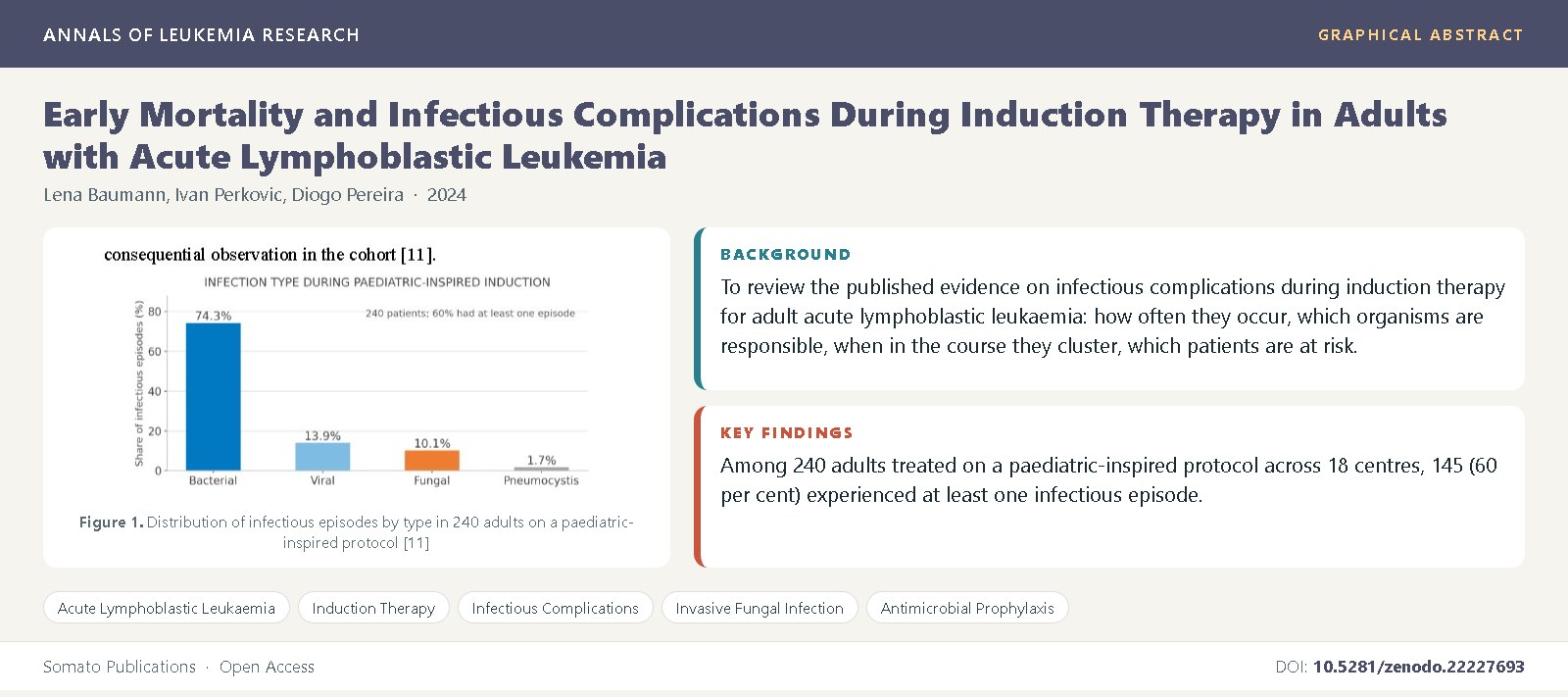
Material and Methods: Narrative review of prospective and retrospective cohorts, cooperative group trial analyses and comparative studies indexed in PubMed and the major haematology and infectious disease journals. Studies were eligible if they reported the incidence, microbiology, timing or outcome of infection during induction therapy in a defined adult acute lymphoblastic leukaemia population. No new patient data were generated and no patients were recruited; every estimate quoted is one published by the original investigators. Results: Among 240 adults treated on a paediatric-inspired protocol across 18 centres, 145 (60 per cent) experienced at least one infectious episode. Bacterial infections accounted for 74.3 per cent, viral for 13.9, fungal for 10.1 and Pneumocystis for 1.7 per cent, with the bloodstream the commonest site and pneumonia in 14.6 per cent, half of it fungal. Infection clustered in the first course, affecting 40.5 per cent of patients, and invasive fungal infection occurred in 12.5 per cent.
Mortality from infection was 3.3 per cent. Antibacterial, antiviral, antifungal and anti-Pneumocystis prophylaxis were variably given and none was associated with a significant reduction in infection rate. In a separate comparison of 552 chemotherapy episodes, invasive fungal infection occurred in 8.1 per cent of lymphoblastic episodes without antimould prophylaxis against 5.9 per cent of myeloid episodes with it (p = 0.856), despite median neutropenia of 8 against 18 days.
: The assumption that shorter neutropenia makes lymphoblastic induction a low-risk setting for fungal infection is not supported by direct comparison. Age above 65 is the dominant risk factor, and observational data do not show benefit from the prophylaxis currently given. Abbreviations: ALL – Acute Lymphoblastic Leukaemia, AML – Acute Myeloid Leukaemia, Ph – Philadelphia Chromosome, IFI – Invasive Fungal Infection, BSI – Bloodstream Infection, PJ – Pneumocystis jirovecii, C1 – First Chemotherapy Course, CR – Complete Remission, CCI – Charlson Comorbidity Index, TRM – Treatment-Related Mortality, IRM – Induction-Related Mortality, HSCT – Haematopoietic Stem Cell Transplantation.
References
Paul, S., Kantarjian, H., Jabbour, EJ. (2016) Adult acute lymphoblastic leukemia. Mayo Clin Proc, 91(11): 1645-1666.
Goekbuget, N. (2013) How I treat older patients with ALL. Blood, 122(8): 1366-1375.
Rubnitz, JE., Lensing, S., Zhou, Y., Sandlund, JT., Razzouk, BI., Ribeiro, RC., et al. (2004) Death during induction therapy and first remission of acute leukemia in childhood: the St. Jude experience. Cancer, 101(7): 1677-1684.
Pichler, H., Reismuller, B., Steiner, M., Dworzak, MN., Palfi, M., et al. (2013) The inferior prognosis of adolescents with acute lymphoblastic leukaemia (ALL) is caused by a higher rate of treatment-related mortality and not an increased relapse rate. Br J Haematol, 161(4): 556-565.
Lehrnbecher, T., Fisher, BT., Phillips, B., Alexander, S., Ammann, RA., Beauchemin, M., et al. (2020) Clinical practice guideline for systemic antifungal prophylaxis in pediatric patients with cancer and hematopoietic stem-cell transplantation recipients. J Clin Oncol, 38(27): 3205-3216.
Lehrnbecher, T., Varwig, D., Kaiser, J., Reinhardt, D., Klingebiel, T., Creutzig, U. (2004) Infectious complications in pediatric acute myeloid leukemia: analysis of the prospective multi-institutional clinical trial AML-BFM 93. Leukemia, 18(1): 72-77.
Fisher, BT., Zaoutis, T., Dvorak, CC., Nieder, M., Zerr, D., Wingard, JR., et al. (2019) Effect of caspofungin vs fluconazole prophylaxis on invasive fungal disease among children and young adults with acute myeloid leukemia: a randomized clinical trial. JAMA, 322(17): 1673-1681.
Huguet, F., Leguay, T., Raffoux, E., Thomas, X., Beldjord, K., Delabesse, E., et al. (2009) Pediatric-inspired therapy in adults with Philadelphia chromosome-negative acute lymphoblastic leukemia: the GRAALL-2003 study. J Clin Oncol, 27(6): 911-918.
Stock, W., Luger, SM., Advani, AS., Yin, J., Harvey, RC., Mullighan, CG., et al. (2019) A pediatric regimen for older adolescents and young adults with acute lymphoblastic leukemia: results of CALGB 10403. Blood, 133(14): 1548-1559.
Curran, E., Stock, W. (2015) How I treat acute lymphoblastic leukemia in older adolescents and young adults. Blood, 125(24): 3702-3710.
Cattaneo, C., Marchesi, F., Delia, M., Del Principe, MI., Fracchiolla, NS., Pagani, C., et al. (2025) Real world incidence and etiology of infectious complications in adults with Ph-negative acute lymphoblastic leukemia treated with the pediatric-inspired GIMEMA LAL1913 program: a Campus ALL study. Hematol Oncol.
Chevallier, P., Chevaux, JB., Delaunay, J., Guillaume, T., Peterlin, P., Le Bourgeois, A., et al. (2019) Epidemiology of bacterial infections during induction chemotherapy in adult patients with acute lymphoblastic leukemia: analysis of the GRAALL-2005 study. Blood, 134(Suppl 1): 5051.
Kim, SH., Kwon, JC., Park, C., Han, S., Yim, DS., Choi, JK., et al. (2021) Incidence of invasive fungal infection in acute lymphoblastic and acute myelogenous leukemia in the era of antimold prophylaxis. Sci Rep, 11(1): 22160.
Patel, B., Kirkwood, AA., Dey, A., Marks, DI., McMillan, AK., Menne, TF., et al. (2017) Pegylated-asparaginase during induction therapy for adult acute lymphoblastic leukaemia: toxicity data from the UKALL14 trial. Leukemia, 31(1): 58-64.
Alexander, S., Fisher, BT., Gaur, AH., Dvorak, CC., Villa Luna, D., Dang, H., et al. (2018) Effect of levofloxacin prophylaxis on bacteremia in children with acute leukemia or undergoing hematopoietic stem cell transplantation: a randomized clinical trial. JAMA, 320(10): 995-1004.
Wolf, J., Tang, L., Flynn, PM., Pui, CH., Gaur, AH., Sun, Y., et al. (2017) Levofloxacin prophylaxis during induction therapy for pediatric acute lymphoblastic leukemia. Clin Infect Dis, 65(11): 1790-1798.
Lehrnbecher, T., Fisher, BT., Phillips, B., Alexander, S., Ammann, RA., Beauchemin, M., et al. (2020) Clinical practice guideline for antibacterial prophylaxis in pediatric patients with cancer. Clin Infect Dis, 71(1): 226-236.
Bochennek, K., Hassler, A., Perner, C., Gilfert, J., Schoning, S., et al. (2016) Infectious complications in children with acute myeloid leukemia: decreased mortality in multicenter trial AML-BFM 2004. Blood Cancer J, 6: e382.
Wisplinghoff, H., Seifert, H., Wenzel, RP., Edmond, MB. (2003) Current trends in the epidemiology of nosocomial bloodstream infections in patients with hematological malignancies and solid neoplasms in hospitals in the United States. Clin Infect Dis, 36(9): 1103-1110.
Tunkel, AR., Sepkowitz, KA. (2002) Infections caused by viridans streptococci in patients with neutropenia. Clin Infect Dis, 34(11): 1524-1529.
Cordonnier, C., Buzyn, A., Leverger, G., Herbrecht, R., Hunault, M., Leclercq, R., et al. (2003) Epidemiology and risk factors for Gram-positive coccal infections in neutropenia: toward a more targeted antibiotic strategy. Clin Infect Dis, 36(2): 149-158.
Dombret, H., Chevallier, P., Huguet, F., Cayuela, JM., Chalandon, Y., et al. (2022) In adults with Ph-negative acute lymphoblastic leukemia, age-adapted chemotherapy intensity and MRD-driven transplant indication significantly reduces treatment-related mortality and improves overall survival. Blood, 140(Suppl 1): 112-114.
Goldstone, AH., Richards, SM., Lazarus, HM., Tallman, MS., Buck, G., Fielding, AK., et al. (2008) In adults with standard-risk acute lymphoblastic leukemia, the greatest benefit is achieved from a matched sibling allogeneic transplantation in first complete remission: final results of the international ALL trial (MRC UKALL XII/ECOG E2993). Blood, 111(4): 1827-1833.
Rogers, AE., Eisenman, K., Dolan, SA., Belderson, KM., Zauche, JR., Tong, S., et al. (2017) Risk factors for bacteremia and central line-associated blood stream infections in children with acute myelogenous leukemia: a single-institution report. Pediatr Blood Cancer, 64(3): e26254.
Roberts, KG. (2018) Genetics and prognosis of ALL in children vs adults. Hematology Am Soc Hematol Educ Program, 2018: 137-145.





