
Outcomes of Reduced-Intensity Conditioning Allogeneic Stem Cell Transplantation in Elderly Patients with Acute Myeloid Leukemia
DOI:
https://doi.org/10.5281/zenodo.22227611Keywords:
Acute Myeloid Leukaemia, Allogeneic Transplantation, Reduced-Intensity Conditioning, Elderly, Non-Relapse MortalityAbstract
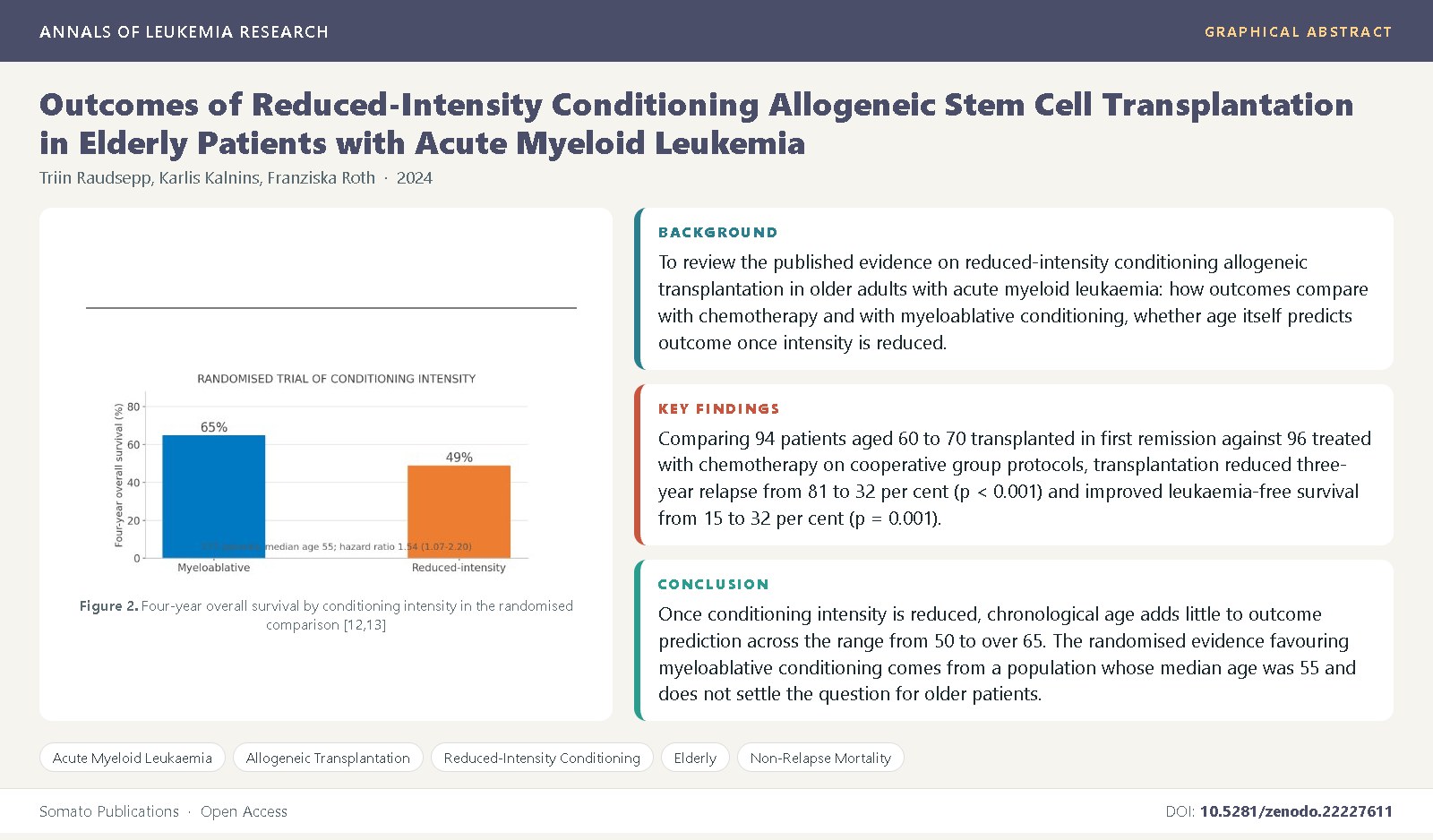
Acute myeloid leukaemia is a disease of people in their late sixties and seventies, and transplantation is the only reliably curative option. Reduced-intensity conditioning was developed to make that option available to them. The registry data suggest chronological age is the wrong thing to be selecting on. Objectives: To review the published evidence on reduced-intensity conditioning allogeneic transplantation in older adults with acute myeloid leukaemia: how outcomes compare with chemotherapy and with myeloablative conditioning, whether age itself predicts outcome once intensity is reduced, and what should be selected on instead. Material and Methods: Narrative review of randomised trials, registry analyses, comparative cohorts and consensus documents indexed in PubMed and the major haematology and transplantation journals. Studies were eligible if they reported outcomes after reduced-intensity conditioning transplantation in a defined acute myeloid leukaemia population, compared conditioning intensities, or examined the effect of age or comorbidity on transplant outcome. No new patient data were generated and no patients were recruited; every estimate quoted is one published by the original investigators. Results: Comparing 94 patients aged 60 to 70 transplanted in first remission against 96 treated with chemotherapy on cooperative group protocols, transplantation reduced three-year relapse from 81 to 32 per cent (p < 0.001) and improved leukaemia-free survival from 15 to 32 per cent (p = 0.001), at the cost of raising non-relapse mortality from 4 to 36 per cent (p < 0.001); overall survival favoured transplantation at 37 against 25 per cent but did not reach significance (p = 0.08). In the randomised comparison of conditioning intensity, four-year survival was 65 per cent with myeloablative and 49 per cent with reduced-intensity conditioning (HR 1.54, 95% CI 1.07-2.20), but the median age was 55. Among 757 patients receiving reduced-intensity conditioning, three-year survival was 47.8, 45.2, 37.9 and 36.6 per cent across age bands from 50 to 65 and above, with no significant difference (p = 0.24), and non-relapse mortality was similarly flat. Conclusion: Once conditioning intensity is reduced, chronological age adds little to outcome prediction across the range from 50 to over 65. The randomised evidence favouring myeloablative conditioning comes from a population whose median age was 55 and does not settle the question for older patients.
Abbreviations: AML – Acute Myeloid Leukaemia, MDS – Myelodysplastic Syndrome, allo-HCT – Allogeneic Haematopoietic Cell Transplantation, RIC – Reduced-Intensity Conditioning, MAC – Myeloablative Conditioning, NMA – Non-Myeloablative, NRM – Non-Relapse Mortality, TRM – Treatment-Related Mortality, LFS – Leukaemia-Free Survival, GVHD – Graft-Versus-Host Disease, HCT-CI – HCT Comorbidity Index, CR1 – First Complete Remission, PBSC – Peripheral Blood Stem Cells
References
Deschler, B., Lübbert, M. (2006) Acute myeloid leukemia: epidemiology and etiology. Cancer, 107(9): 2099-2107.
Thein, MS., Ershler, WB., Jemal, A., Yates, JW., Baer, MR. (2013) Outcome of older patients with acute myeloid leukemia: an analysis of SEER data over 3 decades. Cancer, 119(15): 2720-2727.
Yanada, M. (2015) Allogeneic hematopoietic cell transplantation for acute myeloid leukemia during first complete remission: a clinical perspective. Int J Hematol, 101(3): 243-254.
Döhner, H., Wei, AH., Appelbaum, FR., Craddock, C., DiNardo, CD., Dombret, H., et al. (2022) Diagnosis and management of AML in adults: 2022 recommendations from an international expert panel on behalf of the ELN. Blood, 140(12): 1345-1377.
Appelbaum, FR., Gundacker, H., Head, DR., Slovak, ML., Willman, CL., et al. (2006) Age and acute myeloid leukemia. Blood, 107(9): 3481-3485.
Juliusson, G., Antunovic, P., Derolf, A., Lehmann, S., Möllgård, L., et al. (2009) Age and acute myeloid leukemia: real world data on decision to treat and outcomes from the Swedish Acute Leukemia Registry. Blood, 113(18): 4179-4187.
Blaise, D., Vey, N., Faucher, C., Mohty, M. (2007) Current status of reduced-intensity-conditioning allogeneic stem cell transplantation for acute myeloid leukemia. Haematologica, 92(4): 533-541.
Martino, R., Caballero, MD., Simón, JAP., Canals, C., Solé, F., et al. (2002) Evidence for a graft-versus-leukemia effect after allogeneic peripheral blood stem cell transplantation with reduced-intensity conditioning in acute myelogenous leukemia and myelodysplastic syndromes. Blood, 100(6): 2243-2245.
Sengsayadeth, S., Savani, BN., Blaise, D., Malard, F., Nagler, A., Mohty, M. (2015) Reduced intensity conditioning allogeneic hematopoietic cell transplantation for adult acute myeloid leukemia in complete remission: a review from the Acute Leukemia Working Party of the EBMT. Haematologica, 100(7): 859-869.
Nagler, A., Labopin, M., Blaise, D., Ciceri, F., Gedde-Dahl, T., Sengeloev, H., et al. (2026) Non-myeloablative versus reduced intensity conditioning for allogeneic hematopoietic stem cell transplantation in acute myeloid leukemia patients aged ≥65: a study from the ALWP of EBMT. Bone Marrow Transplant.
Farag, SS., Maharry, K., Zhang, MJ., Pérez, WS., George, SL., Mrózek, K., et al. (2011) Comparison of reduced-intensity hematopoietic cell transplantation with chemotherapy in patients age 60-70 years with acute myelogenous leukemia in first remission. Biol Blood Marrow Transplant, 17(12): 1796-1803.
Scott, BL., Pasquini, MC., Logan, BR., Wu, J., Devine, SM., Porter, DL., Maziarz, RT., Warlick, ED., Fernandez, HF., Alyea, EP., et al. (2017) Myeloablative versus reduced-intensity hematopoietic cell transplantation for acute myeloid leukemia and myelodysplastic syndromes. J Clin Oncol, 35(11): 1154-1161.
Scott, BL., Pasquini, MC., Fei, M., Fraser, R., Wu, J., Devine, SM., et al. (2021) Myeloablative versus reduced-intensity conditioning for hematopoietic cell transplantation in acute myelogenous leukemia and myelodysplastic syndromes: long-term follow-up of the BMT CTN 0901 clinical trial. Transplant Cell Ther, 27(6): 483.e1-483.e6.
Aoudjhane, M., Labopin, M., Gorin, NC., Shimoni, A., Ruutu, T., Kolb, HJ., et al. (2005) Comparative outcome of reduced intensity and myeloablative conditioning regimen in HLA identical sibling allogeneic haematopoietic stem cell transplantation for patients older than 50 years of age with acute myeloblastic leukaemia: a retrospective survey from the Acute Leukemia Working Party of the EBMT. Leukemia, 19(12): 2304-2312.
McClune, BL., Weisdorf, DJ., Pedersen, TL., Tunes da Silva, G., Tallman, MS., Sierra, J., et al. (2010) Effect of age on outcome of reduced-intensity hematopoietic cell transplantation for older patients with acute myeloid leukemia in first complete remission or with myelodysplastic syndrome. J Clin Oncol, 28(11): 1878-1887.
Aoki, J., Kanamori, H., Tanaka, M., Yamasaki, S., Fukuda, T., Ogawa, H., et al. (2016) Impact of age on outcomes of allogeneic hematopoietic stem cell transplantation with reduced intensity conditioning in elderly patients with acute myeloid leukemia. Am J Hematol, 91(3): 302-307.
Ringdén, O., Boumendil, A., Labopin, M., Canaani, J., Beelen, D., Ehninger, G., et al. (2019) Outcome of allogeneic hematopoietic stem cell transplantation in patients age >69 years with acute myelogenous leukemia: on behalf of the Acute Leukemia Working Party of the EBMT. Biol Blood Marrow Transplant, 25(10): 1975-1983.
Sorror, ML., Maris, MB., Storb, R., Baron, F., Sandmaier, BM., Maloney, DG., Storer, B. (2005) Hematopoietic cell transplantation (HCT)-specific comorbidity index: a new tool for risk assessment before allogeneic HCT. Blood, 106(8): 2912-2919.
Martino, R., Iacobelli, S., Brand, R., Jansen, T., van Biezen, A., Finke, J., et al. (2006) Retrospective comparison of reduced-intensity conditioning and conventional high-dose conditioning for allogeneic hematopoietic stem cell transplantation using HLA-identical sibling donors in myelodysplastic syndromes. Blood, 108(3): 836-846.
Walter, RB., Gooley, TA., Wood, BL., Milano, F., Fang, M., Sorror, ML., et al. (2011) Impact of pretransplantation minimal residual disease, as detected by multiparametric flow cytometry, on outcome of myeloablative hematopoietic cell transplantation for acute myeloid leukemia. J Clin Oncol, 29(9): 1190-1197.
Schuurhuis, GJ., Heuser, M., Freeman, S., Béné, MC., Buccisano, F., Cloos, J., et al. (2018) Minimal/measurable residual disease in AML: a consensus document from the European LeukemiaNet MRD Working Party. Blood, 131(12): 1275-1291.
Hoffmann, AP., Besch, AL., Othus, M., Morsink, LM., Wood, BL., Mielcarek, M., et al. (2020) Early achievement of measurable residual disease (MRD)-negative complete remission as predictor of outcome after myeloablative allogeneic hematopoietic cell transplantation in acute myeloid leukemia. Bone Marrow Transplant, 55(3): 669-672.
Paras, G., Morsink, LM., Othus, M., Milano, F., Sandmaier, BM., Zarling, LC., et al. (2022) Conditioning intensity and peritransplant flow cytometric MRD dynamics in adult AML. Blood, 139(11): 1694-1706.
Yeshurun, M., Labopin, M., Blaise, D., Cornelissen, JJ., Sengeloev, H., Vindelov, L., et al. (2014) Impact of postremission consolidation chemotherapy on outcome after reduced-intensity conditioning allogeneic stem cell transplantation for patients with acute myeloid leukemia in first complete remission: a report from the Acute Leukemia Working Party of the EBMT. Cancer, 120(6): 855-863.
Heuser, M., Freeman, SD., Ossenkoppele, GJ., Buccisano, F., Hourigan, CS., Ngai, LL., et al. (2021) 2021 update on MRD in acute myeloid leukemia: a consensus document from the European LeukemiaNet MRD Working Party. Blood, 138(26): 2753-2767.





