
Trends in Five-Year Overall Survival Among Elderly Patients with Acute Myeloid Leukemia (AML) Between 2000-2009 and 2010-2019
DOI:
https://doi.org/10.5281/zenodo.22213601Keywords:
Acute Myeloid Leukaemia, Elderly, Overall Survival, Hypomethylating Agents, Population-Based RegistryAbstract
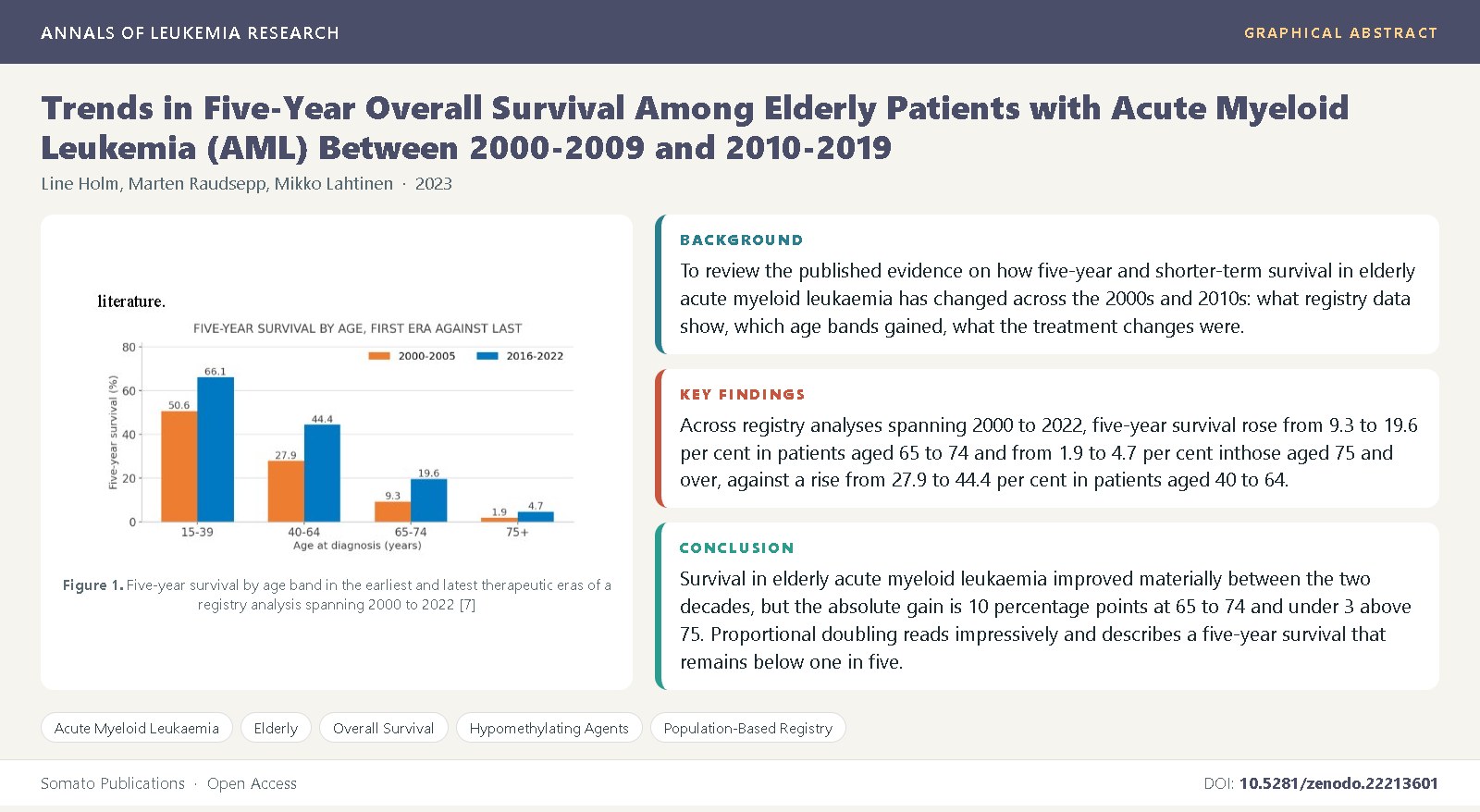
Acute myeloid leukaemia is a disease of older people, with a median age at diagnosis around 70, yet almost every therapeutic advance of the past two decades has been measured in populations younger than that. Population-level survival data show what reached the patients who actually have the disease. Objectives: To review the published evidence on how five-year and shorter-term survival in elderly acute myeloid leukaemia has changed across the 2000s and 2010s: what registry data show, which age bands gained, what the treatment changes were, and why the gains are smaller than the trial literature would suggest. Material and Methods: Narrative review of population-based registry analyses, randomised trials in older or unfit patients, and consensus recommendations indexed in PubMed and the major haematology journals. Studies were eligible if they reported survival by age band and calendar period in a defined acute myeloid leukaemia population, or the efficacy of a therapy studied specifically in older adults. No new patient data were generated and no patients were recruited; every estimate quoted is one published by the original investigators. Results: Across registry analyses spanning 2000 to 2022, five-year survival rose from 9.3 to 19.6 per cent in patients aged 65 to 74 and from 1.9 to 4.7 per cent in
those aged 75 and over, against a rise from 27.9 to 44.4 per cent in patients aged 40 to 64. Earlier analysis of roughly 19,000 patients aged 65 and above across three decades showed 12-month survival in the 65 to 74 group rising from 20 to 25 to 30 per cent, with no improvement at all above 75. In randomised comparison restricted to high-risk or secondary disease in 309 patients aged 60 to 75, a liposomal anthracycline-cytarabine formulation extended median overall survival from 5.95 to 9.56 months (HR 0.69, 95% CI 0.52-0.90). Registry work consistently shows that a large minority of older patients receive no antileukaemic therapy at all. Conclusion: Survival in elderly acute myeloid leukaemia improved materially between the two decades, but the absolute gain is 10 percentage points at 65 to 74 and under 3 above 75. Proportional doubling reads impressively and describes a five-year survival that remains below one in five. The largest single determinant at population level is whether the patient is treated at all. Abbreviations: AML – Acute Myeloid Leukaemia, HMA – Hypomethylating Agent, CR – Complete Remission, OS – Overall Survival, RS – Relative Survival,
SEER – Surveillance, Epidemiology and End Results, ELN – European LeukemiaNet, alloHCT – Allogeneic Haematopoietic Cell Transplantation, MRD – Measurable Residual Disease, HR – Hazard Ratio, CI – Confidence Interval.
Acute Myeloid Leukaemia; Elderly; Overall Survival; Hypomethylating Agents; Population-Based Registry
References
Deschler, B., Lübbert, M. (2006) Acute myeloid leukemia: epidemiology and etiology. Cancer, 107(9): 2099-2107.
Thein, MS., Ershler, WB., Jemal, A., Yates, JW., Baer, MR. (2013) Outcome of older patients with acute myeloid leukemia: an analysis of SEER data over 3 decades. Cancer, 119(15): 2720-2727.
Appelbaum, FR., Gundacker, H., Head, DR., Slovak, ML., Willman, CL., et al. (2006) Age and acute myeloid leukemia. Blood, 107(9): 3481-3485.
Juliusson, G., Antunovic, P., Derolf, A., Lehmann, S., Möllgård, L., et al. (2009) Age and acute myeloid leukemia: real world data on decision to treat and outcomes from the Swedish Acute Leukemia Registry. Blood, 113(18): 4179-4187.
Juliusson, G. (2011) Older patients with acute myeloid leukemia benefit from intensive chemotherapy: an update from the Swedish Acute Leukemia Registry. Clin Lymphoma Myeloma Leuk, 11(Suppl 1): S54-S59.
Bacher, U., Haferlach, T. (2012) The benefit of population-based studies for older patients with acute myeloid leukemia. Haematologica, 97(12): 1781-1782.
Acharya, UH., Halpern, AB., Wu, Q., Voutsinas, JM., Walter, RB., et al. (2018) Impact of region of diagnosis, ethnicity, age, and gender on survival in acute myeloid leukemia. J Drug Assess, 7(1): 51-53.
Diekmann, B., Veeger, N., Rozema, J., Kibbelaar, R., Franken, B., Güler, Y., Adema, B., van Roon, E., Hoogendoorn, M. (2024) The evolution of treatment policies and outcomes for patients aged 60 and older with acute myeloid leukemia: a population-based analysis over two decades. Cancers, 16(23): 3907.
Fenaux, P., Mufti, GJ., Hellström-Lindberg, E., Santini, V., Gattermann, N., et al. (2010) Azacitidine prolongs overall survival compared with conventional care regimens in elderly patients with low bone marrow blast count acute myeloid leukemia. J Clin Oncol, 28(4): 562-569.
Dombret, H., Seymour, JF., Butrym, A., Wierzbowska, A., Selleslag, D., Jang, JH., et al. (2015) International phase 3 study of azacitidine vs conventional care regimens in older patients with newly diagnosed AML with >30% blasts. Blood, 126(3): 291-299.
DiNardo, CD., Jonas, BA., Pullarkat, V., Thirman, MJ., Garcia, JS., Wei, AH., et al. (2020) Azacitidine and venetoclax in previously untreated acute myeloid leukemia. N Engl J Med, 383(7): 617-629.
Lancet, JE., Uy, GL., Cortes, JE., Newell, LF., Lin, TL., Ritchie, EK., et al. (2018) CPX-351 (cytarabine and daunorubicin) liposome for injection versus conventional cytarabine plus daunorubicin in older patients with newly diagnosed secondary acute myeloid leukemia. J Clin Oncol, 36(26): 2684-2692.
Lancet, JE., Cortes, JE., Hogge, DE., Tallman, MS., Kovacsovics, TJ., et al. (2014) Phase 2 trial of CPX-351, a fixed 5:1 molar ratio of cytarabine/daunorubicin, vs cytarabine/daunorubicin in older adults with untreated AML. Blood, 123(21): 3239-3246.
Uy, GL., Newell, LF., Lin, TL., Goldberg, SL., Wieduwilt, MJ., Ryan, RJ., Faderl, S., Lancet, JE. (2022) Transplant outcomes after CPX-351 vs 7+3 in older adults with newly diagnosed high-risk and/or secondary AML. Blood Adv, 6(17): 4989-4993.
Cortes, JE., Lin, TL., Asubonteng, K., Faderl, S., Lancet, JE., Prebet, T. (2022) Efficacy and safety of CPX-351 versus 7+3 chemotherapy by European LeukemiaNet 2017 risk subgroups in older adults with newly diagnosed, high-risk/secondary AML: post hoc analysis of a randomized, phase 3 trial. J Hematol Oncol, 15(1): 155.
Chiche, E., Rahmé, R., Bertoli, S., Dumas, PY., Micol, JB., et al. (2021) Real-life experience with CPX-351 and impact on the outcome of high-risk AML patients: a multicentric French cohort. Blood Adv, 5(1): 176-184.
Döhner, H., Wei, AH., Appelbaum, FR., Craddock, C., DiNardo, CD., Dombret, H., et al. (2022) Diagnosis and management of AML in adults: 2022 recommendations from an international expert panel on behalf of the ELN. Blood, 140(12): 1345-1377.
Döhner, H., Estey, E., Grimwade, D., Amadori, S., Appelbaum, FR., Büchner, T., et al. (2017) Diagnosis and management of AML in adults: 2017 ELN recommendations from an international expert panel. Blood, 129(4): 424-447.
Wei, AH., Döhner, H., Pocock, C., Montesinos, P., Afanasyev, B., Dombret, H., et al. (2020) Oral azacitidine maintenance therapy for acute myeloid leukemia in first remission. N Engl J Med, 383(26): 2526-2537.
Wei, AH., Döhner, H., Sayar, H., Ravandi, F., Montesinos, P., Dombret, H., et al. (2023) Long-term survival with oral azacitidine for patients with acute myeloid leukemia in first remission after chemotherapy: updated results from the randomized, placebo-controlled, phase 3 QUAZAR AML-001 trial. Am J Hematol, 98(2): E64-E67.
Roboz, GJ., Ravandi, F., Wei, AH., Dombret, H., Döhner, H., et al. (2022) Oral azacitidine prolongs survival of patients with AML in remission independent of measurable residual disease status. Blood, 139(14): 2145-2155.
Döhner, H., Wei, AH., Roboz, GJ., Montesinos, P., Thol, FR., et al. (2022) Prognostic impact of NPM1 and FLT3 mutations in patients with AML in first remission treated with oral azacitidine. Blood, 140(15): 1674-1685.
Heuser, M., Ofran, Y., Boissel, N., Brunet Mauri, S., Craddock, C., et al. (2020) Acute myeloid leukaemia in adult patients: ESMO clinical practice guidelines for diagnosis, treatment and follow-up. Ann Oncol, 31(6): 697-712.
Kantarjian, H., Kadia, T., DiNardo, C., Daver, N., Borthakur, G., Jabbour, E., et al. (2021) Acute myeloid leukemia: current progress and future directions. Blood Cancer J, 11: 41.
Kayser, S., Levis, MJ. (2021) Updates on targeted therapies for acute myeloid leukaemia. Br J Haematol, 196(2): 316-328.
Zeijlemaker, W., Grob, T., Meijer, R., Hanekamp, D., Kelder, A., et al. (2019) CD34+CD38- leukemic stem cell frequency to predict outcome in acute myeloid leukemia. Leukemia, 33(5): 1102-1112.
Ravandi, F., Walter, RB., Freeman, SD. (2018) Evaluating measurable residual disease in acute myeloid leukemia. Blood Adv, 2(11): 1356-1366.





