
Ki-67 Index and Somatostatin Receptor Expression as Prognostic Markers in Patients with Pancreatic Neuroendocrine Tumours: A Review
DOI:
https://doi.org/10.5281/zenodo.22202865Keywords:
Pancreatic Neuroendocrine Tumour, Ki-67, Somatostatin Receptor, Tumour Grading, PrognosisAbstract
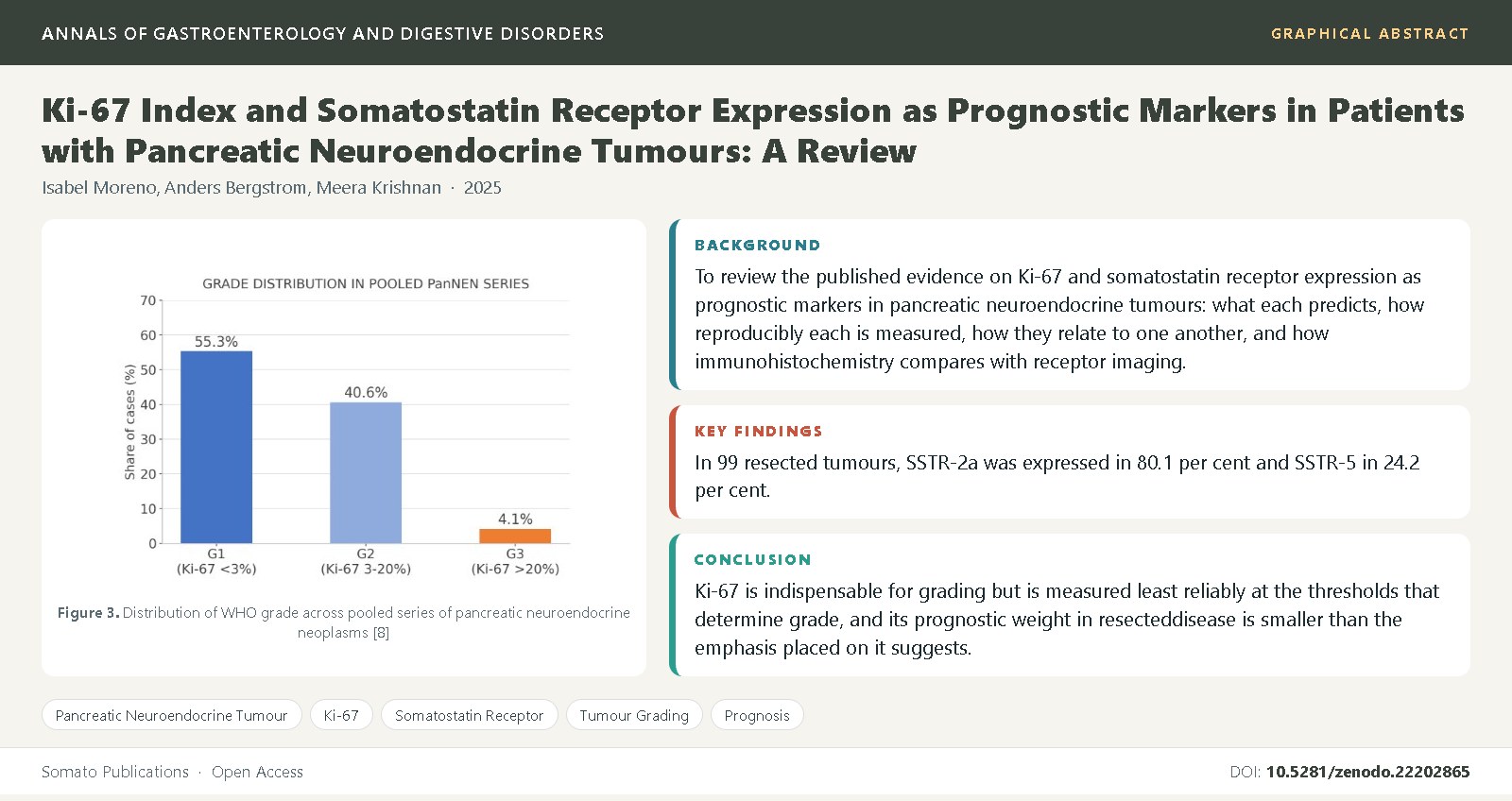
The Ki-67 proliferation index is the marker on which pancreatic neuroendocrine tumours are graded, and somatostatin receptor expression is the marker on which they are imaged and treated. They are usually discussed as a pair. In the one cohort that compared them directly, the receptor outperformed the proliferation index as a predictor of survival. Objectives: To review the published evidence on Ki-67 and somatostatin receptor expression as prognostic markers in pancreatic neuroendocrine tumours: what each predicts, how reproducibly each is measured, how they relate to one another, and how immunohistochemistry compares with receptor imaging.
Material and Methods: Narrative review of resection cohorts, immunohistochemical series, imaging correlation studies and pooled analyses indexed in PubMed and the major oncology, pathology and nuclear medicine journals. Studies were eligible if they reported outcomes stratified by Ki-67 index or somatostatin receptor expression, the reproducibility of either measurement, or correlation between immunohistochemistry and receptor imaging. No new patient data were generated; every estimate quoted is one published by the original investigators. Results: In 99 resected tumours, SSTR-2a was expressed in 80.1 per cent and SSTR-5 in 24.2 per cent. SSTR-2a positivity was associated with improved overall survival, with cumulative rates of 97.5, 91.5 and 82.9 per cent at one, three and five years, and on multivariable analysis it was the stronger predictor, with a hazard ratio of 0.2 (95% CI 0.1-0.8) against 0.8 (95% CI 0.1-5.7) for high Ki-67. SSTR-5 was not associated with survival. In a separate series of 279 patients, SSTR2 immunohistochemistry was an independent prognostic marker for overall survival (HR 0.82, 95% CI 0.67-0.99), correlated with tumour uptake on receptor imaging, but was outperformed by the imaging itself, which carried a positive predictive value advantage of 27 percentage points. Ki-67 measurement remains discrepant between observers precisely at the grade boundaries of 3 and 20 per cent. Conclusion: Ki-67 is indispensable for grading but is measured least reliably at the thresholds that determine grade, and its prognostic weight in resected
disease is smaller than the emphasis placed on it suggests. Somatostatin receptor status carries independent prognostic information and, where receptor imaging is available, the imaging is the more accurate of the two receptor measurements. Abbreviations: PanNET – Pancreatic Neuroendocrine Tumour, PanNEN – Pancreatic Neuroendocrine Neoplasm, NEC – Neuroendocrine Carcinoma,
SSTR – Somatostatin Receptor, IHC – Immunohistochemistry, DIA – Digital Image Analysis, WHO – World Health Organization, ENETS – European Neuroendocrine Tumour Society, PET – Positron Emission Tomography, PRRT – Peptide Receptor Radionuclide Therapy, SSA – Somatostatin Analogue, HR – Hazard Ratio, OS – Overall Survival, HPF – High-Power Field.
References
Basturk O, Yang Z, Tang LH, Hruban RH, Adsay V, et al. "The high-grade (WHO G3) pancreatic neuroendocrine tumor category is morphologically and biologically heterogenous and includes both well differentiated and poorly differentiated neoplasms". Am J Surg Pathol 39(2015):683-690.
Rindi G, Klöppel G, Albarello L, Alexiev V, Anlauf M, et al. "TNM staging of foregut (neuro)endocrine tumors: a consensus proposal including a grading system". Virchows Arch 449(2006):395-401.
Yang M, Zeng L, Zhang Y, Wang WG, Wang L, et al. "World Health Organization grading classification for pancreatic neuroendocrine neoplasms: a comprehensive analysis from a large Chinese institution". BMC Cancer 20(2020):906.
Strosberg J, El-Haddad G, Wolin E, Hendifar A, Yao J, et al. "Phase 3 trial of 177Lu-Dotatate for midgut neuroendocrine tumors". N Engl J Med 376(2017):125-135.
Caplin ME, Pavel M, nwikna JB, Phan AT, Raderer M, et al. "Lanreotide in metastatic enteropancreatic neuroendocrine tumors". N Engl J Med 371(2014):224-233.
Rinke A, Müller HH, Schade-Brittinger C, Klose KJ, Barth P, et al. "Placebo-controlled, double-blind, prospective, randomized study on the effect of octreotide LAR in the control of tumor growth in patients with metastatic neuroendocrine midgut tumors (PROMID)". J Clin Oncol 27(2009):4656-4663.
Bodei L, Mueller-Brand J, Baum RP, Pavel ME, Horsch D, et al. "The joint IAEA, EANM, and SNMMI practical guidance on peptide receptor radionuclide therapy (PRRNT) in neuroendocrine tumours". Eur J Nucl Med Mol Imaging 40(2013):800-816.
Owens R, Gilmore E, Bingham V, Cardwell C, McBride H, et al. "Ki-67 assessment of pancreatic neuroendocrine neoplasms: systematic review and meta-analysis of manual vs. digital pathology scoring". Mod Pathol 35(2022):712-720.
Xue Y, Reid MD, Pehlivanoglu B, Obeng RC, Jiang H, et al. "Subgrading of G2 pancreatic neuroendocrine tumors as 2A (Ki67 3% to <10%) versus 2B (10% to ≤20%) identifies behaviorally distinct subsets in keeping with the evolving management protocols". Ann Surg Oncol 29(2022):6773-6784.
Genc CG, Jilesen AP, Partelli S, Falconi M, Muffatti F, et al. "Recurrence of pancreatic neuroendocrine tumors and survival predicted by Ki67". Ann Surg Oncol 25(2018):2467-2474.
Weiss VL, Kiernan C, Wright J, Merchant NB, Coogan AC, et al. "Fine-needle aspiration-based grading of pancreatic neuroendocrine neoplasms using Ki-67: is accurate WHO grading possible on cytologic material?". J Am Soc Cytopathol 7(2018):154-459.
Mehta S, de Reuver PR, Gill P, Andrici J, D’Urso L, Mittal A, Pavlakis N, Clarke S, Samra JS, Gill AJ. "Somatostatin receptor SSTR-2a expression is a stronger predictor for survival than Ki-67 in pancreatic neuroendocrine tumors". Medicine (Baltimore) 94(2015):e1281.
Corleto VD, Falconi M, Panzuto F, Milione M, De Luca O, Perri P, Cannizzaro R, Bordi C, Pederzoli P, Scarpa A, Delle Fave G. "Somatostatin receptor subtypes 2 and 5 are associated with better survival in well-differentiated endocrine carcinomas". Neuroendocrinology 89(2009):223-230.
Okuwaki K, Kida M, Mikami T, Yamauchi H, Imaizumi H, Miyazawa S, Iwai T, Takezawa M, Saegusa M, Watanabe M, Koizumi W. "Clinicopathologic characteristics of pancreatic neuroendocrine tumors and relation of somatostatin receptor type 2A to outcomes". Cancer 119(2013):4094-4102.
Qian ZR, Li T, Ter-Minassian M, Yang J, Chan JA, et al. "Association between somatostatin receptor expression and clinical outcomes in neuroendocrine tumors". Pancreas 45(2016):1386-1393.
Song KB, Kim SC, Kim JH, Seo DW, Hong SM, et al. "Prognostic value of somatostatin receptor subtypes in pancreatic neuroendocrine tumors". Pancreas 45(2016):187-192.
Wada H, Matsuda K, Akazawa Y, Yamaguchi Y, Miura S, et al. "Expression of somatostatin receptor type 2A and PTEN in neuroendocrine neoplasms is associated with tumor grade but not with site of origin". Endocr Pathol 27(2016):179-187.
Brunner P, Jörg AC, Glatz K, Bubendorf L, Radojewski P, et al. "The prognostic and predictive value of sstr2-immunohistochemistry and sstr2-targeted imaging in neuroendocrine tumors". Eur J Nucl Med Mol Imaging 44(2017):468-475.
Majala S, Vesterinen T, Seppanen H, Mustonen H, Sundstrom J, et al. "Correlation of somatostatin receptor 1-5 expression, [68Ga]Ga-DOTANOC, [18F]F-FDG PET/CT and clinical outcome in a prospective cohort of pancreatic neuroendocrine neoplasms". Cancers 14(2022):162.
Sclafani F, Carnaghi C, Di Tommaso L, Rodari M, Destro A, Rimassa L, Giordano L, Chiti A, Roncalli M, Santoro A. "Detection of somatostatin receptor subtypes 2 and 5 by somatostatin receptor scintigraphy and immunohistochemistry: clinical implications in the diagnostic and therapeutic management of gastroenteropancreatic neuroendocrine tumors". Tumori 97(2011):620-628.
Diakatou E, Alexandraki KI, Tsolakis AV, Kontogeorgos G, Chatzellis E, Leonti A, Kaltsas GA. "Somatostatin and dopamine receptor expression in neuroendocrine neoplasms: correlation of immunohistochemical findings with somatostatin receptor scintigraphy visual scores". Clin Endocrinol 83(2015):420-428.
Kim JY, Kim J, Kim YI, Yang DH, Yoo C, Park IJ, Ryoo BY, Ryu JS, Hong SM. "Somatostatin receptor 2 (SSTR2) expression is associated with better clinical outcome and prognosis in rectal neuroendocrine tumors". Sci Rep 14(2024):4047.





